Welcome to my new blog space!
My name is Lloyd, I am an avid explorer of the great state of Utah, which is my home. I am an amateur photographer devoted to getting better. Along the way, I share my perspective, process, and photographer's favorites*.
*As such, blog posts may contain affiliate links for products and services I use myself, for which I may be paid a referral commission.
Lloyd Shell is a participant in the Amazon Services LLC Associates Program, an affiliate advertising program designed to provide a means for sites to earn advertising fees by advertising and linking to amazon.com.


Go Long or Go Home? Tokina AT-X 400 AF f5.6
Well, it has been a bit, I have been doing sparse photo stuff, but I have just not been wanting to sit down and process photos. Anywhoo, I have this batch ready to go and I wanted to post this then move on to a comparison/quick and dirty test of this lens. Which is... Drumroll... The Tokina AT-X 400 AF a 400mm f5.6 lens I was given by my friend Mark. I have a zoom that covers this focal length, but it is BEAST. My Pentax 150-450 Zoom is great lens, but I have no desire to carry it to do street photography. This lens is light enough I am willing to give it a shot. 400mm will definitely provide a different view than what I usually walk the street with. Tokina still has this listed on their website though it is out of production. https://tokinalens.com/product/at_x_400_af/
I want to introduce the lens a little then get on to the photos I took, basically in one afternoon after getting off work a little early. Some on the U of U campus and some downtown SLC.
This is an autofocus lens, the focus is pretty zippy and the lens is reasonably balanced on a K1 it feels solid without being ridiculously heavy. It has a pull out hood that I never used and a focus ring as well as an aperture ring with A setting as well as ability to select the aperture on the lens. Meaning it can be used on any k mount body even the old film ones. I think it may need a focus adjustment which I can do in body should I desire to use this lens more. I may... it has a very different field of view from my usual wide angle lenses. Telephoto lenses allow you to do some things very well, bring distant things closer, compress the distance between two or more subjects in the frame, frame things differently. I find it a challenging change of pace as well as refreshing.
Now, the first, biggest question for me when I pull out a lens is: Can it produce sharp images? and Can it do so without a lot of post processing to fix things? I think by modern standards this lens is just OK for sharpness, I will learn more as I work through the next post comparing it with a contemporary and my 150-450 zoom. I doubt a newer lens would do worse. That said... it ain't BAD, and when I hold it steady enough it IS reasonably sharp. It just isn't bitingly sharp and hand held 400mm doesn't help as the slightest movement will induce motion blur and reduce detail. The f5.6 aperture doesn't help either, that is fairly slow. I think shooting it off a tripod may help quite a bit, but that really limits street shooting.
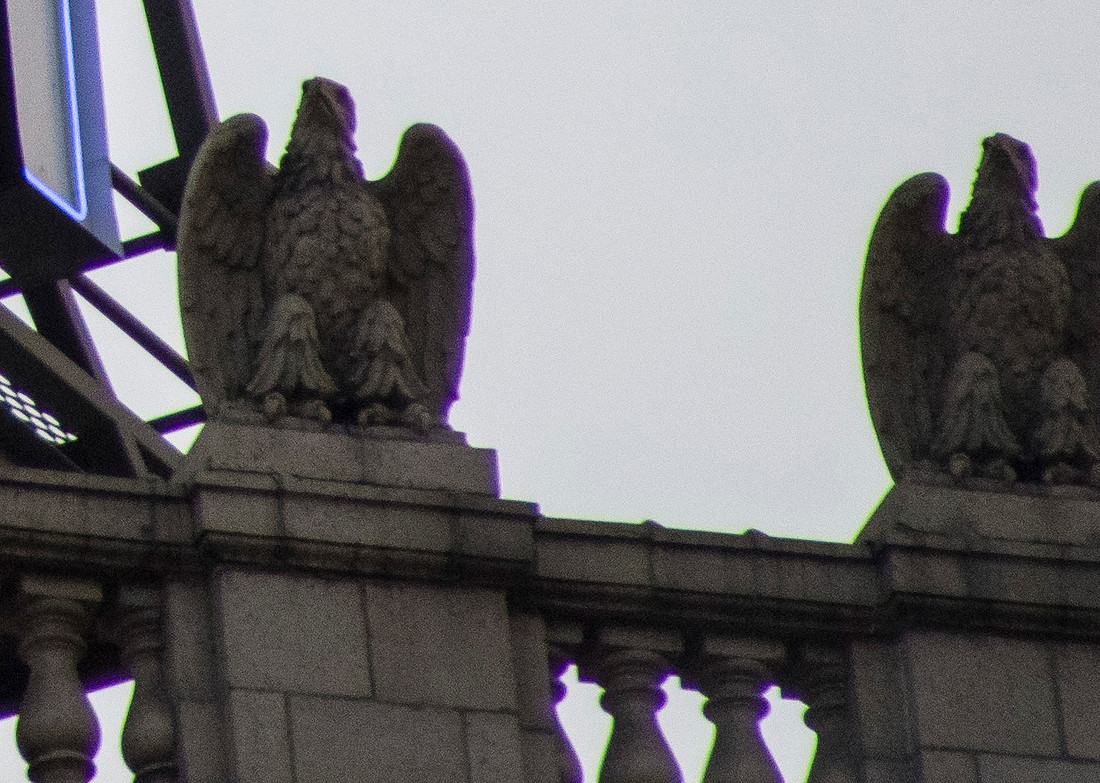
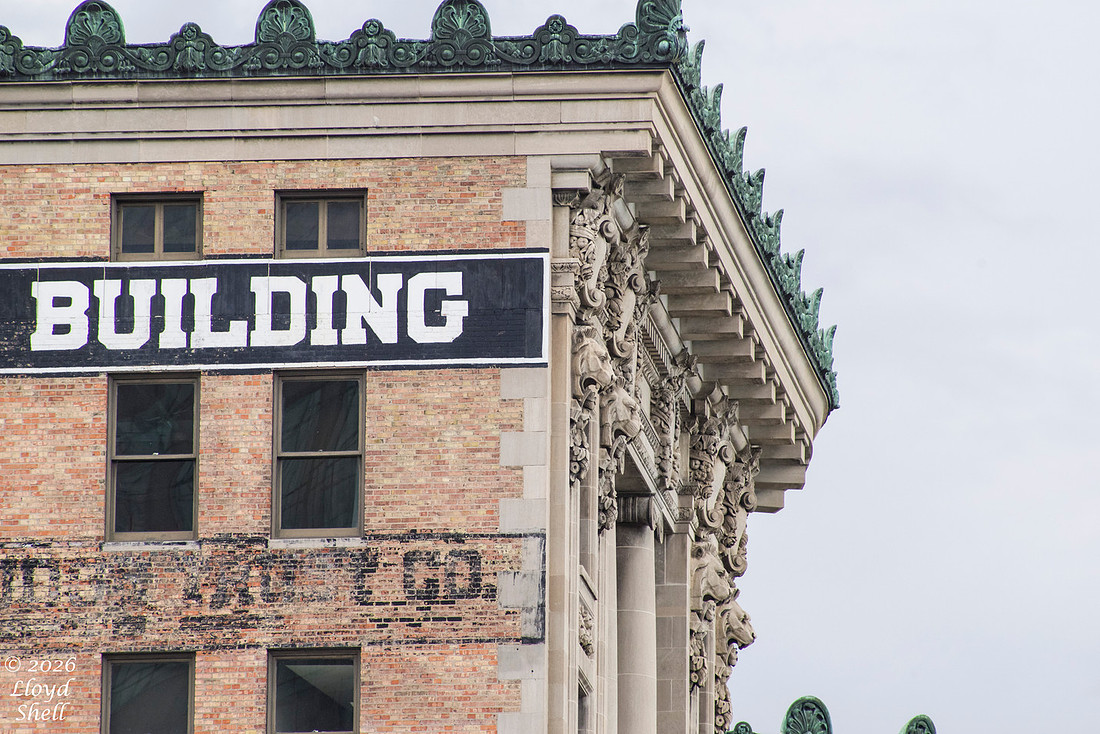
Post processing need? Yeah there can be a bit, the exposure metering is spot on, but in certain situations there can be some chromatic aberration, with green on one side of a dark/light transition and purple on the other. The two photos below show after and before in crops from the third photo. First one could maybe have used a smidge more green correction but it cleaned up decently. This was taken early in the morning with cloudy skies and High ISO at f5.6.
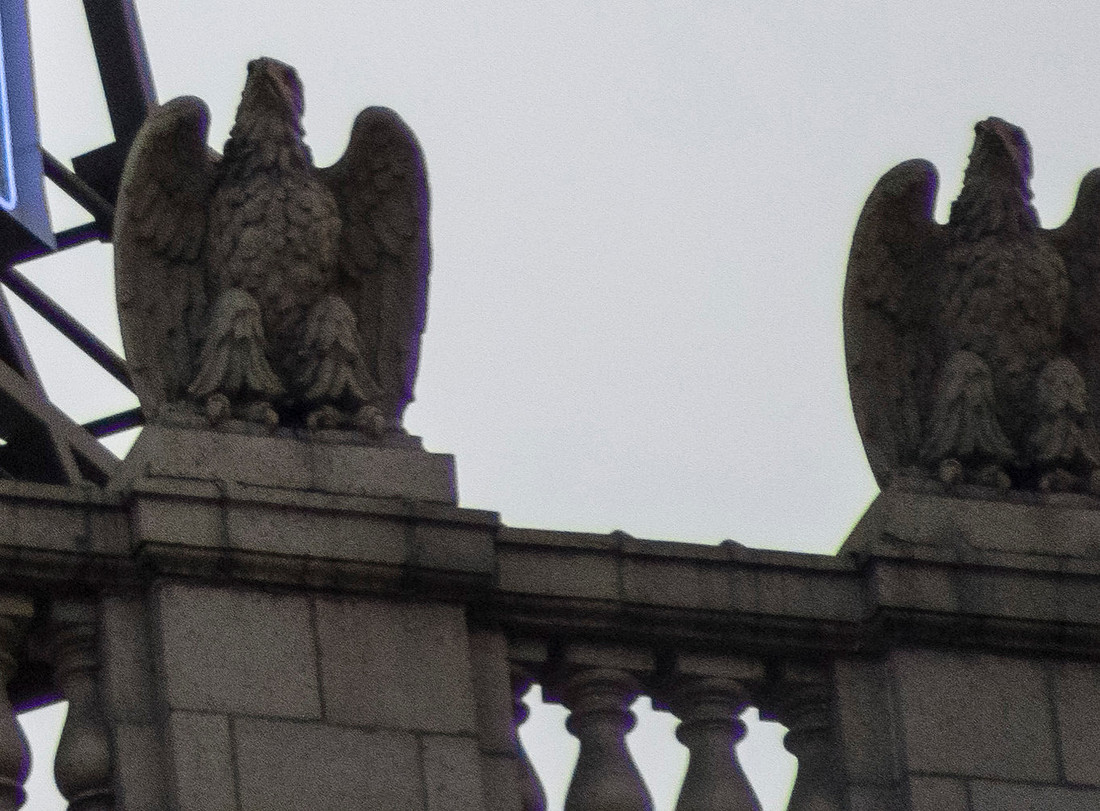
This is straight out of ACR converting the RAW. I don't think there is any baked in correction in the software without me telling it to. You can see the difference.
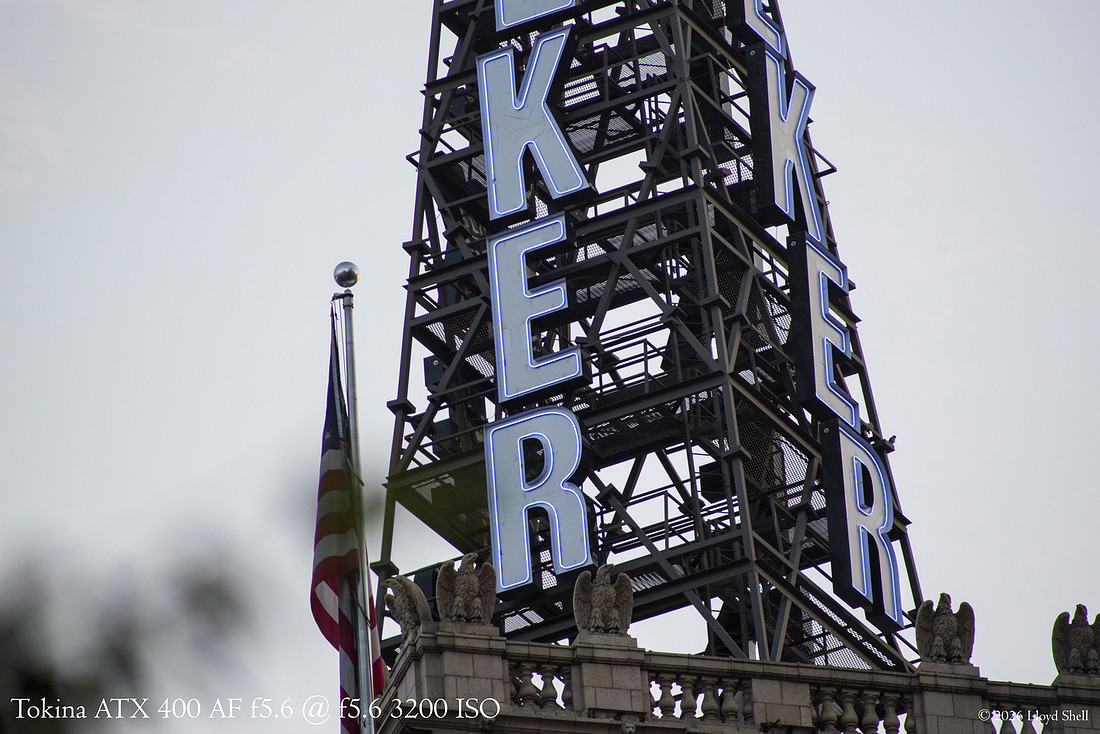
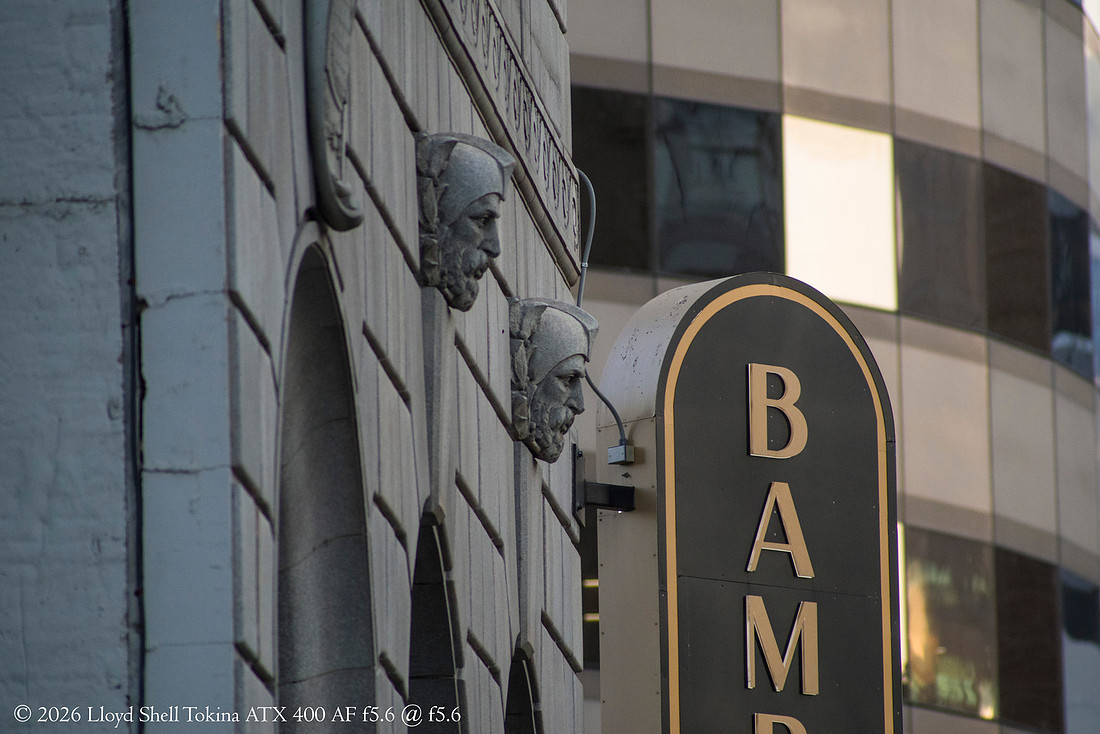
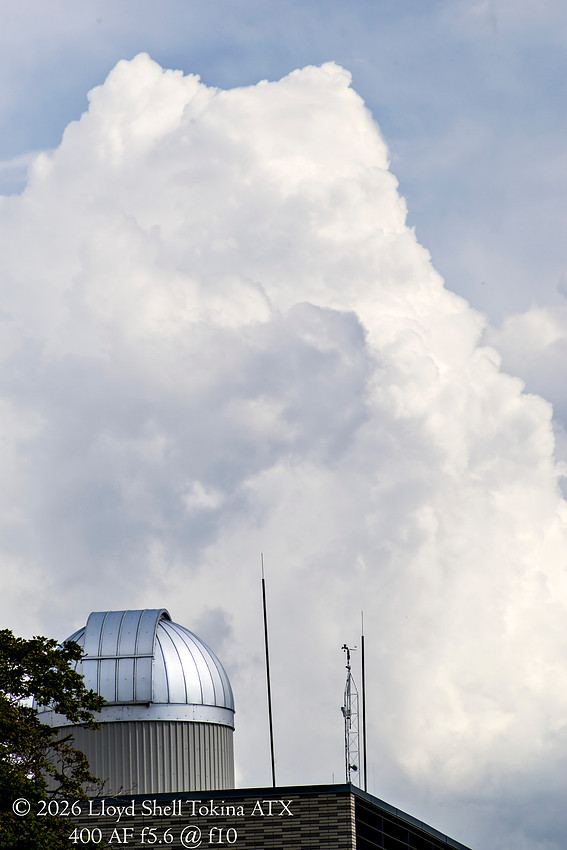
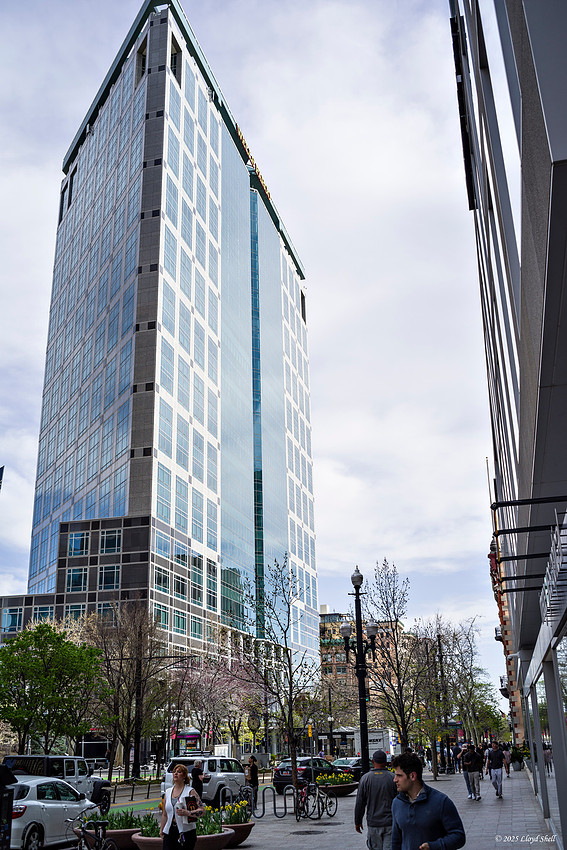
This building has featured in may test shots in other posts, comparing this to other shots taken from the same spot shows the change in field of view compared to a more wide angle lens.
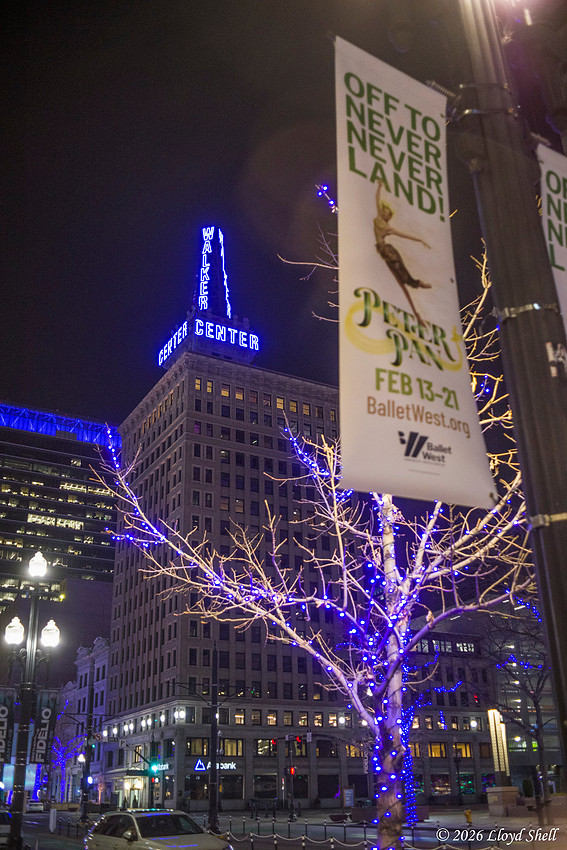
This is from a slightly different angle at 35mm, quite the perspective difference.
Back to the 400mm, I really needed to think differently to compose images with this, had to look further away.
Now after work I got off the bus at Presidents Circle on the west side of the U of U campus. Looking west I can compress several miles of cityscape together, it was hot enough that heat mirage made the buildings wavy if you look close. It was a weird effect. Focus point was on the upper right building.
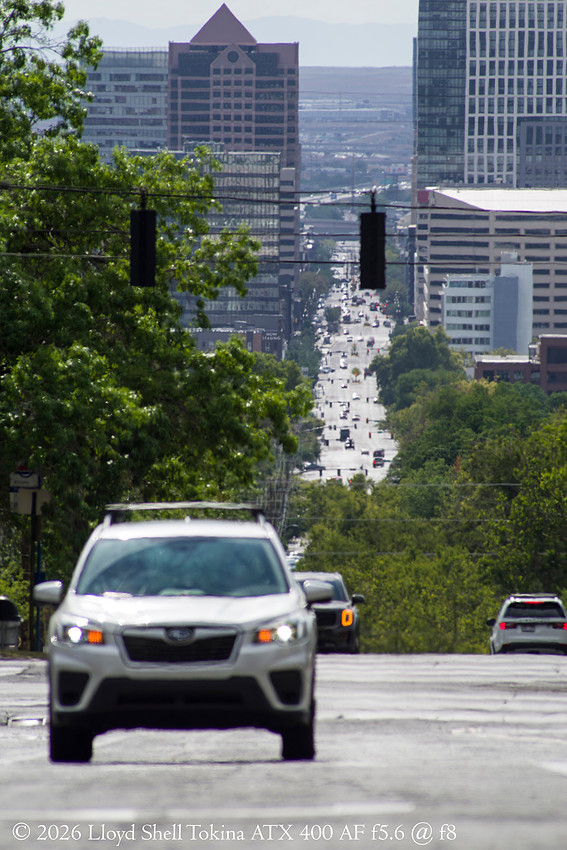
Stopping the aperture down to f11 definitely helps with sharpness. Also slows your shutter speed down, broad daylight helps with this, also cuts down on the chromatic aberrations like most lenses.
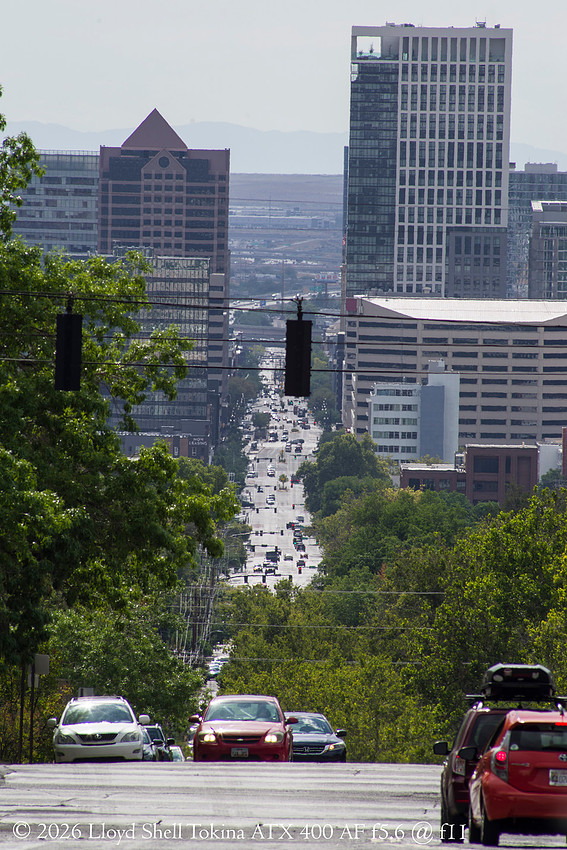
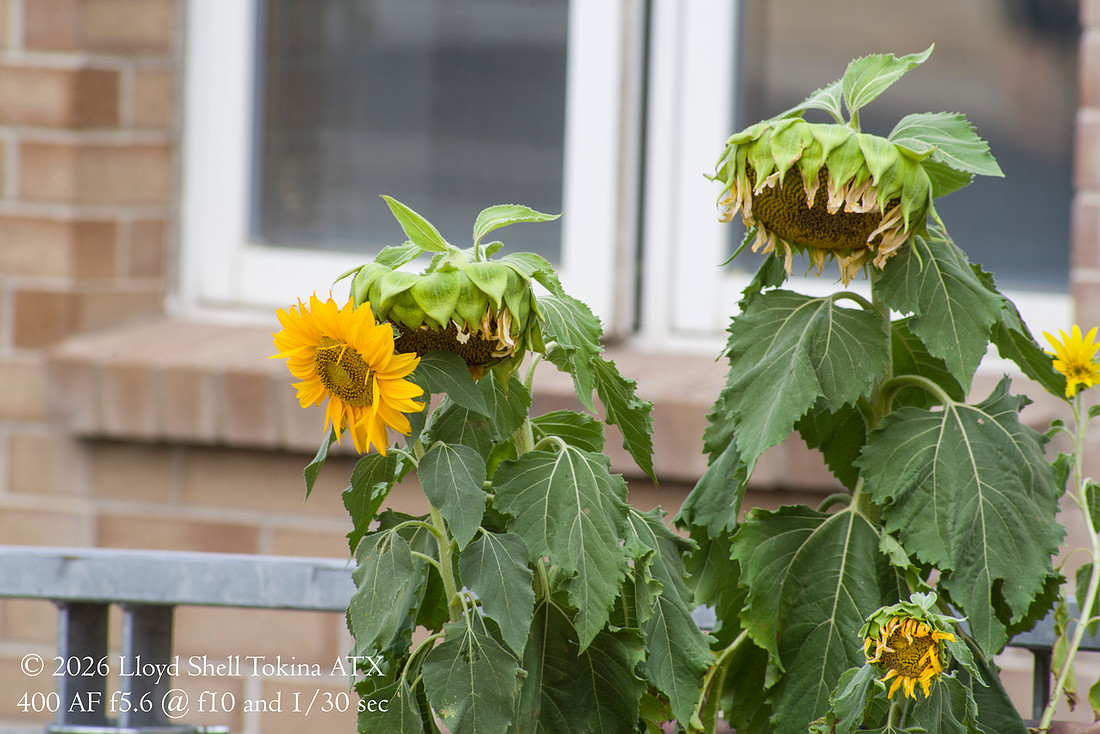
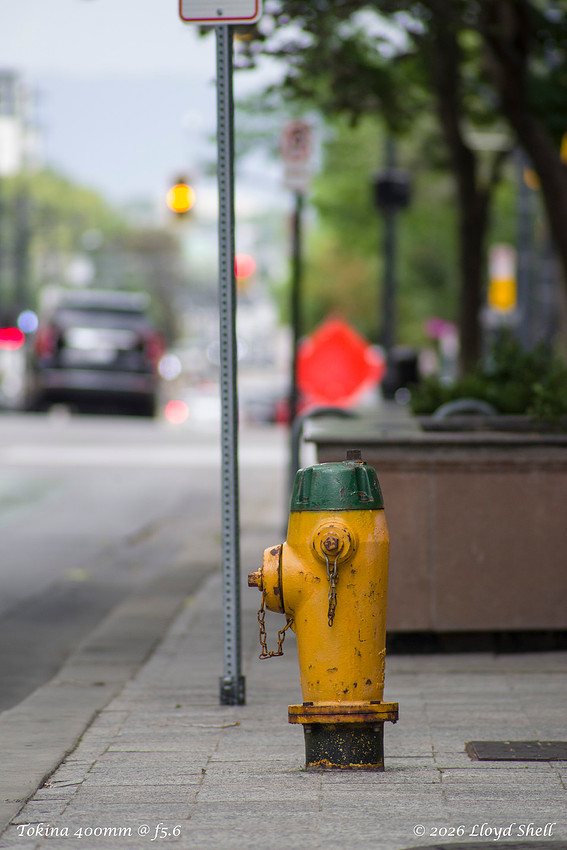
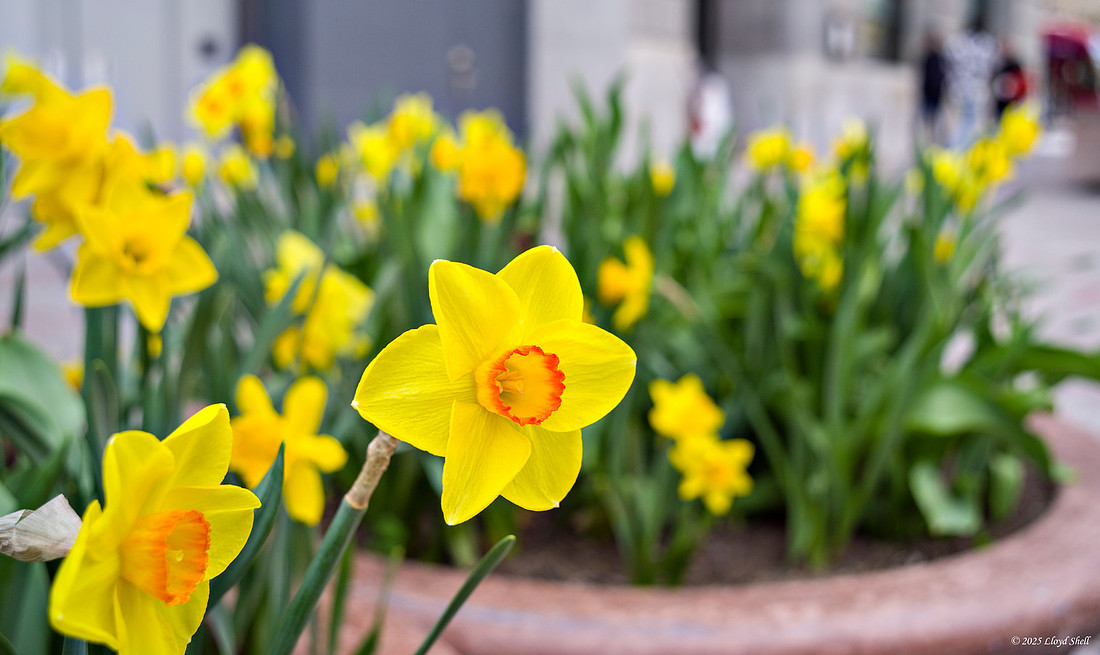
The background blur is reasonable especially the closer you focus, This lens focuses closer than the other 400mm I will be comparing it too. That was a big plus.
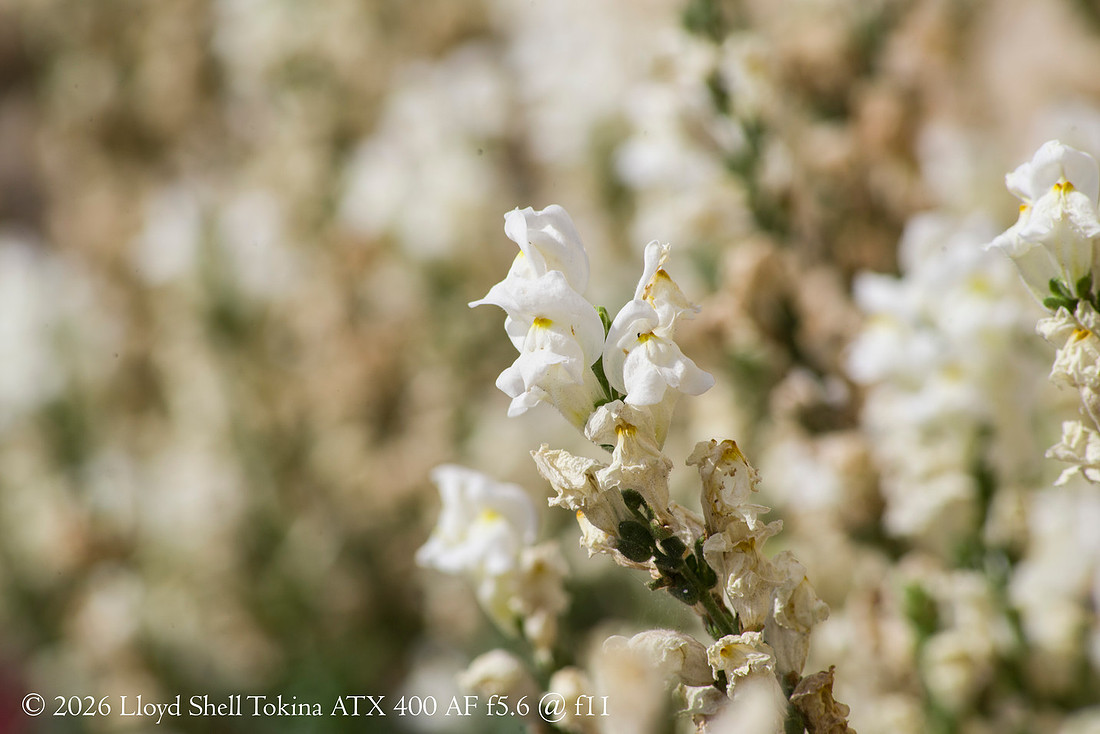
Wide open at f5.6 the background is quite perfectly acceptable.
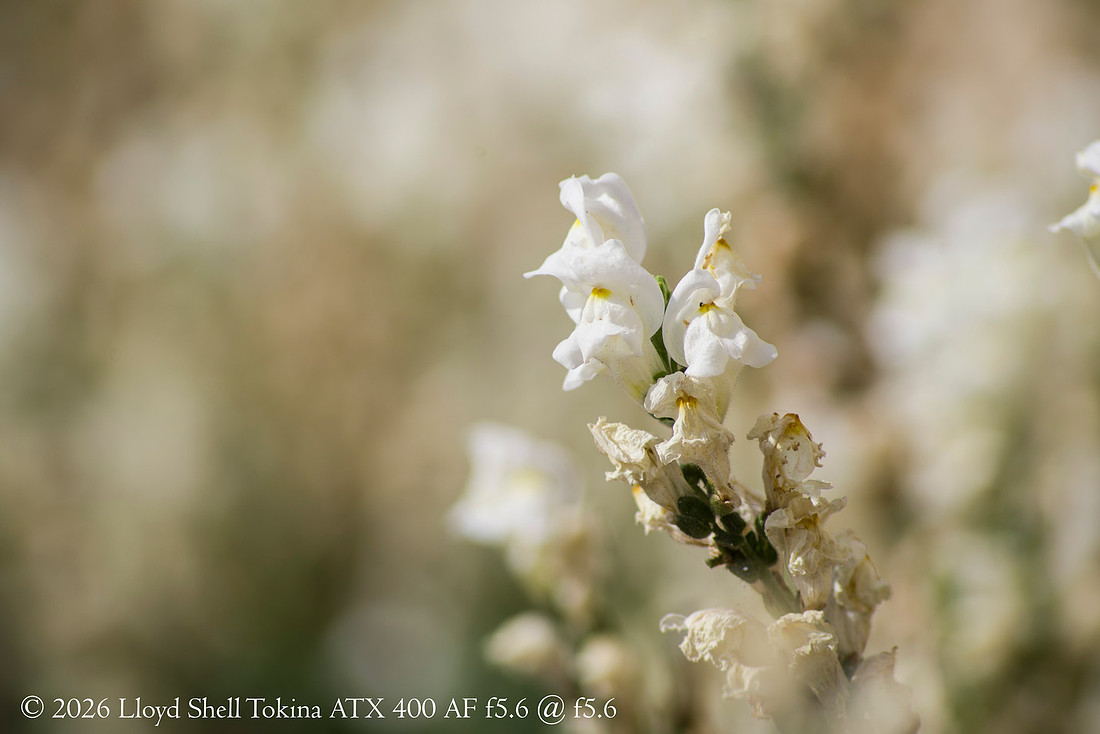
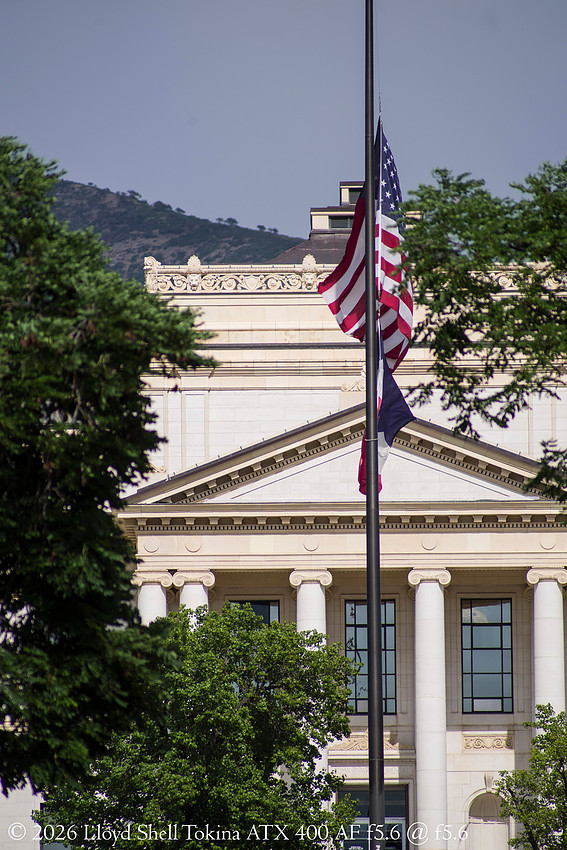
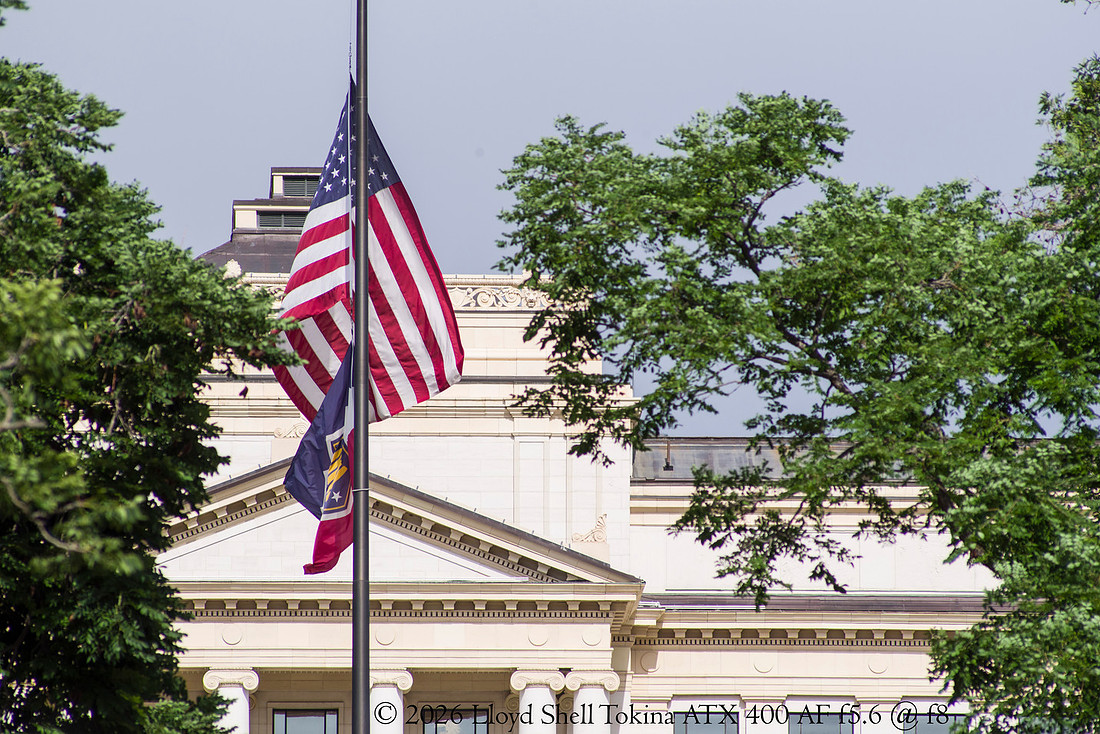
I found the focal length too constricting here. Not the lenses fault though.
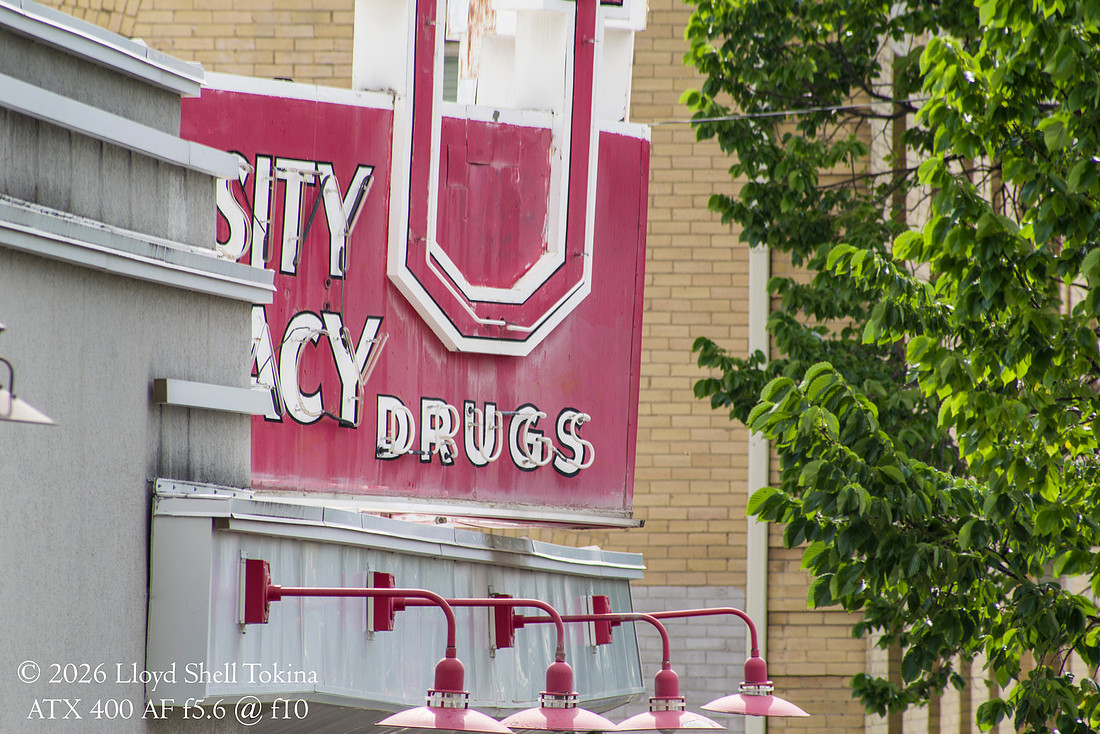
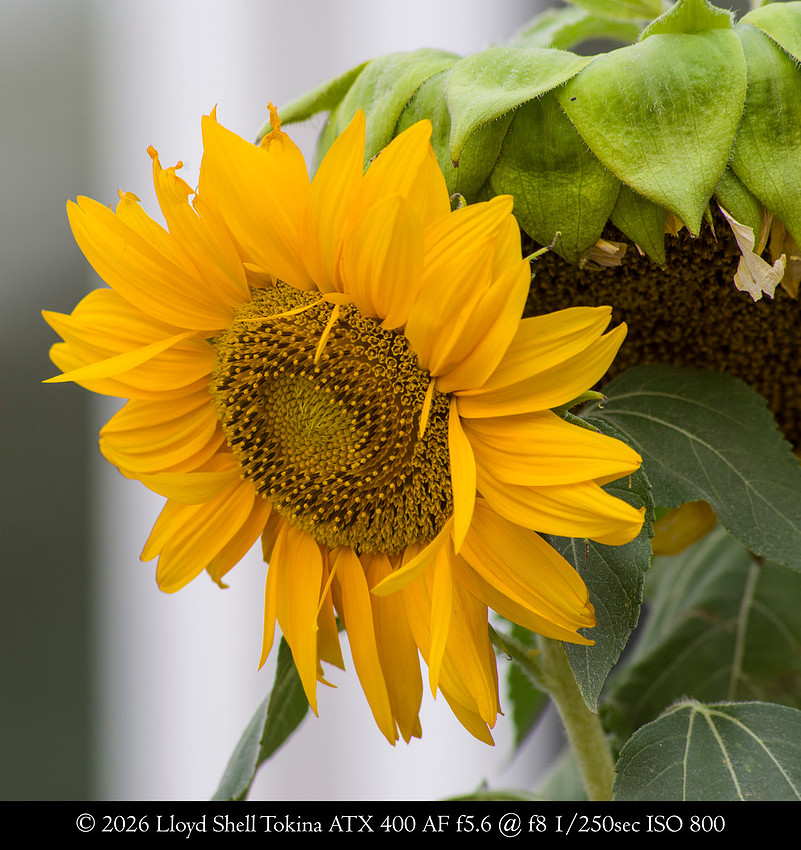
I really like this shot, not entirely sure why... but I like it. The image was plenty sharp, and the colors are good as well.
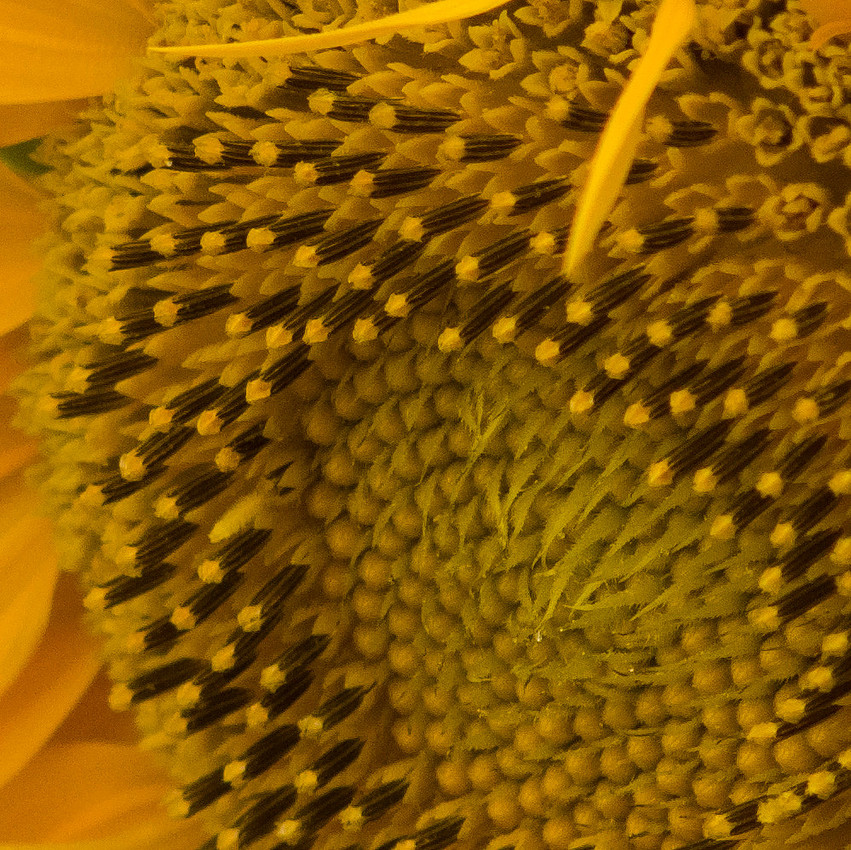
This is a 1000 x 1000 pixel crop from the photo below so quite a big crop that should display pixel for pixel on your screen That is a really good level of detail all things considered.
Sometimes older lenses, or medium age lenses like this one that were designed for film can struggle with color casts and rendering color correctly, this lens did great here. All my photos are taken with daylight white balance in camera when I am just walking around.
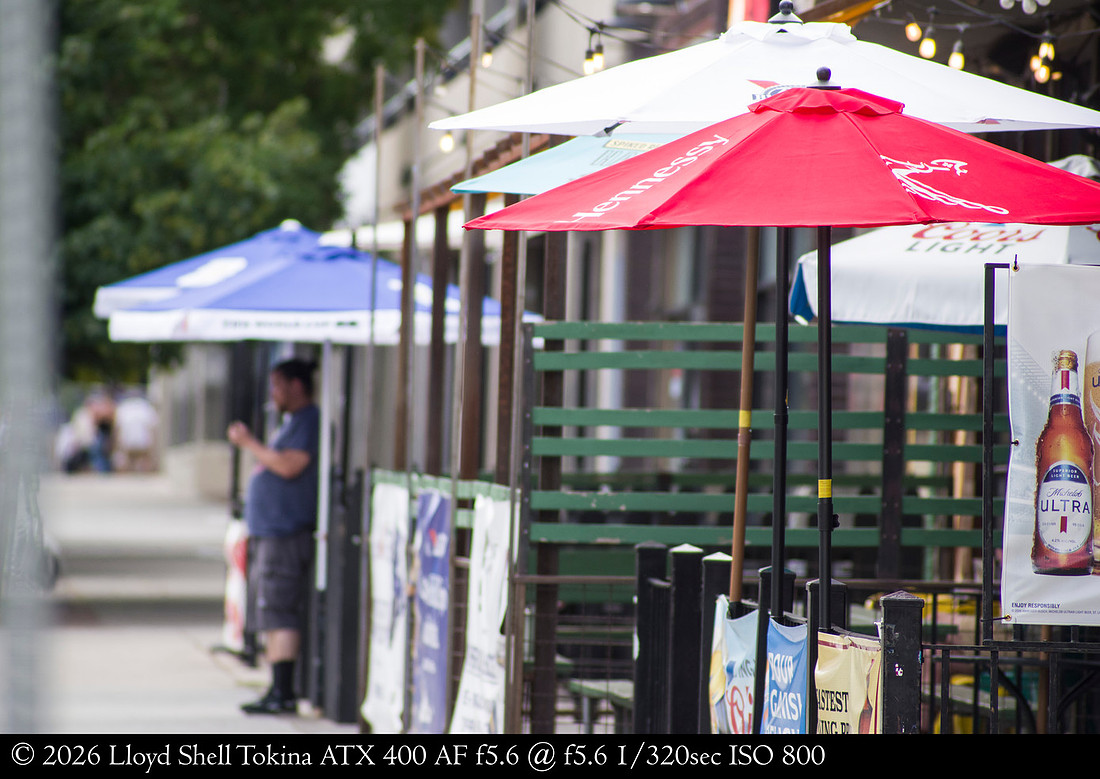
I LIKE the compression effect of a telephoto, this was wide open at f5.6 stopping down to f11 would have given more depth of field, but I made the choice for thinner depth of field. I normally would not have kept this as it has no strong subject except the hennessy canopy. But I wanted to show the DOF and compressive effect. Don't judge me. ;-)
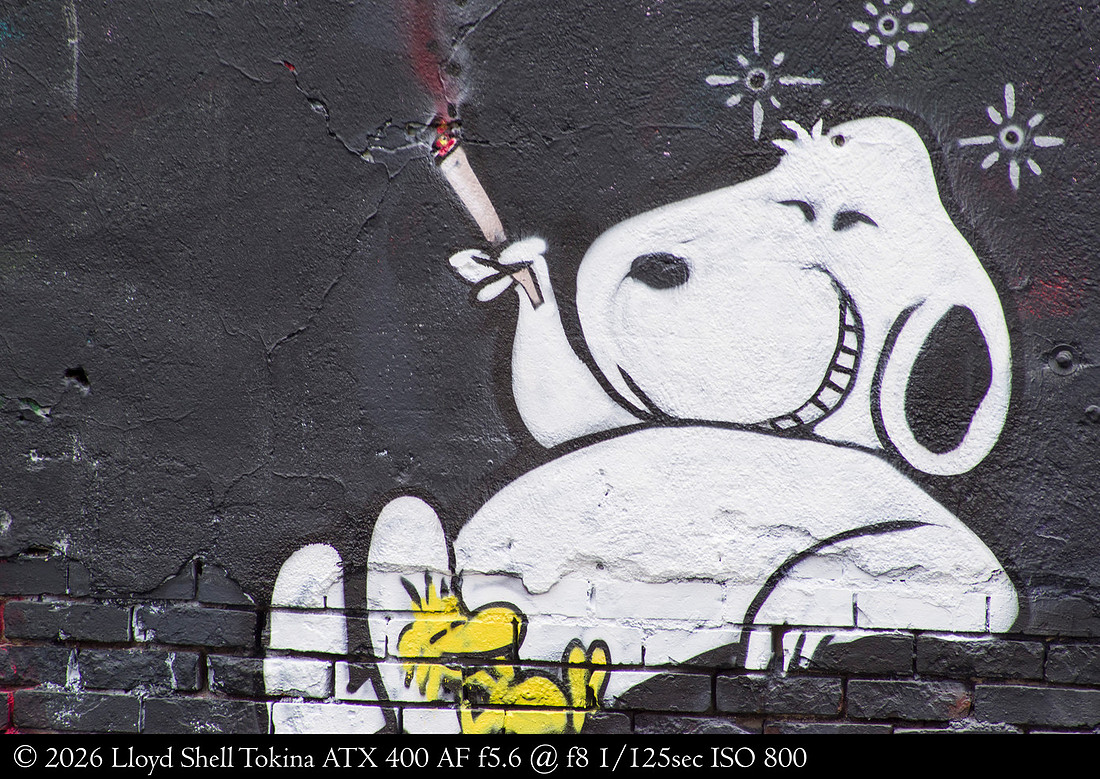
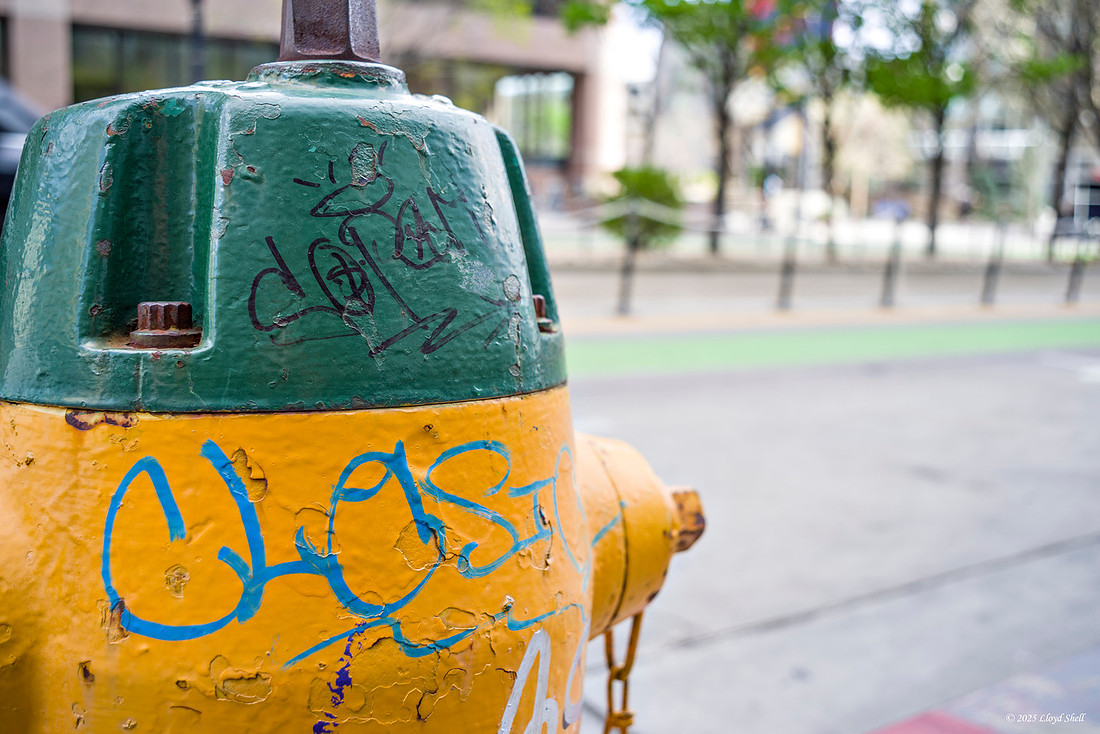
This back alley next to Gallensons Gun shop has some GREAT Grafitti and I enjoy it.
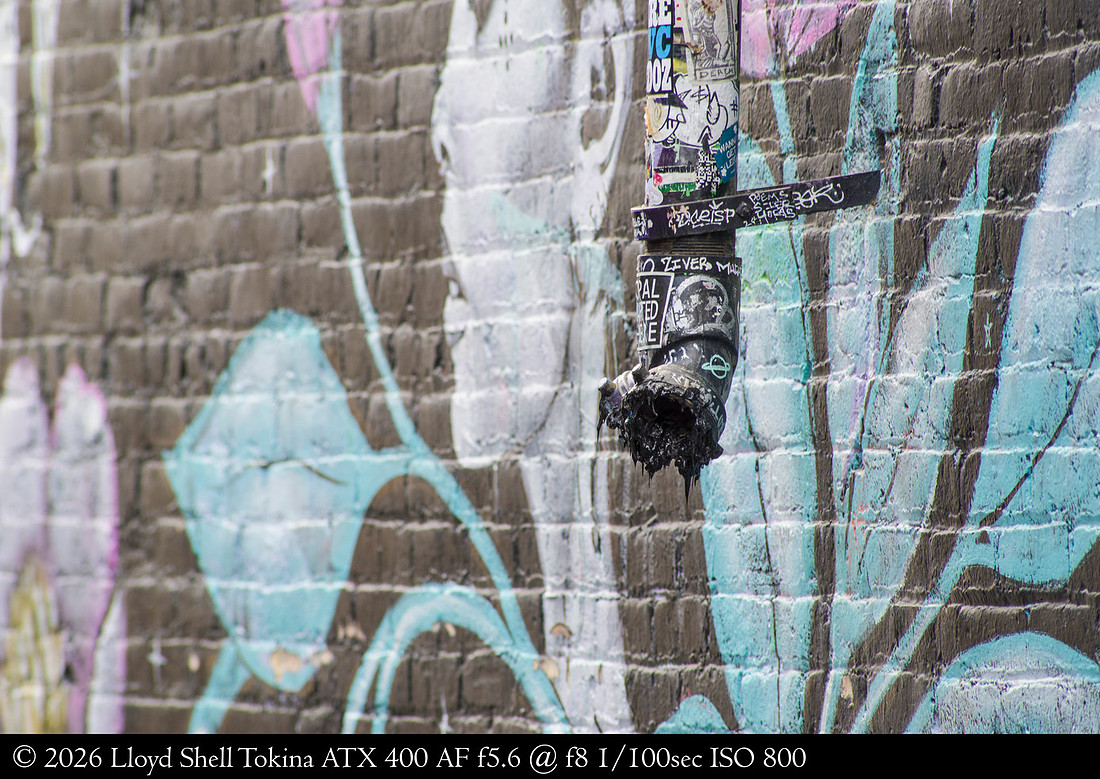
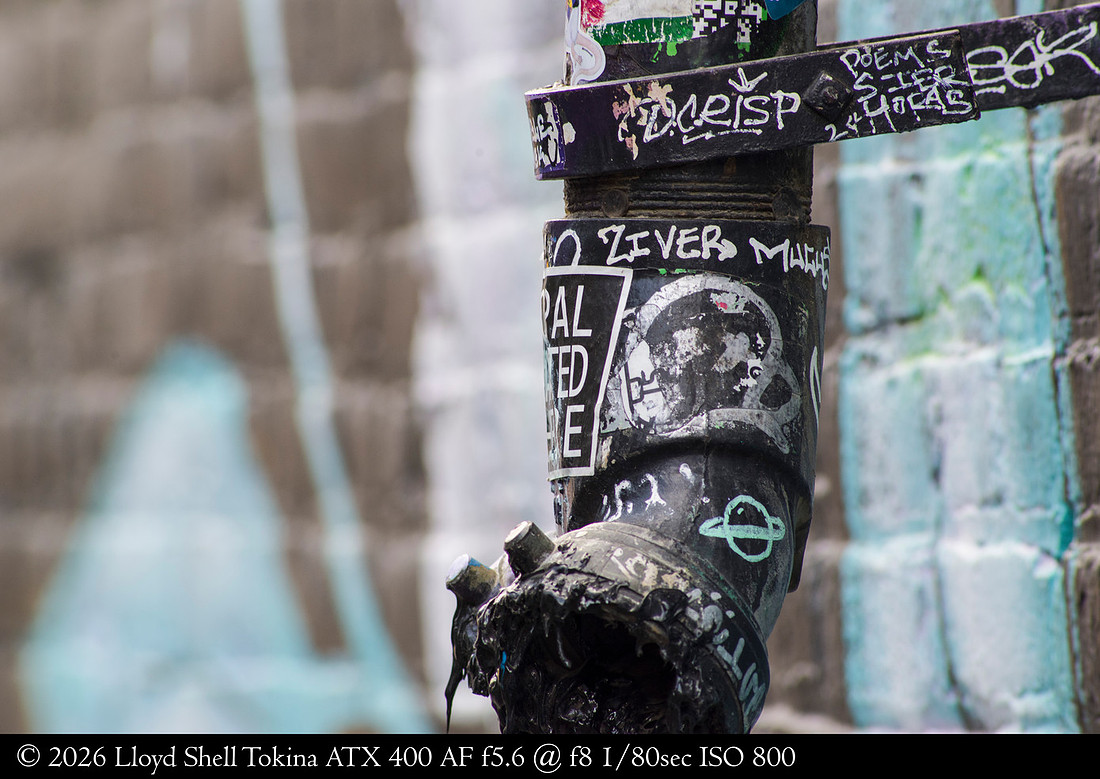
Snoopy is new, he looks happy.....
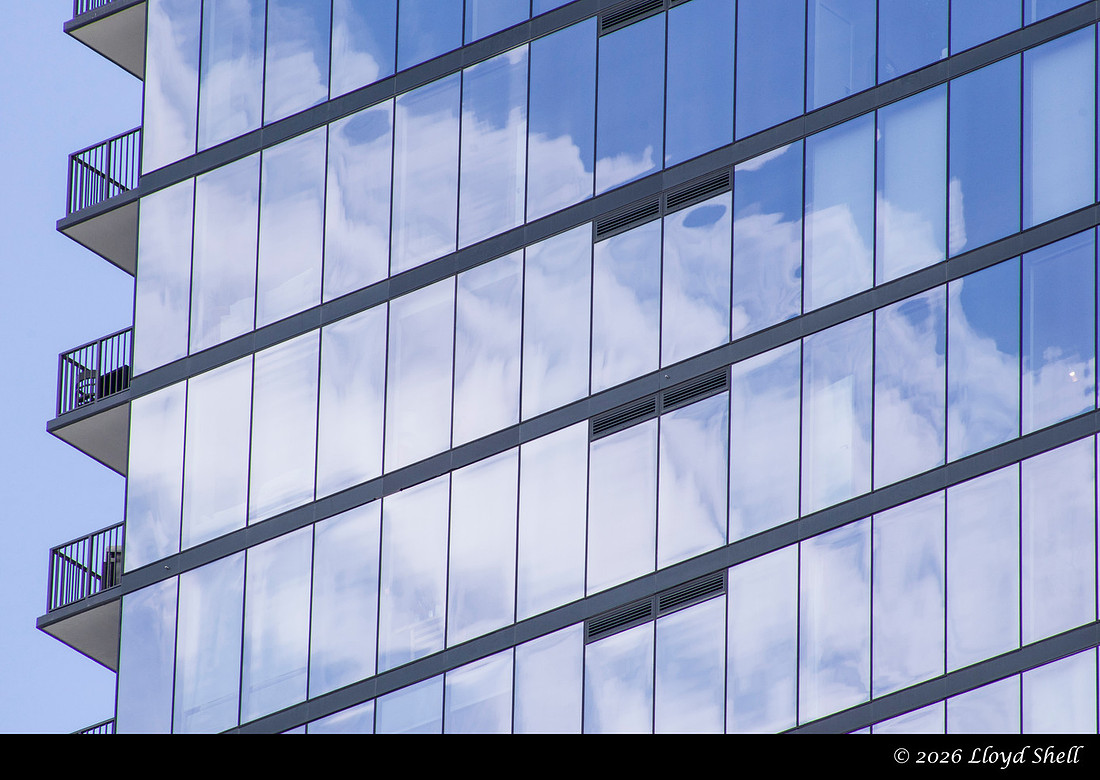
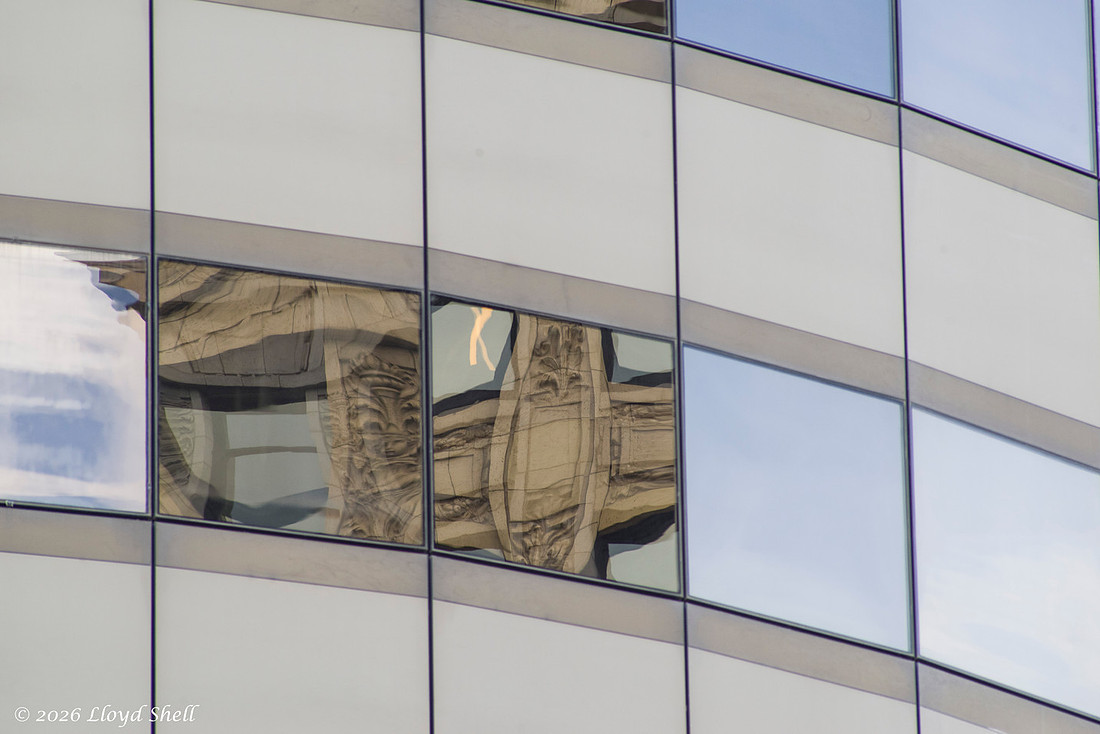
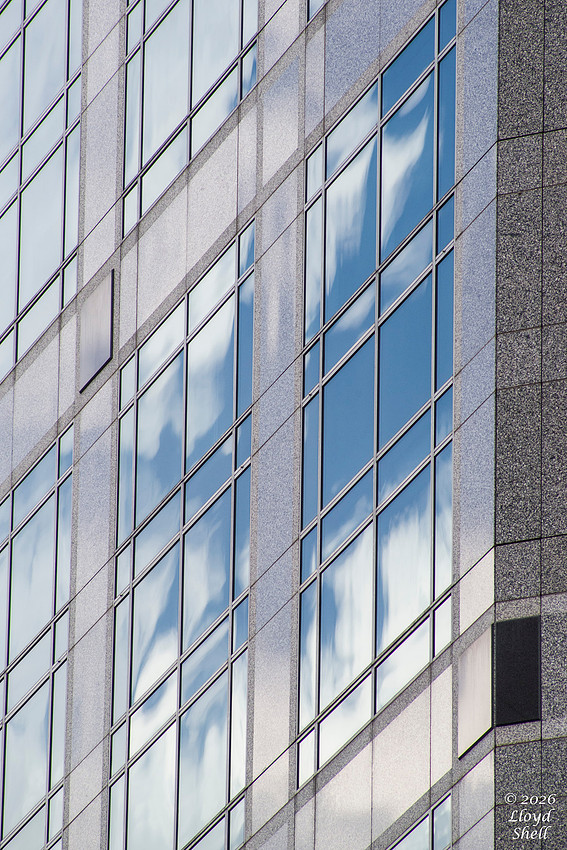
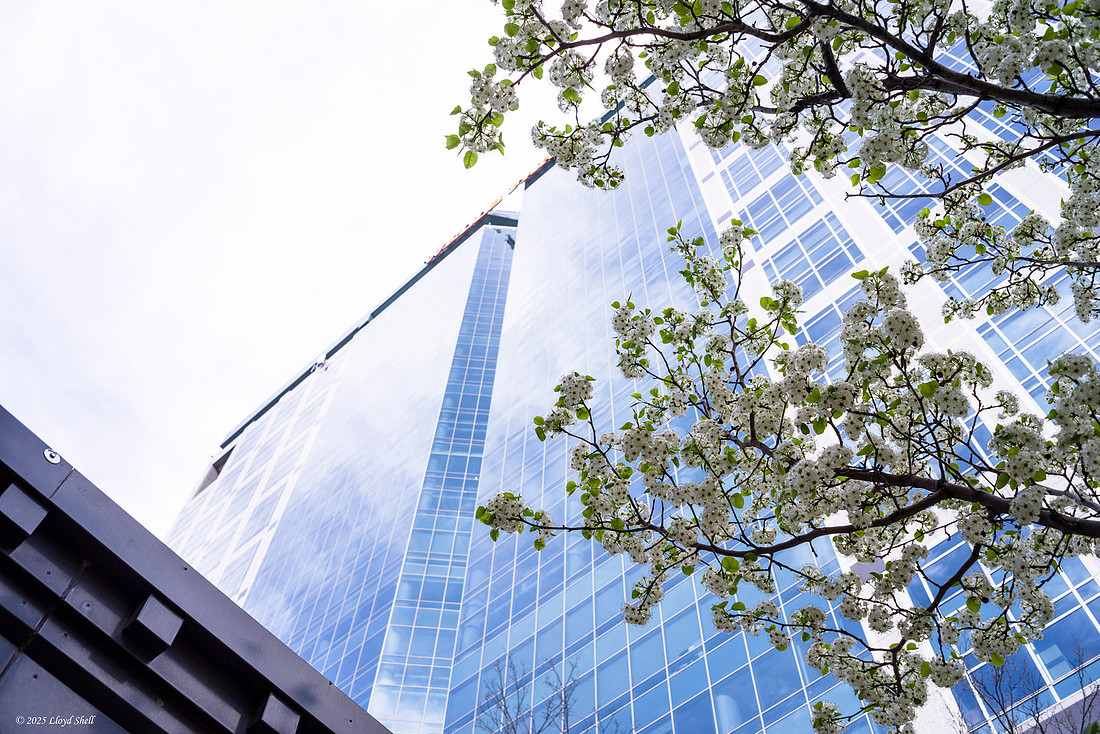
Another subject I wanted to explore with this lens was reflections. I do enjoy how the bend in the glass distorts the reflections and yet gives a cool image.
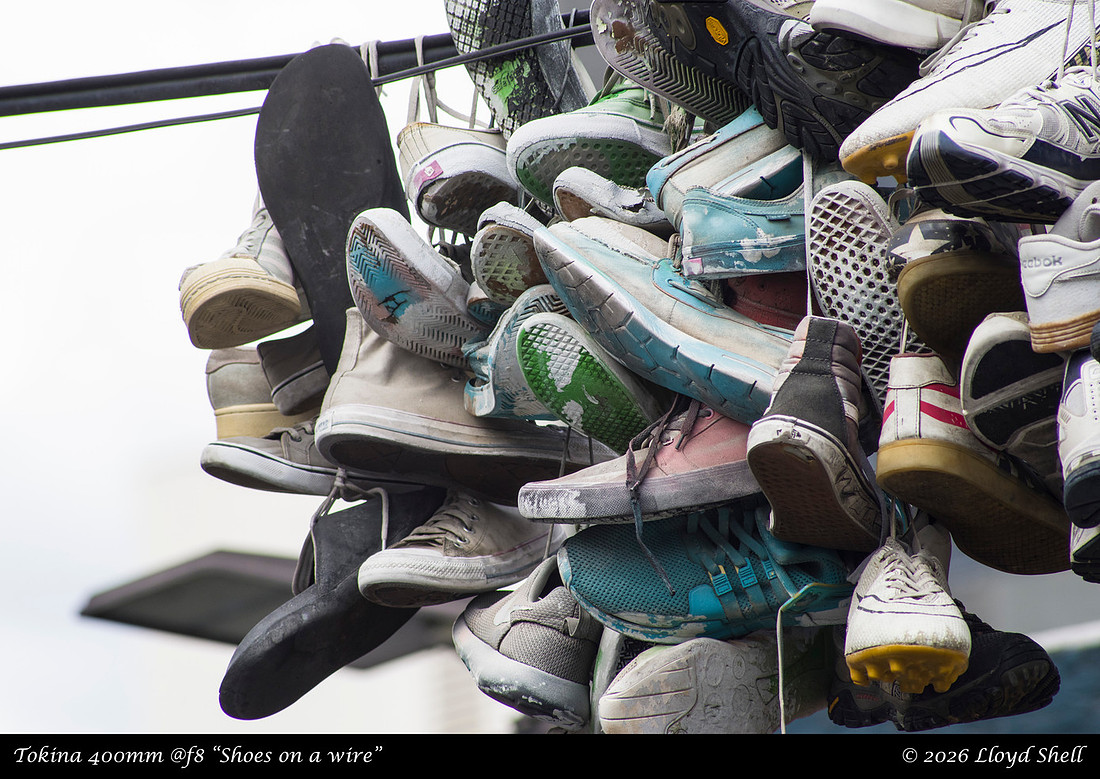
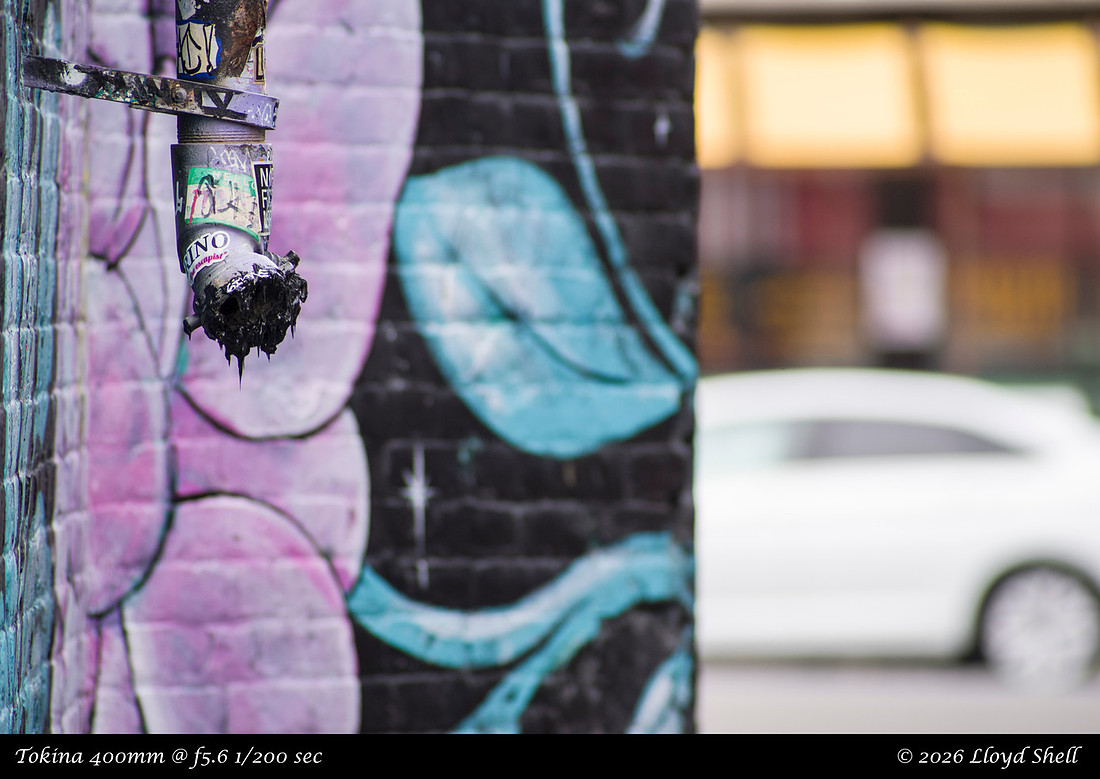
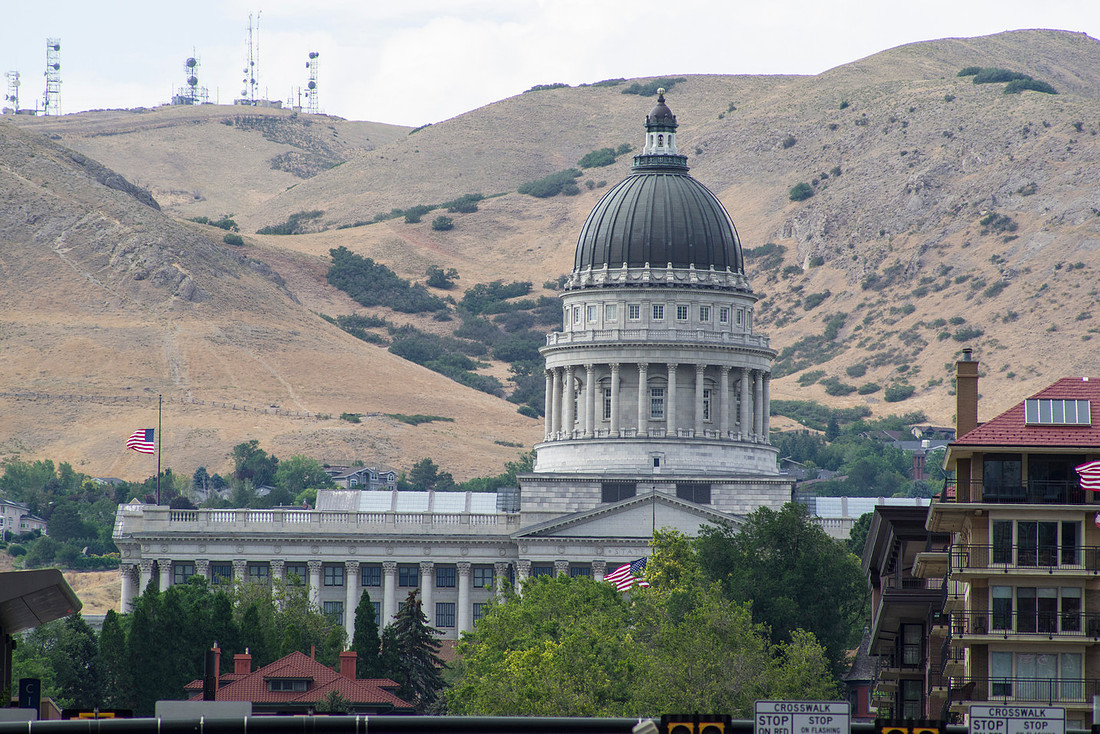
Zooming with my feet would have put me in the street as roadkill, I need to remember this spot when I play with my 200mm f2.5 lens... Here I did acutely feel the limitation of the field of view at 400mm.
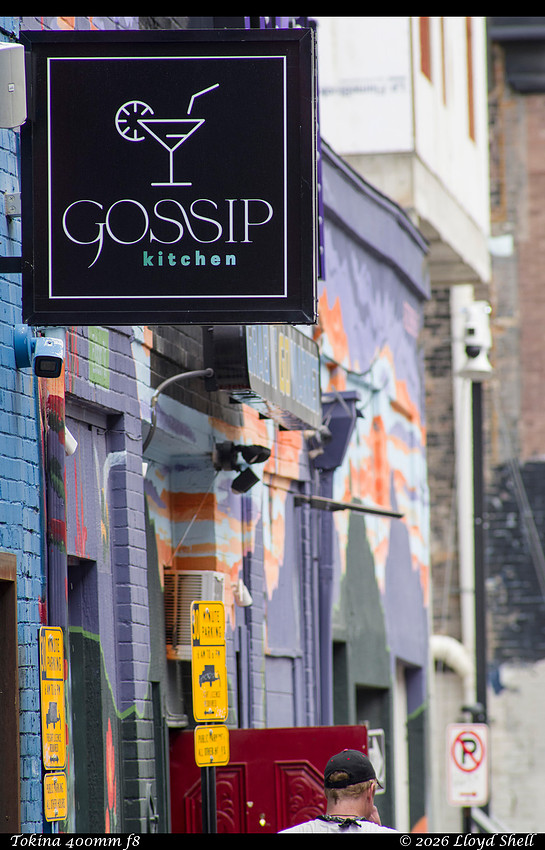
The purple fringing is very visible even uncropped here, I can easily be removed, but is a drawback.
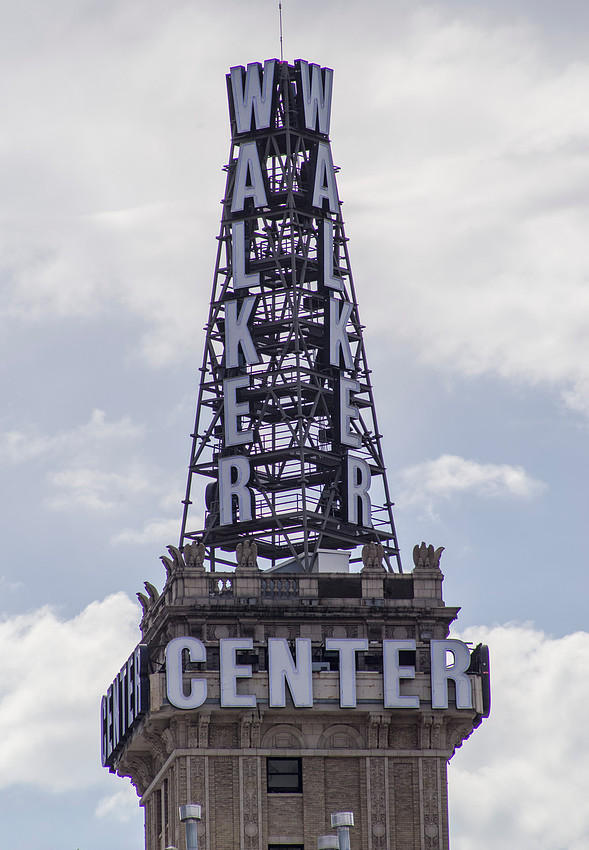
Nothing here is a close together as it appears.
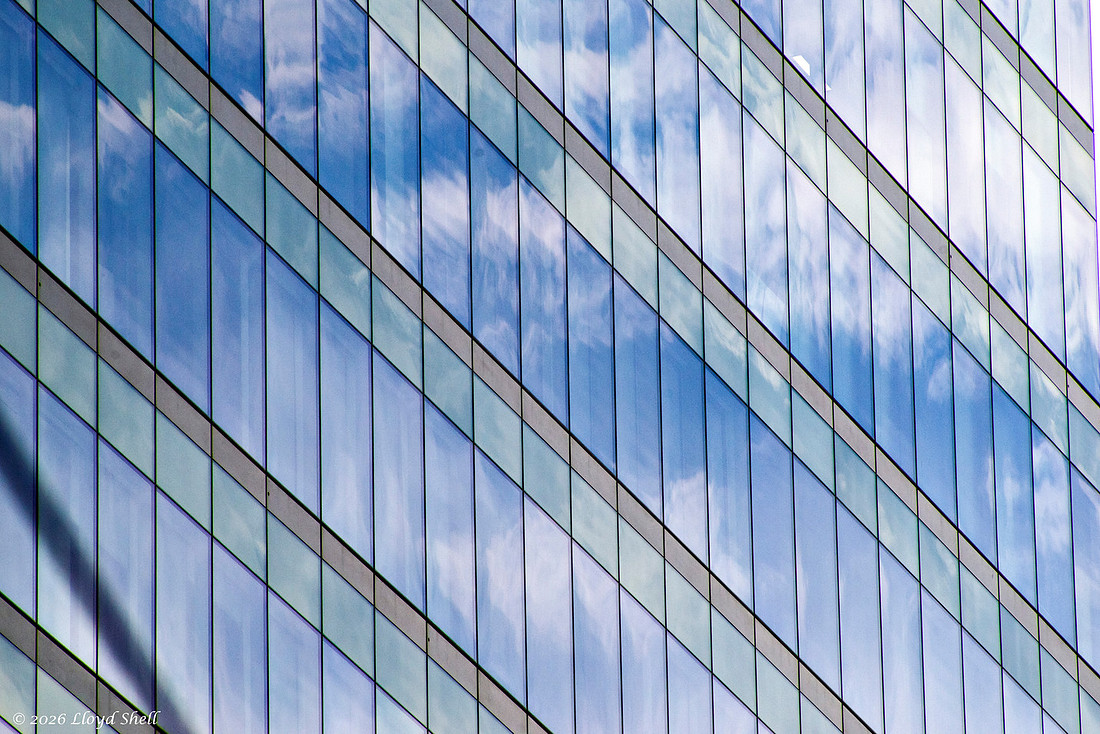
This is literally the shot I wanted to get, when I decided to play with 400mm at this time. I see this reflection but with the naked eye it doesn't look like much, but I knew more reach would get me there. It looks sharp enough at this size, it is not quite super sharp at 100%, again I think I would need to dial in some focus correction for front focus, but I ain't printing this big and it does look OK for this purpose.
Notice the pattern?
This one a punched up just a little bit, but not much. It just warms my soul for some reason.
So, what did I learn about this lens? It is reasonably sharp, this may improve with correcting a little front focus, it has moderate chromatic aberrations that can be fixed in software. It is a little long, but not too heavy and balances OK on my K1. On a mirrorless with an adapter it could possibly be awkward and too long. The focal length provided me with a nice change of pace and the colors were pretty good. It can be had for $150 plus shipping on fleebay if you can find it. The autofocus is pretty snappy and overall it handles acceptably well. I may not use it much but it is a fun lens.
If you have a shorter zoom, say 55-300 or 50-200/70-200 range and want more reach this could be a lens to consider.
Thanks for sticking around and keep an eye out for a comparison of this and a similar Sigma lens to my Pentax 150-450 lens.
Vintage Lens: SMC Pentax 50mm f1.4
I'm finally back blogging, I hit a bit of a funk after damaging that lens and my K1 (see my previous post), and I am a feel based photographer, vibes if you will. If I am not feeling it I tend to not try to push it too much, I have found that I tend to take rubbish when I force things. Though I will occasionally run into a good photo here and there.
This post is going to be a musing post (as opposed to amusing) on the concept of "Everybody needs a fast 50." I started in photography in 1982... ish... when I talked my dad into paying half of a Canon AE-1 Program with 50mm f1.8 lens. That was the way the came, no zoom lens as a "Kit lens" like you get now days. Zooms were routinely terrible unless they were EXPENSIVE back then, with a few exceptions. You had the choice of a f1.8 or f2 lens for the poors, and if you had a little money then f1.4, or as a pro maybe f1.2. There are several reasons for this behavior on the part of the lens makers. First, as I said, zooms were either affordable rubbish or good but expensive, primes were typically pretty good to amazing and way cheaper. Second, 50mm lenses were pretty much figured out by then, everyone made a least a few good ones, many were exceptional. And they were easy and cheap to produce meaning that everyone could afford one. They became ubiquitous, and the common wisdom seemed to be that they were the most essential lens to own, you could do about anything with one. Which I knew at the time was hogwash, and it continues to be hogwash. That said, you can do a lot with them and they can be a lot of fun.
Why?
That large aperture of course, it allows more light in and you can shoot in darker situations with less light and still get enough light in to the film. In the days of film that was a big deal, like, a cannot be overstated big deal. I loved shooting film, but if I had Kodachrome 64 ISO loaded I wasn't going to get a decent photo indoors without a flash, if then, though I had a better chance at f1.4 than f5.6. Those of you who have only known digital where you can just spin the ISO dial and increase the sensitivity at a whim just don't know the pain. So, film days, a fast 50mm was an important tool, nearly indispensable really. Is it really THAT needed on Digital?
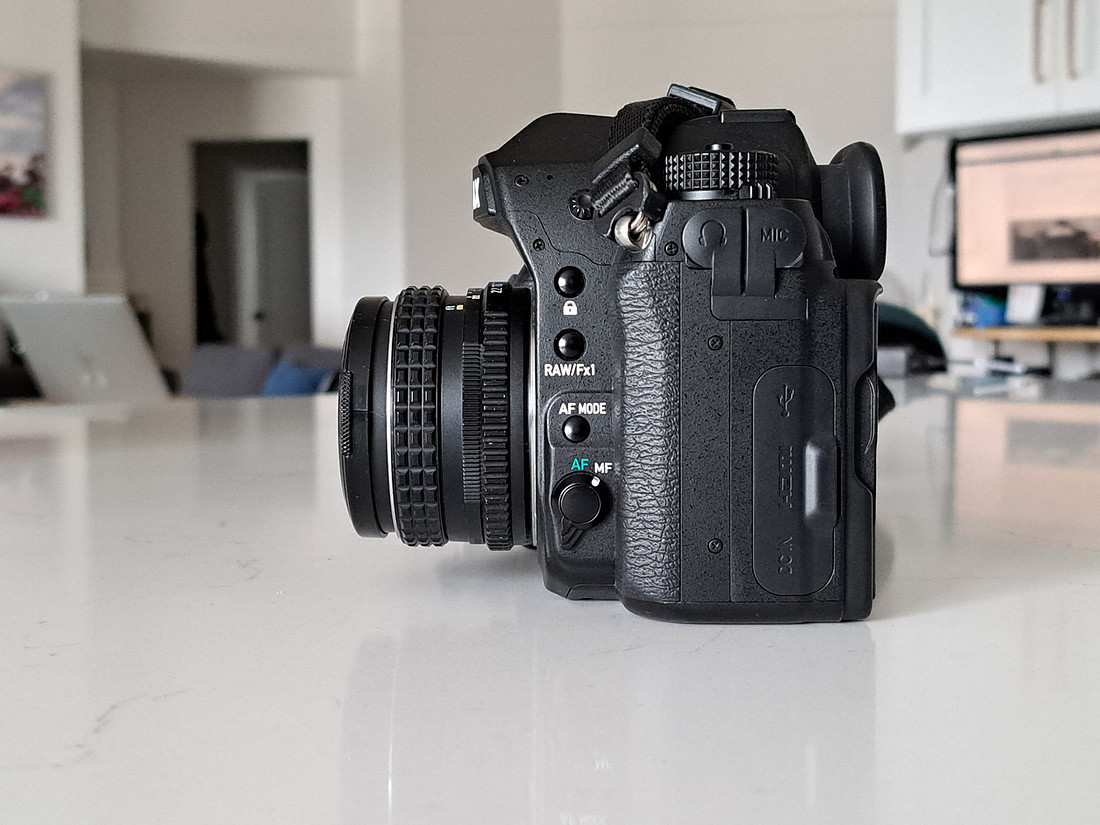
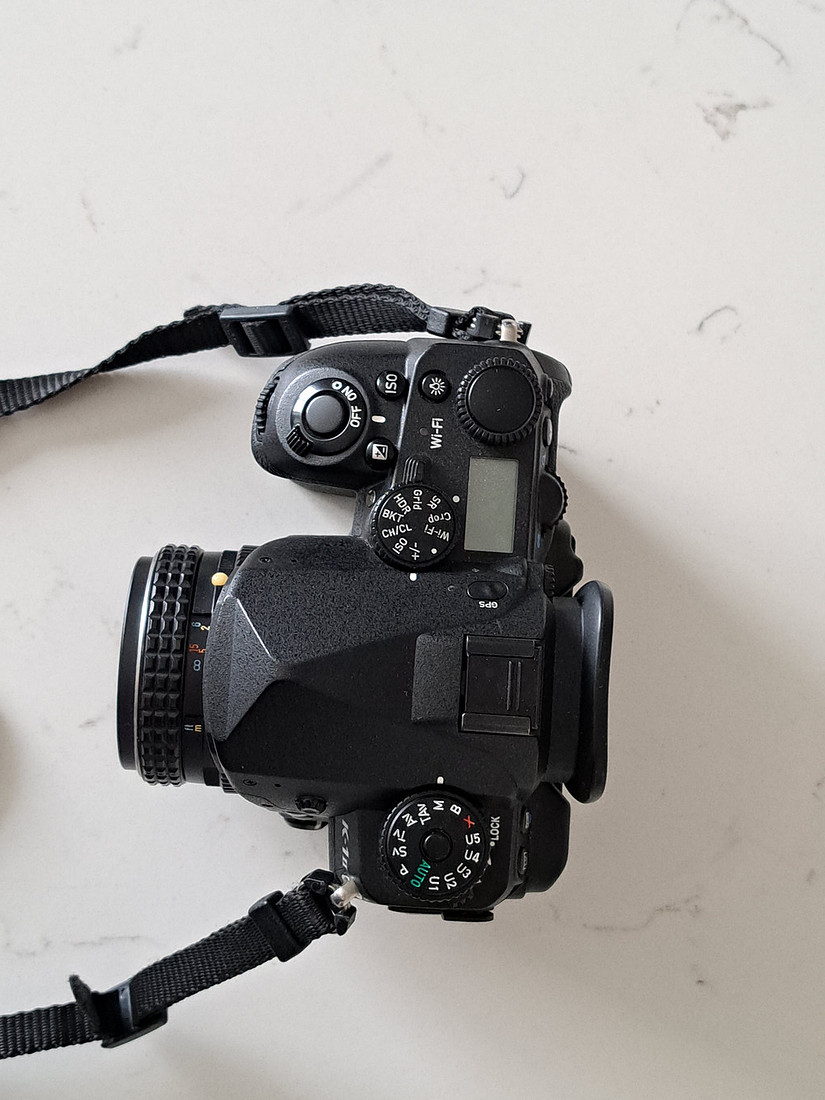
Here are a couple cell phone shots of mine in my K1. Yes the K1 is a big honking beast, I love it. The 50mm handles nicely and fits well.
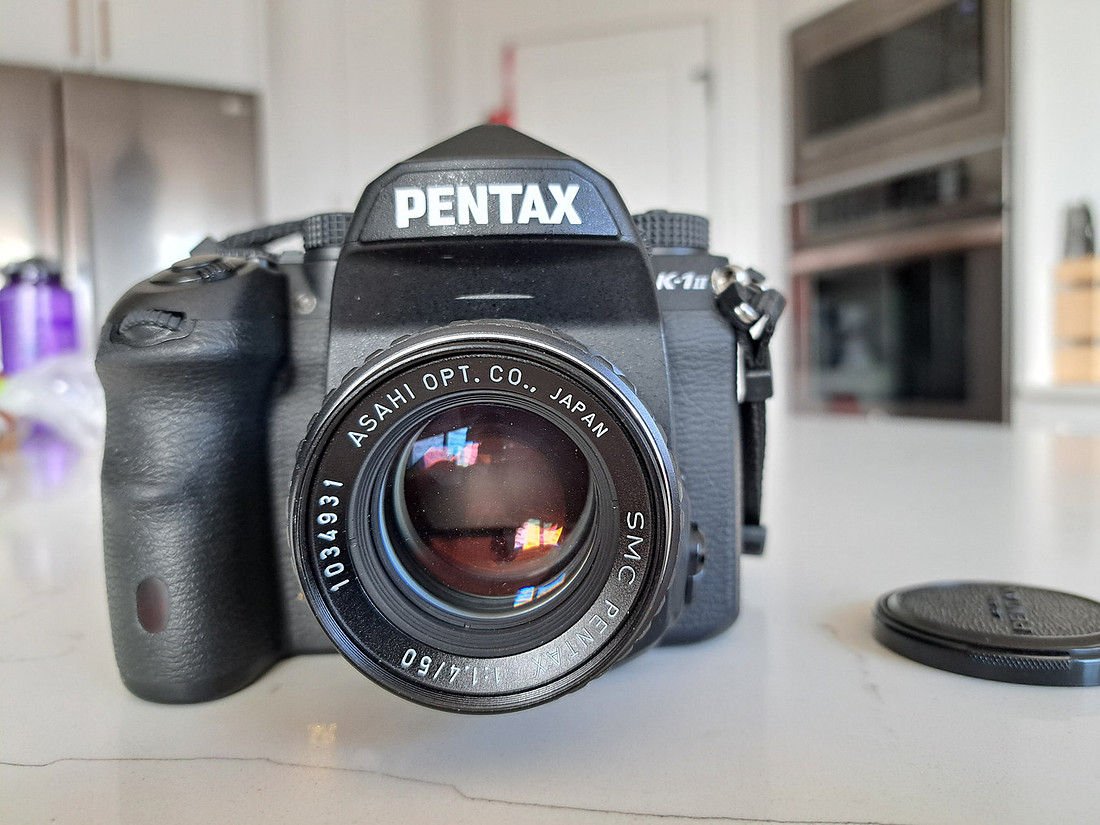
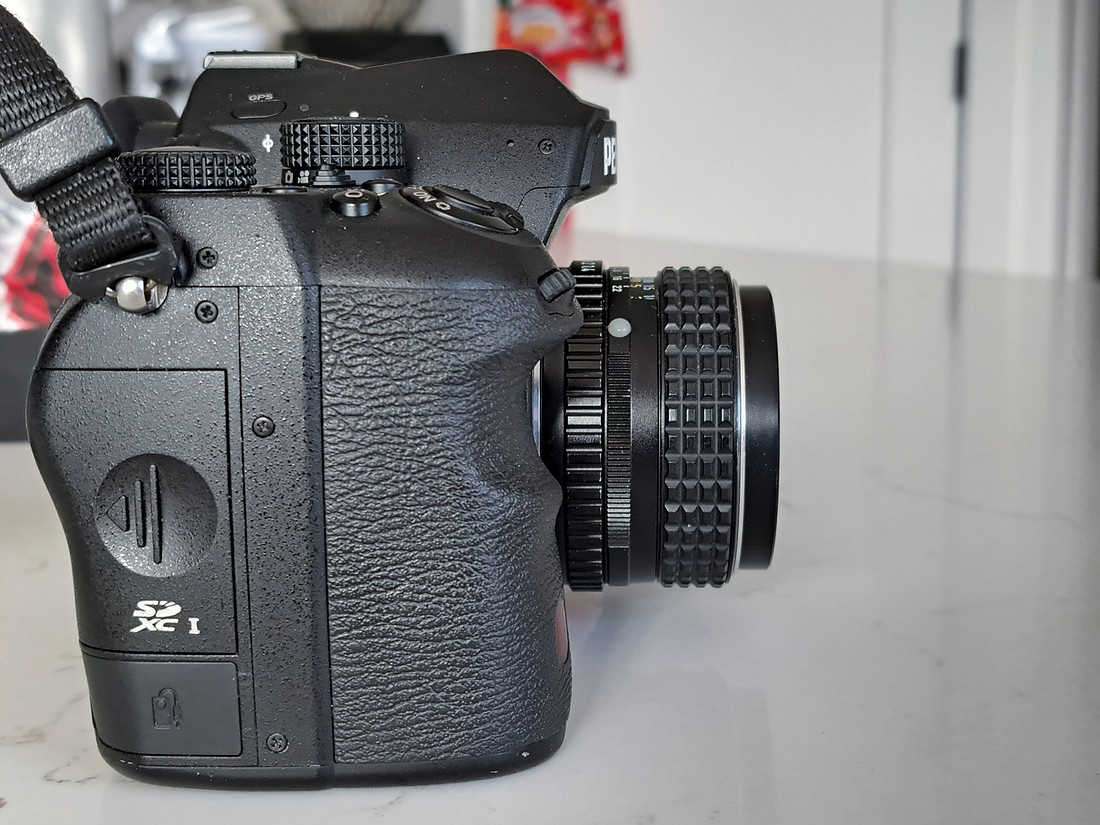
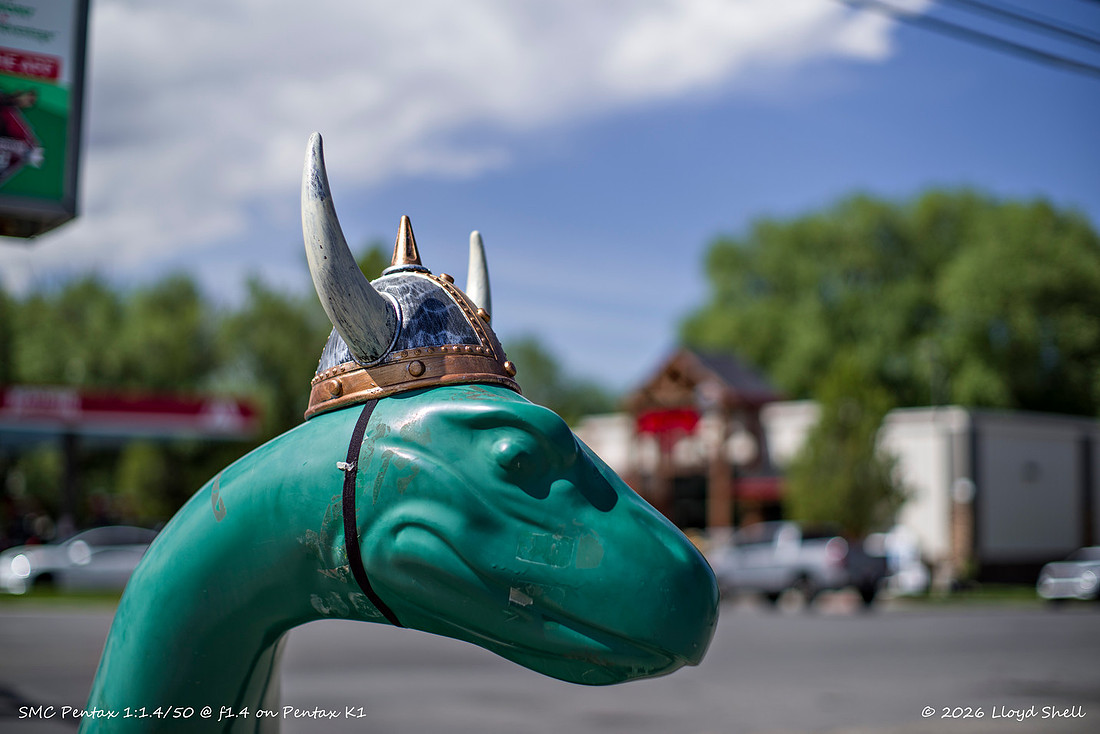
What about on digital I asked? Well, this is where another lens design feature comes into play that we have talked about before. The larger the aperture the thinner depth of field (area that is in focus) so with f1.4 you can get a pretty thin slice of your subject in focus, blurring the rest. Focal length affects this as well, longer focal lengths have thinner DOF at a similar aperture and shorter give more DOF. On a 50mm this opens up creative possibilities you can SIMULATE in post processing (Cell Phone cameras are starting to do this type of stuff with software but it looks crap in my opinion) but you cannot authentically create it without a lens with a large aperture. Like this photo below.

And this one, do you see how shooting wide open allows for isolation of only part of the image from the rest?

The problem with having the ability to do this, is that you tend to want to ALWAYS do this, shooting wide open for everything, even when the shot doesn't need it, just for the effect.


Extreme effects can be had with closest focus distance and maximum aperture, but it requires very careful focusing technique, everyone has postural sway when you are standing "still" and that can move the part of the image in focus around. Making it harder to get the exact shot you want. I* believe the photo above was at f1.4, but, with these old lenses not recording the aperture and taking this photo 2 years ago I don't know.
A photo like the one below is a good compromise of distance to subject giving you a decent chance at getting the focus right, as distance from the lens increases the depth of field. I am not a portrait guy but something like this distance from the subject would work for a portrait blurring the background at f1.4. The background blur is another coveted part of owning a lens with a large aperture.

One of the biggest drawbacks with old fast 50's is they are not always sharp wide open but do get better stopped down, as most lenses are wont to do. More modern lenses are better at this, something I hope to test in a month or two as I am planning a 50mm comparison test that will either kill me off or be amazing... or both. And give me more information as to how sharp this lens really is. Lack of sharpness can be relative, and most are sharp enough, this particular lens seems to be just fine wide open for me though I have not really tested it, casual shooting can only go so far. Say hello to a viking helmet clad Sinclair Dino in Ephraim Utah. Decorating these is a hilarious custom here.
Normally I would try to wrap things up and move on here, however, I wanted to try something a little different. A big criteria for me when testing a lens is it's suitability to be a walkaround lens, meaning one lens, one camera body and wandering around town. This is a FAVORITE activity of mine, I often try to do it after work if I can sneak out a little early and it isn't too hot. I do not get to indulge it as much as I would like to. In part due to life, responsibilities and getting a little lazy in my middle age. But I WANT to, and when I get to, it can be a lot of fun!
I HAD to take a day off of work, you see when I work on a holiday or a holiday occurs on a day I would not normally work, I bank those hours as paid time off. The caveat being that those hours expire at the end of June each year. (Use it or lose it.) I tend to be pretty scrupulous about keeping on top of those hours, but got down to the wire this year, having Memorial Day hours to use and June 27th being my last scheduled day for the year.
So... I took a Saturday off (I work Wed-Sat if anybody cares, and normally Sat is too thinly staffed to take off.) and engaged a photo walkabout and another favorite activity, riding trains. We have a commuter rail line called Frontrunner here in Utah that I like to ride, and it's northern terminus is in Ogden, which has a really cool rail museum, with a gun museum dedicated to John Moses Browning a Utah Local and a small car museum as well. I planned to find a breakfast place, wander, take some photos and just have a relaxing morning. Turns out there was a farmers market/festival going on too!
I had never really done walkabout with a 50mm, being more of a wide angle vision guy but wanting to try, I bravely set out for your and my benefit, here are a few shots that I took with commentary and a final sum up.
Narrow depth of field, that is what f1.4 gets you, the photo is not super interesting without it, and only slightly interesting with it.
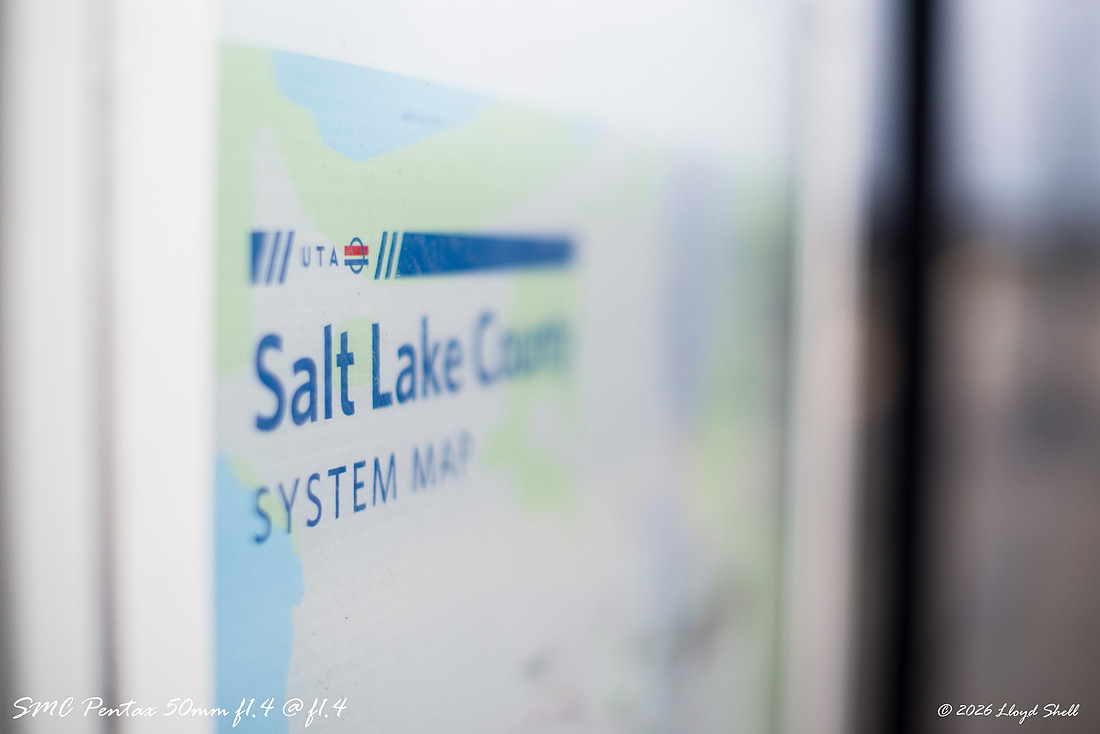
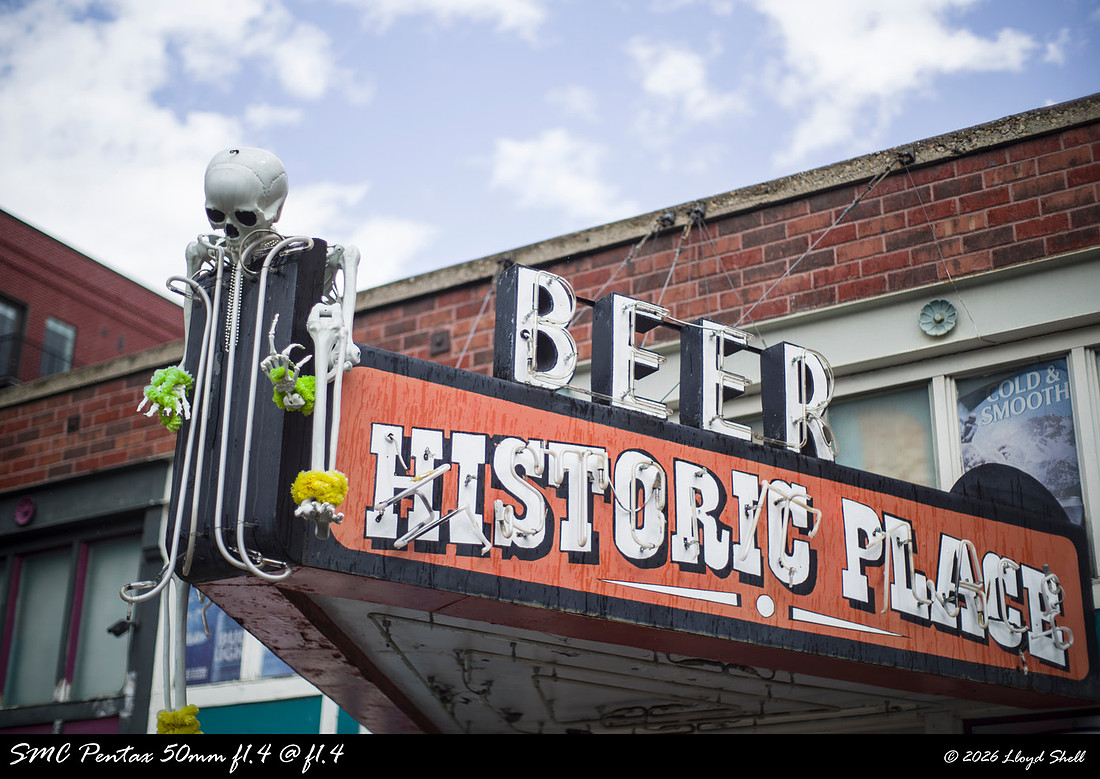
Stopping down, more of the sign is in focus, though with some background blur simply because the lens was focused as closely as it could. I am already wishing I had my 28mm.
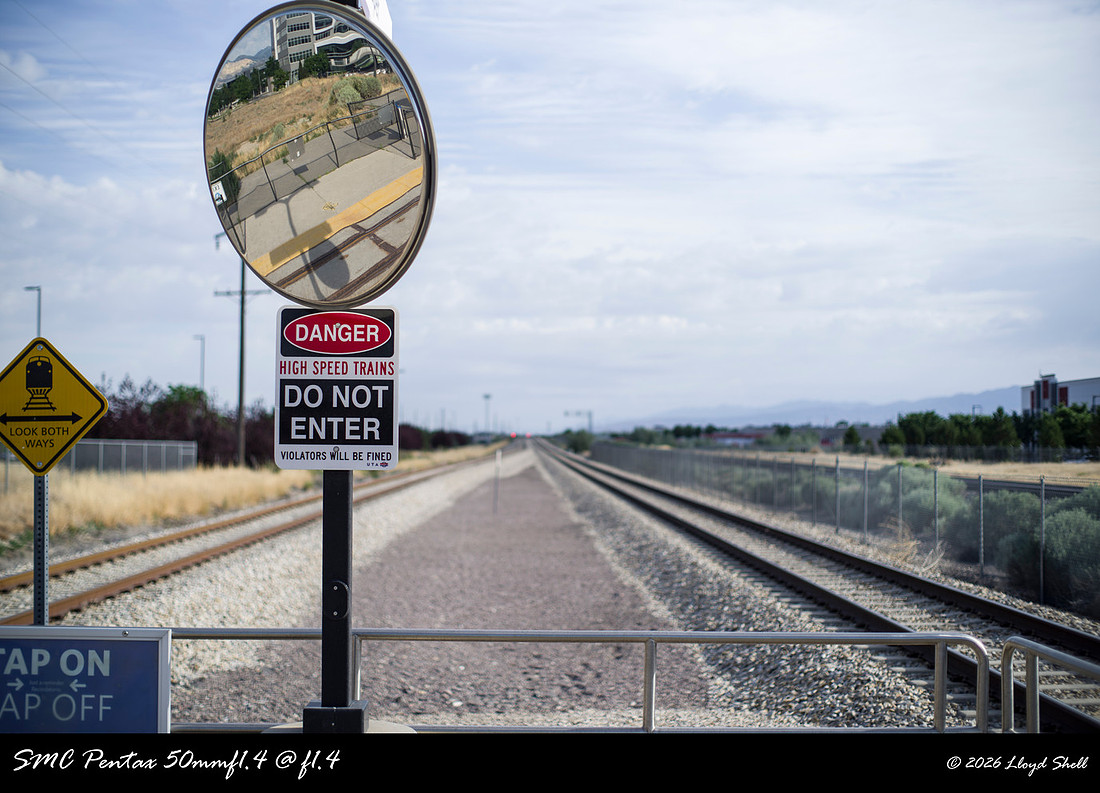
 Back to f1.4 but focusing further away allows for subject isolation, at 1:1 resolution on my computer things are acceptably sharp.
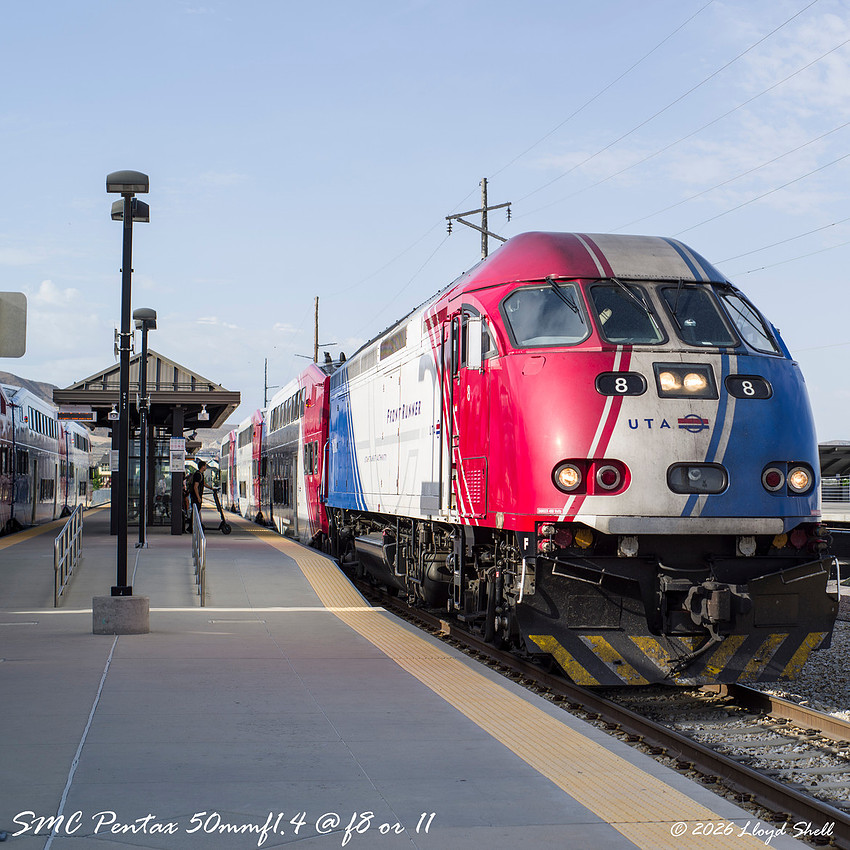
My transport arrives, a picture cannot convey the throb of the diesel engine, I LOVE that feeling in my chest. I had to step back to get things in the frame I wanted, then I ended up with too much in the frame and needed to crop. So not ALWAYS to narrow of an angle of view but it feels like it.
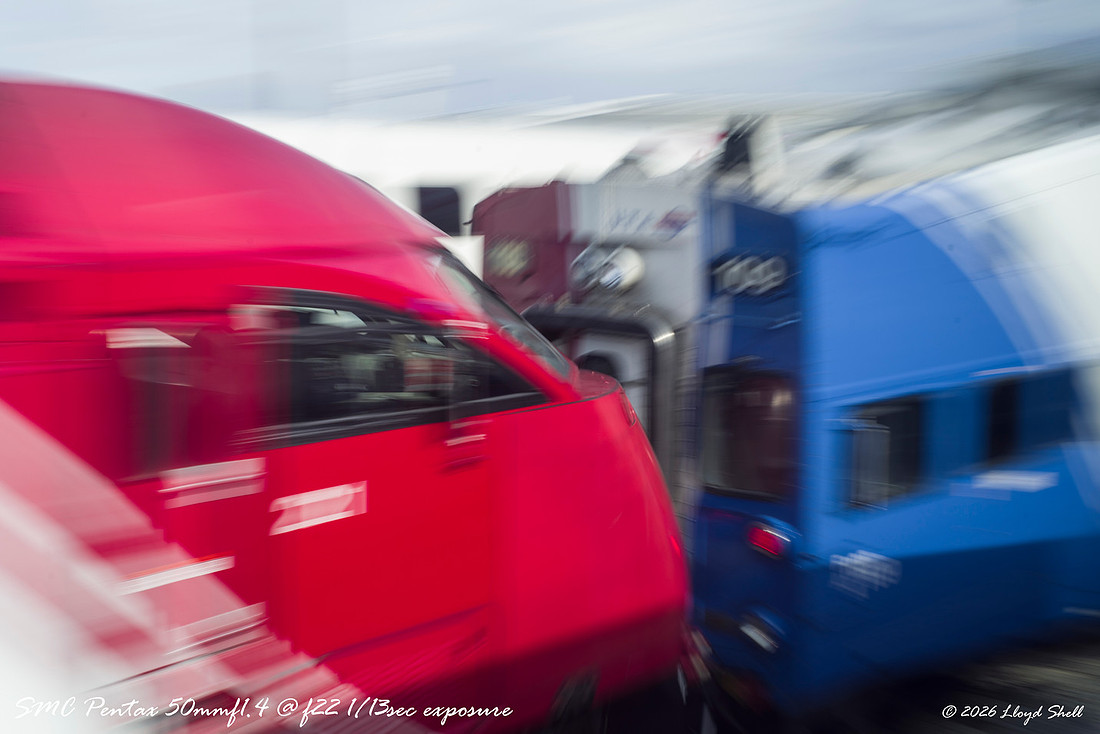
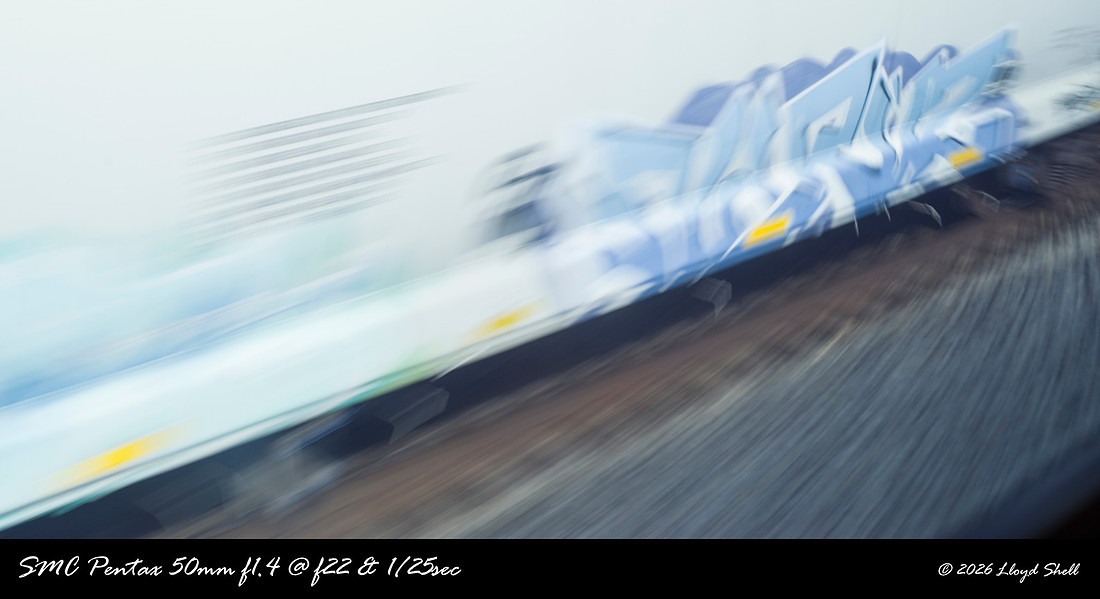
One of my favorite tricks when I'm moving is to stop down and induce motion blur, I love the sense of movement. Nothing here is really sharp, but I still like it. It is easy to get hung up on wanting the sharpest image possible sometimes.
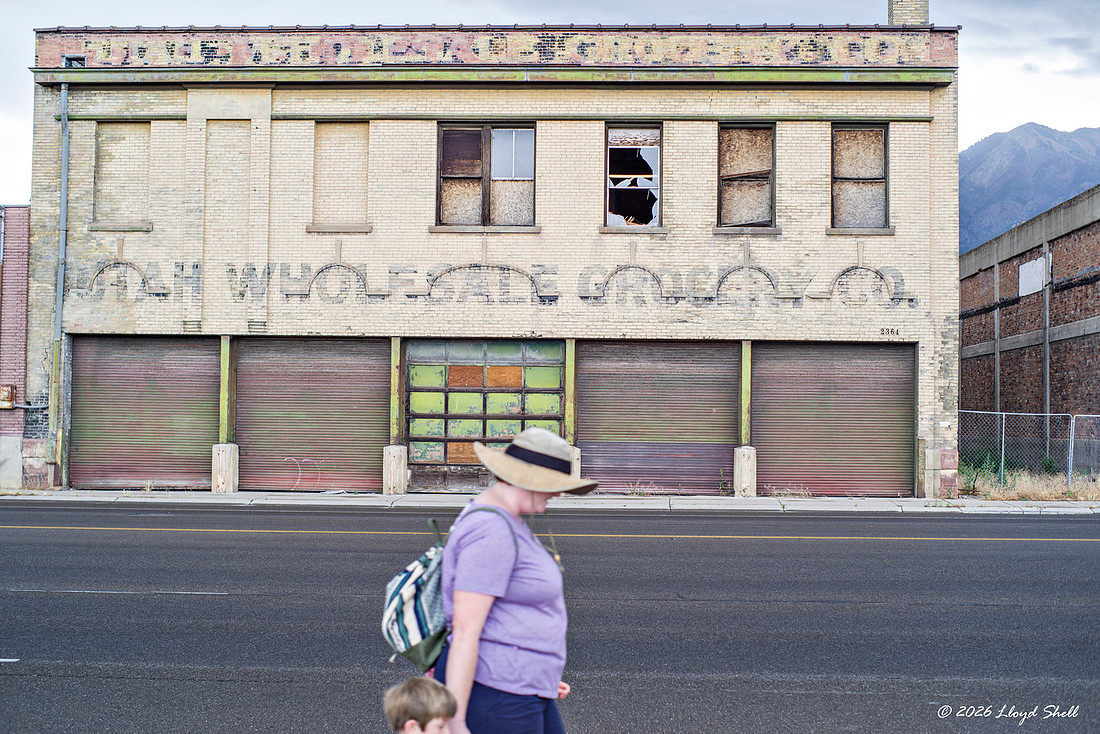
Here, I like what I was able to get, but was wishing for 35mm or 28mm, due to having to stand in just that spot I could not zoom with my feet and didn't get quite the shot I wanted. I still like the building though, it has character.
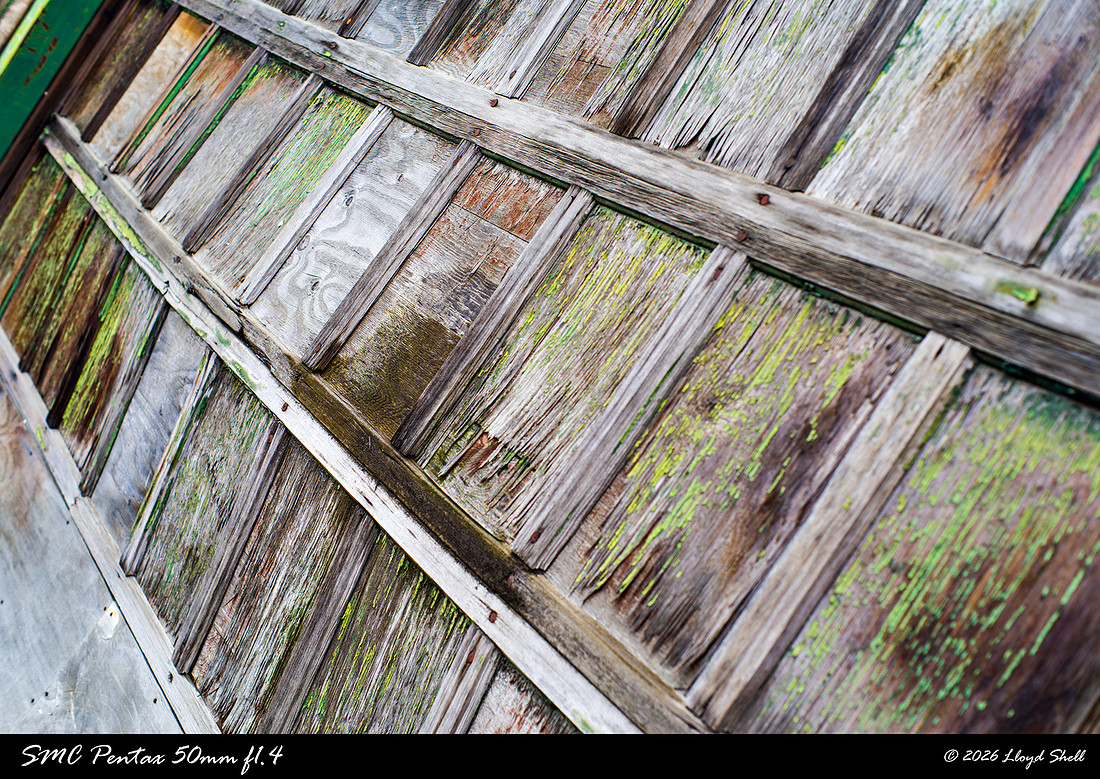
 That door was fun, the textures were magnificent.
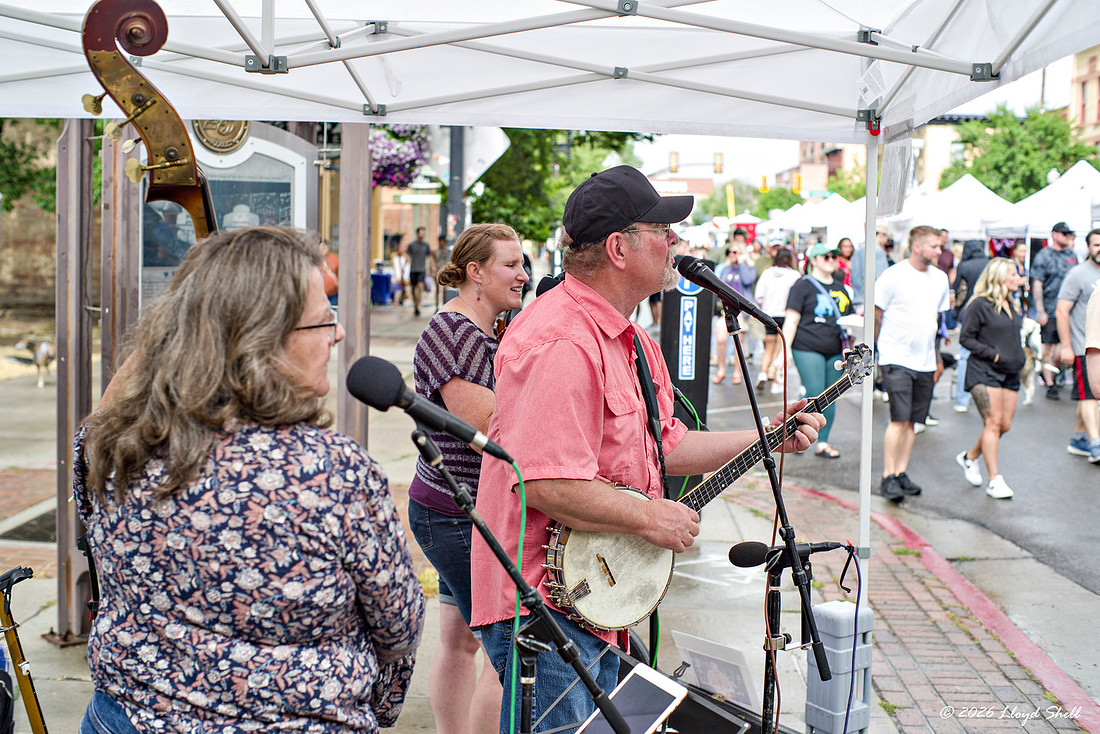
Cornell was kind enough to let me take his photo, this was f2.8 or f4 I found that worked well for reasonable depth of field and sharpness with reasonable ease of focusing. Manual Focusing is hard.

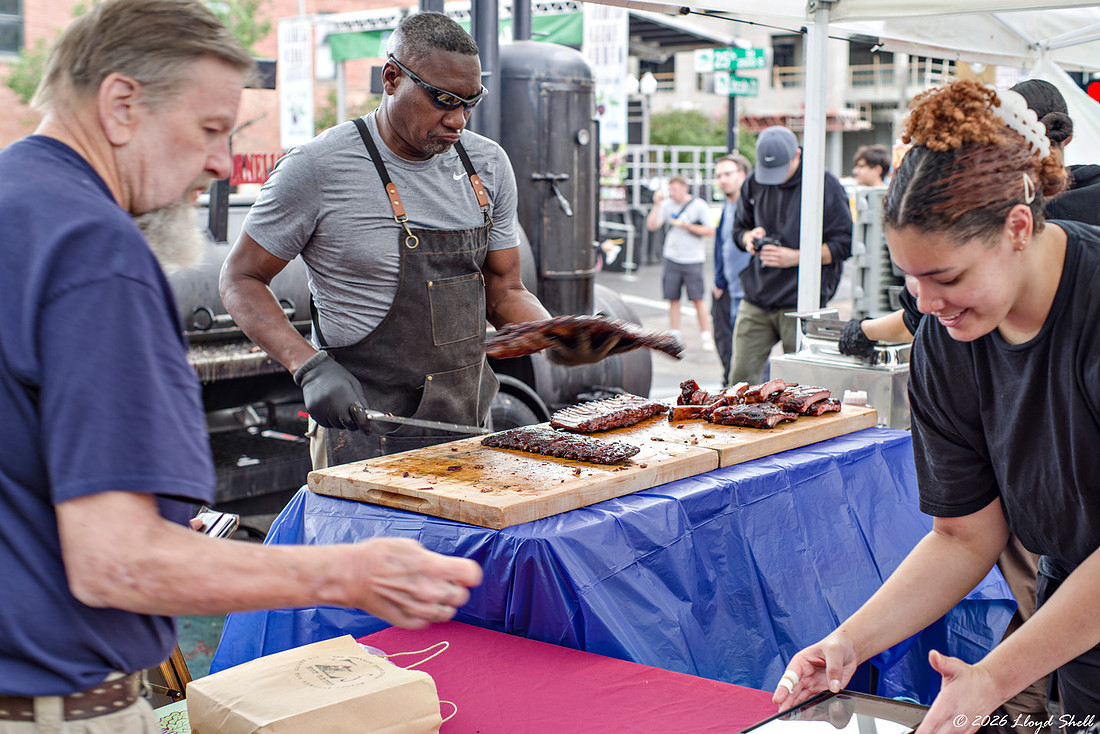
I am really pretty shy about taking pictures of people so this is my compromise, performers normally won't give me a dirty look.
Walking back past Cornell I couldn't help getting one more shot.
This amused me. Greatly. The longer focal length helped me here.
 The car museum was somewhat dimly lit, and required f1.4 and increased ISO to 800.
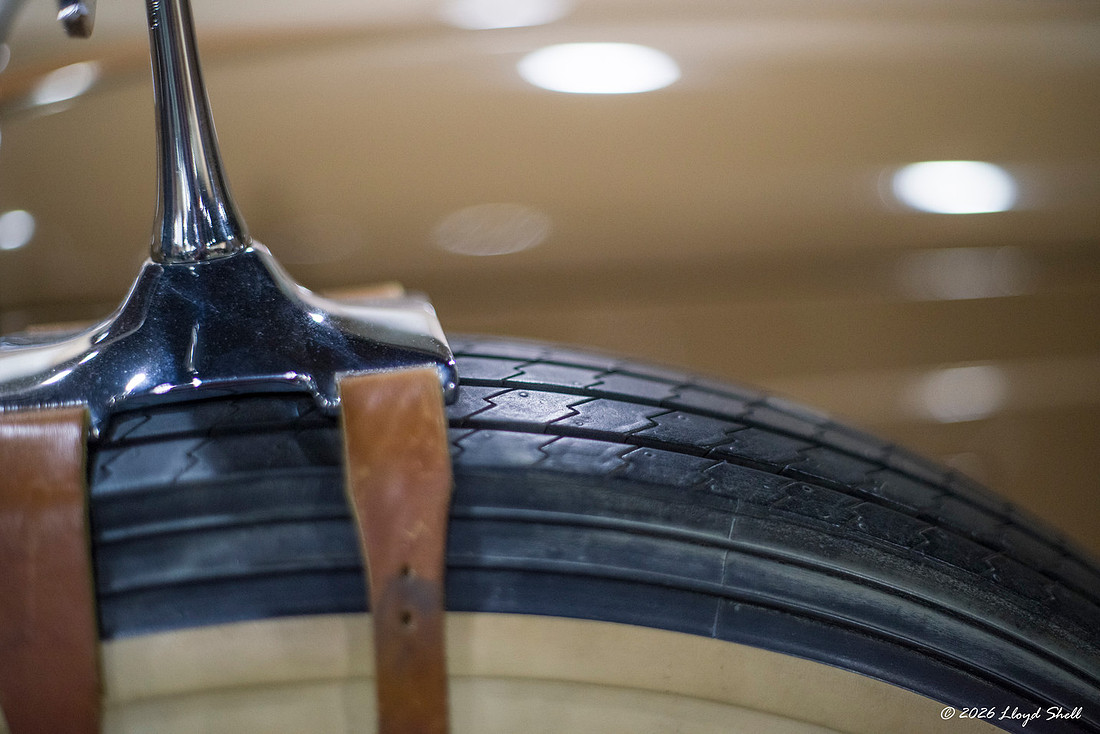 The rendering of out of focus highlights as circles of light in the center getting more oval towards the edges is very common in older lenses, some even render with "swirly" bokeh, I can produce this with a Helios 58mm lens I have, this one not quite as much. Do look for an upcoming post doing a 50-58mm lens comparison test with multiple lenses, hopefully I can reproduce that effect in studio.
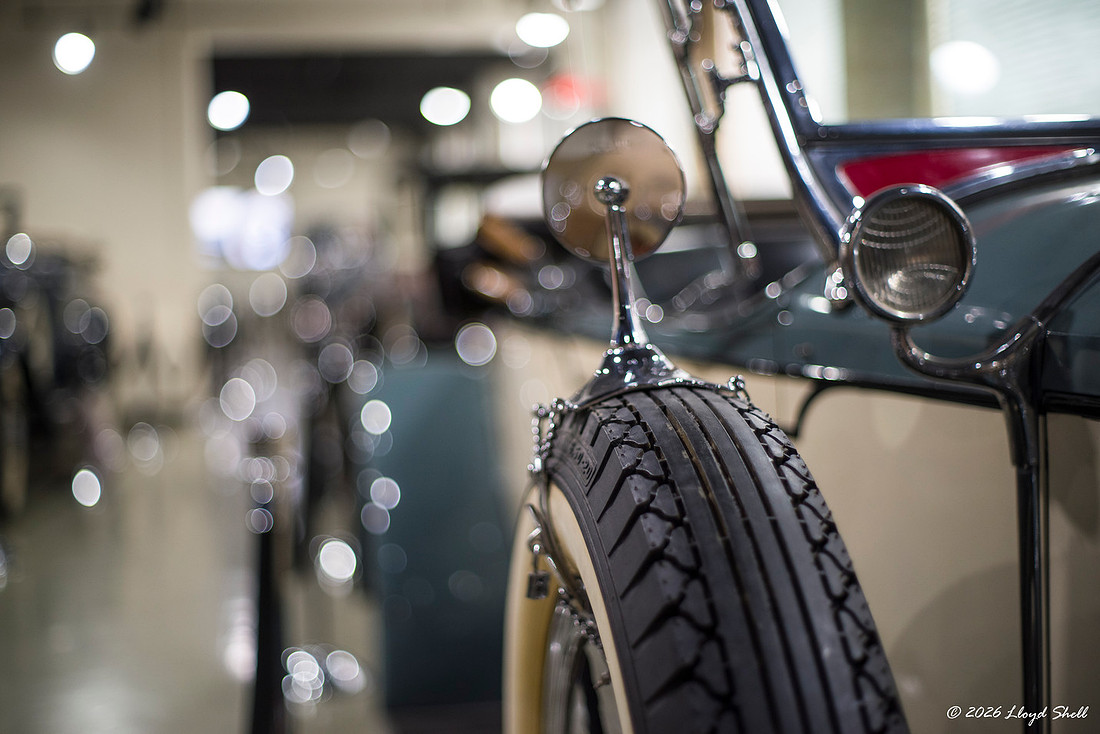
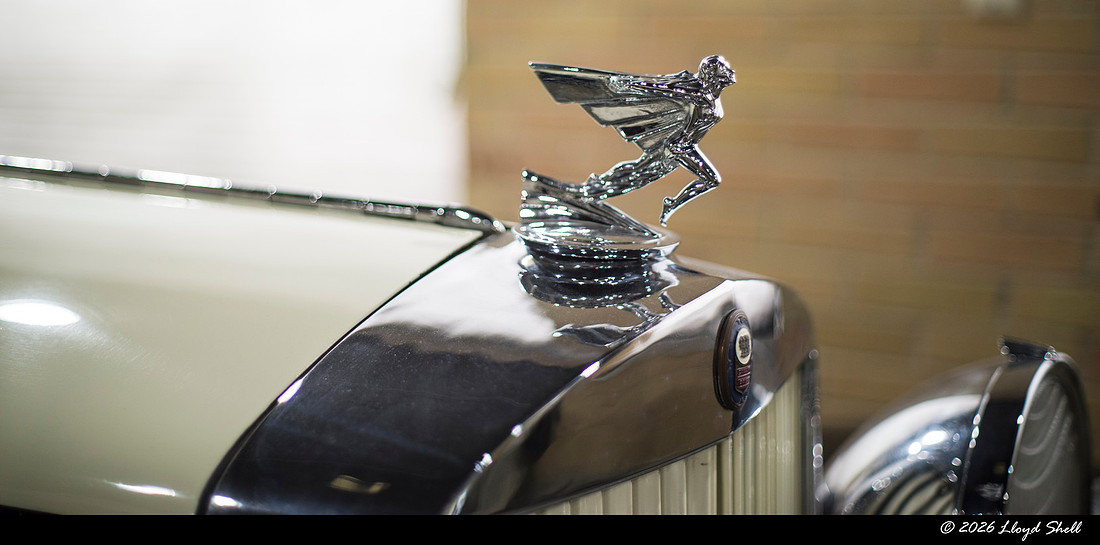
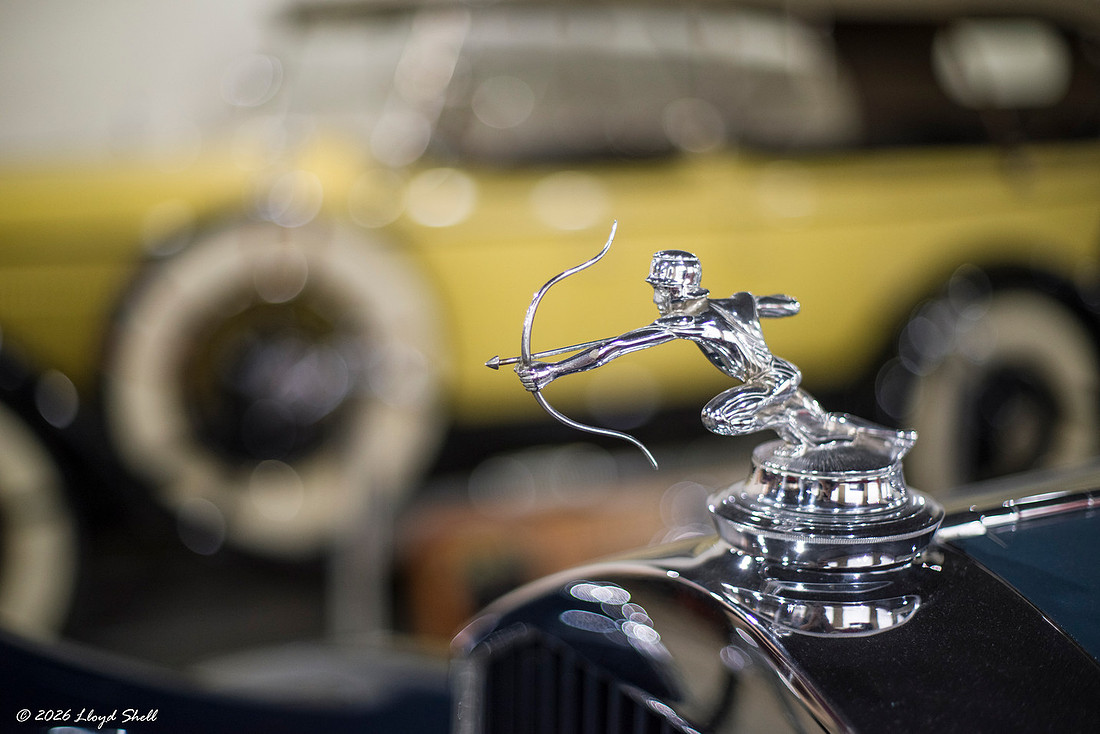
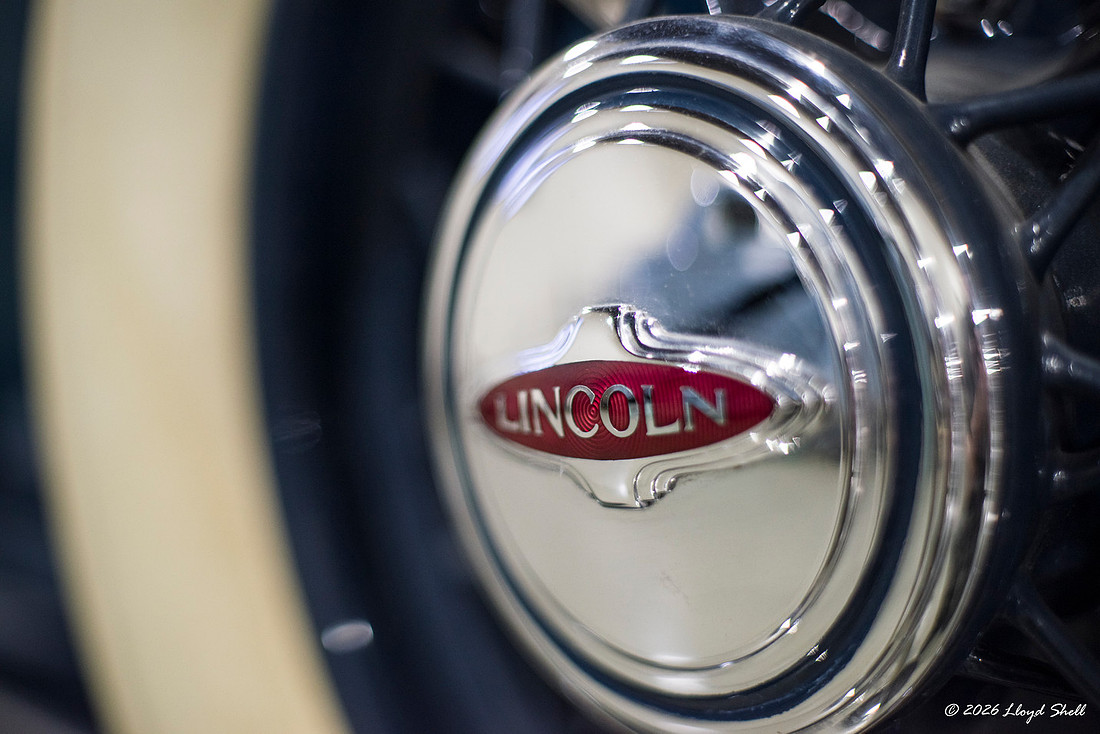
Hood ornaments on these old cars are just COOL! I love taking their photo.
One problem with faster lenses is chromatic abberation, you can see it around some of the bright spots on the archers arm, there is quite pronounced purple fringing, this lens and most older lenses will have that and some green as well. With modern digital post processing you can remove it fairly easily.
Moving outside to the trains. Here I started to see more of the value of increased sharpness at f4 and f5.6 compared to say a zoom lens. I could have framed this exact shot with my 28-105mm zoom, but I don't think the front logo would have popped the same. That may be a subject for further tests as I keep learning and playing. Except for some early stuff with my SMC Pentax 24mm f2.8 I haven't done much comparing in the field instead of indoors/controlled environments. What I do know is this image, seems to have what I would call "POP" with that UP logo just seeming to stand out more. As an aside this locomotive is pretty cool: https://en.wikipedia.org/wiki/Union_Pacific_GTELs
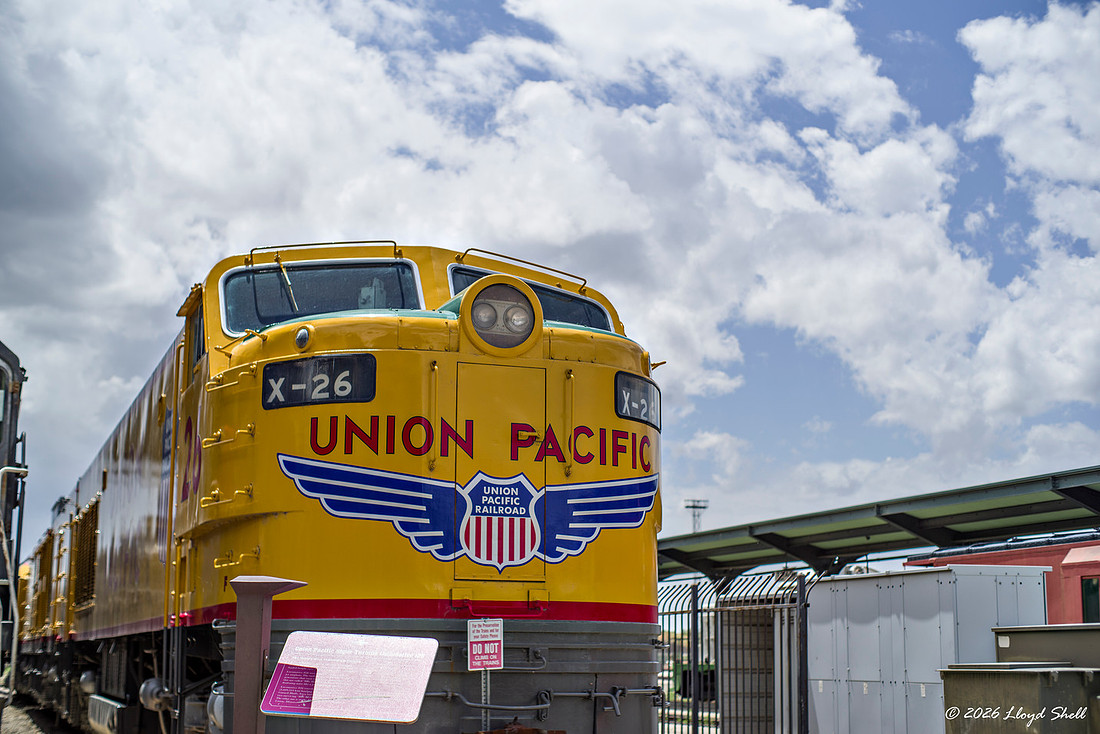

Locomotives, particularly steam locomotives, are among my favorite things, especially to photograph. They have details and symmetry, leading lines and are just a visual treat. UP 833 here is one of the best.
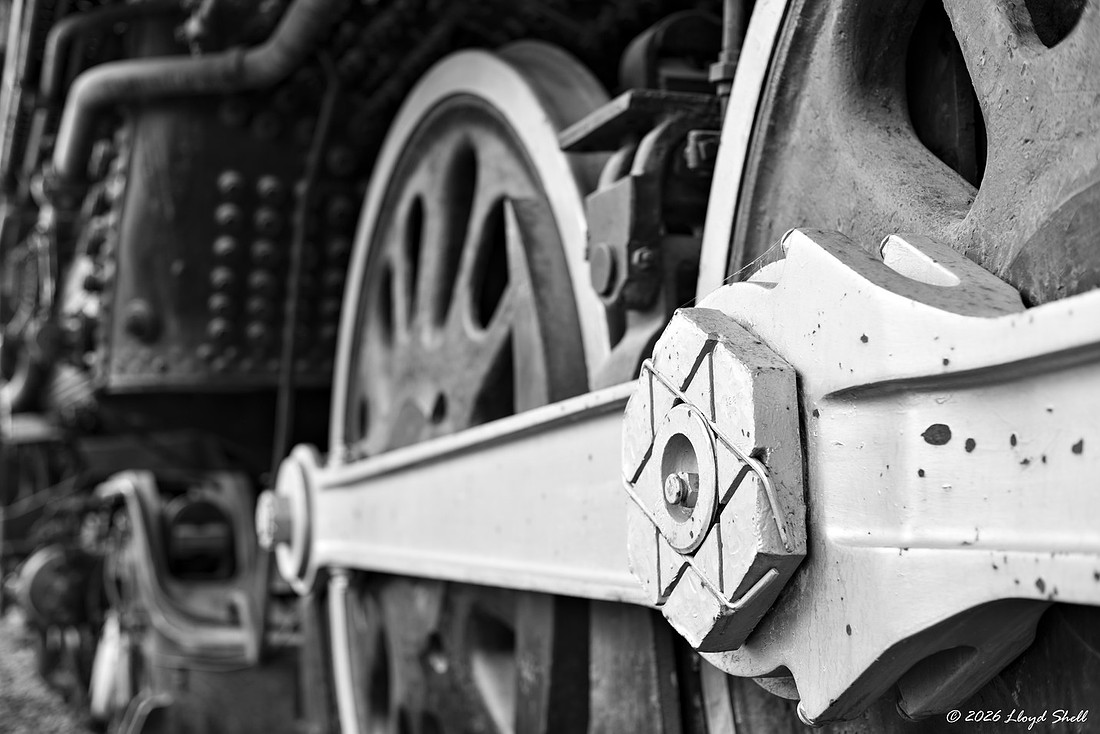
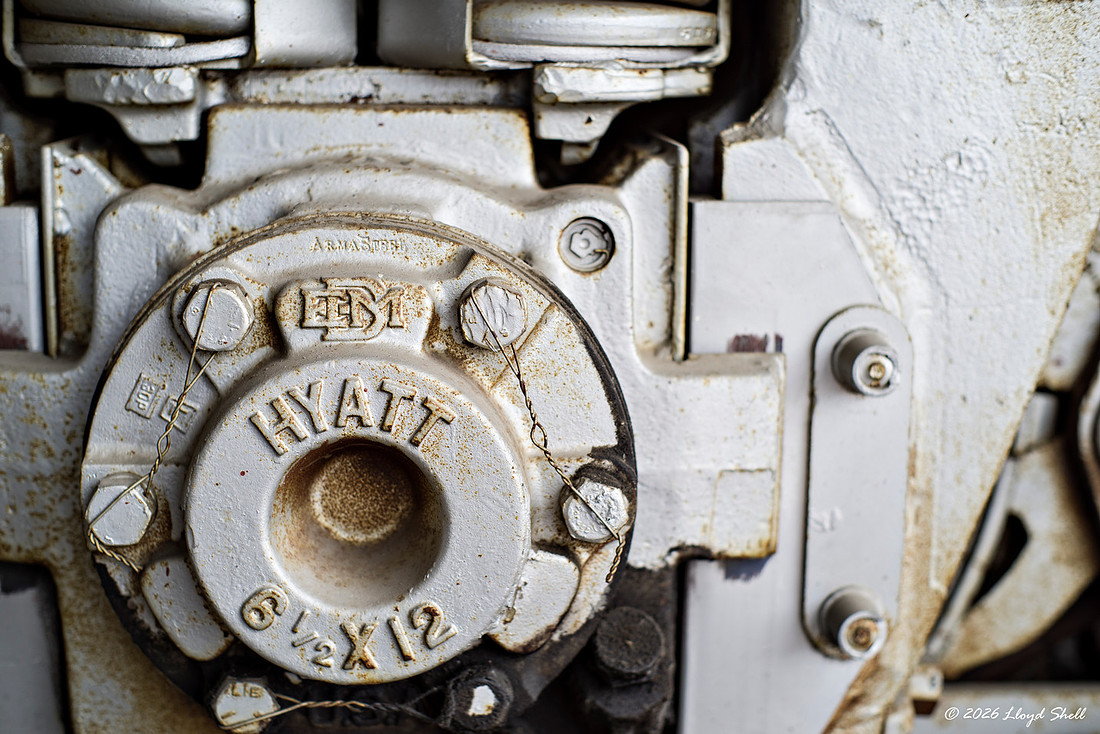
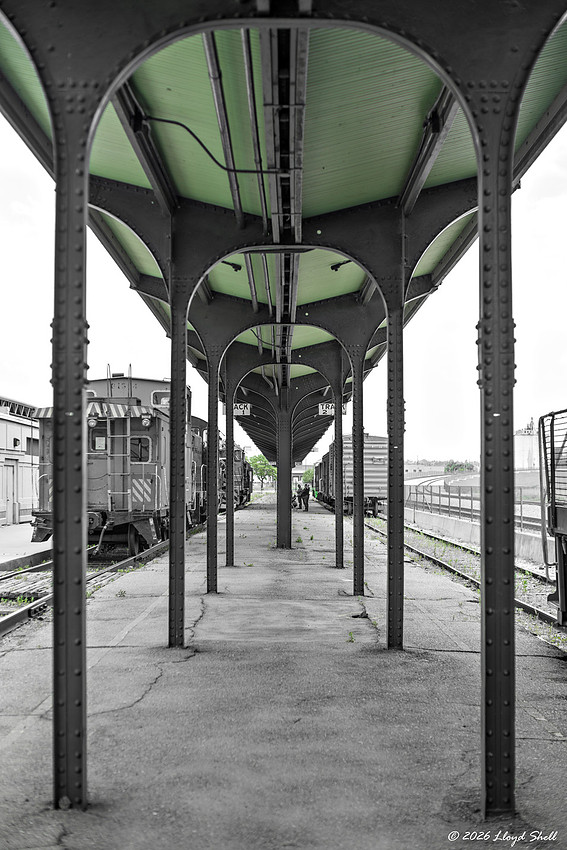
Parting shot of the old passenger platform.
Conclusion: This is a good performing and useful lens! Like all the K series Pentax lenses, the handling and tactile feel is great smooth focusing and clicky aperture rings. Optically the lens performs well, good sharpness even wide open, though you have to work to get it focused as f1.4 gives very thin depth of field especially in closer focus situations and you can get some chromatic abberations, though is hardly unique to this lens.
Stopped down a little it really gets VERY sharp, out resolving my sensor. Not going to get too excited about that without seeing more formal testing later, it may disappoint me, who knows. For me the limitations of the lens have to do with the focal length. I tend to see scenes somewhere between 24-35mm and find 50 a little constrained. I like to be up close to the subject and show environment for context, and that is more easily done with a wide angle. This lens will not displace my SMC 28mm f3.5 lens anytime soon, but it CAN be useful. Pentax makes five 50mm lenses currently, an inexpensive 50mm f1.8 called the "Plastic Fantastic" as it is very cheaply made, but seems to produce good images, a thoroughly modern 50mm f1.4 that is beastly large and has a reputation as an excellent performer two versions of the FA 50mm f1.4 with the old SMC coatings and one with the new HD coatings and a 50mm f2.8 macro that goes to 1:1 reproduction. I hope to be able to borrow an example of all three of them for my 50mm test.
If I had no 50mm lens in my kit right now I would lean to the macro f2.8 lens, I think. Let ya know after I test some stuff... That said I have no reason to not use this lens in the right situation.
As always, thanks for reading to the end and happy to hear from ya!
Lloyd
Lloyd and the Terrible, Horrible, No Good, Very Bad Day
I love photography, I really do. I love taking photos of cool things both for me and for other folks to see. I have been wanting to take a photo of a certain Steam Locomotive UP 4014 at this spot for years. I have investigated it and know exactly what I wanted to get. So on a clear April Day I was there. Middle of nowhere on the west side of the Great Salt Lake. The train was stopped doing some last minute lubrication before crossing the causeway. I'm ready to go. See:
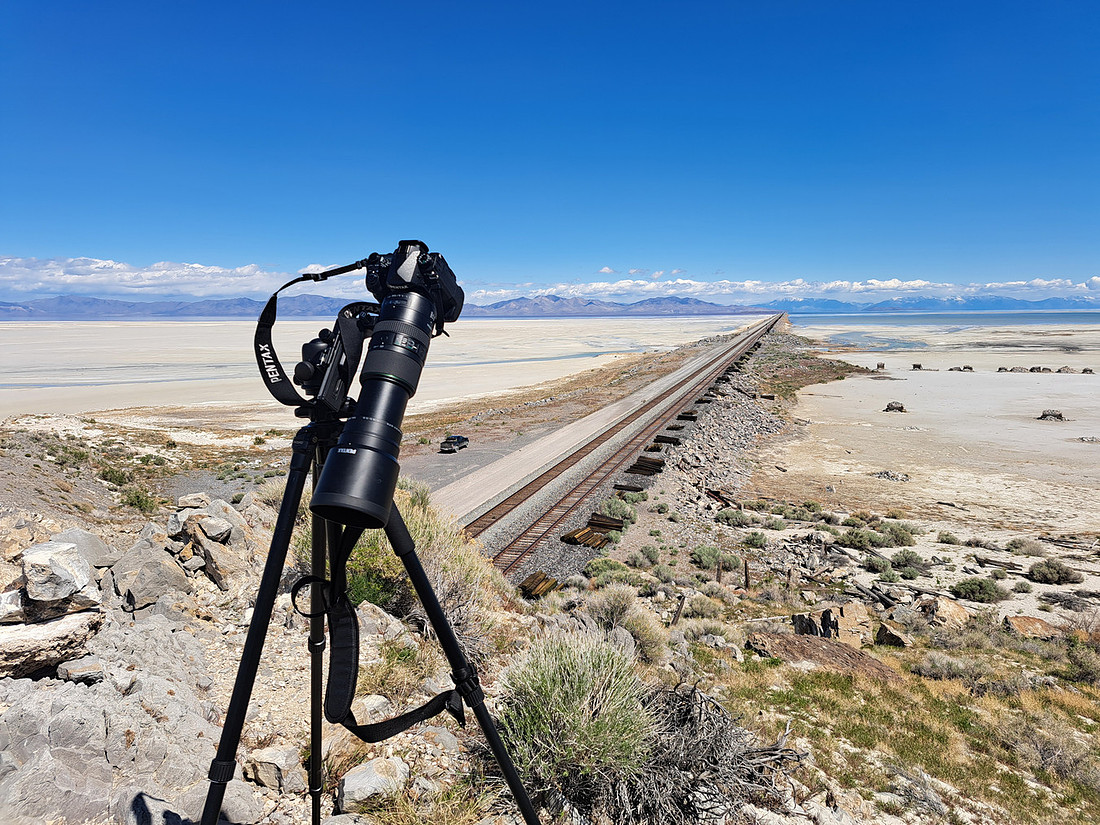
I get a text, I turn to put my phone in the shadow and a gust of wind does this:
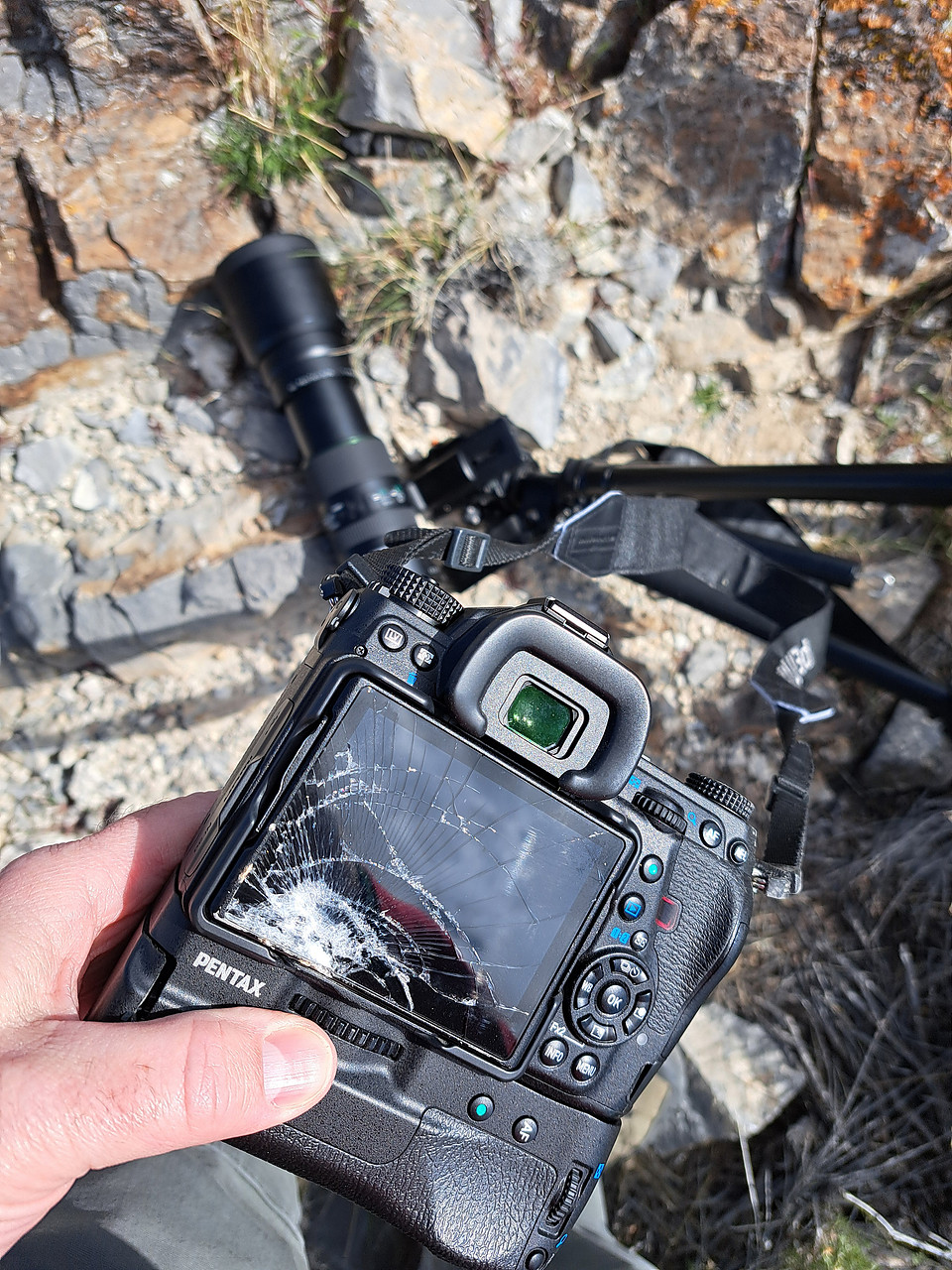
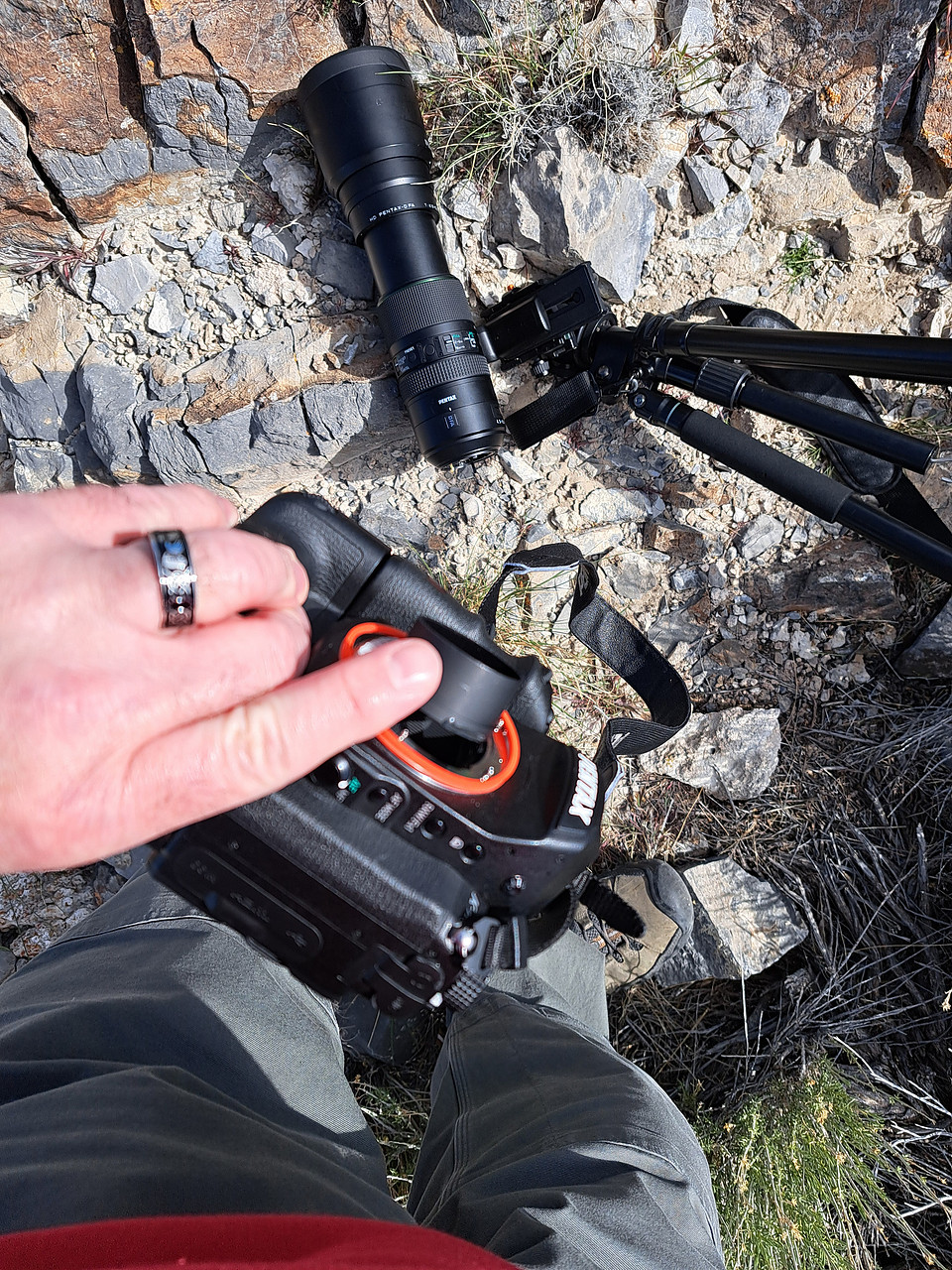
Tripod blown over, LCD broken, grip broken and the mount torn off of the lens. I cannot describe what I was feeling at this point. The title of this post is a start. Even as I type this, I feel the sick feeling I had all over again. I had planned to write a triumphal post talking about planning and having in pay off. Instead... this...
Even worse, I somehow bungled my cell camera video with not being able to see the screen in the bright light and didn't get even that. I later figured out that the camera body still worked and I could have put another lens on and taken some photos had I had the ability to think straight.
It was sincerely a terrible, horrible, no good, very bad day.
I have insurance and the camera body should be repaired soon. The lens is going back to Japan for an estimate. My dad bought me that lens a year or so before he died.
It will all be covered, but the opportunity was lost, and I have been feeling really down about it. Hopefully, I will soon be back at lens testing and all my usual shenanigans, just with more awareness of tripod stability and more than a small helping of extra care.
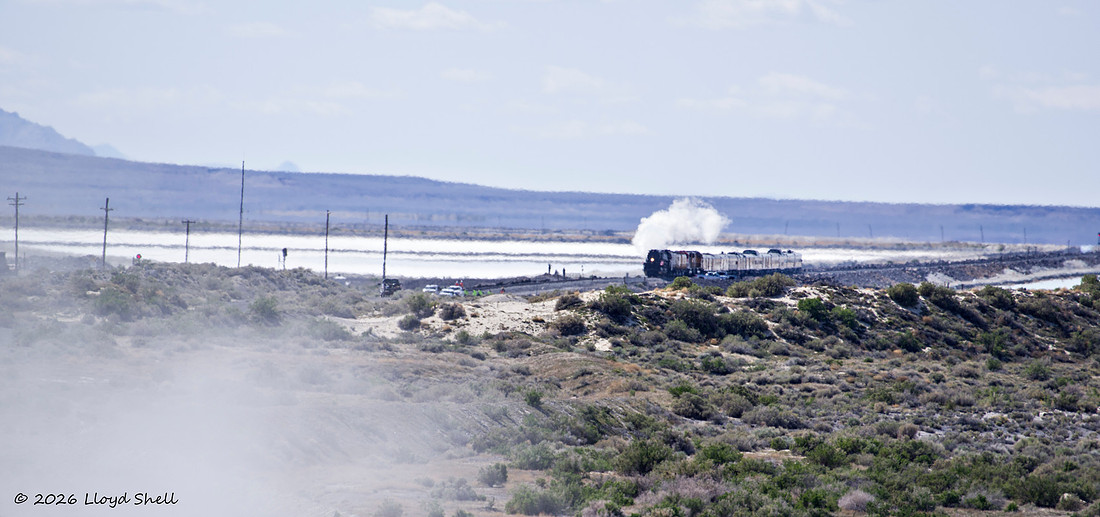
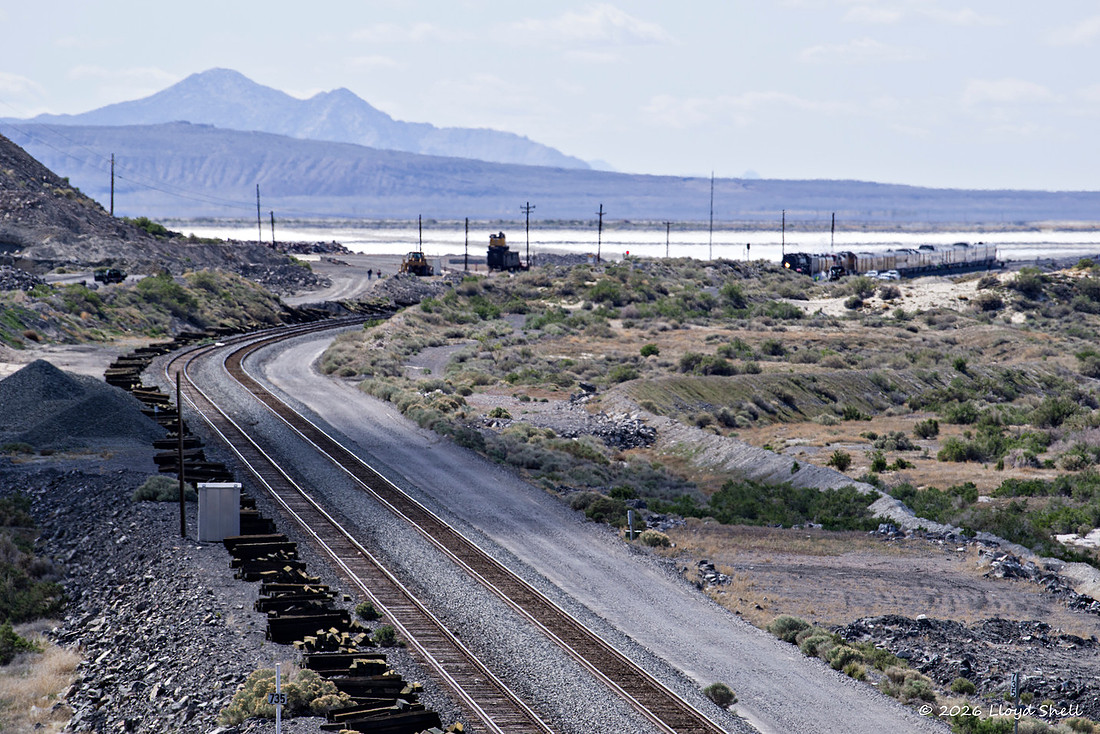
Here are my last two photos with this lens and camera before the big boom.
Part 2 a Bag Full of Lenses Pentax 35mm's
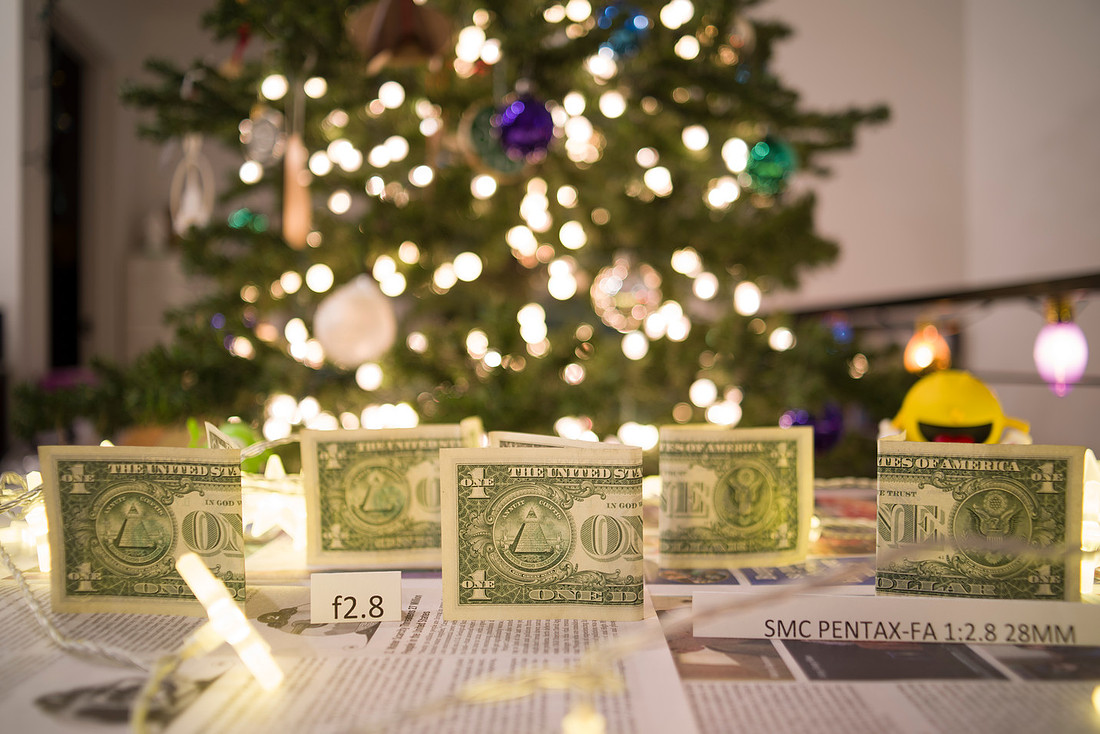
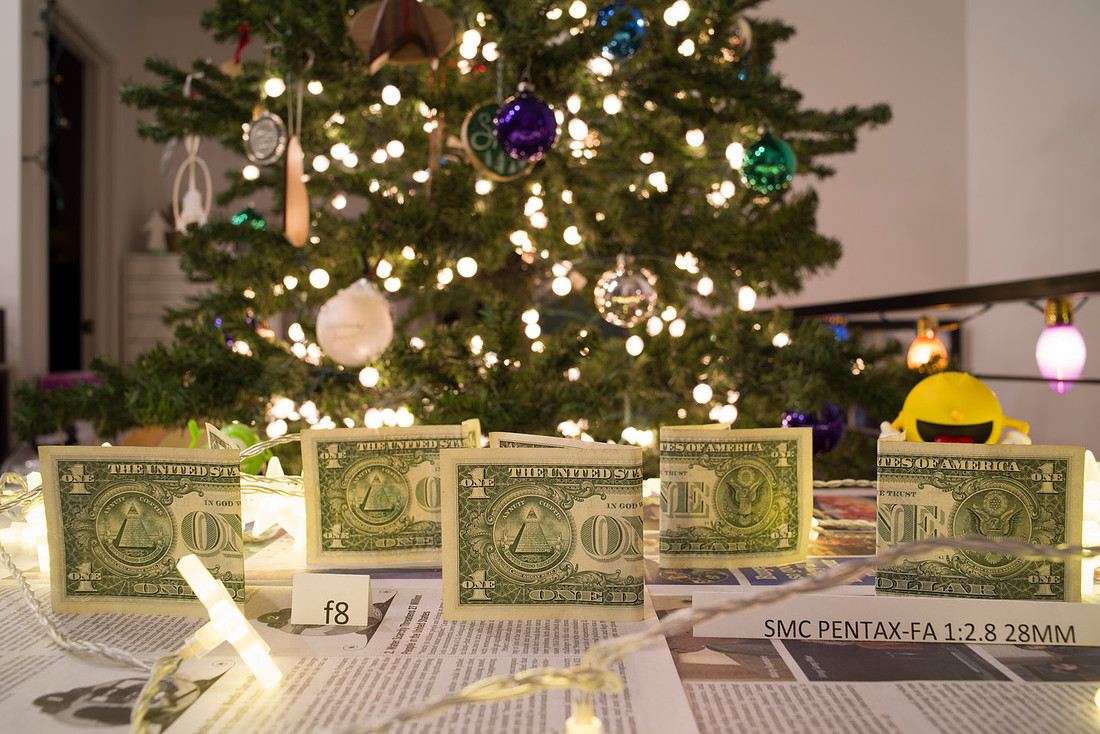
I am back with a big bag of lenses to test but this time all of the 35mm focal length. I have changed how I went about this a little compared with the 28mm test. Christmas is over, so the tree is down and I had to find something else for the background, so I hung a few strands on some chairs in my cinema room, the only quiet place where I was out of the way. I am still looking for the perfect set up. Which I will likely find on my last set of tests...
After a long winded introduction I will give you my thoughts by groups of lenses, then for those of are for those of you want to then you can look or not at all the nitty gritty of the individual crops and video of the lens flare with a light source in frame. I think most of you will as we are photographers and here for the pictures no? Speaking of pictures you can view the complete gallery of all the photos and videos here: https://www.lloydshell.com/p467264132
I am not entirely sure if these blog posts are going to be the death of me or not, they are a lot of work, but I enjoy the intellectual exercise and playing with cool lenses. This was a fun group of lenses to work with, again, I relied on a local Pentaxian that has a VAST collection of Pentax mount lenses to lend me some interesting lenses. Here are the lenses that I ended up testing in approximate age from oldest to newest. All images taken with the lenses mounted on my Pentax K1 mark ii, on tripod and with remote shutter release, manual mode. You can find most of them here if you want more details: https://www.pentaxforums.com/lensreviews/
Takumar 1:4 f=35mm
Auto-Takumar 1:2.3 f=35mm
Super-Takumar 1:2/35 (67mm filter)
Super-Takumar 1:2/35 (49mm filter)
Super-Multi-Coated TAKUMAR 1:2/35 (49mm Filter)
Super-Multi-Coated TAKUMAR 1:3.5/35
SMC PENTAX 1:3.5/35 (I own this lens)
SMC PENTAX 1:2/35
Vivitar 35mm 1:2.5 AUTO WIDE-ANGLE (I own the lens, it is a TX interchangeable mount)
SMC PENTAX-M 1:2.8 35mm
SIGMA 24-135mm 1:2.8-4.5 (Zoom lens I own)
HD PENTAX-FA 1:2 35mm
SIGMA 35mm 1:1.4 DG Art
HD PENTAX-D FA 1:3.5-5.6 28-105mm (Zoom lens I own)
Photos of them? Oh yes, here you go, all taken with a Pentax 55mm f1.8 K series lens.
The Modern Autofocus Group L-R: Sigma 24-135, Pentax 28-105, Sigma 35mm f1.4 and Pentax HD FA 35mm f2
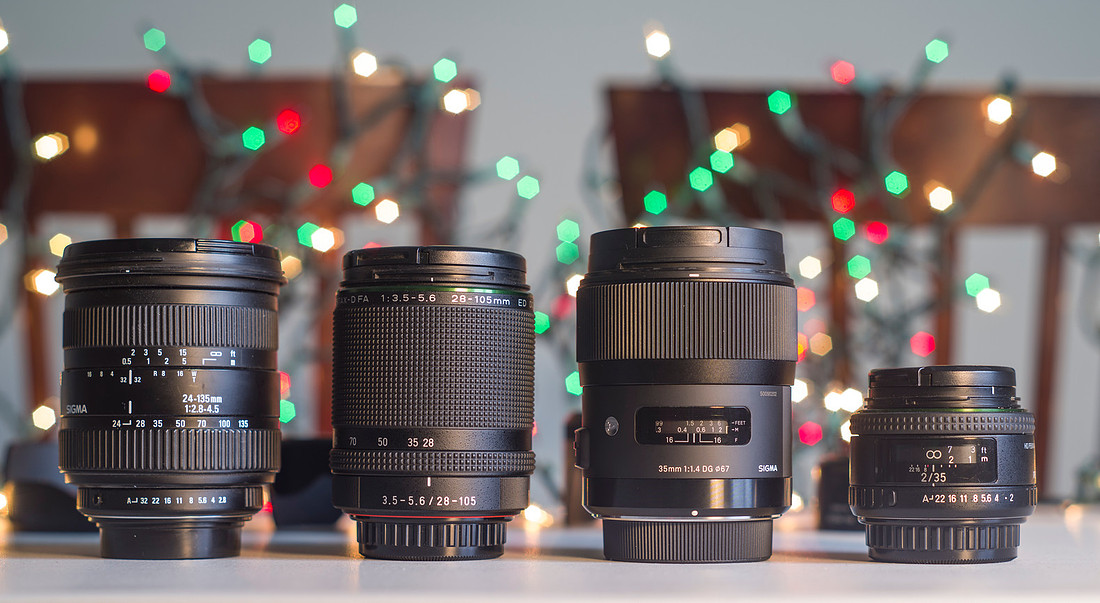
Here with my SMC Pentax 1:3.5/35 for size comparison.
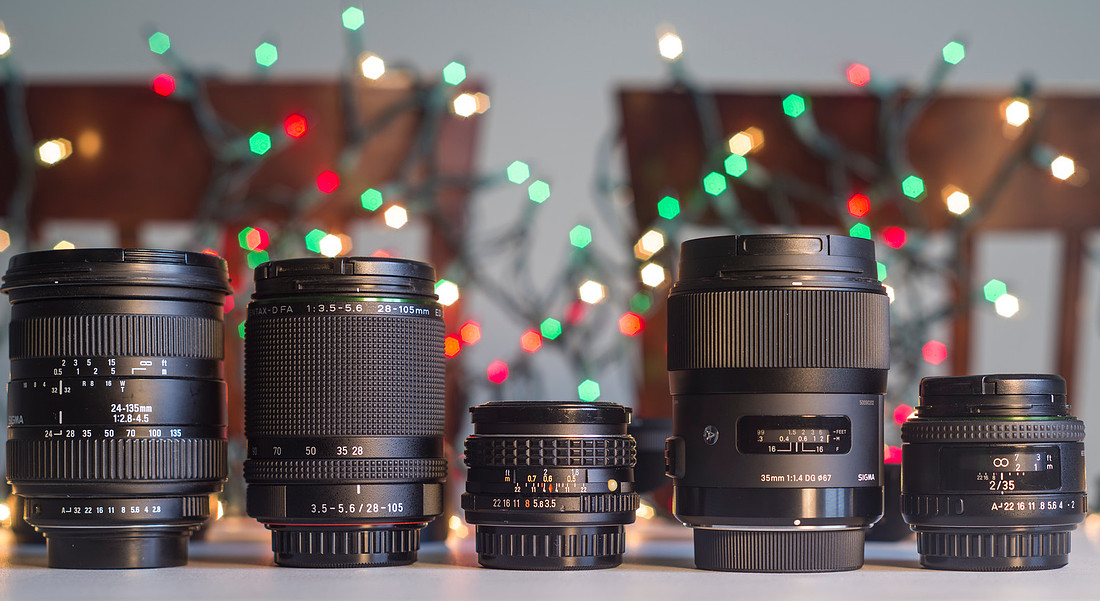
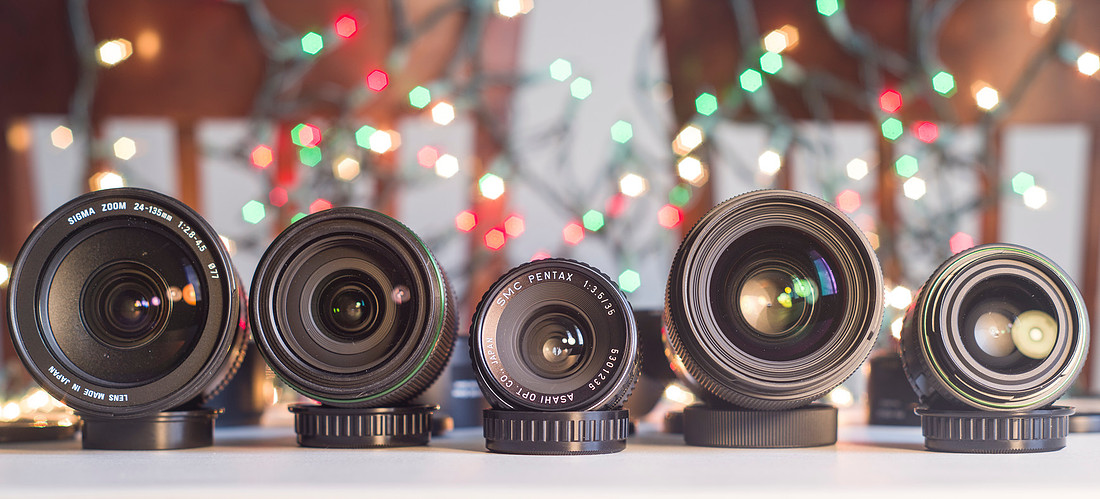
Conclusions about this group: Modern is better, the Sigma f1.4 lens is sharp from wide open, it produces good out of focus light balls (though with some onion ring layering that does distract if you look too close) and excellent bokeh. However it is quite a bit larger than the HDFA f2 from Pentax, which lens is really quite small and light, it is not as sharp as the Sigma and really does show it's age as a design from 1999 with new coatings. BUT the coatings do help with flare, see the videos at the very end of the post for comparison. I don't have the non HD version to compare but the only lens that handles flare better is the old K35mm f3.5 in the middle. It really does handle direct light quite well, and is sharp even on the edges from wide open. The Pentax 28-105 is very good for a zoom, handles flare fairly well, and is close to the same sharpness as the HDFA f2 lens at f4. BUT that is its widest aperture. The Sigma zoom was last of this group, edges being iffy, and only fair handling of lens flare. It was better than I expected though based on other tests at wider focal lengths. The Sigma is clearly the biggest and sharpest, but the smaller size of the Pentax is a point in its favor if you value that.
Comparison at closest focus distance with selected lenses, the Sigma First.
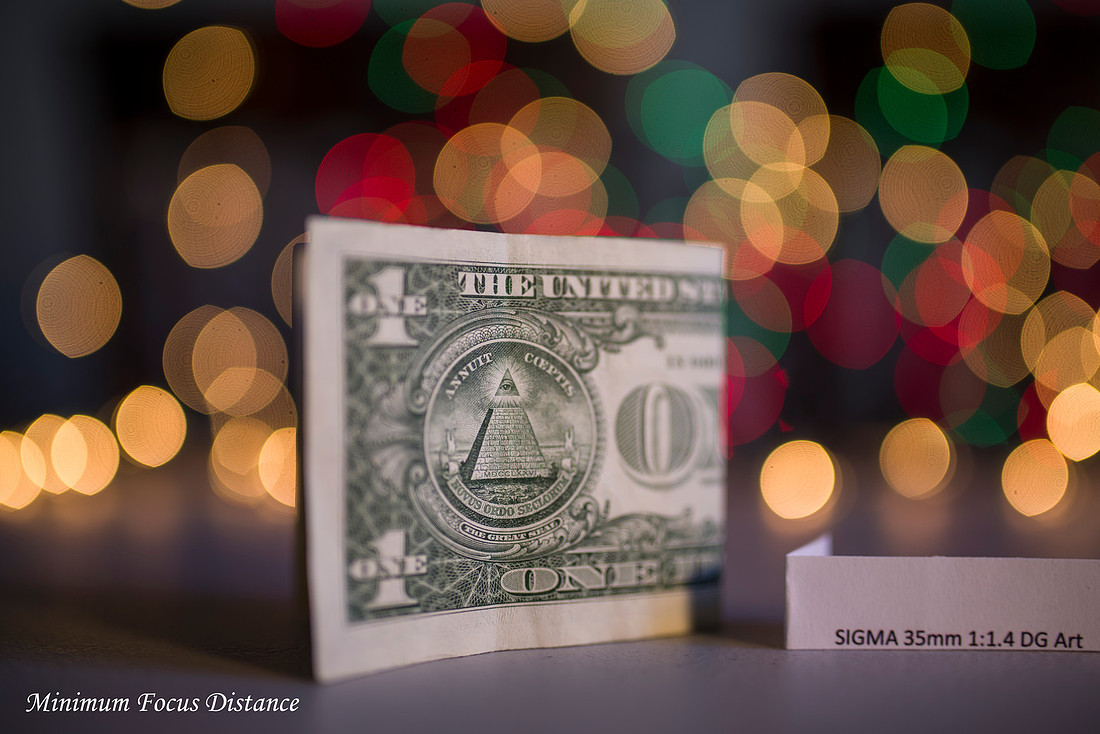
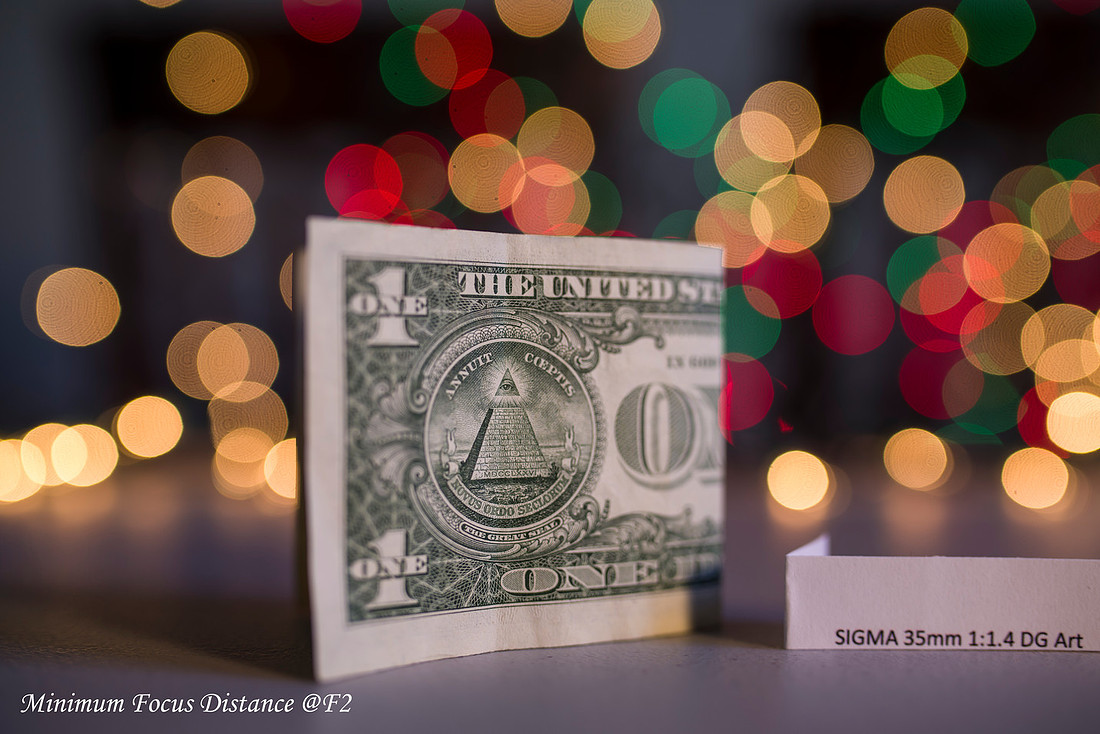
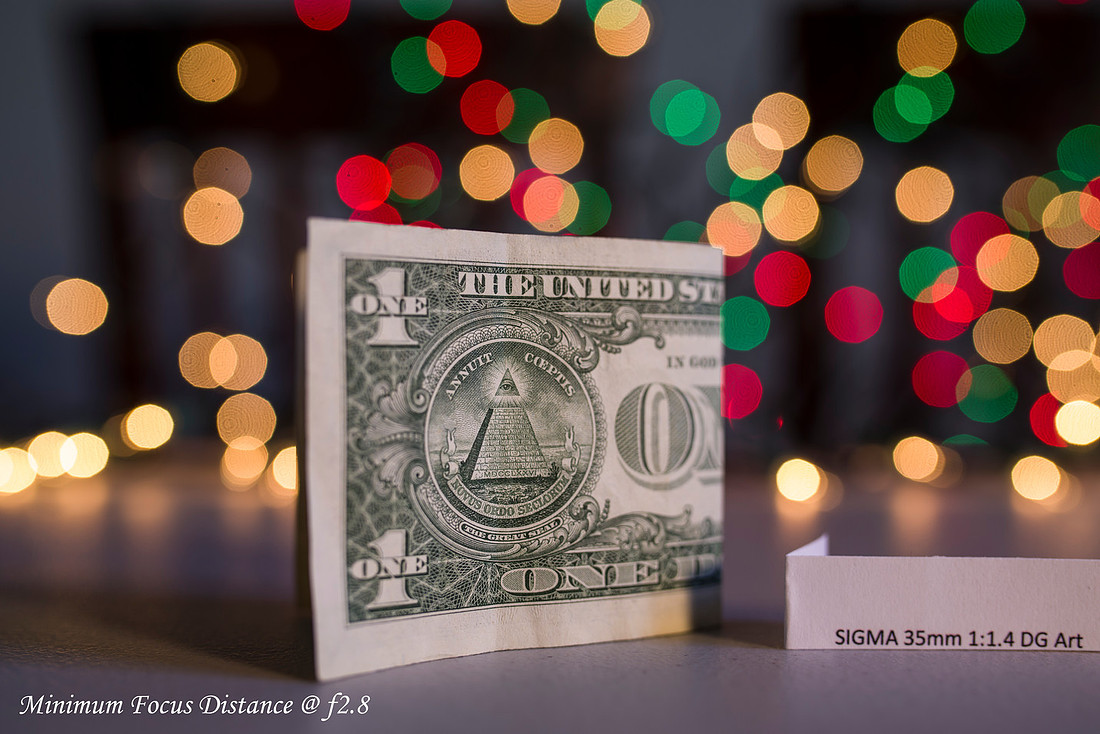
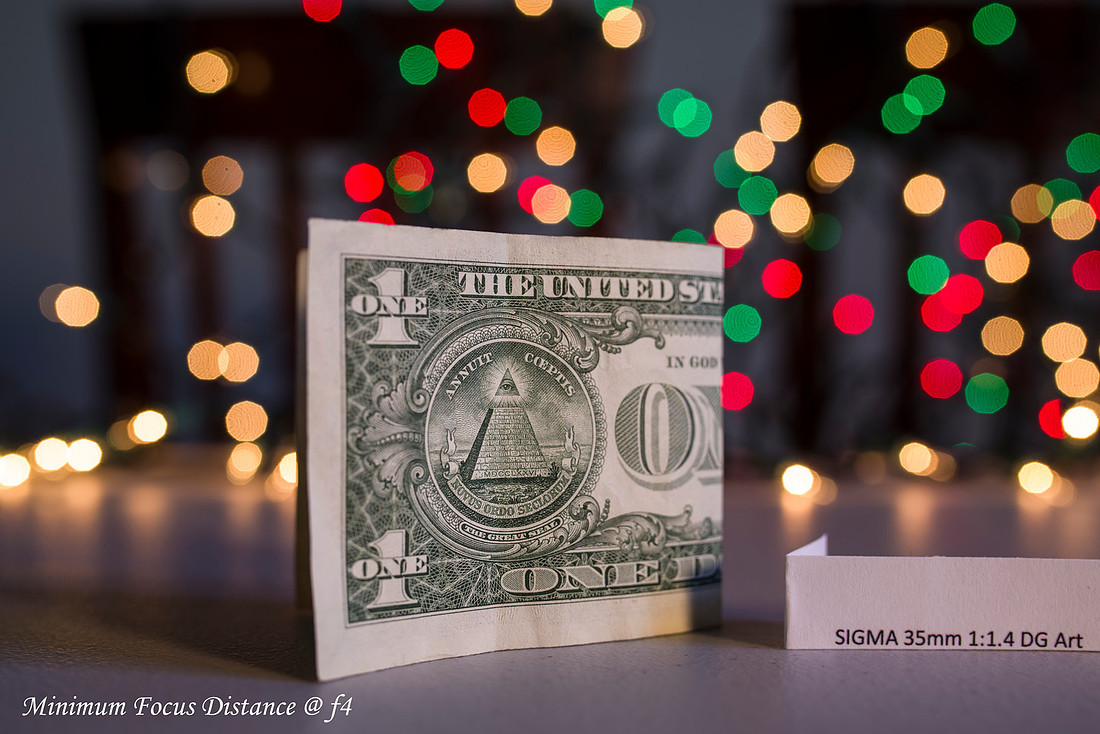
Now the HD FA f2 lens the light balls are very differently rendered here and again, I think it is a personal flavor thing, I think the balls are smoother in the interior with this lens than the Sigma where there are rings inside like an onion. The f3.5 is posted several times below and you can check against those as it really does not compare here.
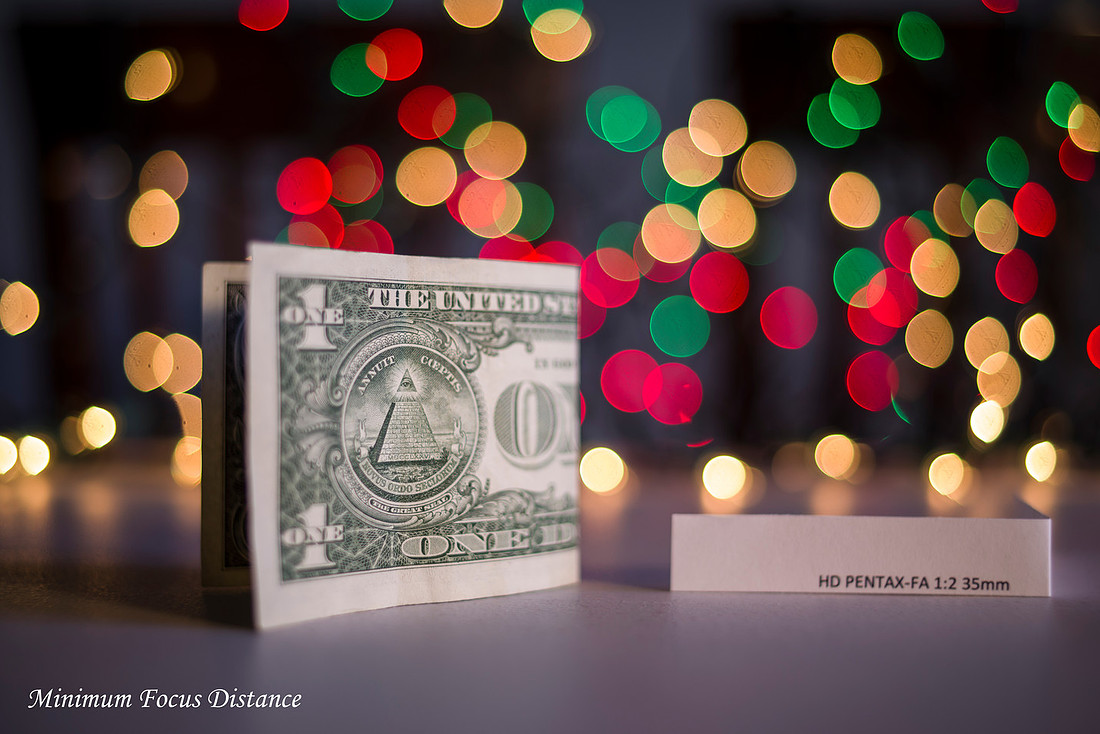
Group 2 K mount (bayonet) lenses all manual focus.
The first two the 1:2/35 and 1:3.5/35 are both K series lenses produced for similar time periods 1975-1977, with the M series 1:2.8/35 from the second K mount series 1977-1984, where the aim of lens design was to make them smaller to match the new smaller camera bodies that were being produced. I overall favor the K series they seem to have been less willing to make compromises and carried over the good lens designs from the M42/Screwmount era. The 1:3.5 as you will see is an exact optical copy except for coatings of two earlier m42/screwmount lenses.
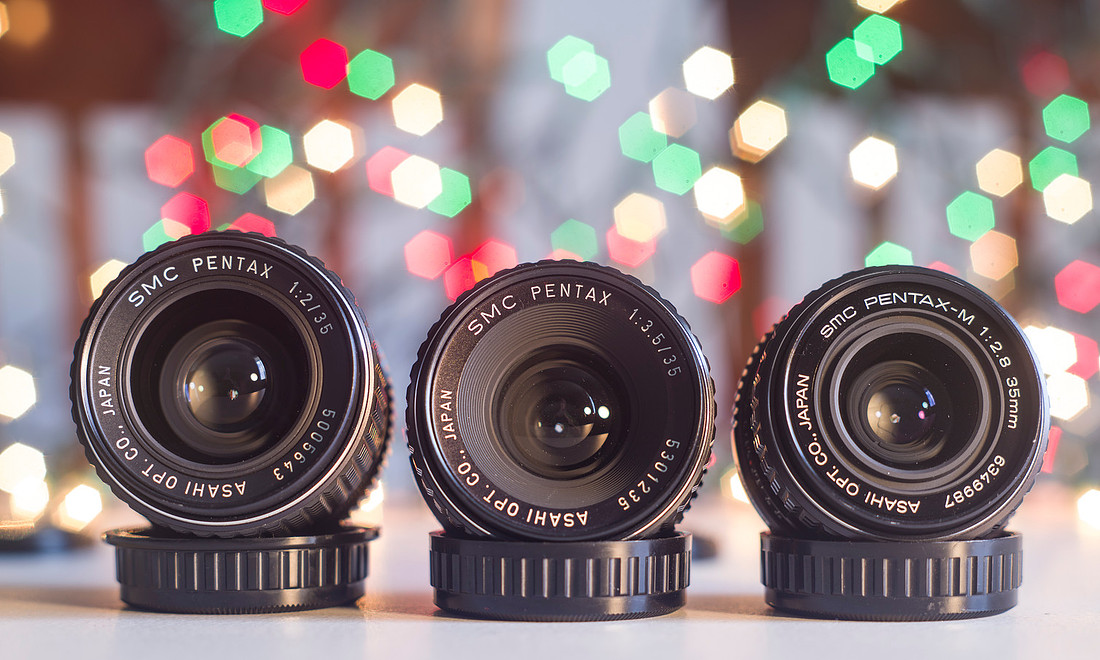
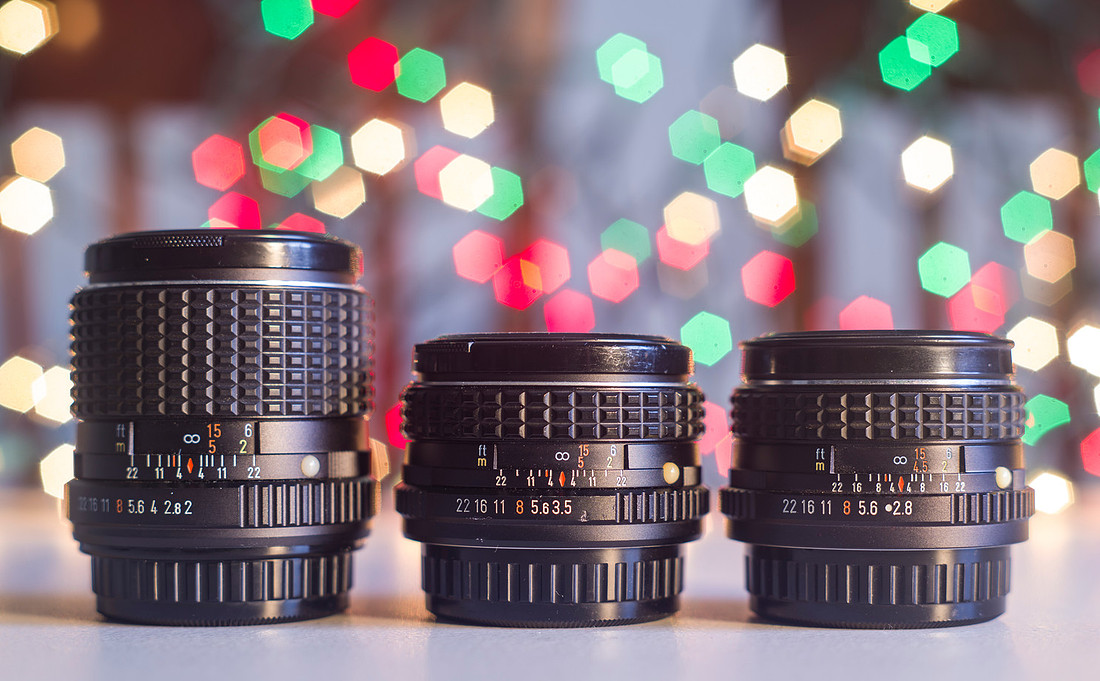
Of these three, the K35mm f3.5 is the sharpest side to side, though the f2 is sharper in the center but with worse edge performance at comparable apertures through f5.6. The M35mm f2.8 is a conundrum, it somehow seems to be both sharp and yet dreamy. You will have to scroll down and look at the cropped photos of center and edge. I kind of want to play more with it, but will have to give it back at some point. Either way it is less sharp than the other two and is slower than the f2 lens. For a long time I had lusted after the K35mm and 28mm f2 lenses, but after testing them I am happy with the f3.5 versions. I may need to find a 24mm f3.5 lens one day to complete the trifecta someday. But for me based on size, weight and edge to edge sharpness I will take the K35mm f3.5, it focuses close enough to get decent background blur if you get up close and personal and it is lighter than the f2.
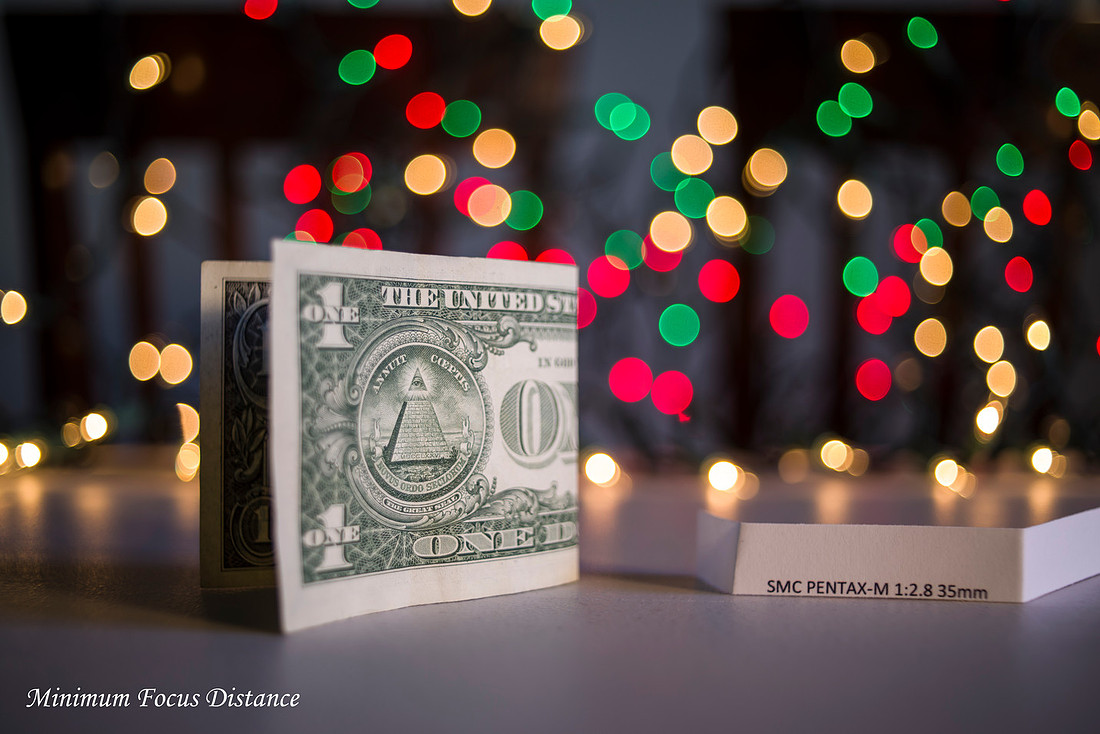
Here at closest focus distance, the K f2 does quite well compared to the f3.5 with the M f2.8 giving the most magnification and actually looking quite good. The light balls from out of focus lights were not too weird with any of them, but they all render a little differently, I will leave it to your personal choice as to which you like.
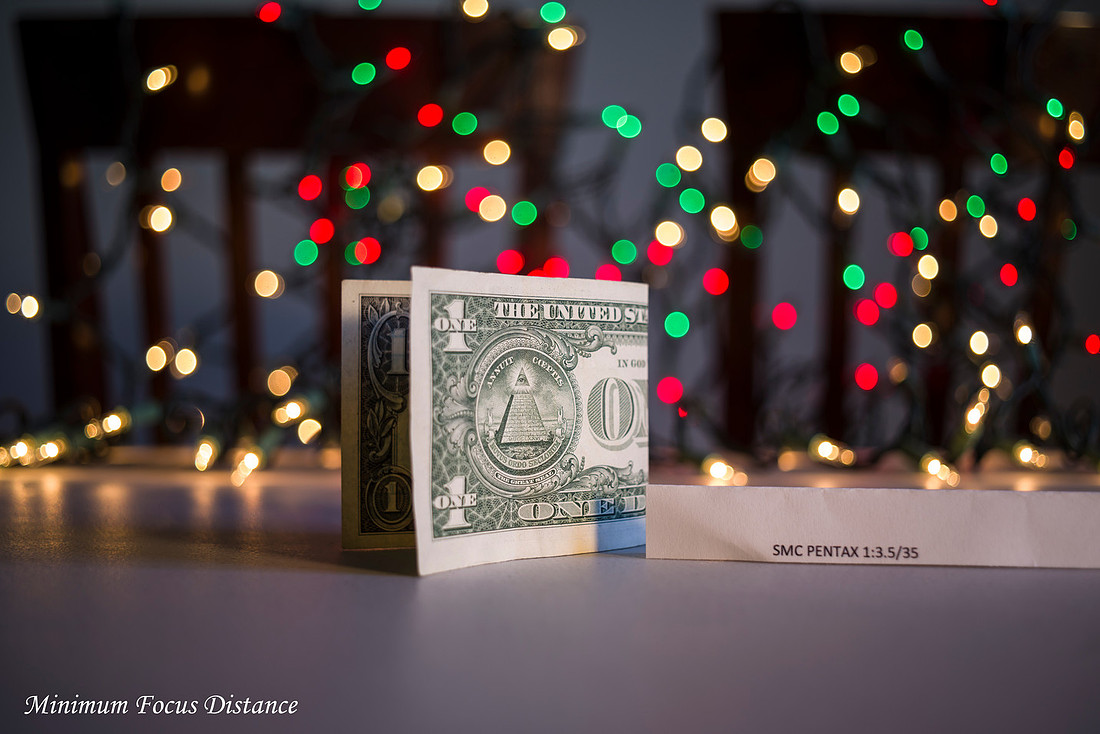
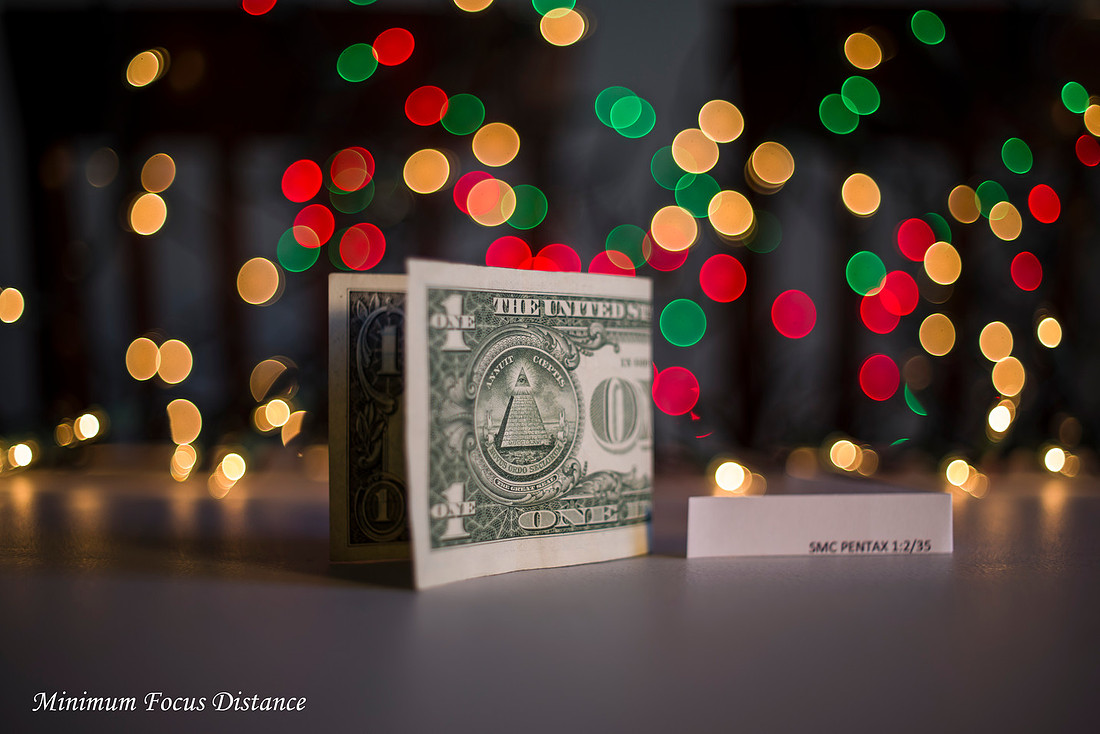
Group 3
These are all the m42/screwmount lenses with the K35mm f3.5 on the far right. First the Takumar f4 which is optically the same design as the K f3.5 just rated at f4. Then the Auto-Takumar f2.3 which has status a cult lens, then three f2 lenses, the "Fat 35" with a 67mm filter ring, then two with slightly different coatings and a 49mm ring. (of note, the righward one of the pair may have had some balsam separation resulting in some weird lens flare in some testing and I will not be including it in all discussions. The next to last is the Super-Multi-Coated 35mm f3.5 that as far as I can tell is optically exactly the same lens as the K just with a different body holding the glass. As SMC stands for Super-Multi-Coated my understanding is they coatings are identical. Those two and the first one all have a bulbous strongly curved front element and tiny rear element and are just unique.
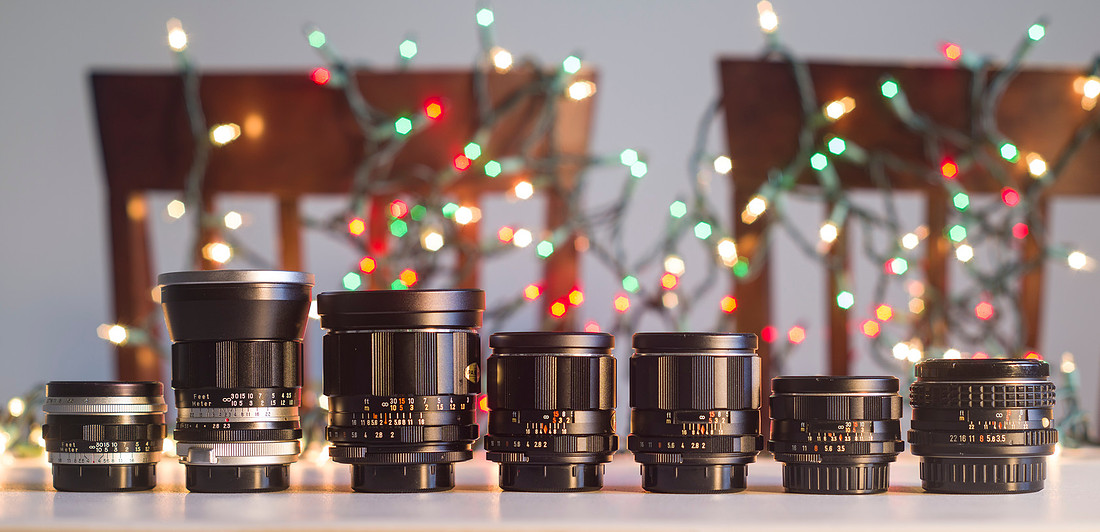
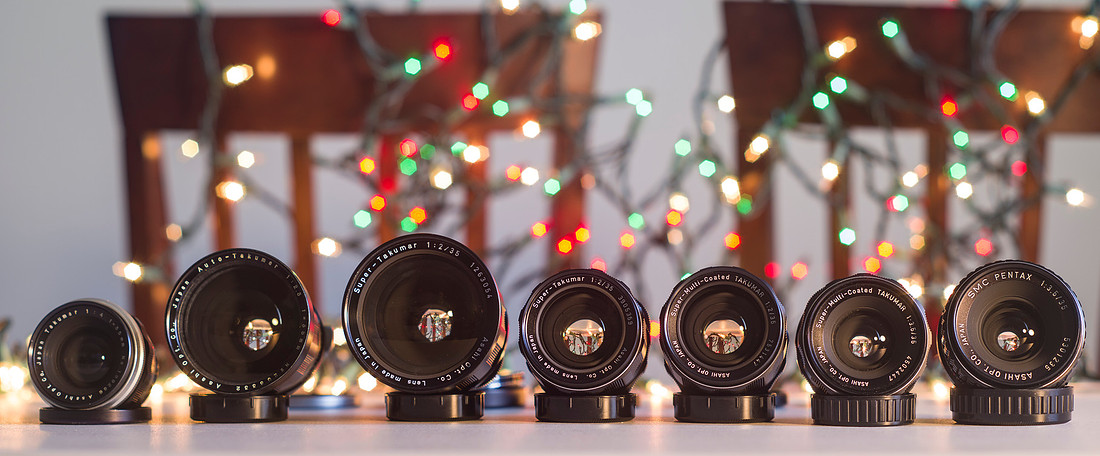
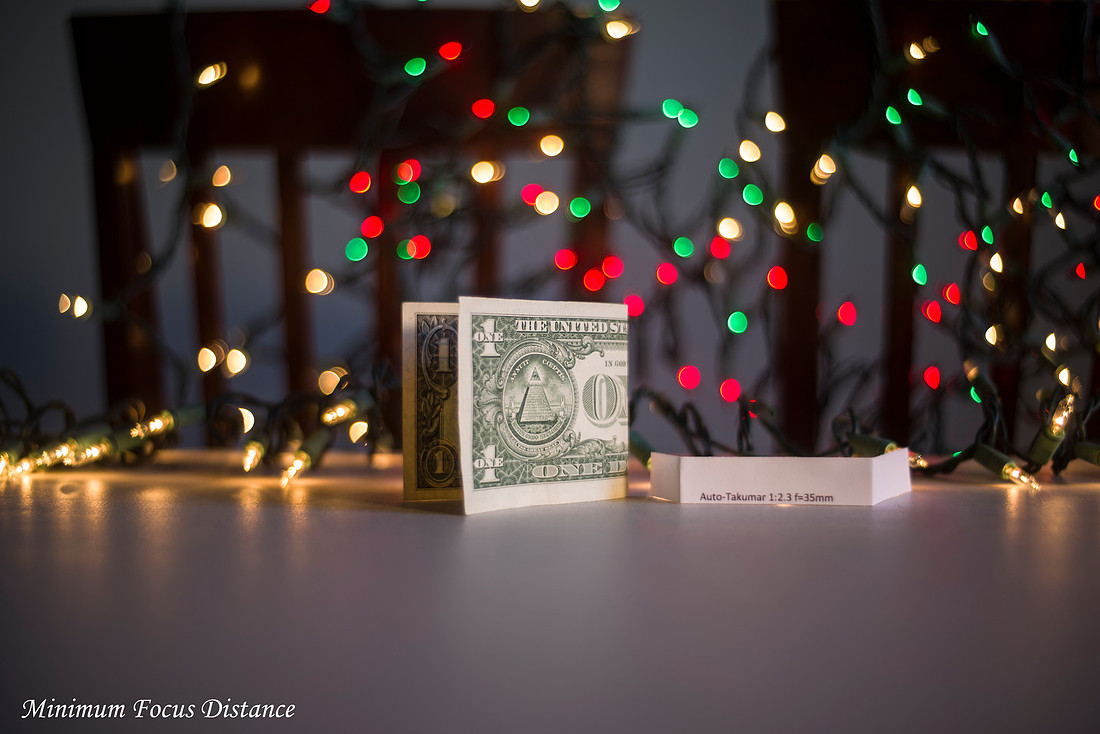
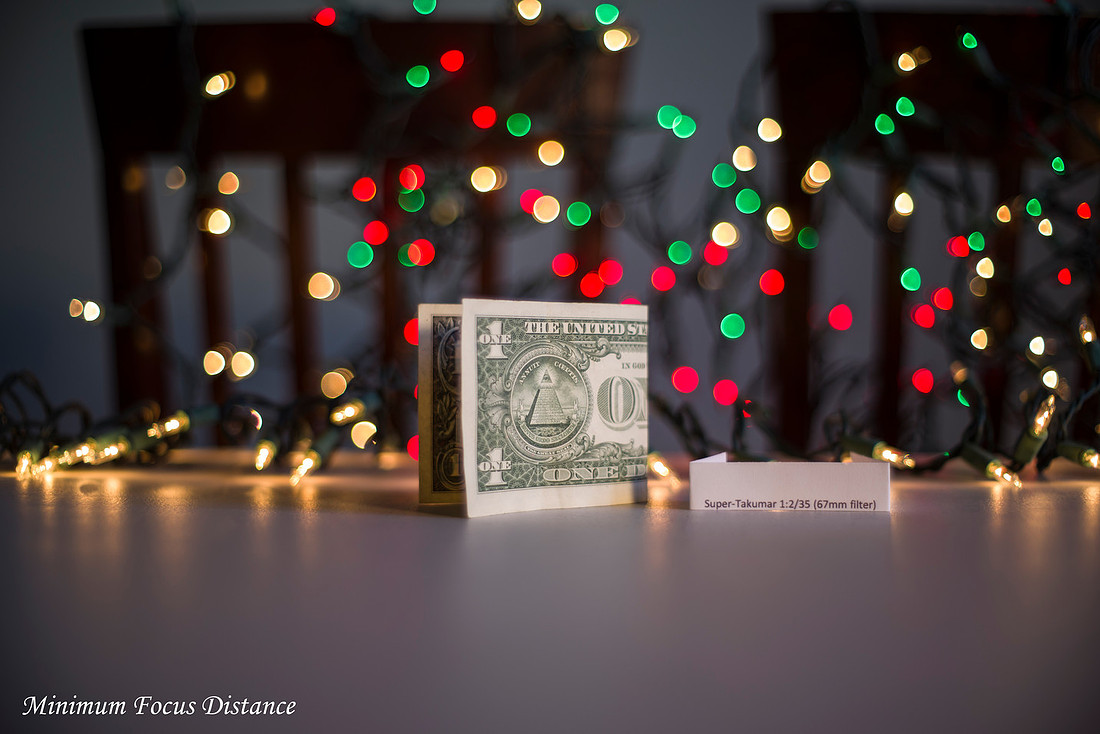
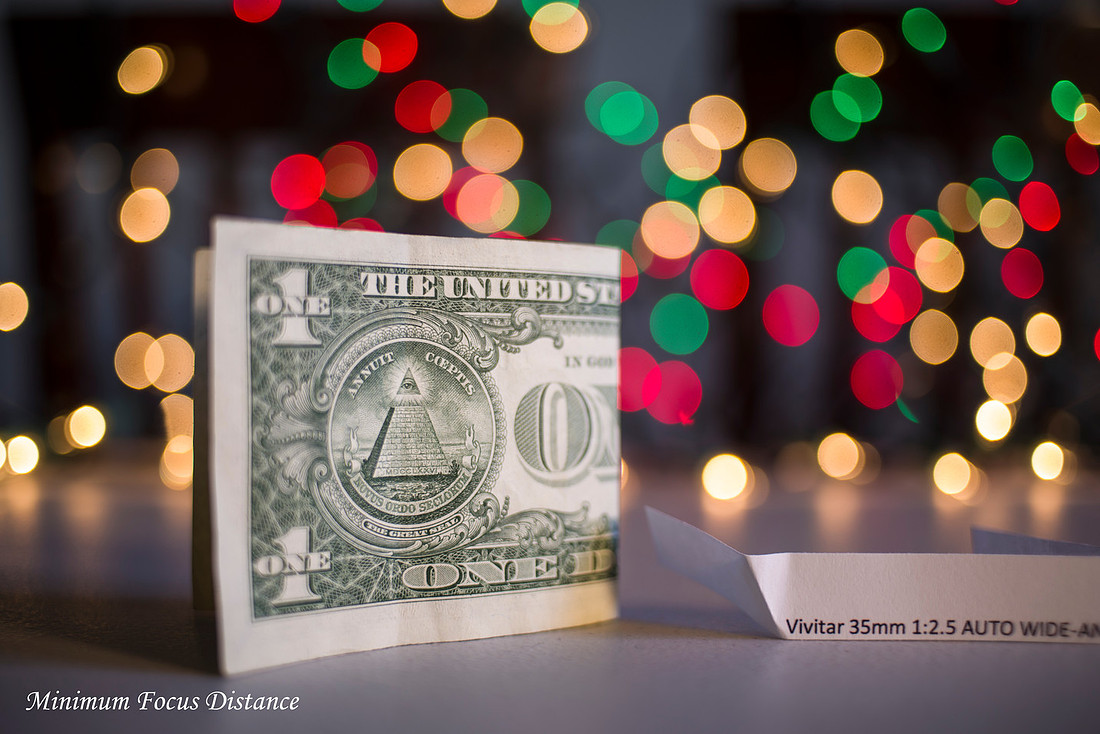
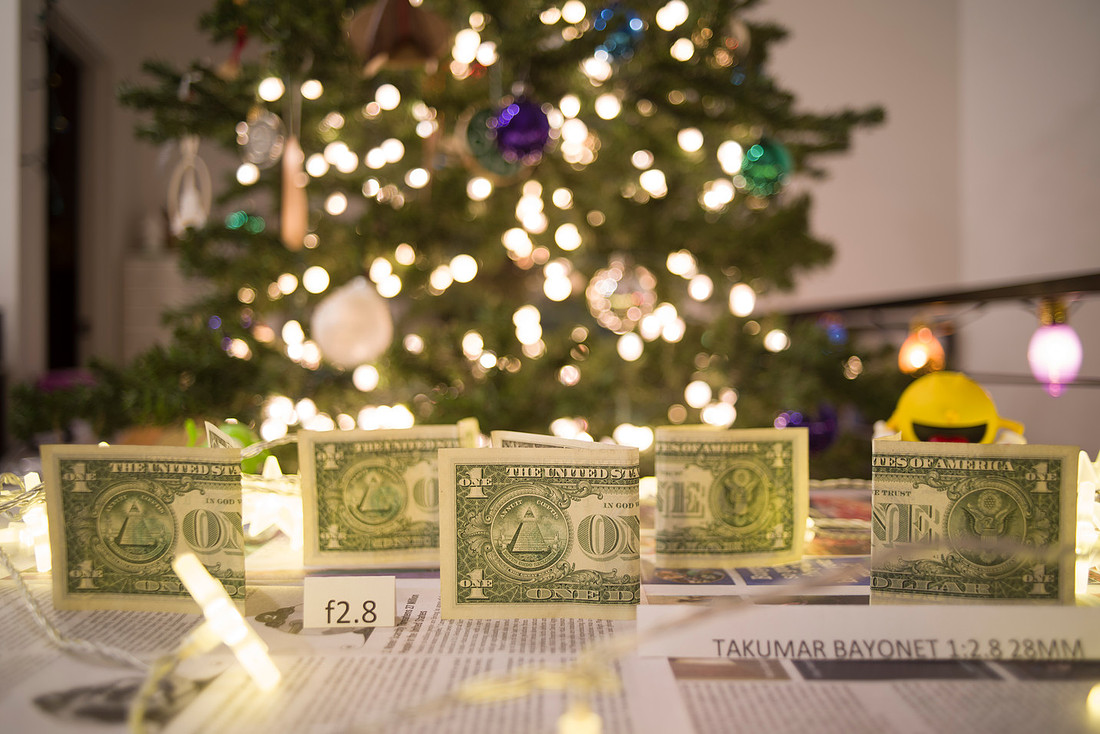
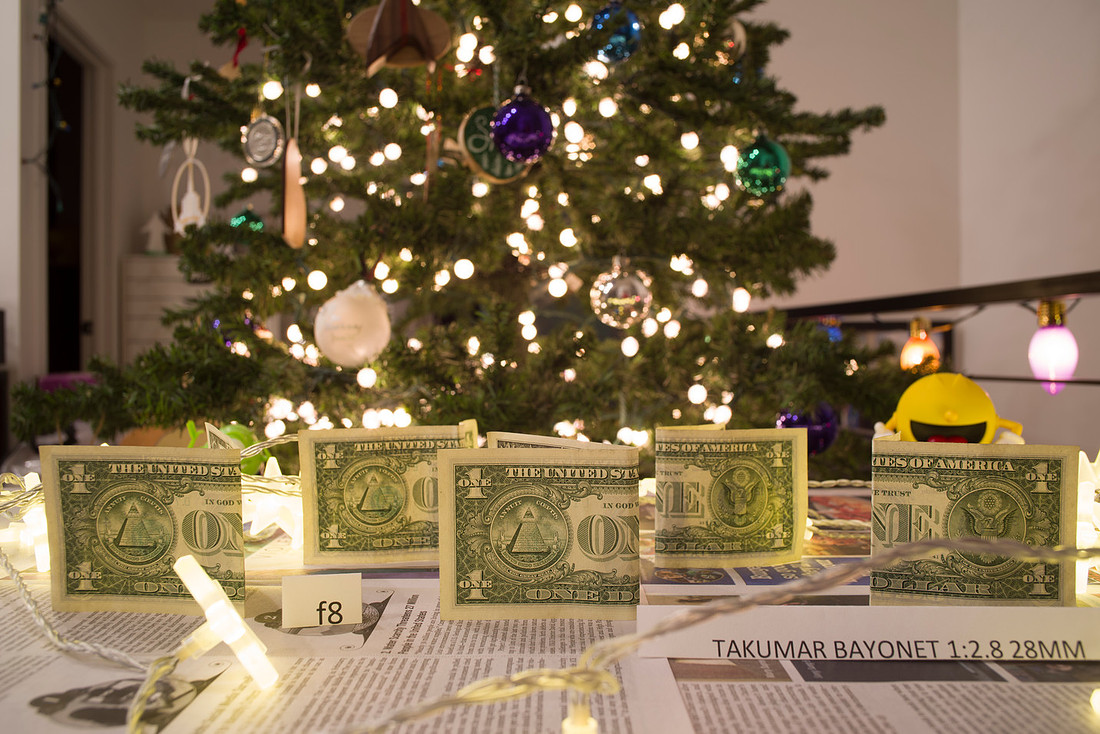
Conclusions on this group... this is hard, The f3.5 and f4 triplets are virtually identical with resolution, though the f3.5's are maybe a little sharper due to better coatings and we know how good they are, but they lack the faster aperture. I wanted to like the Auto-Takumar f2.3 as it is a cult favorite, but it just cannot focus very closely and get the separation I really want. The first version of the f2 lenses (third one from the left) with the 67mm filter ring, is a fun lens that I REALLY want to like, as it is just a nice chunk of glass to hold and use, but again it doesn't focus very closely either. The overall rendering of all of the f2 lenses and the f2.3 was OK central sharpness with worse edges than the later K mounts. IF I had to take one it would be the 67mm filter one as the lens flare was... wild, I could have fun with that and it was a joy to handle. Here are comparisons of the closest focus of the Auto-Tak f2.3 and the Super-Tak f2 (67mm filter ring) Kept the camera in the same spot, put the lens on closest focus distance and moved the bill to place the best focus on the pyramid, approximately.
With it's closer focusing distance the K35mm f3.5 compares well in regards to background blur and the bill has greater magnification.
Lastly we have the K35mm f3.5 with the Vivitar 35mm f2.5. I bought this lens for a really low price on fleebay, with a m42 TX mount adapter, TX being a propriatary interchangeable mount system that allowed you to switch lenses between camera systems. Both Vivitar and Tokina did this, both producing some excellent lenses, the tokina ones being a bit harder to find. I likely will sell this lens after I am all said and done. Unless I cannot let it go. It is a nice handling lens and feels just right sized.
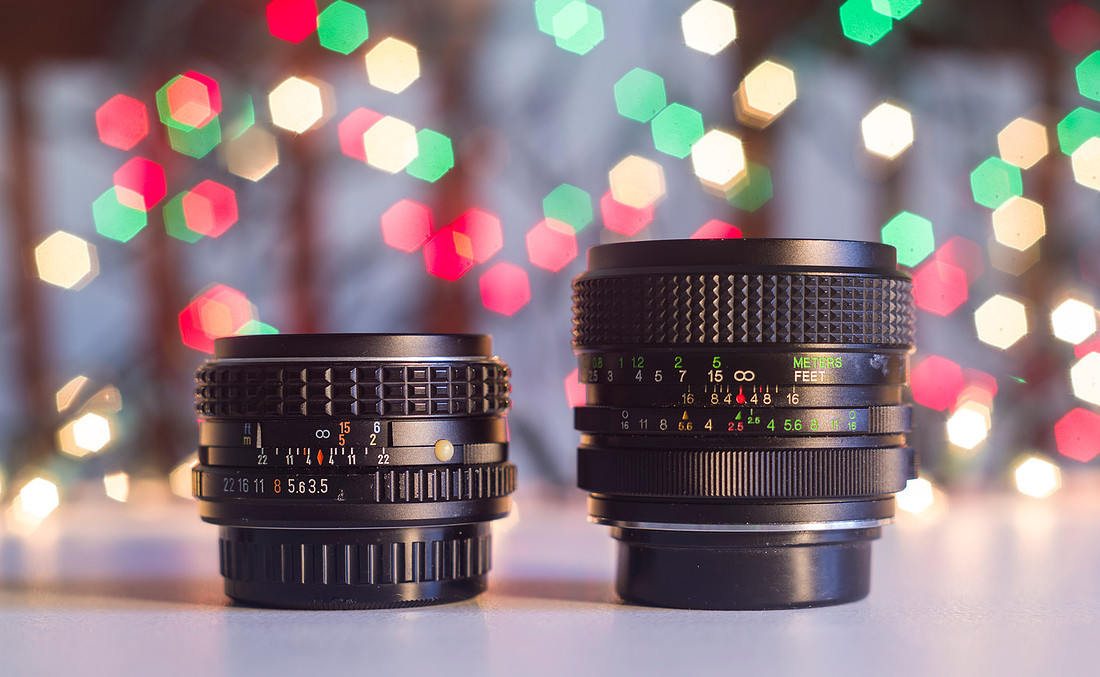
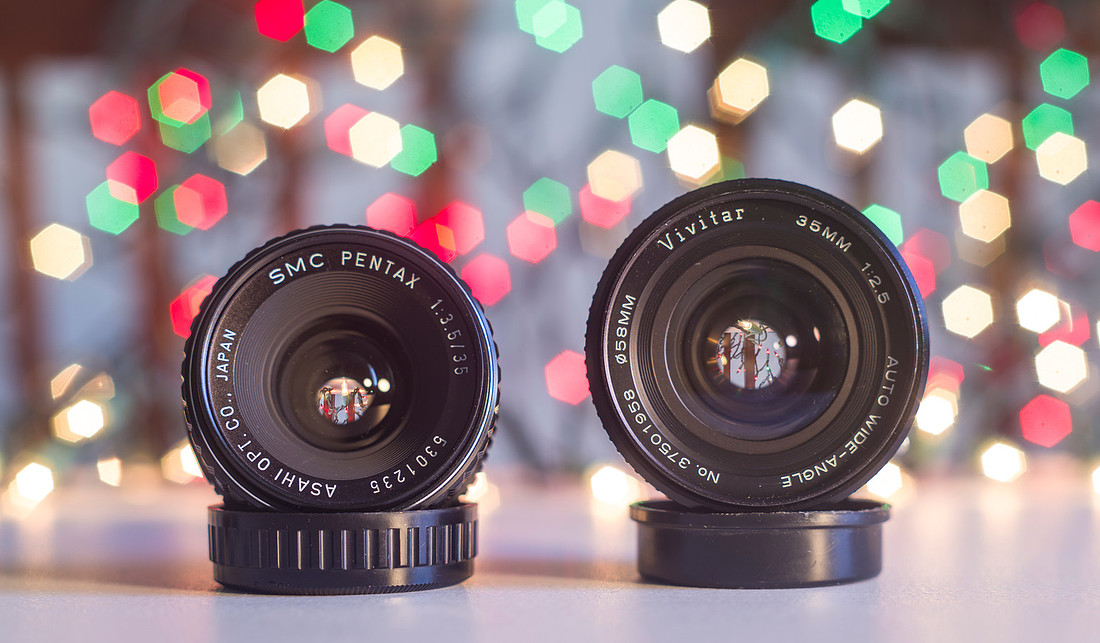
Between the two, the Pentax is sharper at all comparable apertures, the Vivitar is better able to isolate with it's f2.5 aperture, the Vivitar does not win, but I may just keep it as a street lens that I don't have to worry about dinging up walking around. Unless you are printing big, this ain't half bad.
I want to sidebar here a little, I have been thinking about my criteria for choosing what is important to me in a lens. There are many unique aspects to consider. Sharpness (Image quality), ability to separate subject from background (this is a result of the aperture used, and how close the lens can physically focus which influences how close the subject physically is relative to the lens), size, weight, handling and the most subjective of them all Bokeh, a Japanese word describing the quality of the out of focus blur. This last one is highly subjective and varies from person to person. Look at the photos above of the lens groupings, how do you like the light balls behind the lenses, does having the aperture make them hexagons bother you? That is a product of closing the aperture (Stopping the lens down) to deepen the field of focus front to back. How does that compare to the ones of these lenses wide open? Which do you like?
So, what does f1.4 get you when you are just goofing around? This at closest Focus Distance, the thin depth of field can be fun, but makes focusing a more critical task. Does the size difference make you pause? That Sigma is a chunk to carry around for several hours.
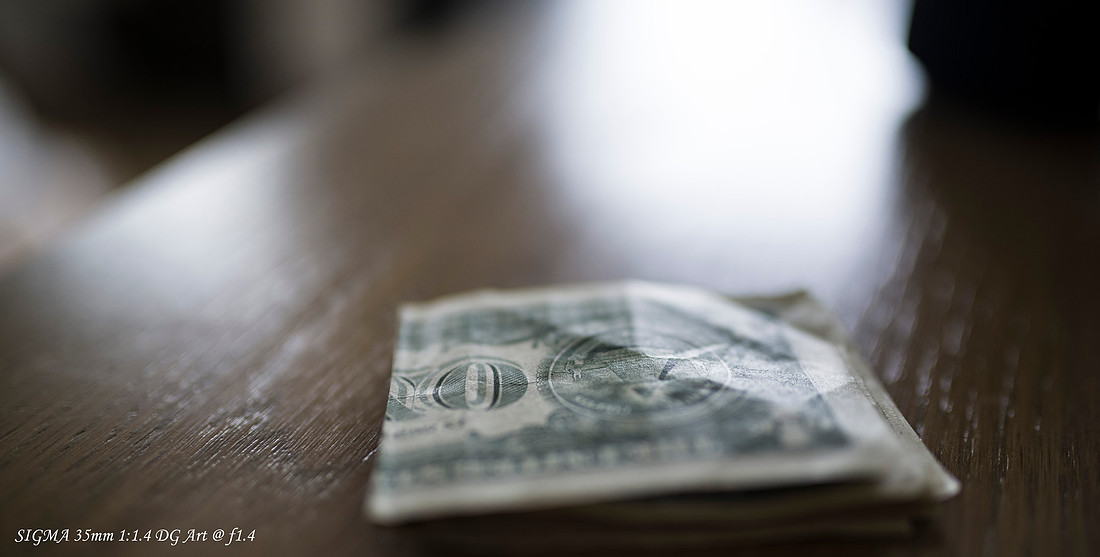
To tie it all up before the boring photos of center and edge crops and videos of the Flare characteristics. For ultimate sharpness I think the Sigma f1.4 wins with the K35mm f3.5 close behind, but with more modest aperture. The K35mm f3.5 is much more compact and easier to carry around but is not auto focus.
The HD FA 35mm f2 is auto focus and compact, but less even across the frame with edges much worse than the f3.5 and is not quite as sharp as the f3.5 centrally but is close at comparable apertures. The m42 Super-Multi-Coated 35mm f3.5 can be interchanged with the K mount for all these comparisons.
Of the rest I find myself wanting to play more with the Super-Takumar 35mm f2 with the 67mm filter the most, just because it is more unique and I like the heft, though it could get to be too heavy over time. And the M f2.8 may deserve another visit some day, as the dreamy wide open but with good detail is just... interesting/weird.
Now the technical stuff.
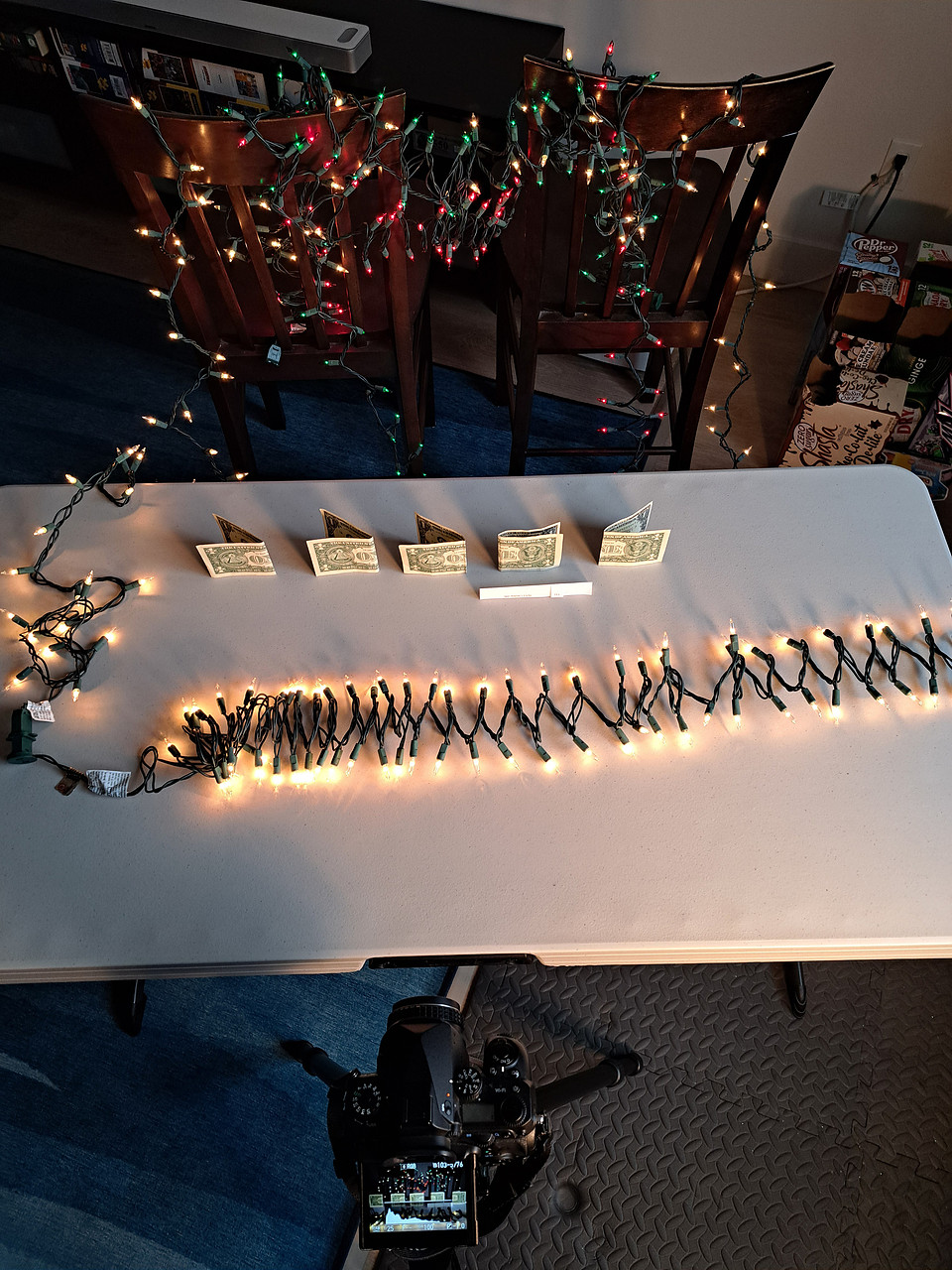
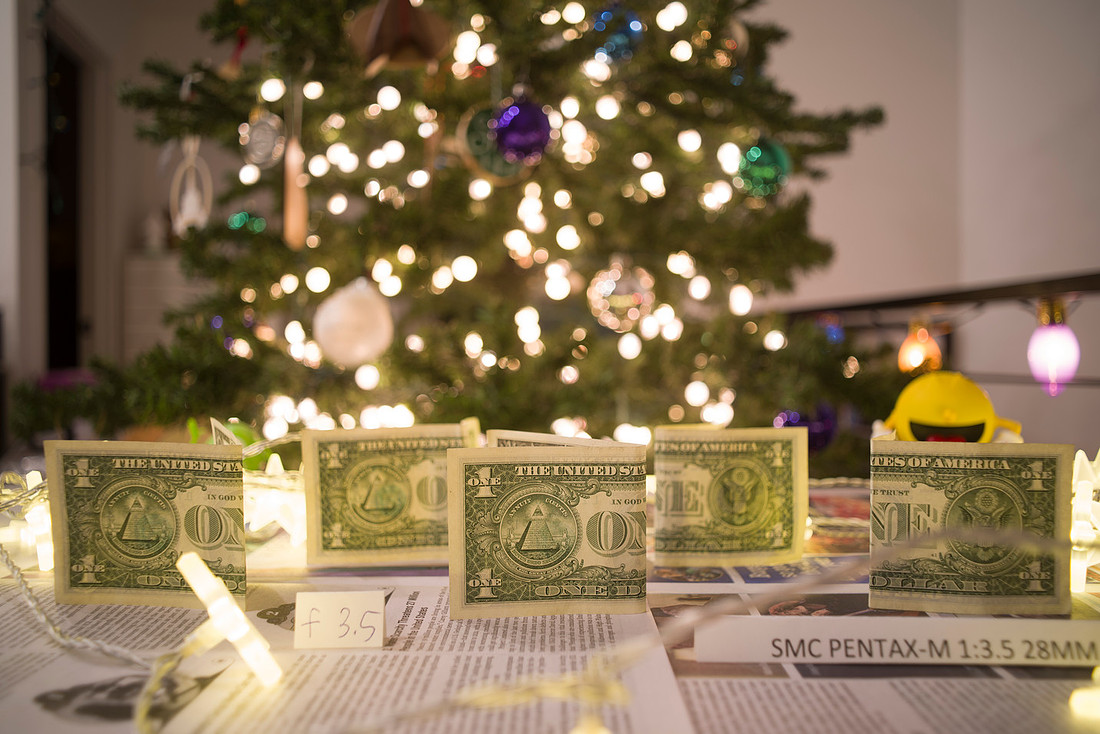
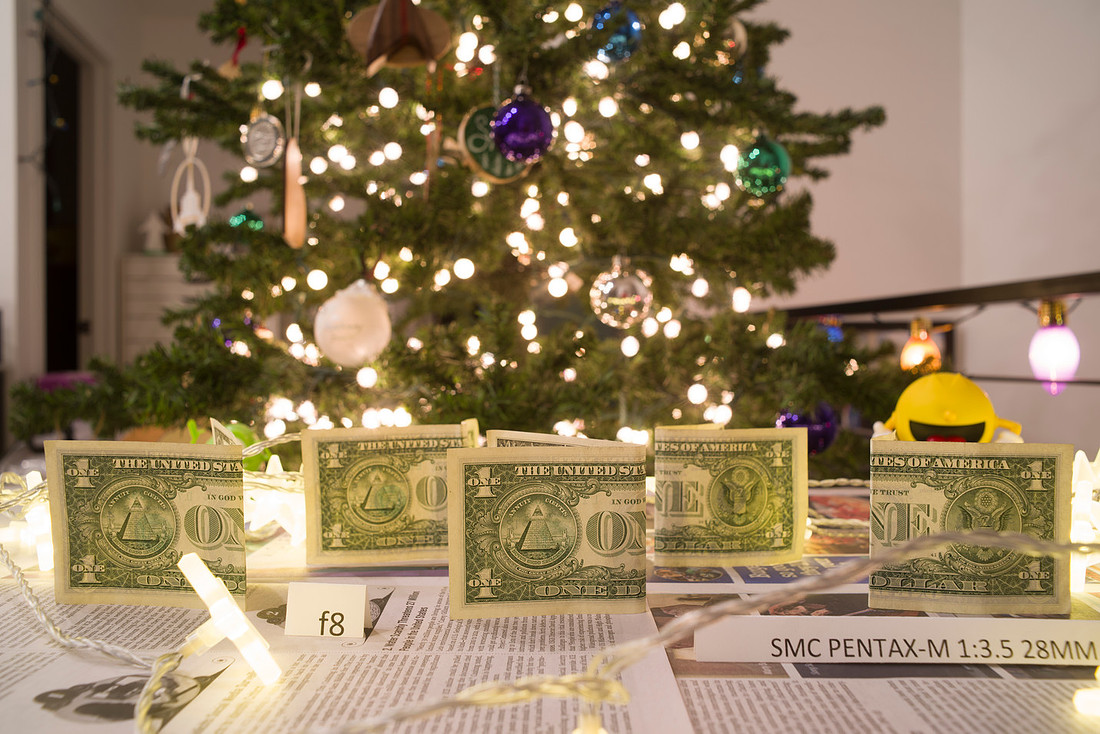
All these upcoming photos except the first, were taken with the camera on a tripod, focusing using magnified live view, changing lenses but not the camera position. I used the same aperture/shutter speed chart for every lens. (I did have the light coming in the window change a little, I apologize, but cannot change it at this point.) Here is a high level view of the setup with my cell phone. I did not have the space to set up things a lot further apart as I wanted to, I didn't want to move my home theater chairs just for this. I will go in order of aperture and age for the photos. These are intended to give a same same comparison with the only difference being aperture.
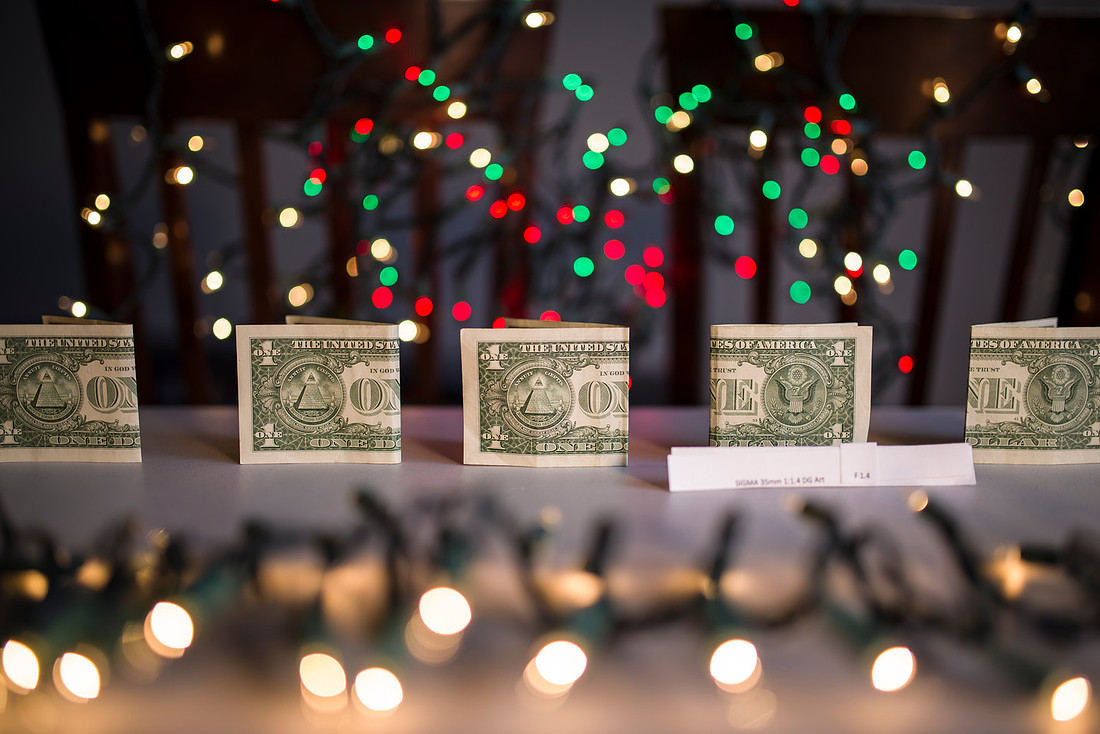
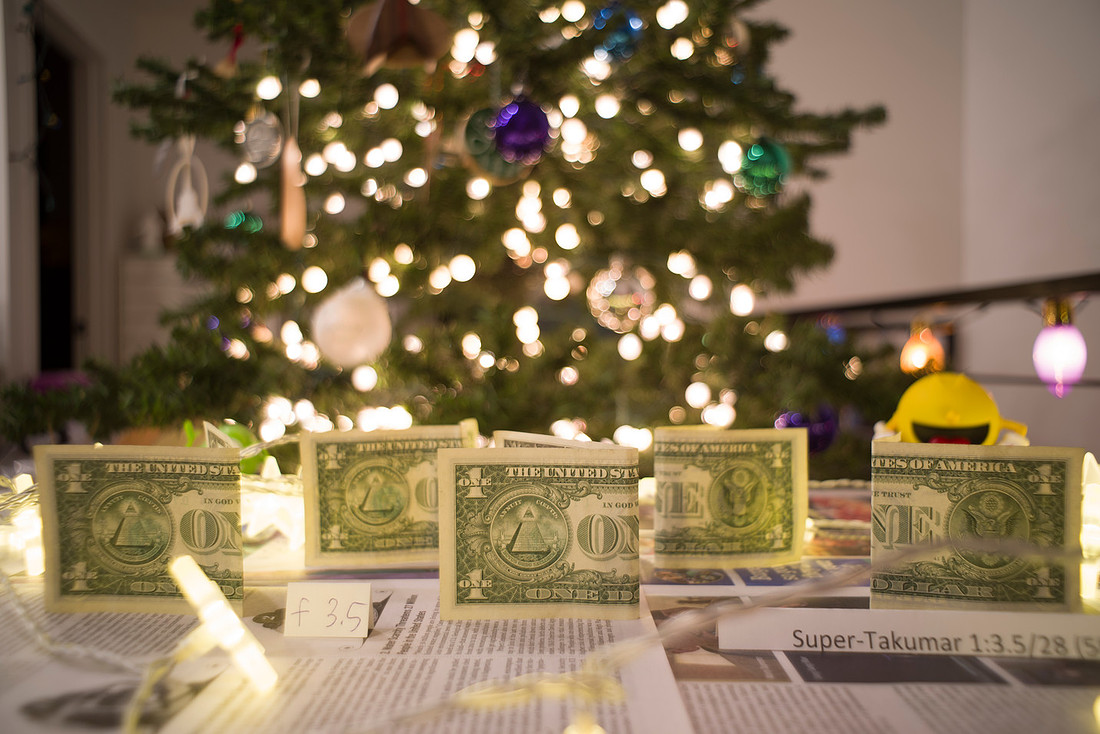
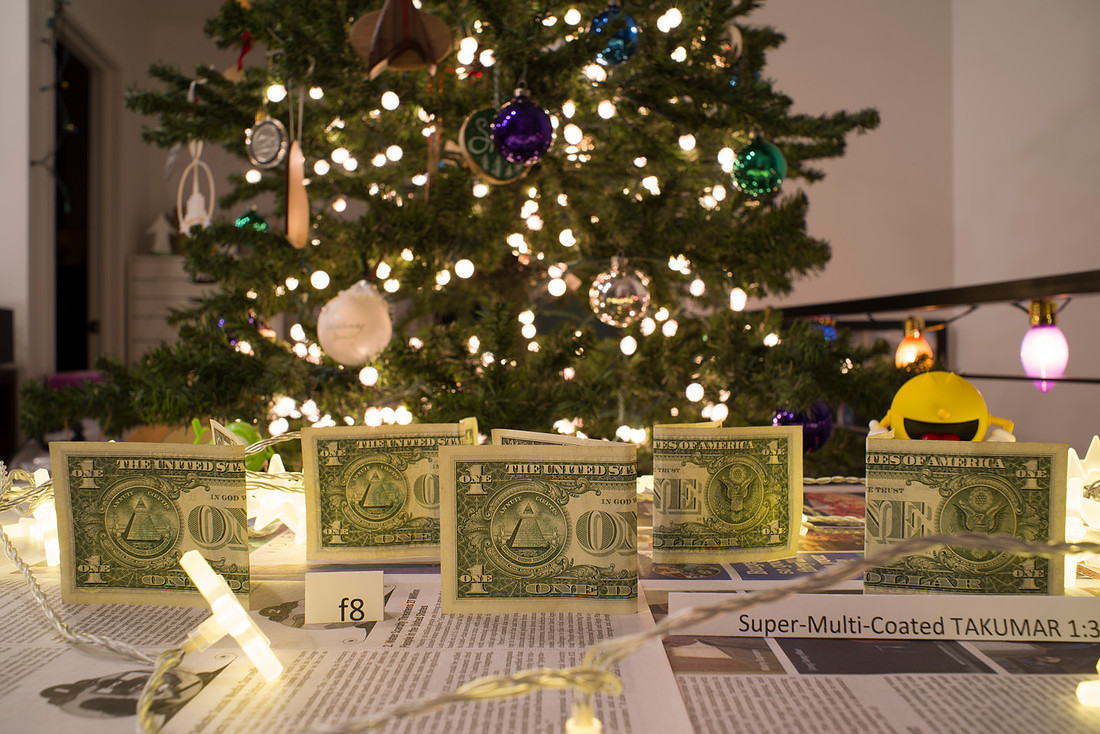
First the Sigma f1.4 lens. Notice how the background lights are not in focus, allowing the focus on the bills to pop. Advantage to having that wide of an aperture.
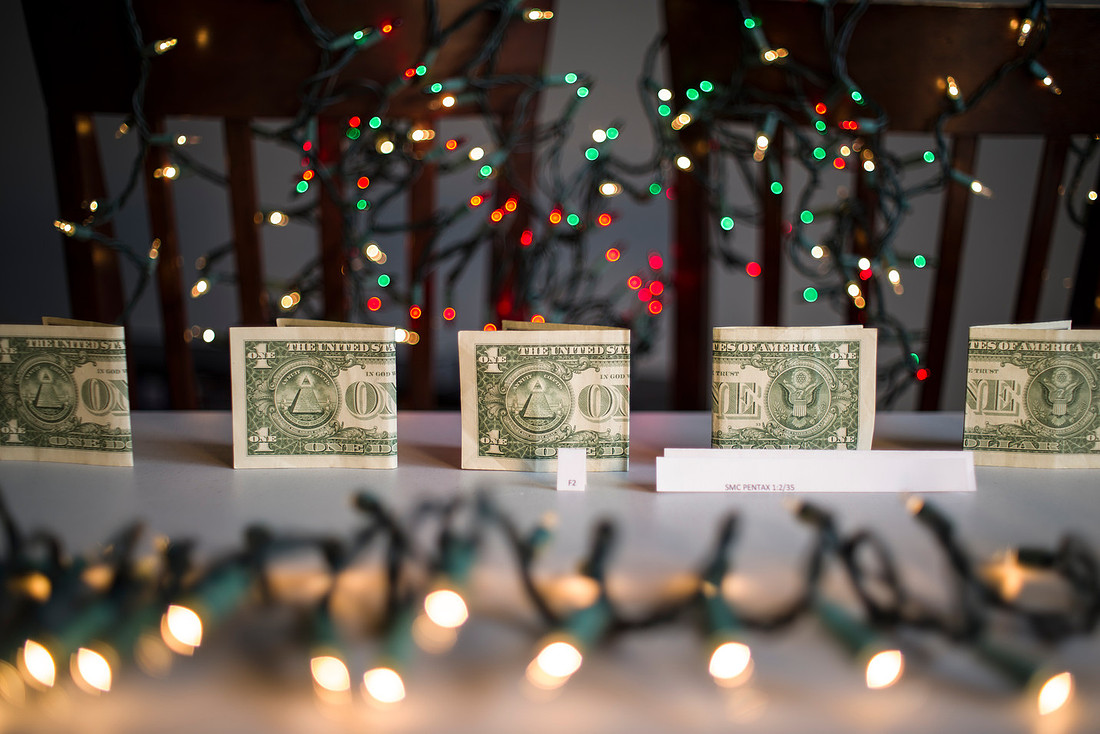
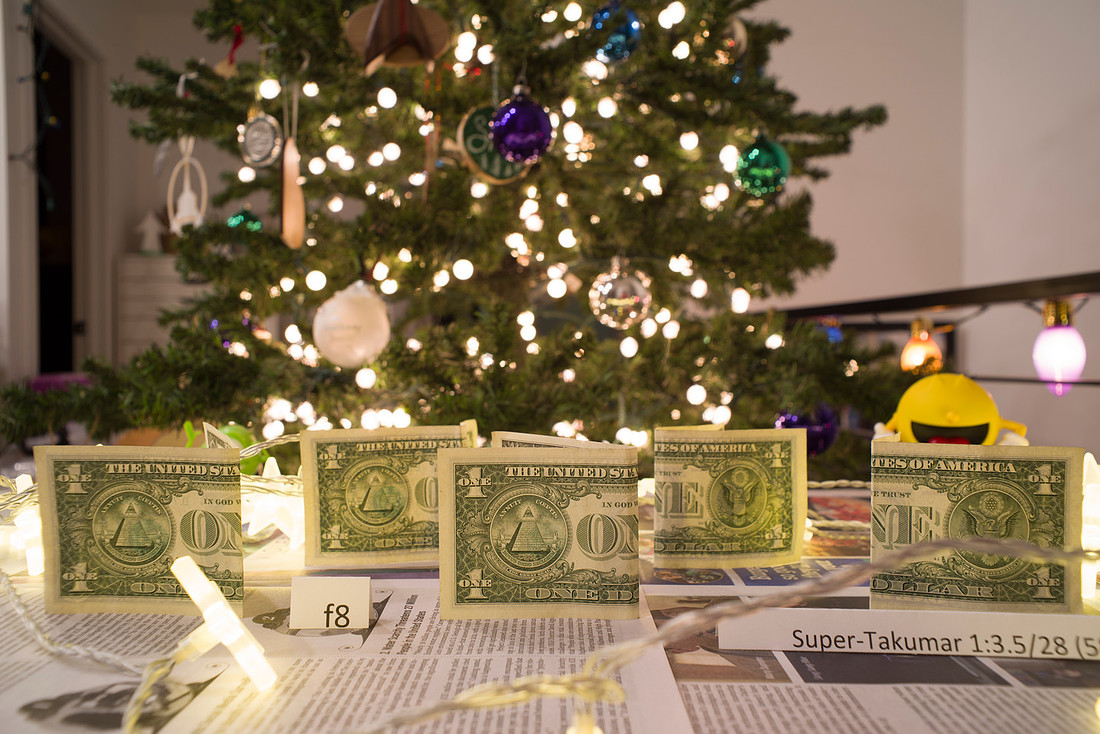
 Now the HD FA Pentax f2 lens @ f2, there is a SIGNIFICANT difference in the look of the background. (I may take the time to do crops of the light balls at some point, or I may just let people who care ask and I will give them full resolution photos to peruse, who knows?)
Another f2 lens the Super Takumar with 67mm filter ring sometimes referred to as the "fat" one as the two newer designs in series are 49mm filter rings. If you look closely you will see that the balls of light in the background are differently shaped than the first two lenses. It is so interesting to me how the lens design changes that aspect.
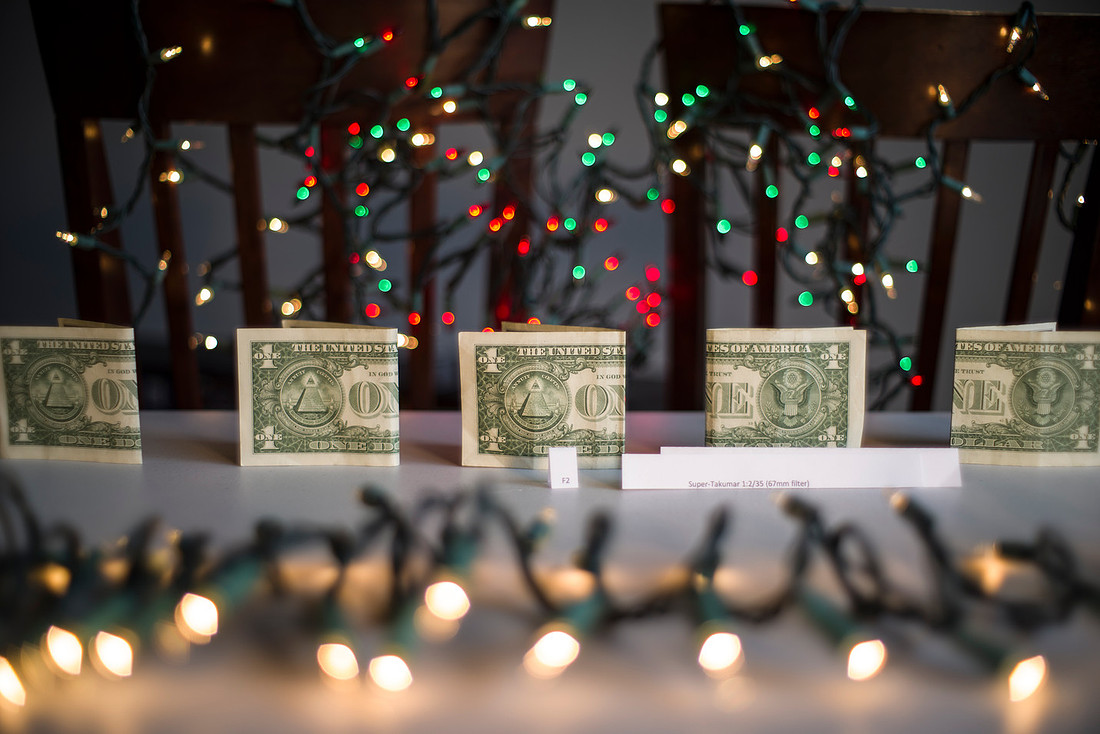
This is the Super-Takumar f2 the newer design with 49mm filter that succeeded the previous one, the light balls are different here too.
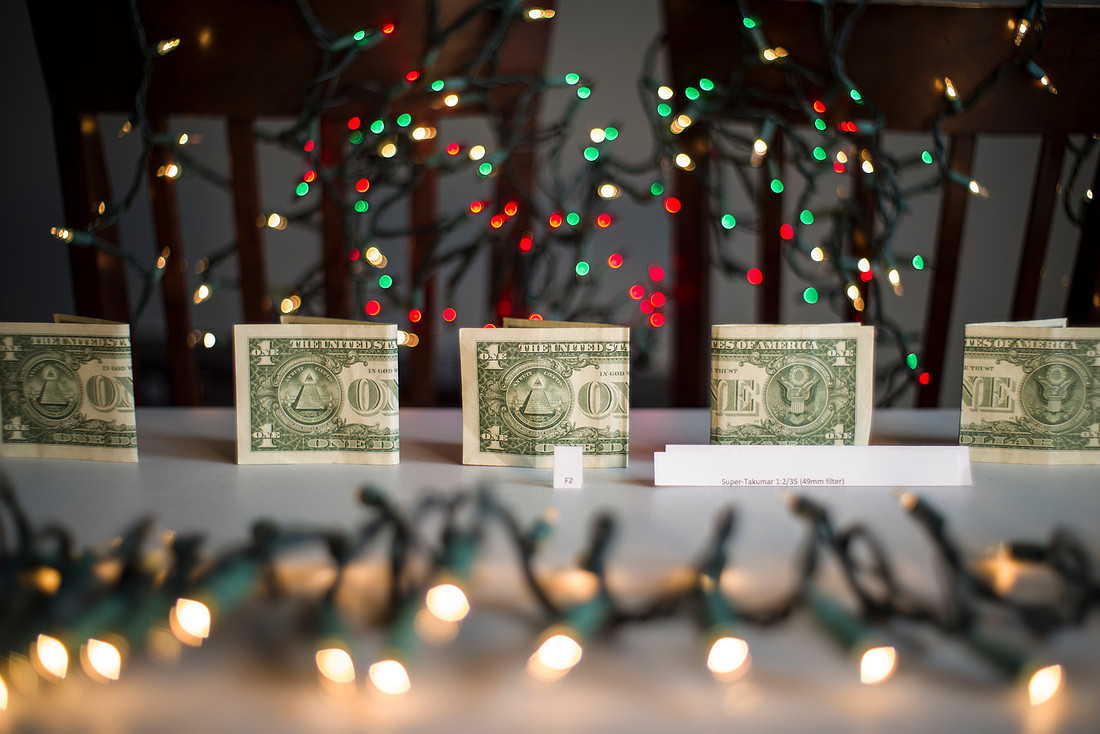
The only difference with this lens in regards to manufacture is additional coatings. I think this one is have balsam separation between two lenses or some other problem, if you look at the foreground blurred lights there is a huge difference from the prior one. Later I will provide comparisons with cropped comparisons in the center and edges for sharpness, I did not do that for this lens as I didn't think it was fair.
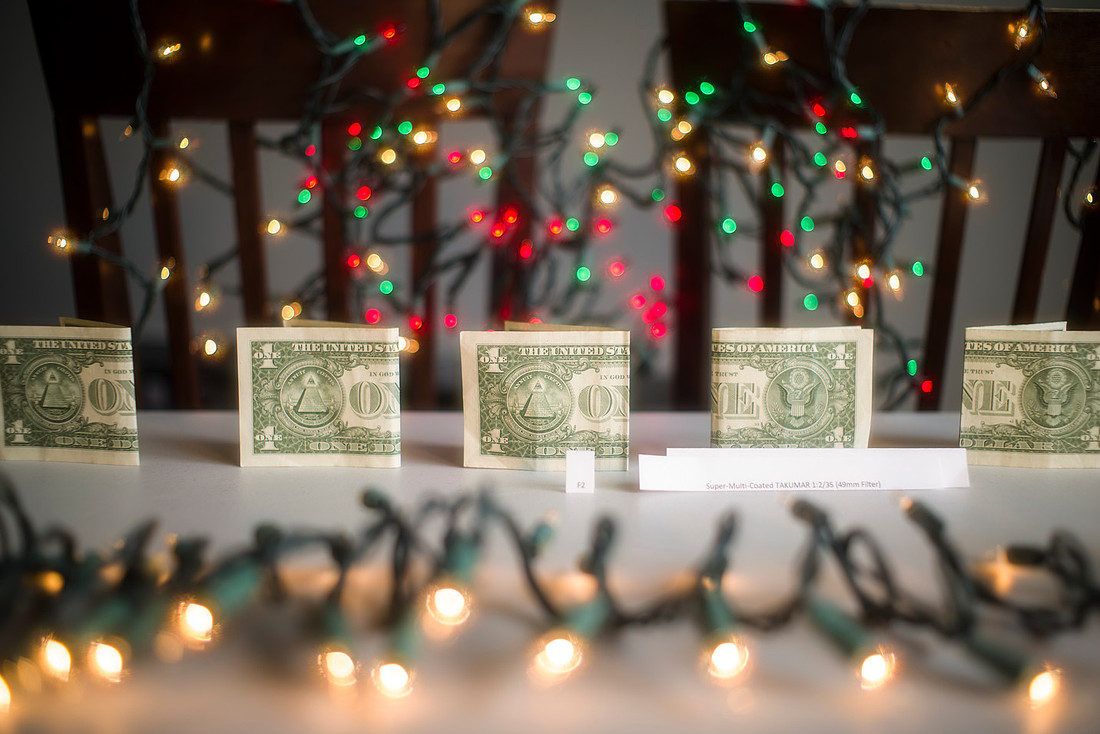
Next @ f2.3 the Auto-Takumar a lens that has certainly achieved cult status over the years. Scrolling back and forth there is not that much difference in this particular setting. IF you look closely at the edges, the focal length may be a little closer to 37mm or else it is just an effect of the lens being physically longer than the other ones, as it has cut off the edges of the bills quite a bit.
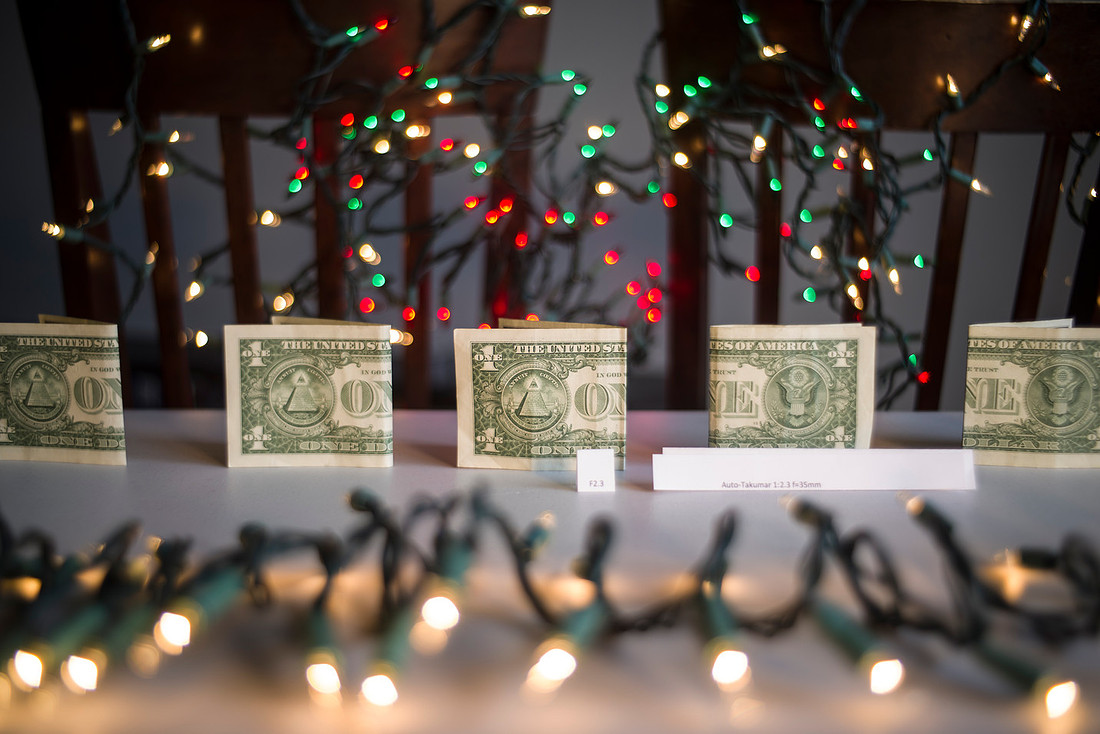
Now 2.5 the Vivitar f2.5, it actually did better than I expected separating subject from the background.
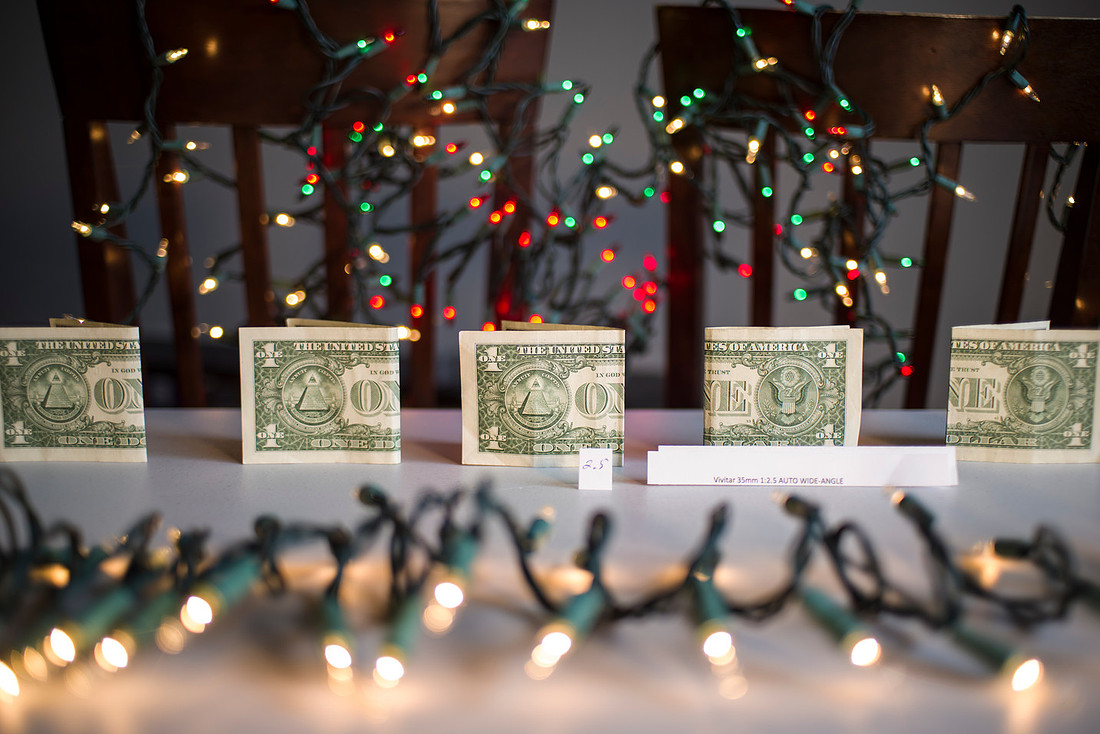 Now we are up to f2.8, the Pentax M, here I am really realizing that I should have put the lights further away, the separation is not ideal, I did intend this as a resolution test more than bokeh for this part, but I still wish I had moved those chairs and given myself more distance between the subject and the lights.
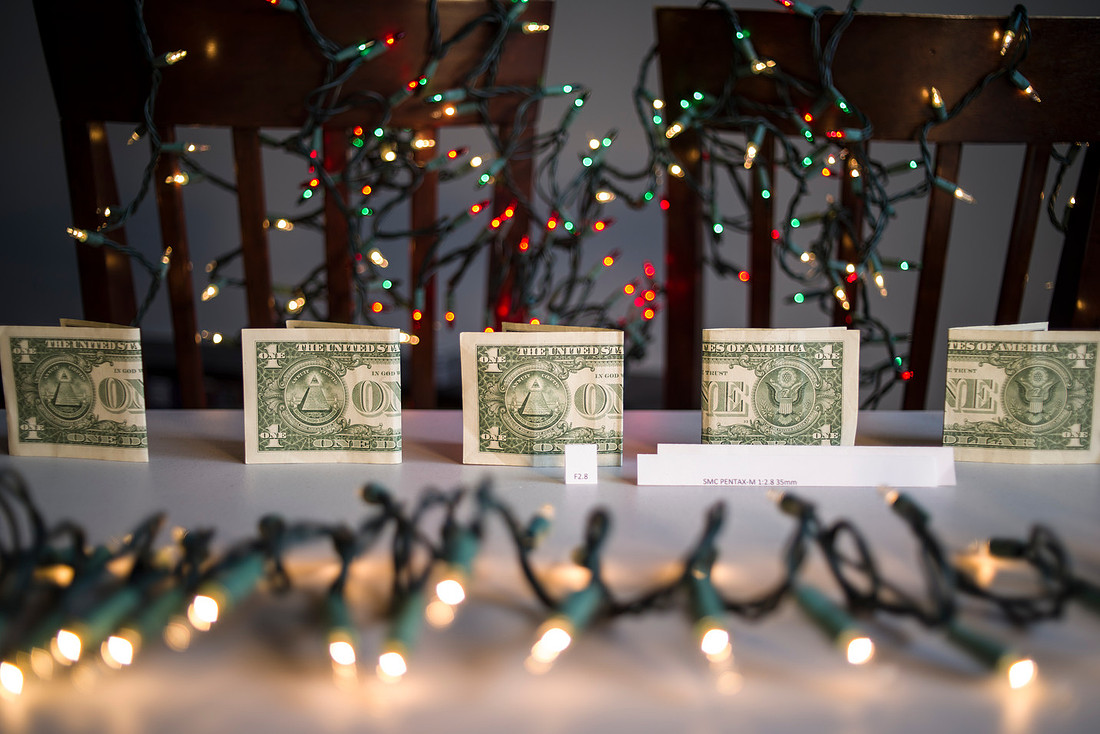
In order to go in age order for this part, first the f4 Takumar, remember these next three are the same optically... more or less... and the lighting differences were due to light outside the window changing.
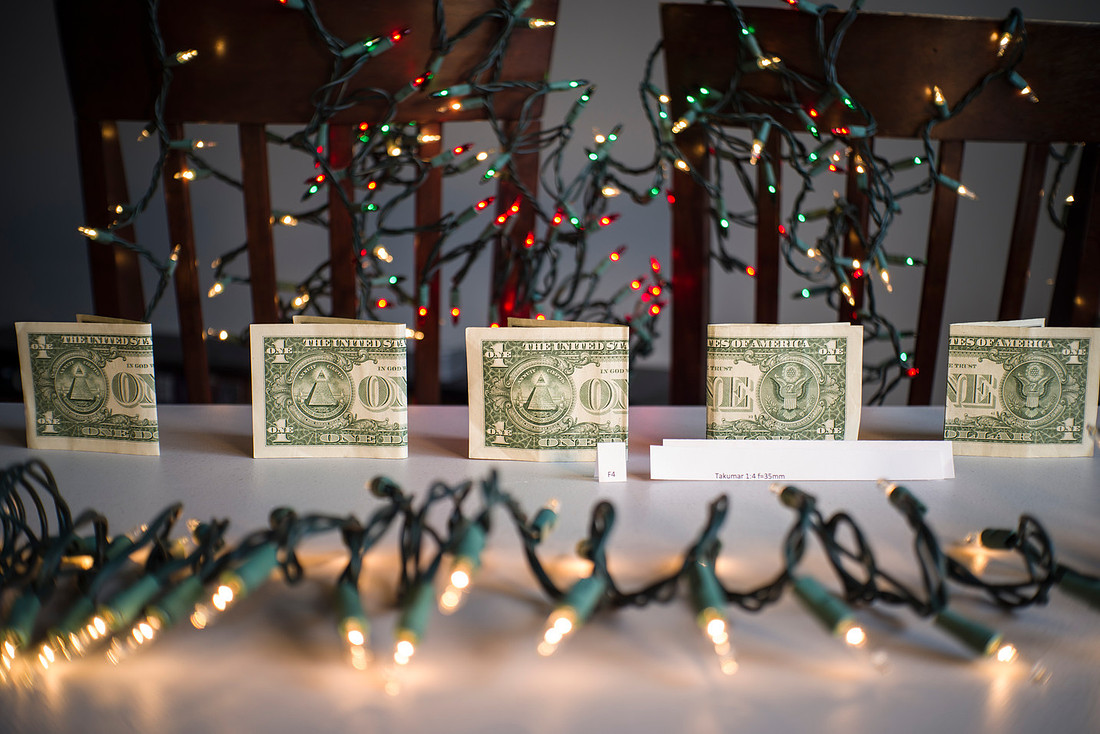
The Super-Multi-Coated Takumar f3.5
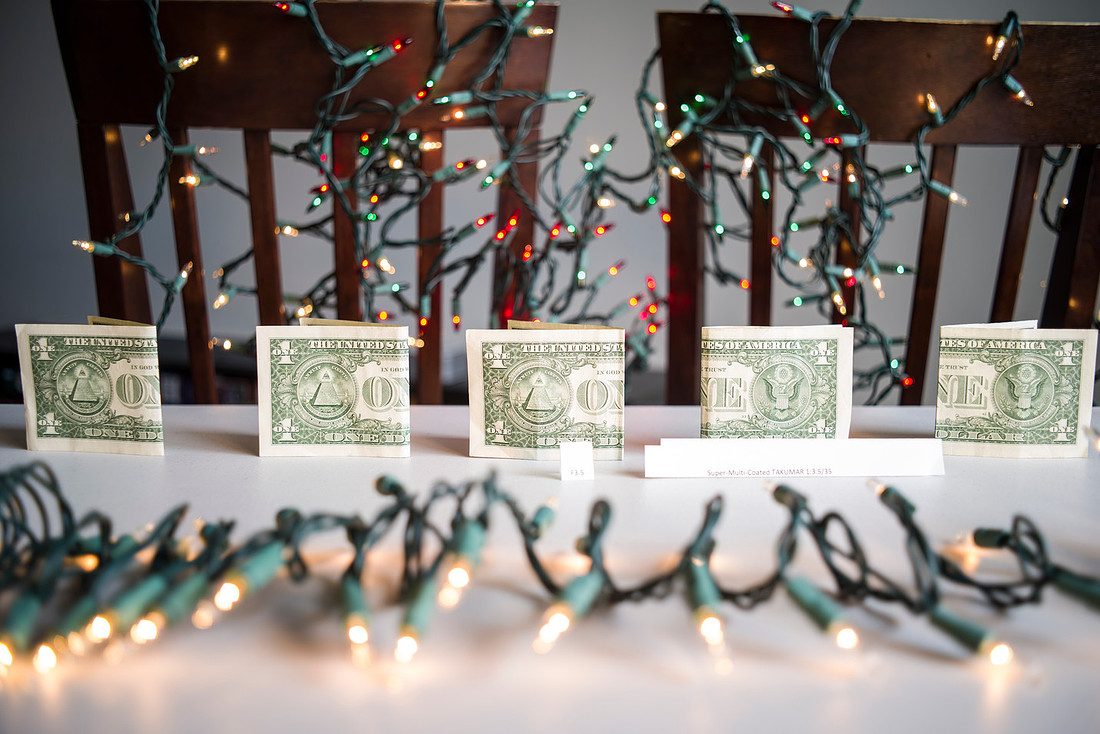
And the SMC f3.5, or K version. Aside from the lighting they were pretty much identical. Though with closer looking, it appears that this lens cut off just a hair more on the ends than the previous two... Hmmm.....
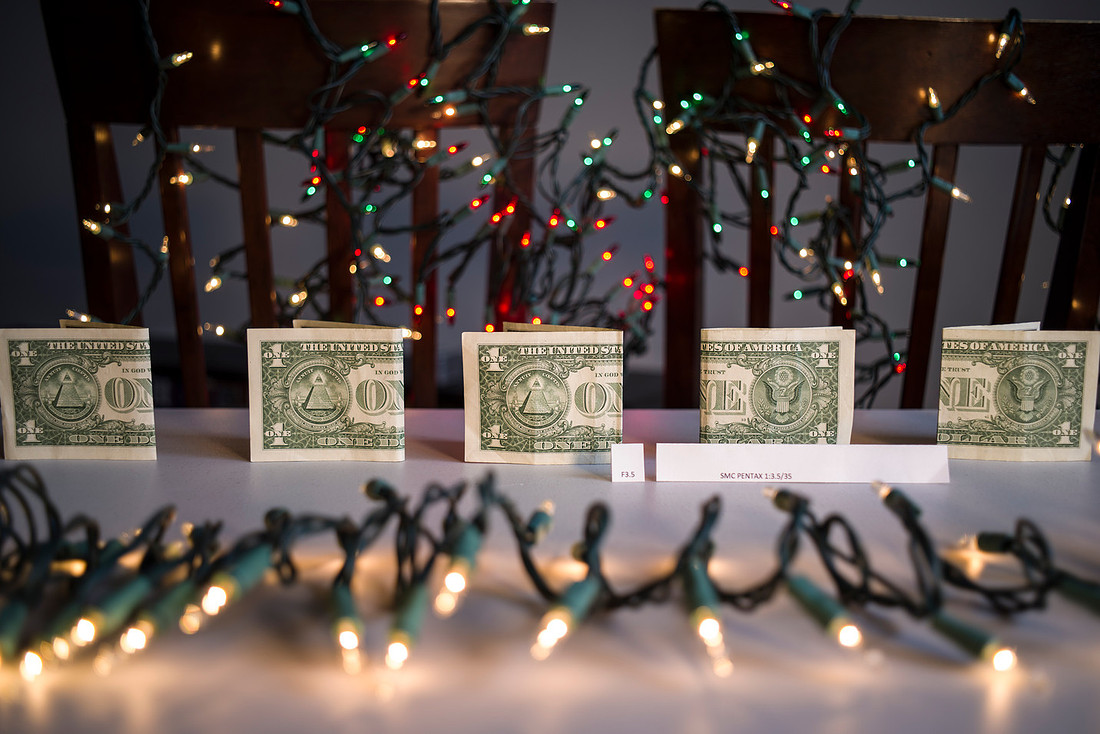
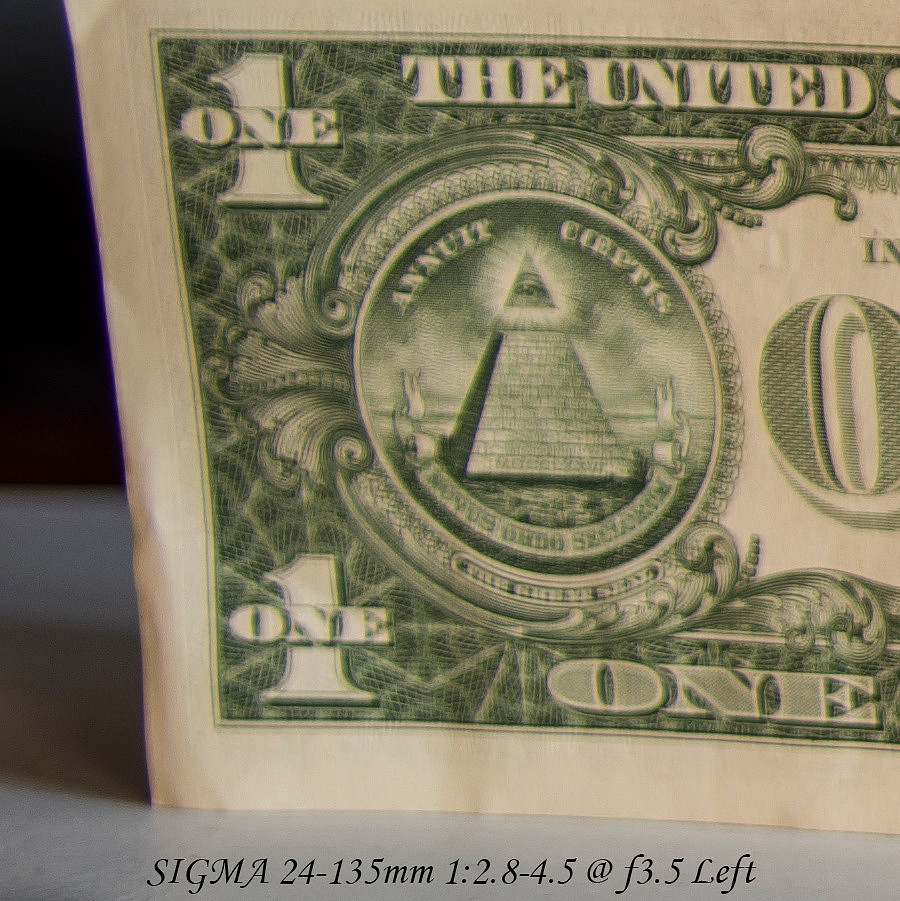
I will include the two zooms for giggles the Sigma was f3.5 at 35mm, the background was quite nice, as you will see later, the sharpness was not.
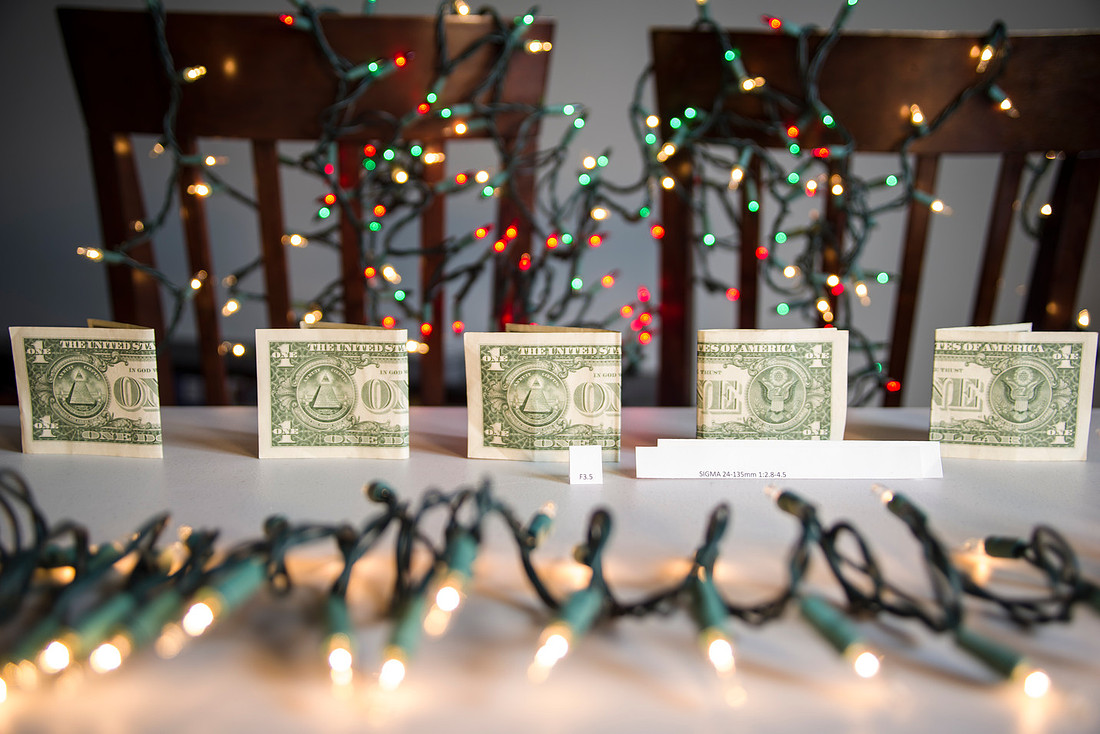
The Pentax 28-105 was at f4 at 35mm, one of the limitations with this lens is the aperture. It is a stellar all around zoom, for hiking or traveling, it is really good, but separating backgrounds at the wider end is just not something I expect it to excel at. That is what a faster prime is for. The HD FA 35mm f2 for example. It is the perfect companion to this lens IMO.
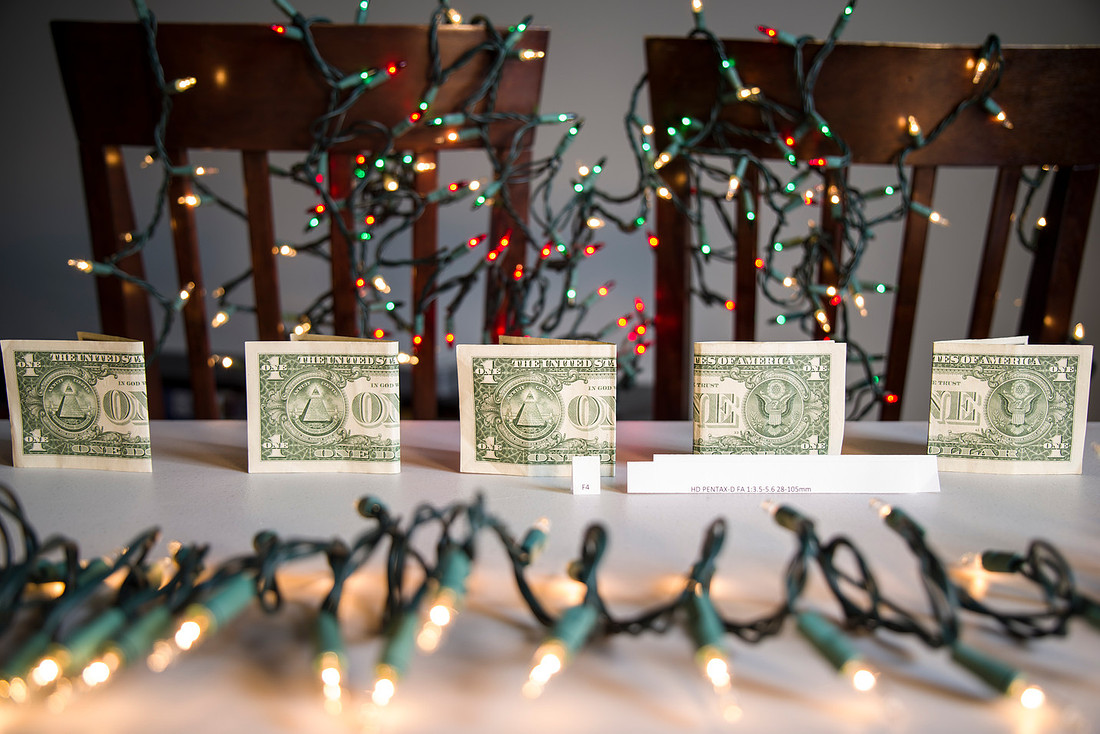
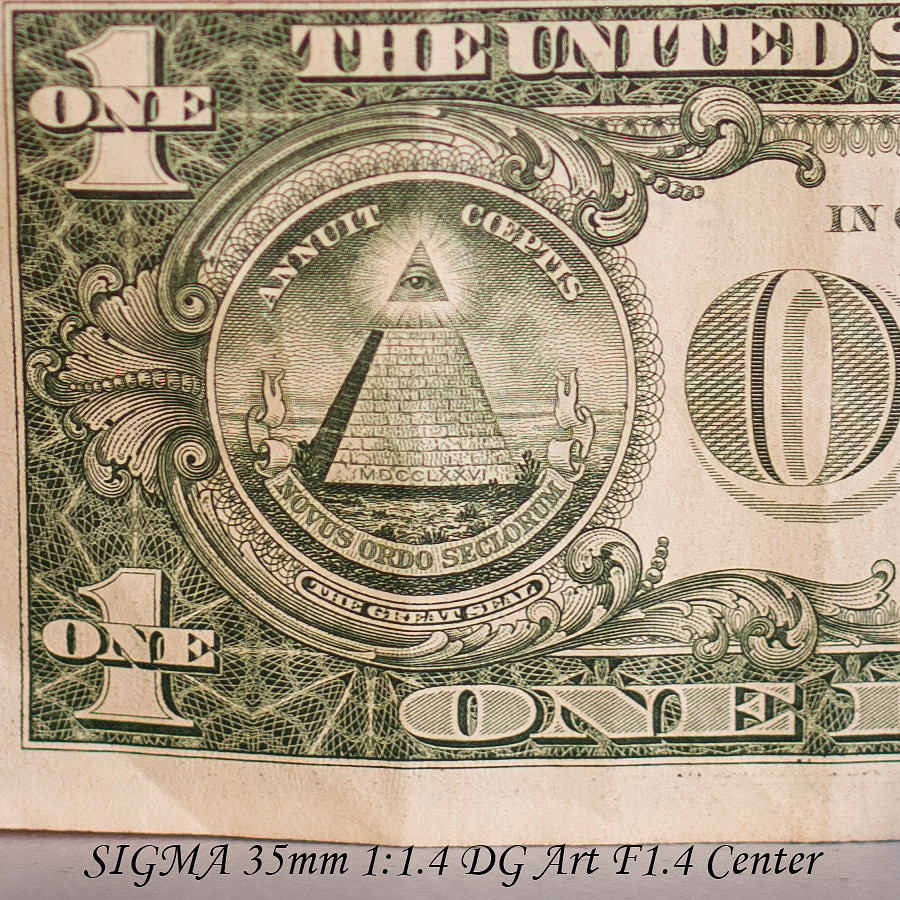
Now, here is a confession, I did my studio session with the lenses is no particular order, and the upload to my gallery reflects that, so I am just going to give you the center crops and then the edge crops in the order they were shot, they are all labeled. I think you will be able to make your own decisions on sharpness. All have center crop at widest open aperture, then some have a crop of the center at either f3.5 or f4. Most of the slower lenses did not have the ability to easily do f4 they went from f3.5 to f5.6 so they just get wide open. I really think they do OK though. All these crops are at 900x900 pixels
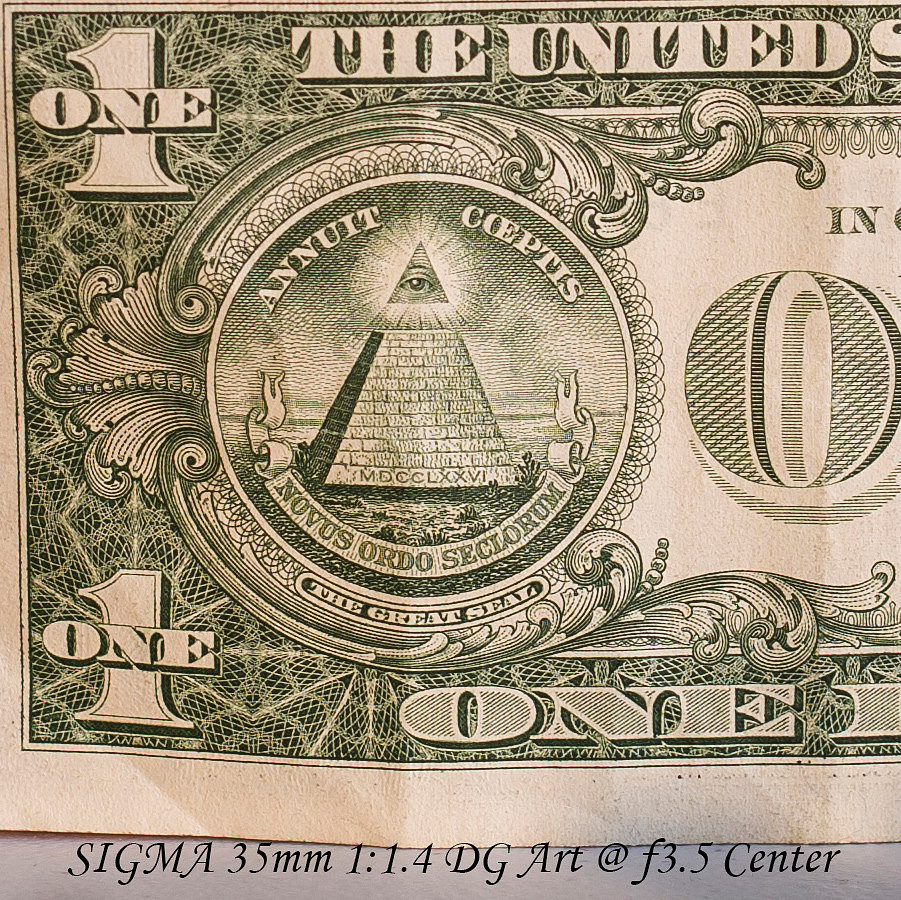
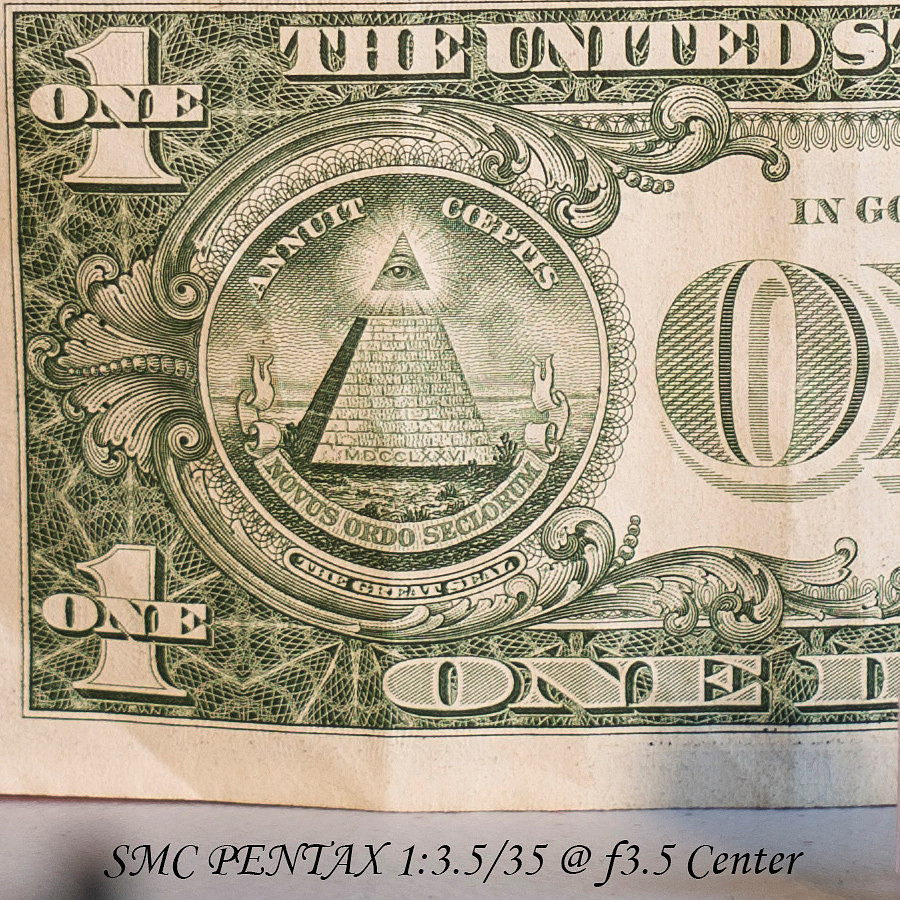
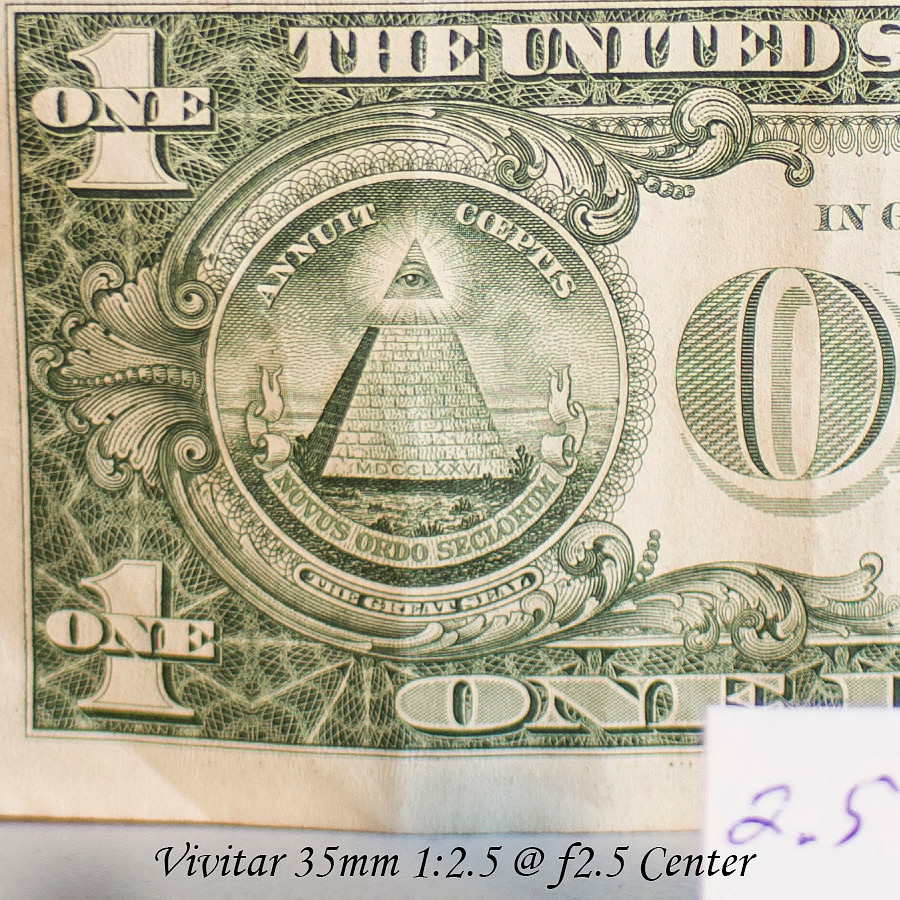
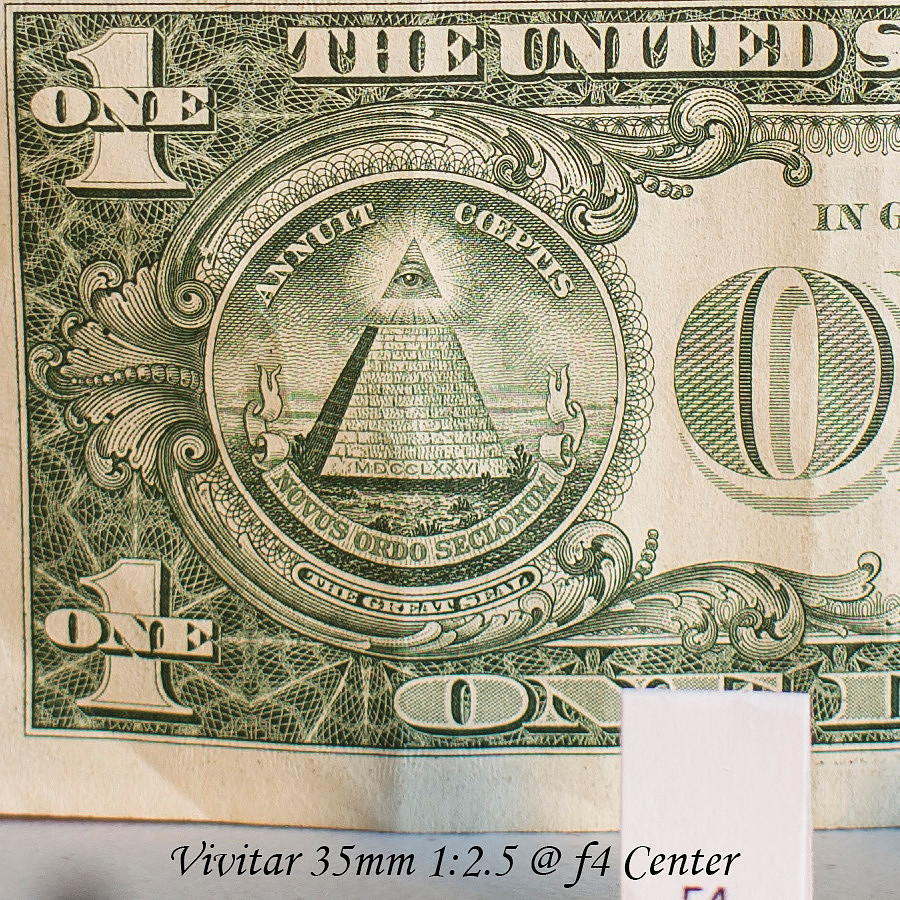
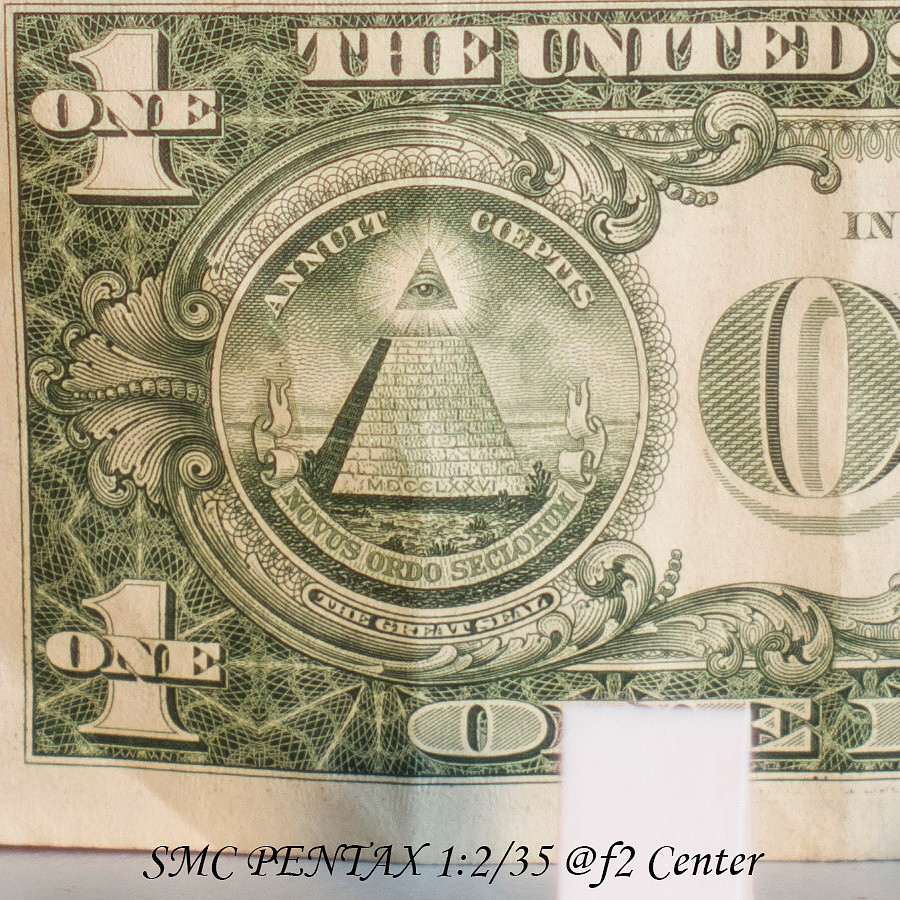
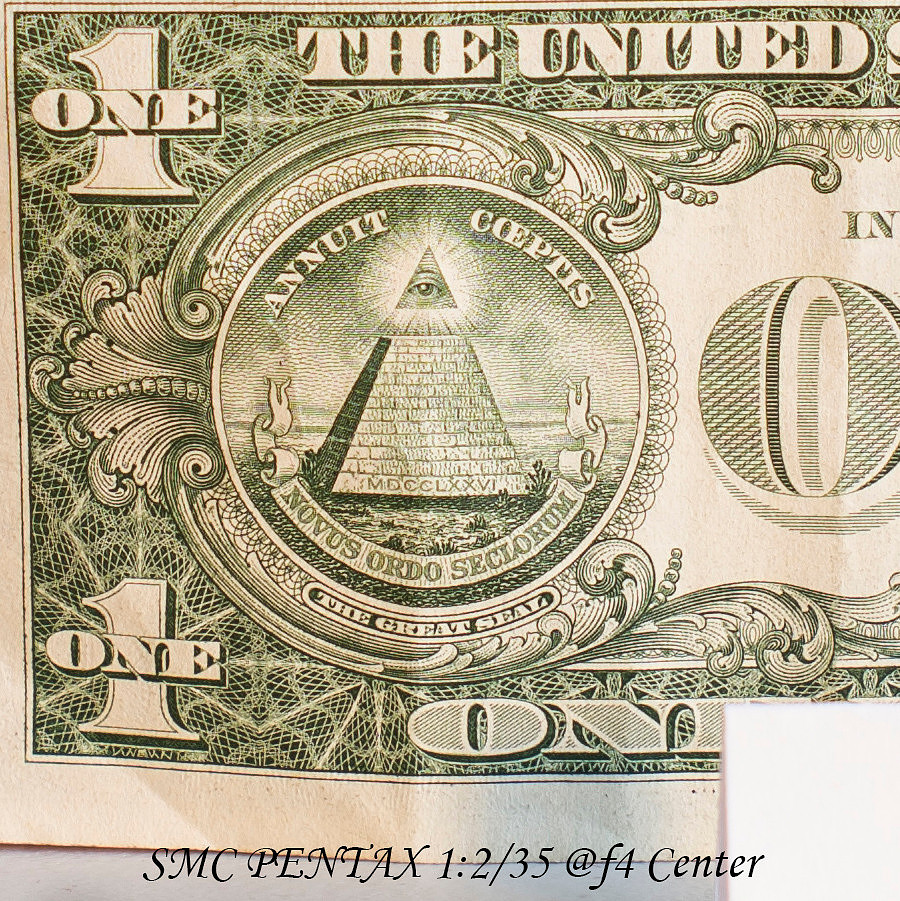
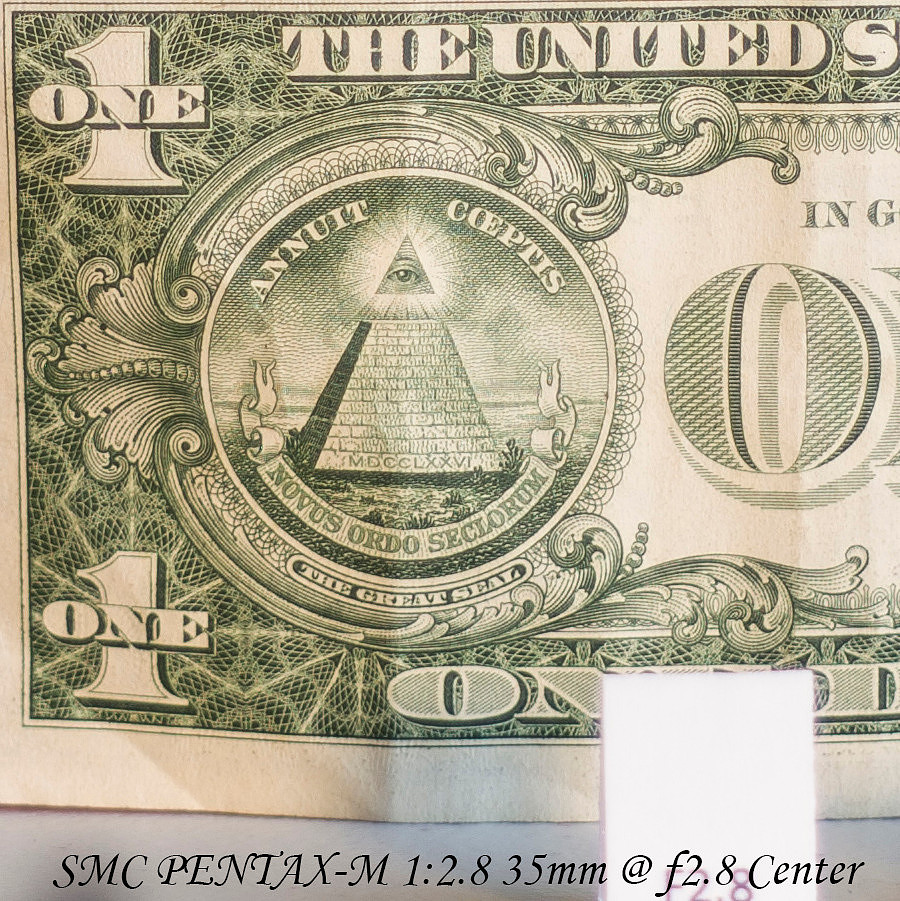
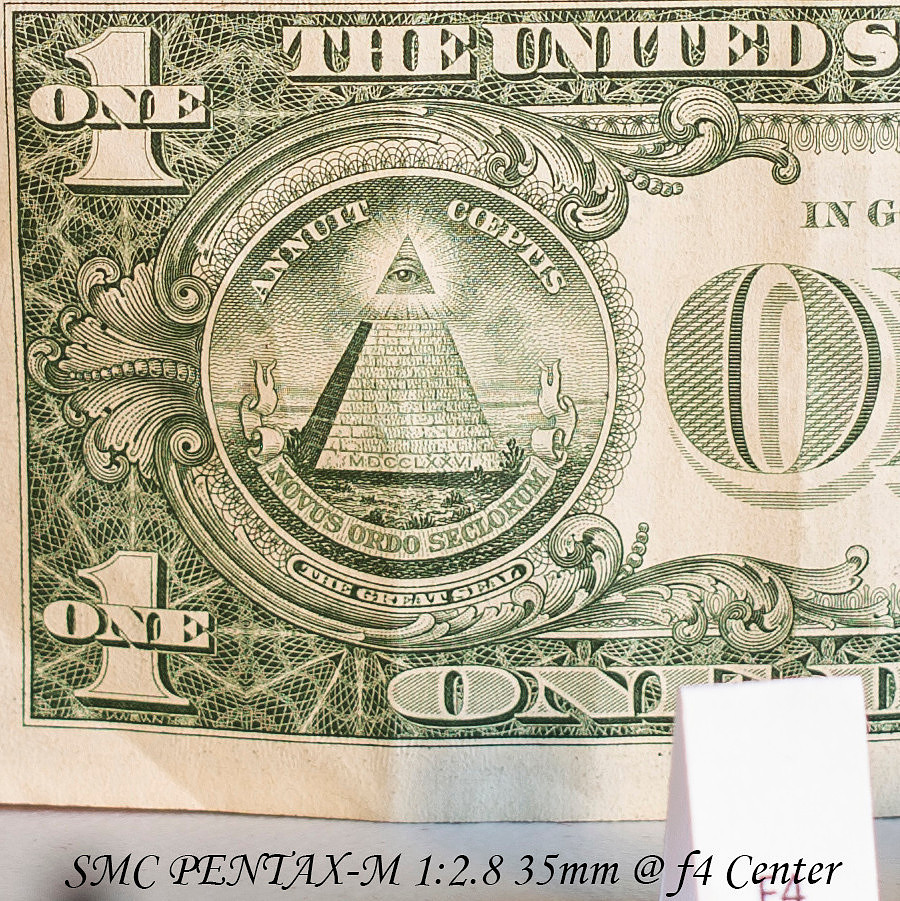
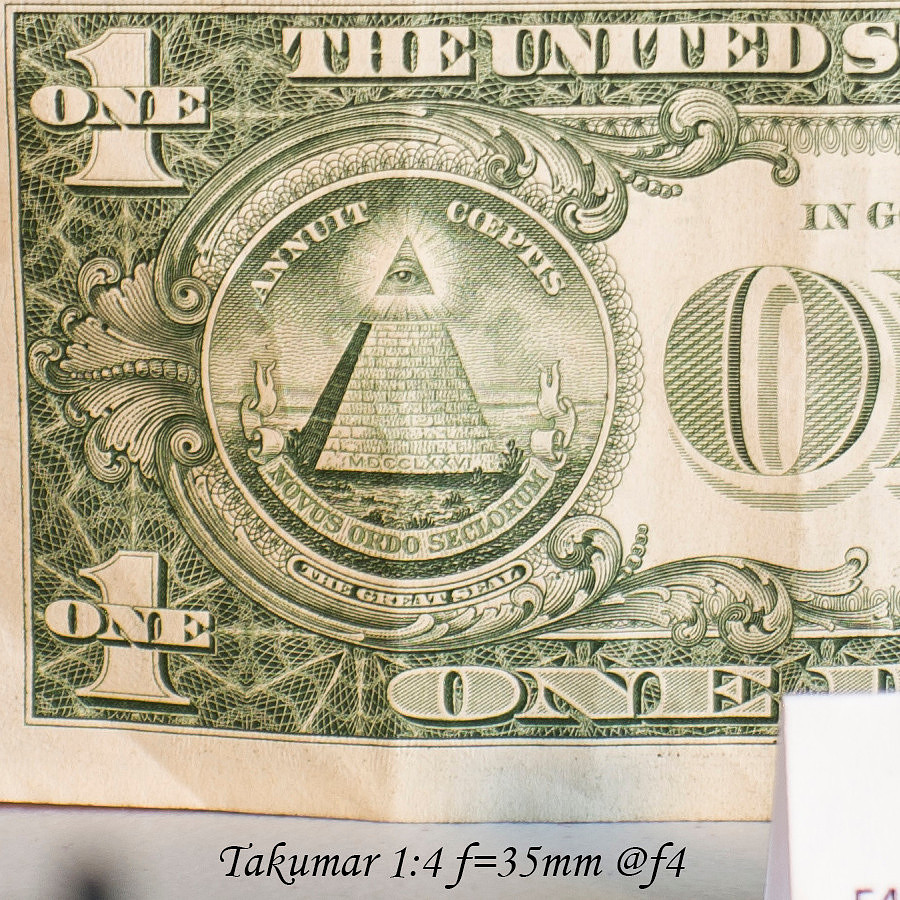
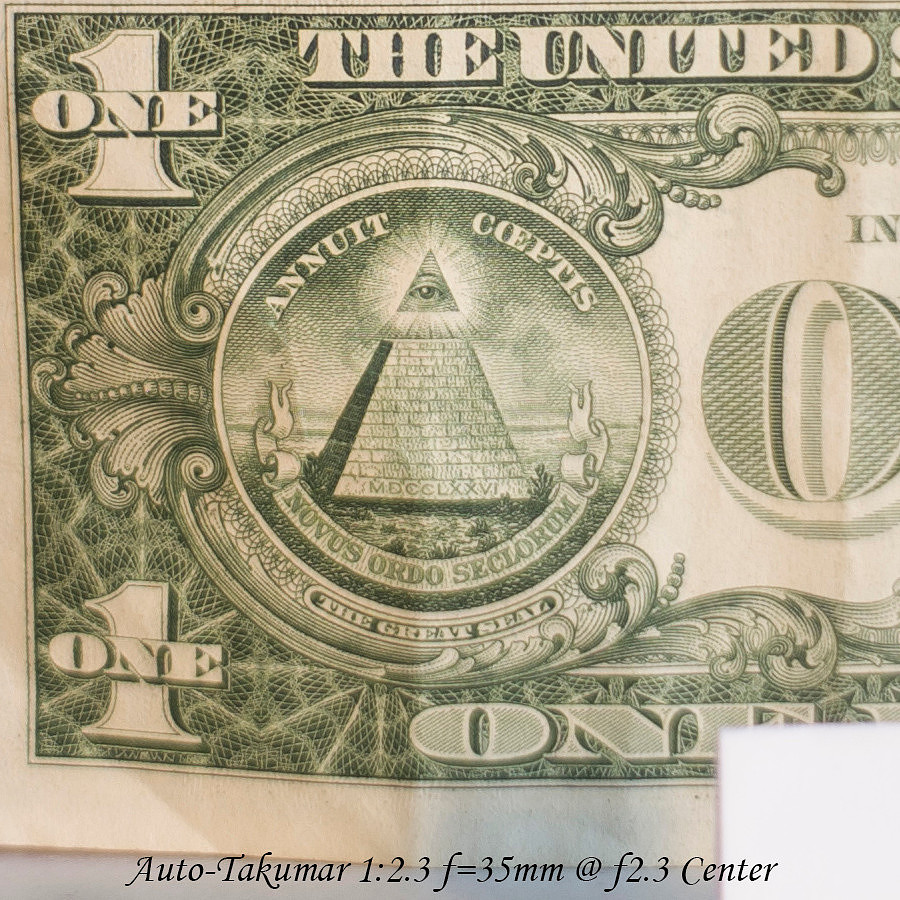
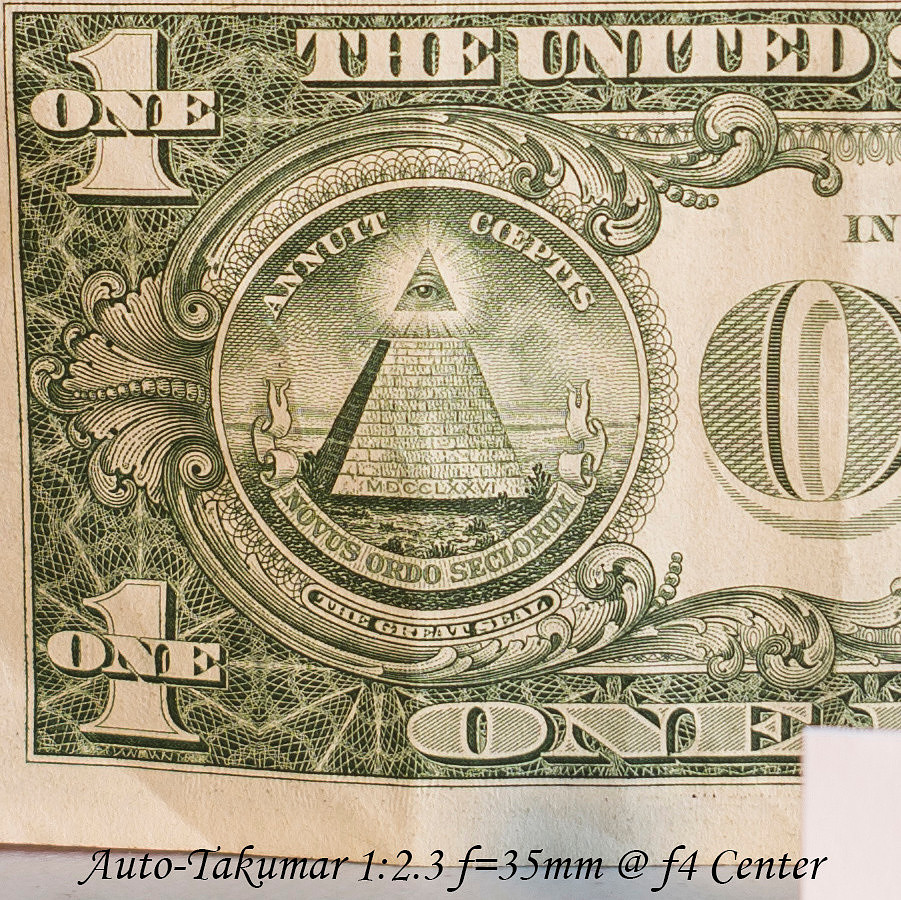
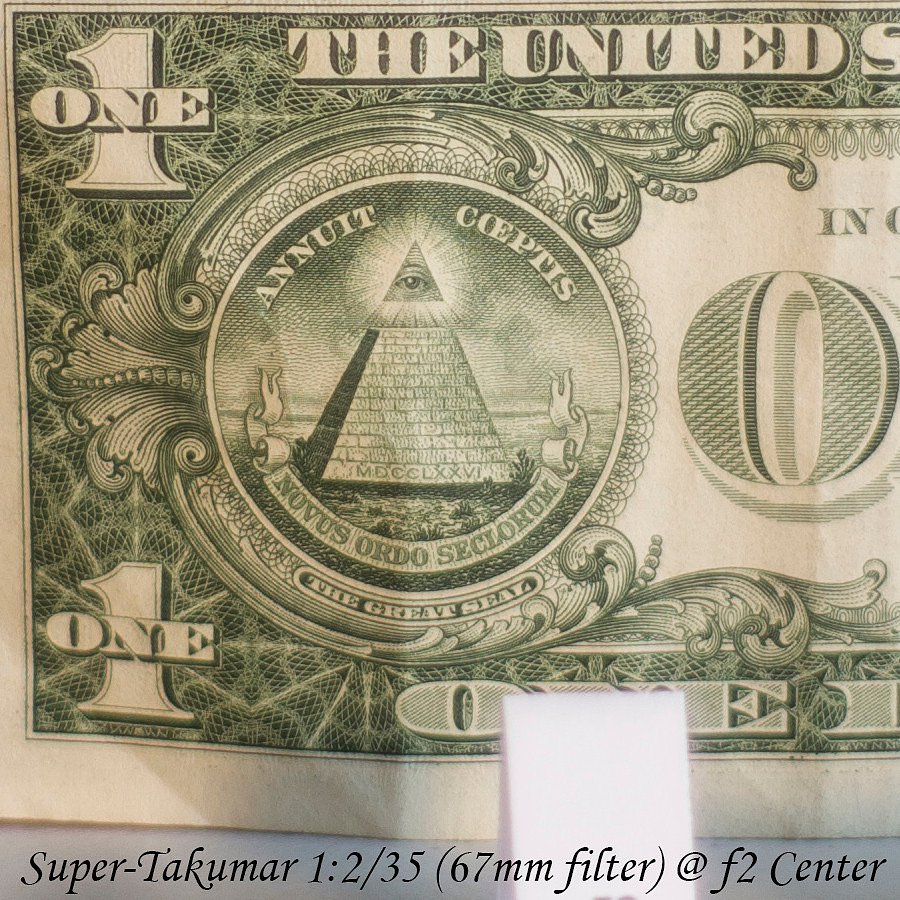
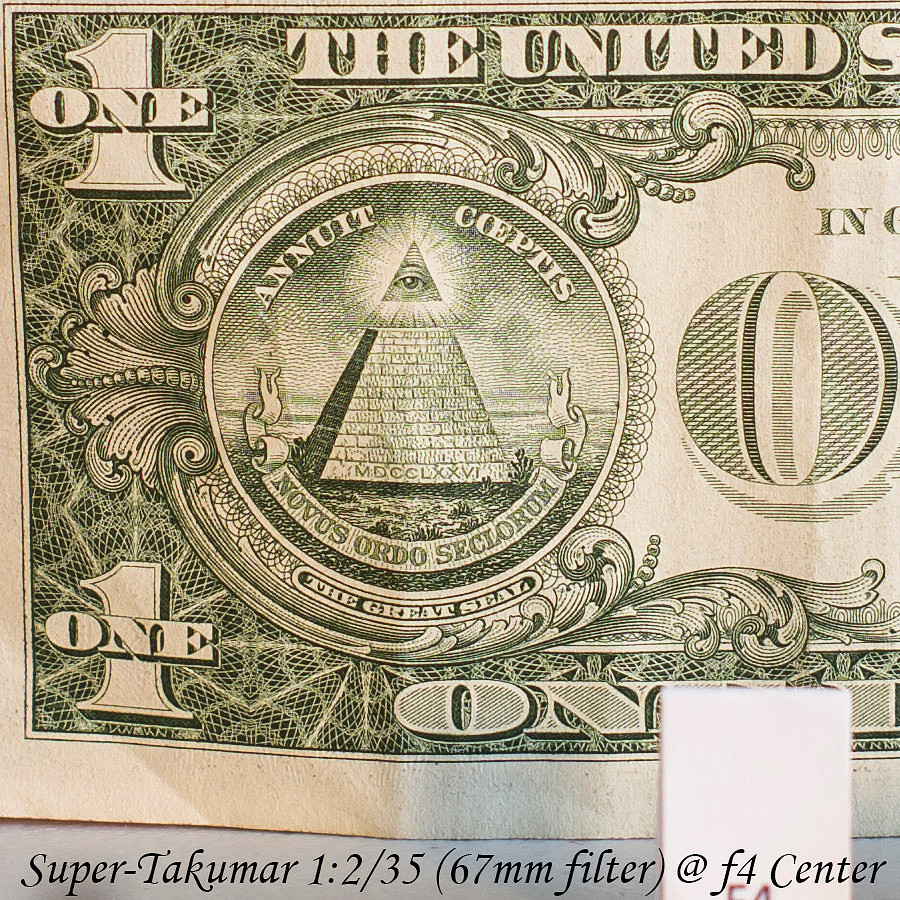
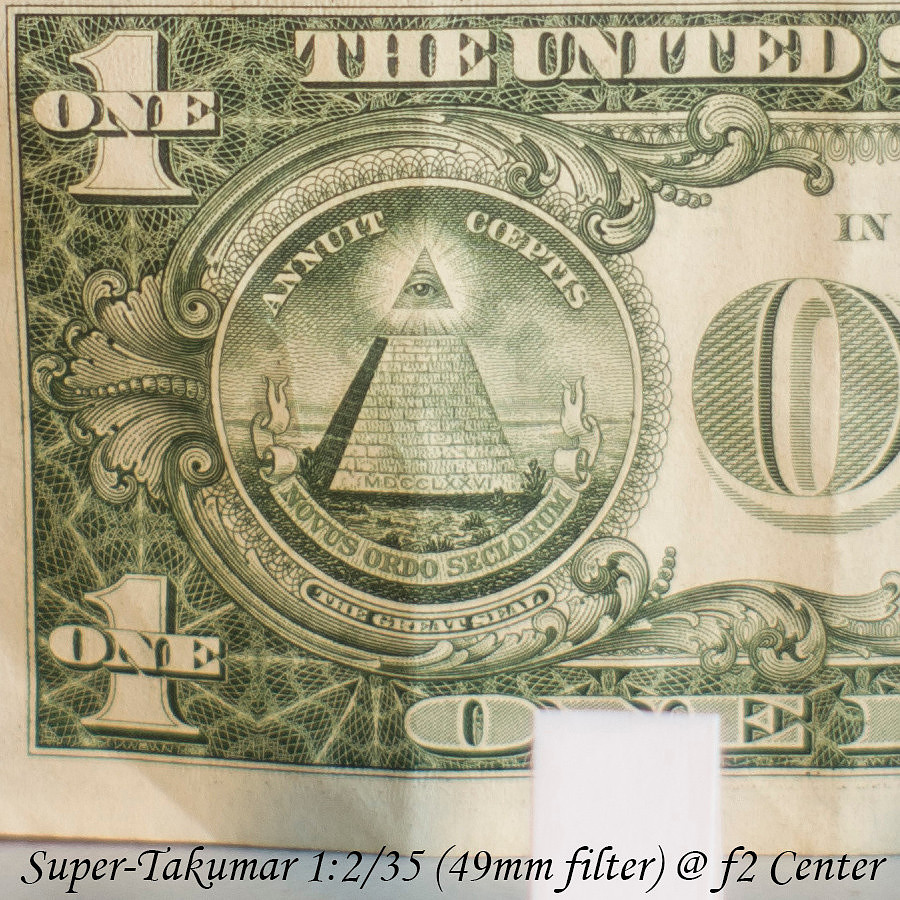
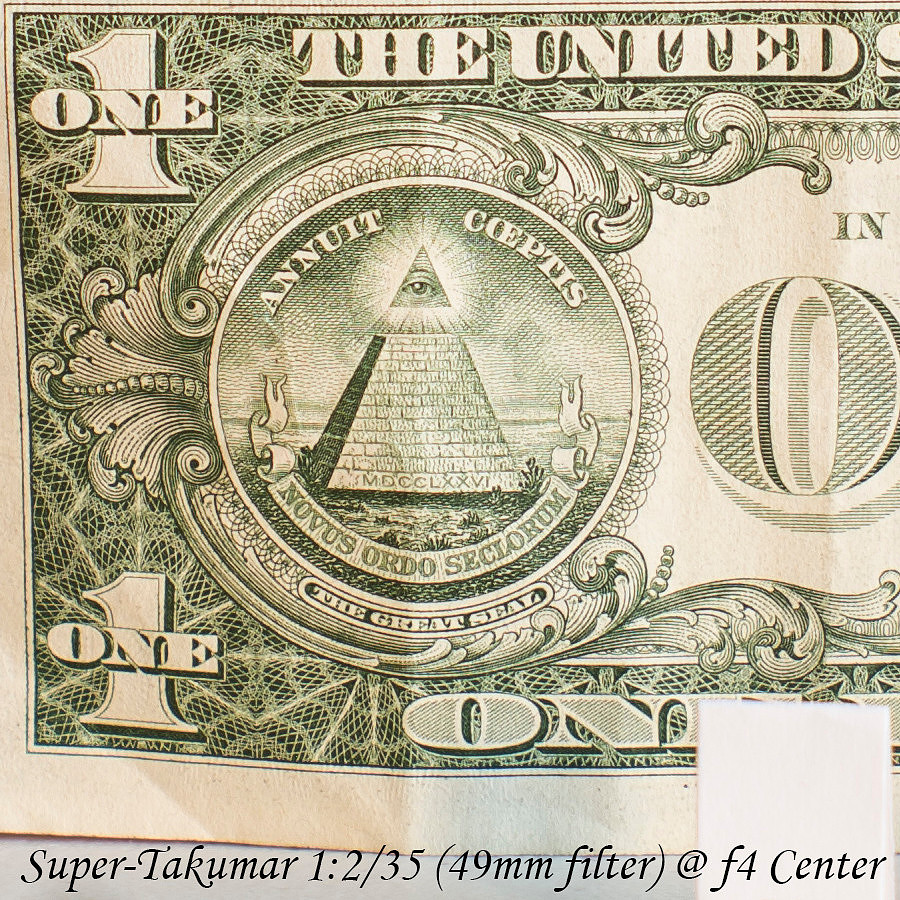
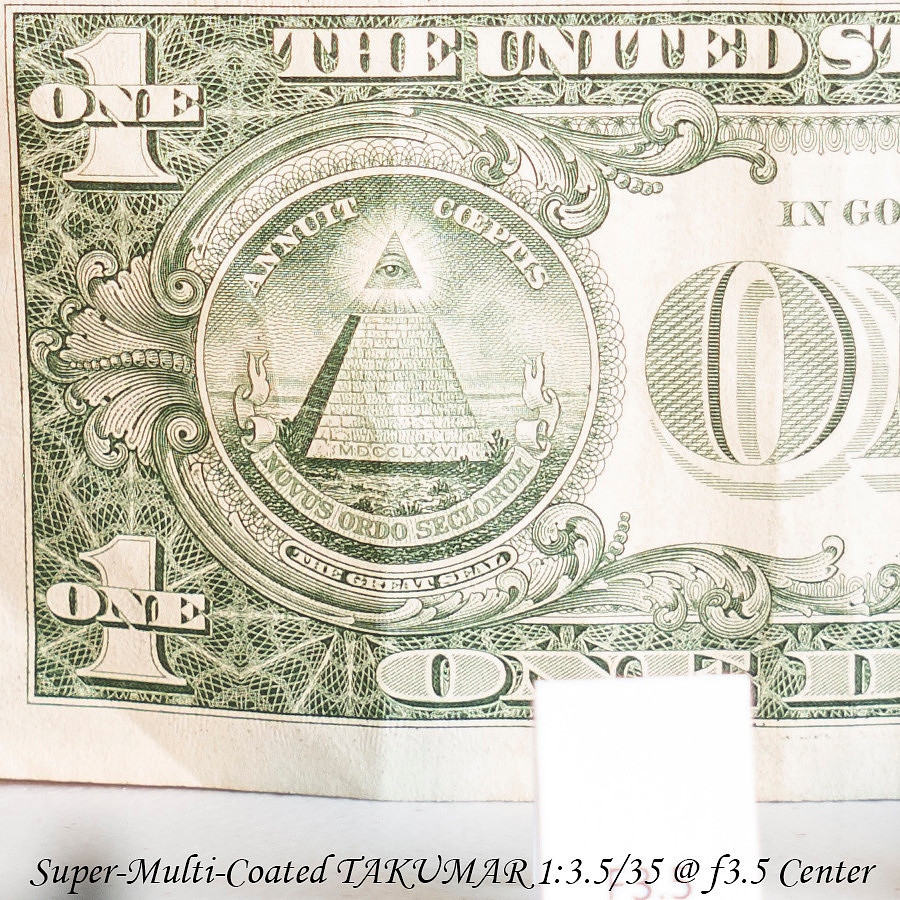
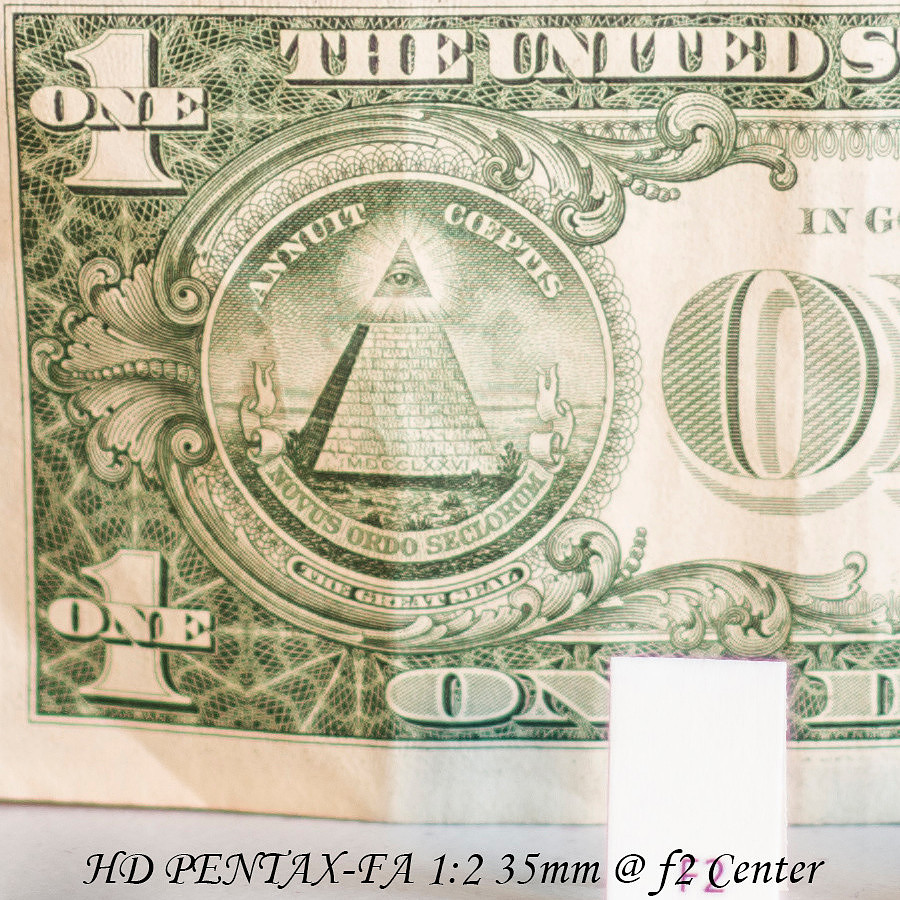
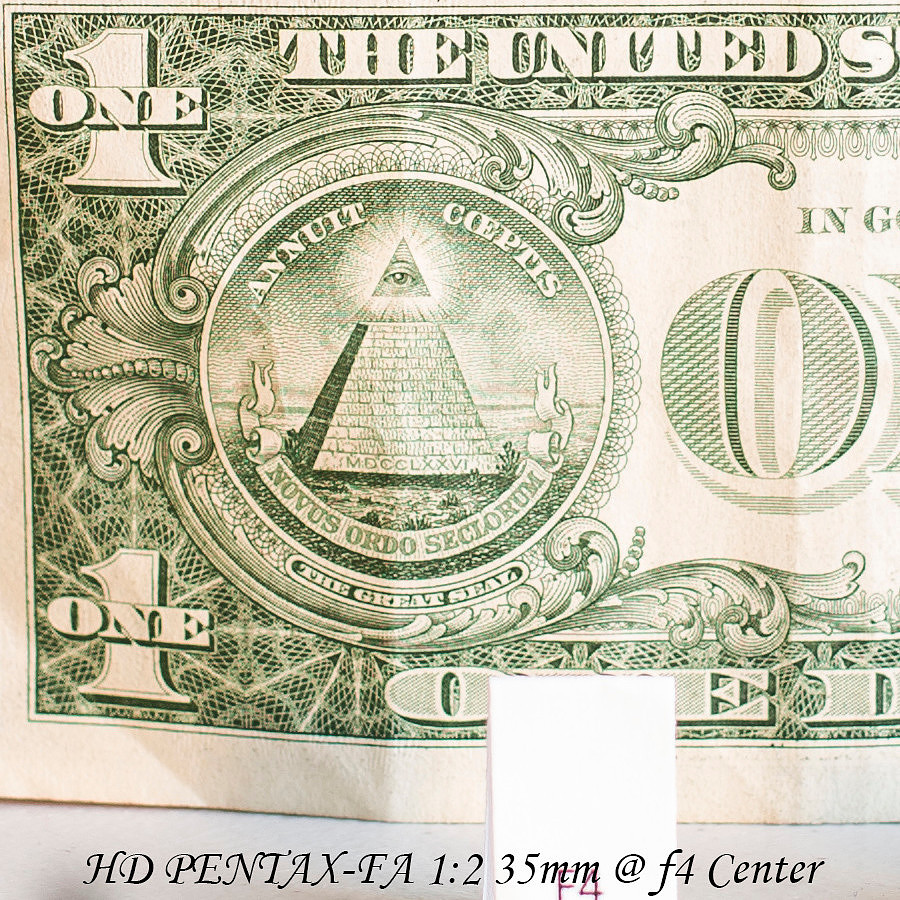
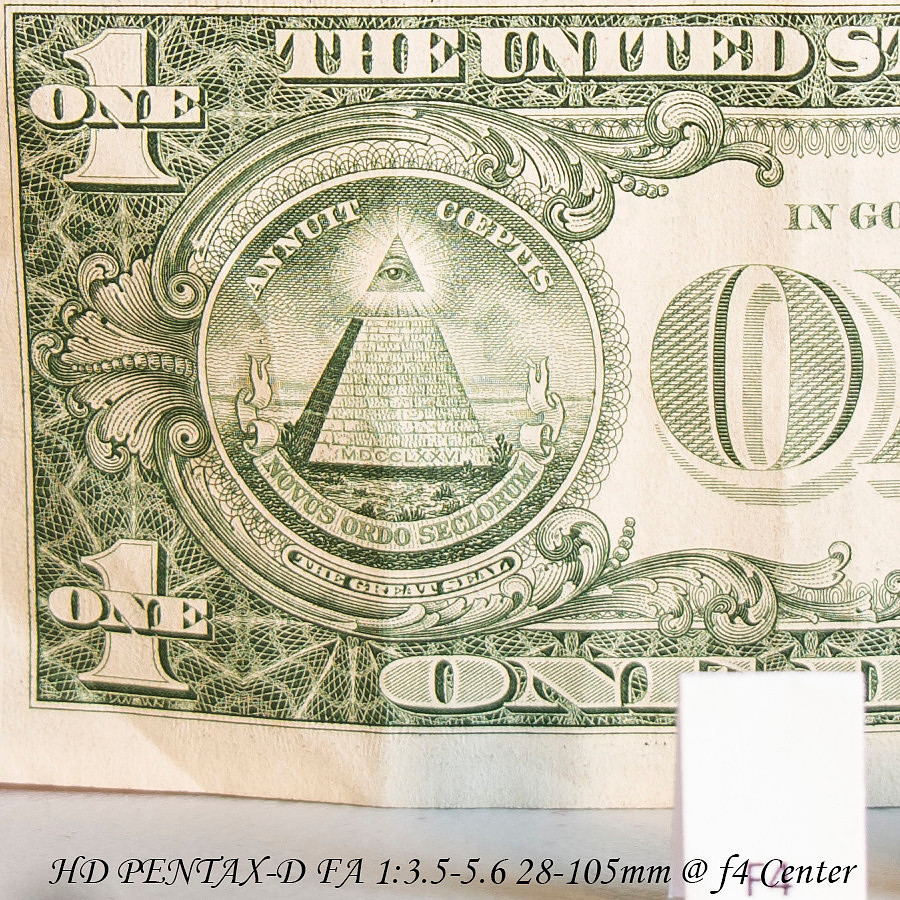
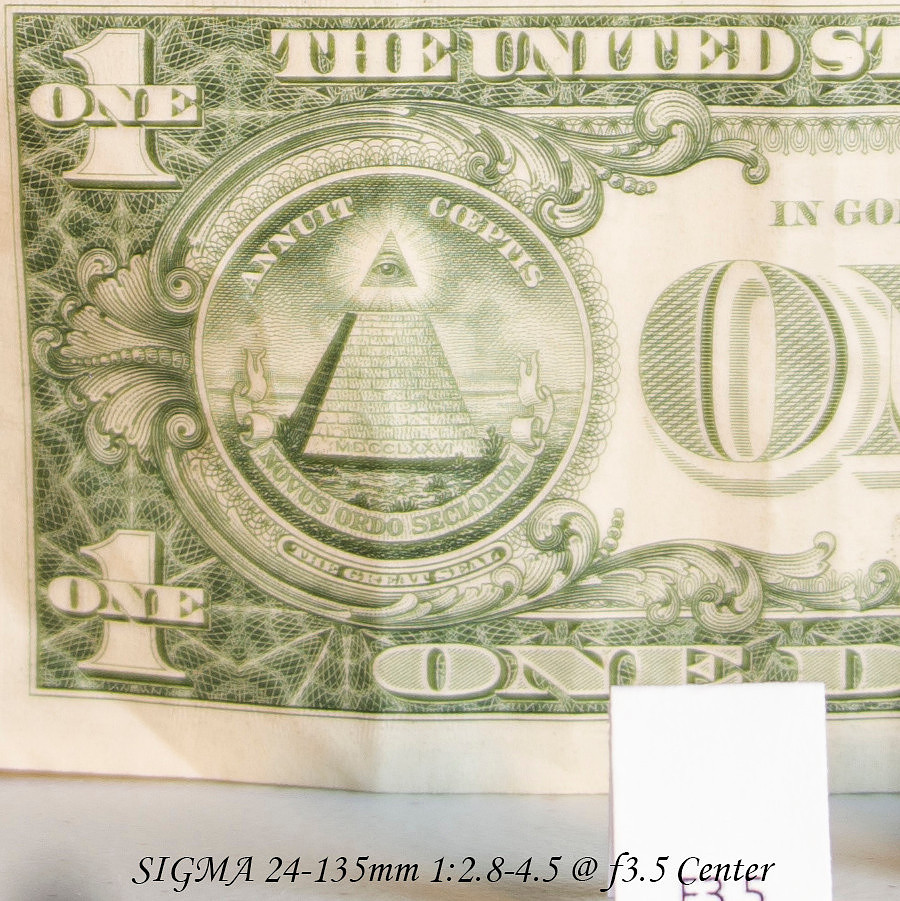
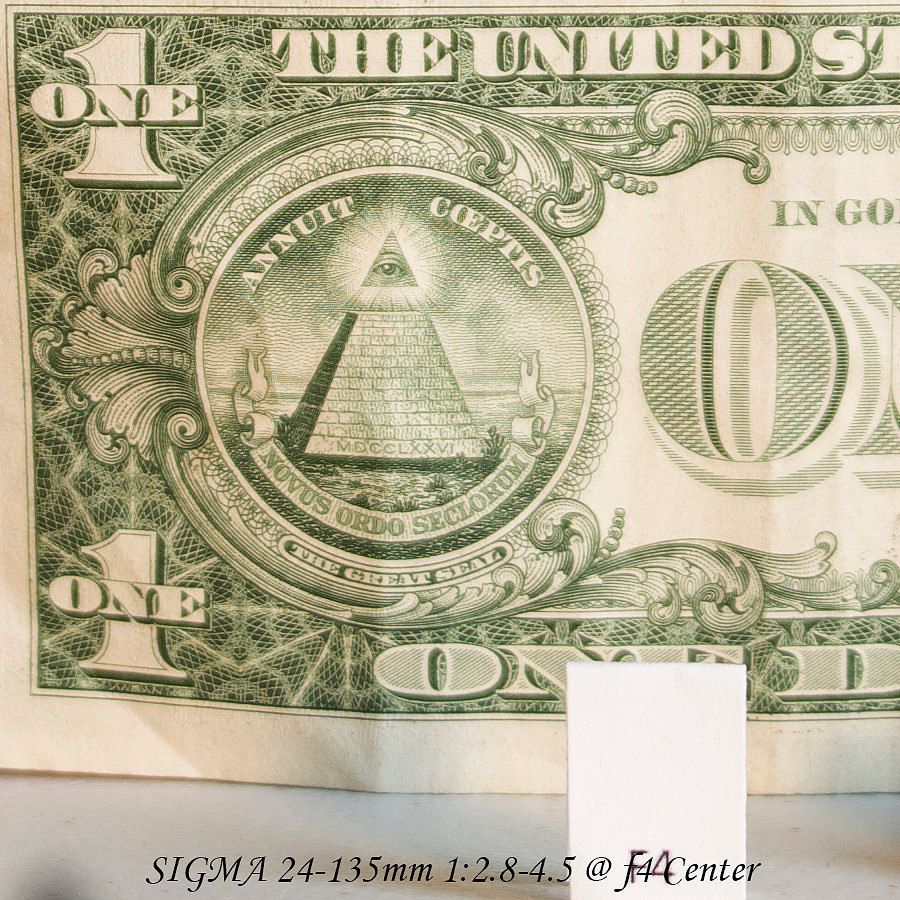
Pretty much everything was acceptable from f5.6 up to f11 so I won't do crops for them. Though the Sigma 24-135 was not all that.
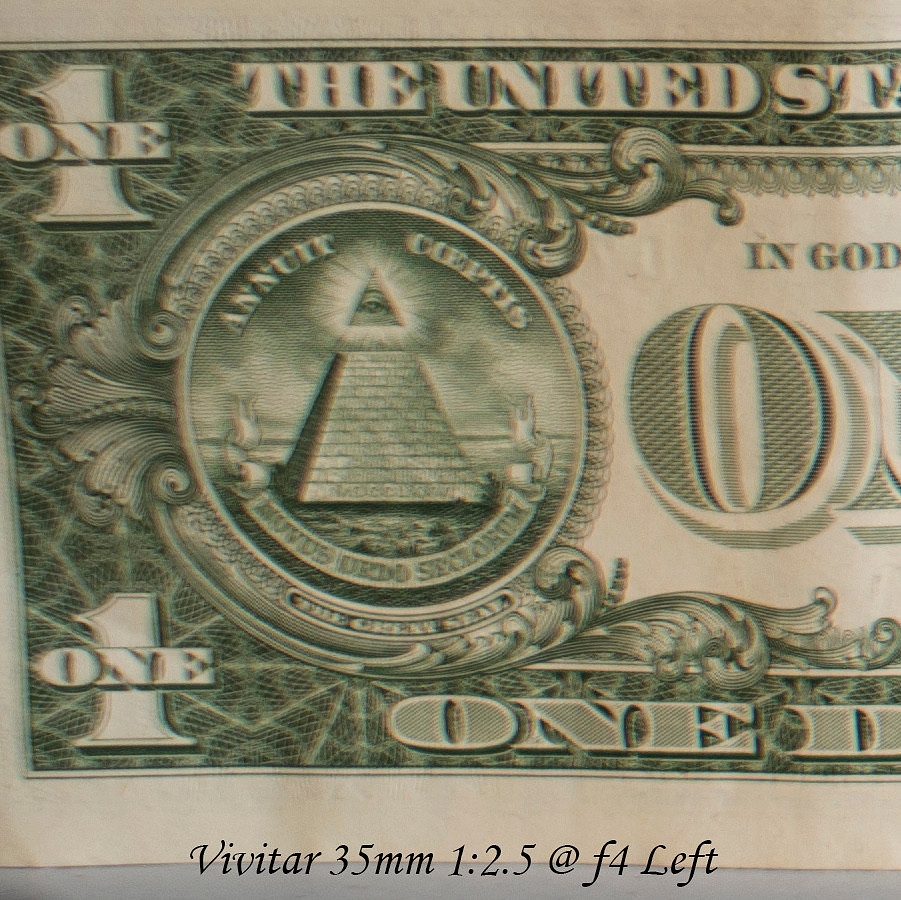
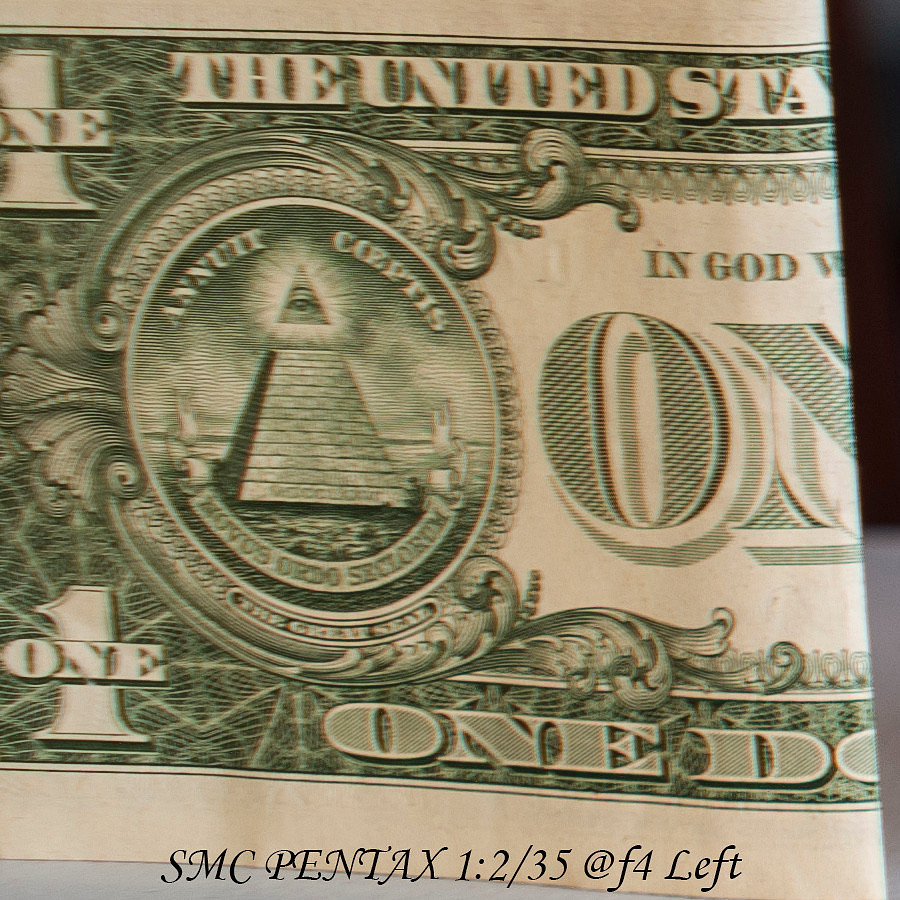
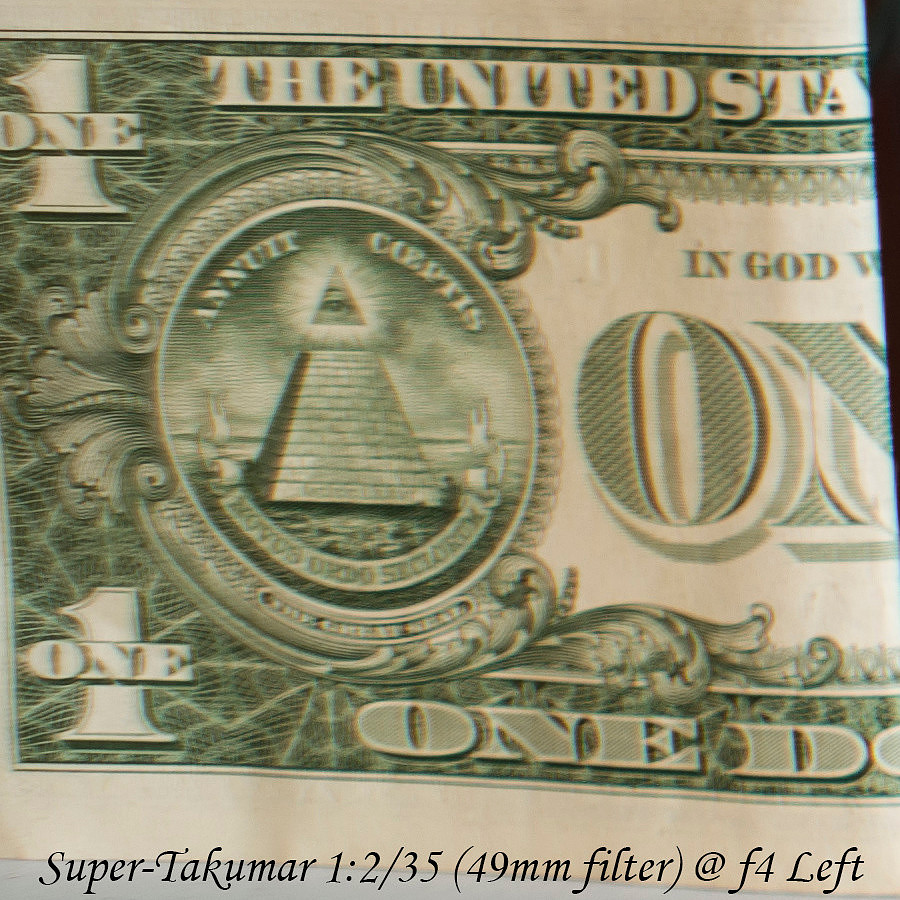
Where things get more telling is on the edges. I chose the left edge just because. I will make a few comments in places for particularly egregious lens behavior. You will notice that different parts of the bill are cropped out, that is due to the effective focal length varying depending on the lens. This Sigma along with the Auto-Takumar seemed to be the longest. This is stunningly sharp for f1.4 on the far edge of the lens.
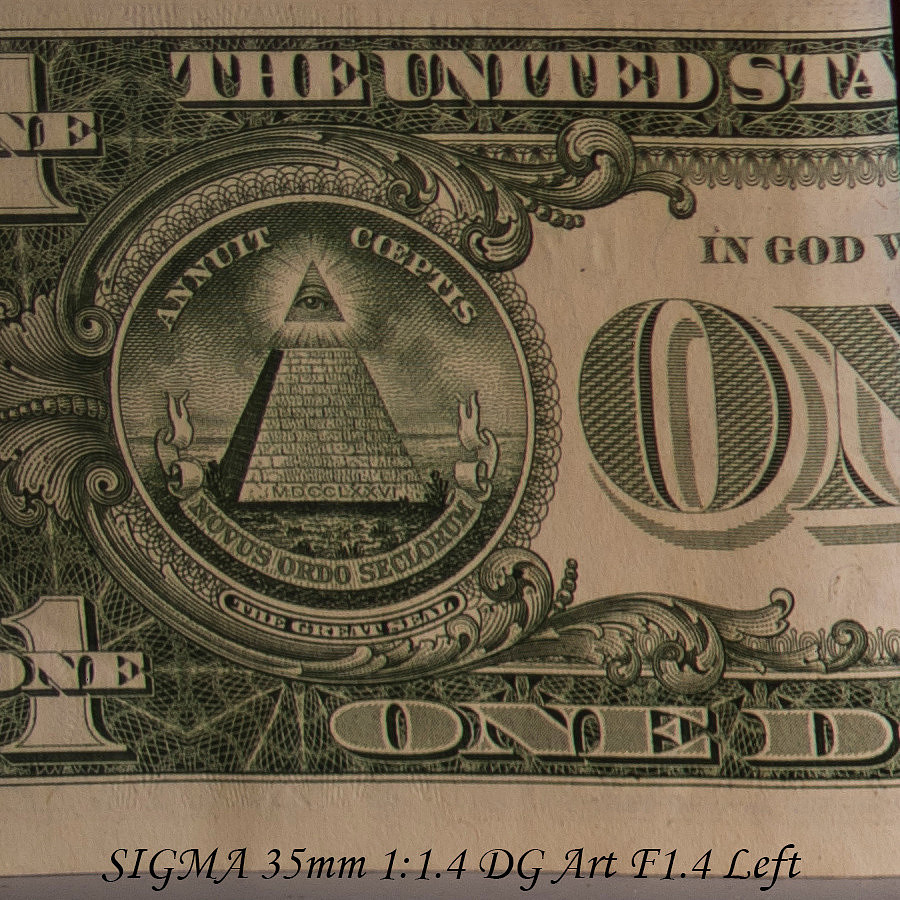
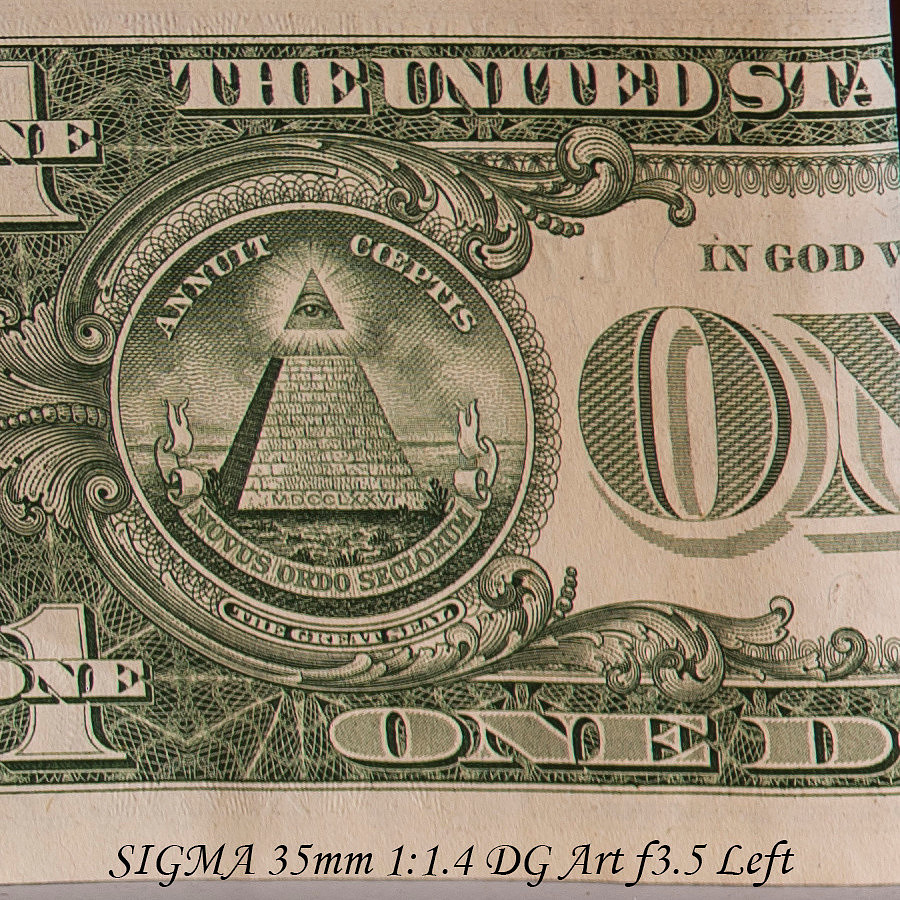
I would shoot this lens at f4 all day long and not lack for resolution. It is SHARP!
This is wide open and honestly a very good result for edge of the frame on this old of a lens, once you start stopping down it just gets better and better. This is my lens I have had for awhile and I will never let it go.
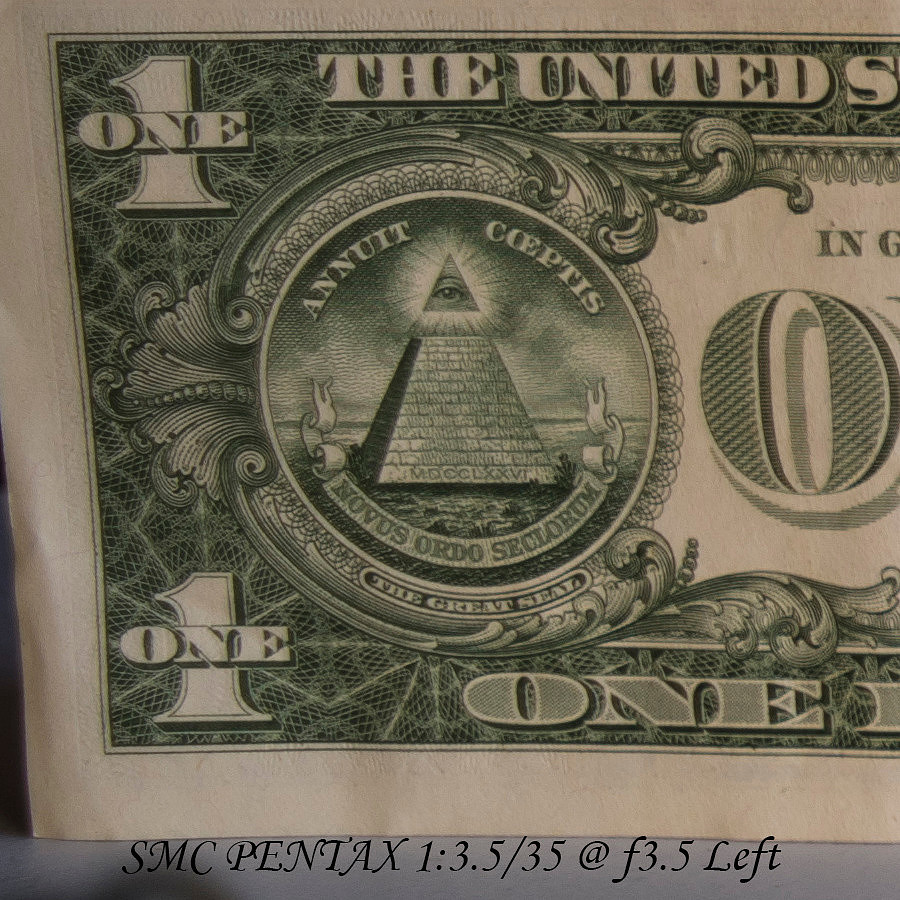
Yeah this is not so good, you can tell this is an older lens.
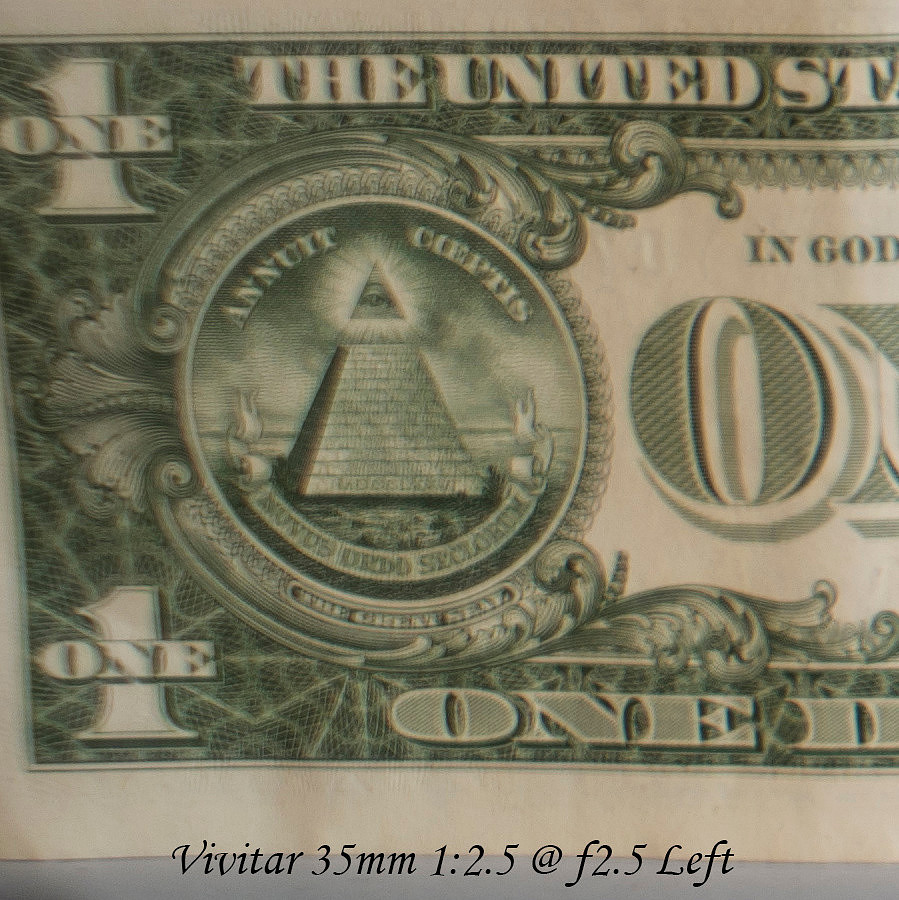
Even at f4 this Vivitar is not good on this far edge, it got low acceptable by f11 but never stellar, this would be a good lens for APS-c coming in from the extreme edge things were actually decent from f4 to f11.
This lens is the same vintage as my f35mm f3.5, I had high hopes, but it looks like edge sharpness was traded for central sharpness and f2
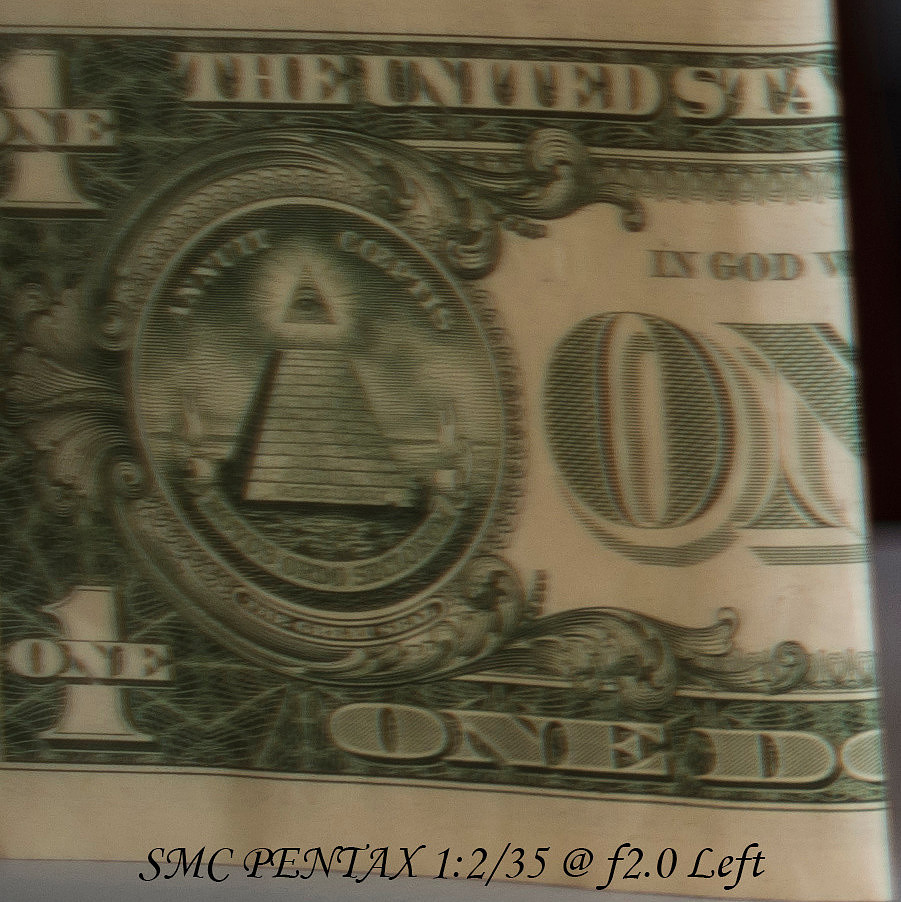
Even at f4 it was not all that good. I am glad I never took the plunge and bought this lens, it was an item of lust for awhile, but not now.
This M f2.8 really stymies me, it is quite dreamy here in the corners, but there is still detail to be had. I don't know what to make of it. It is certainly the most unique of the lenses. Even the center was dreamy but with detail wide open.
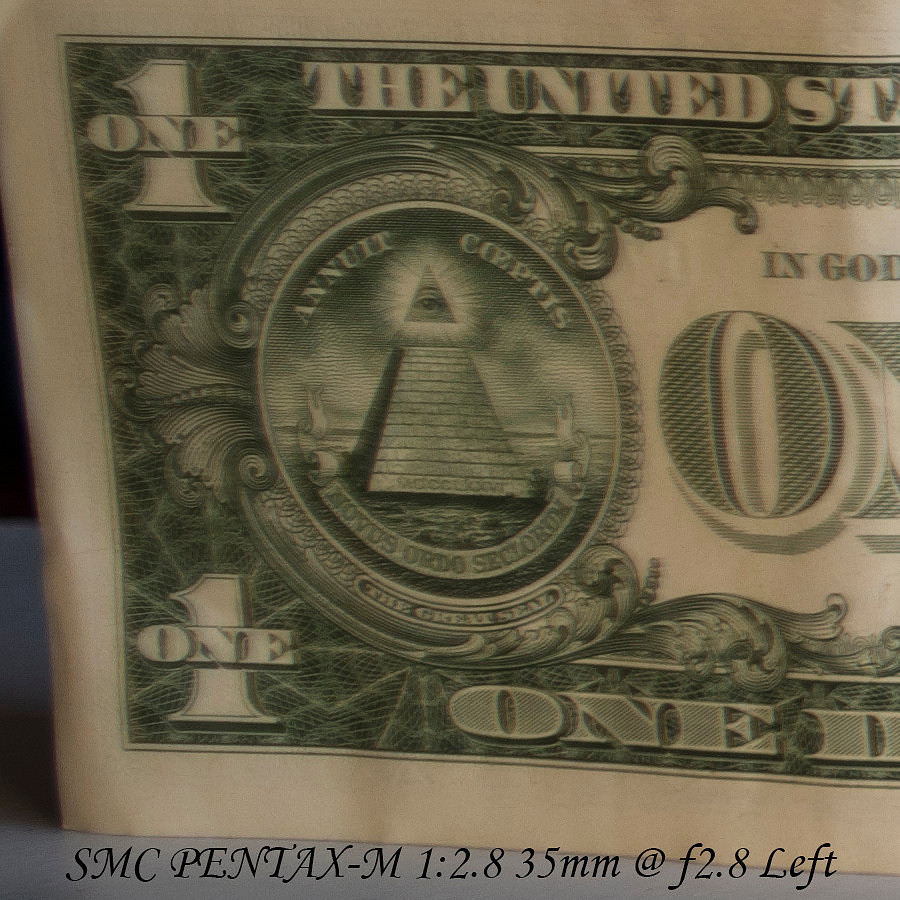
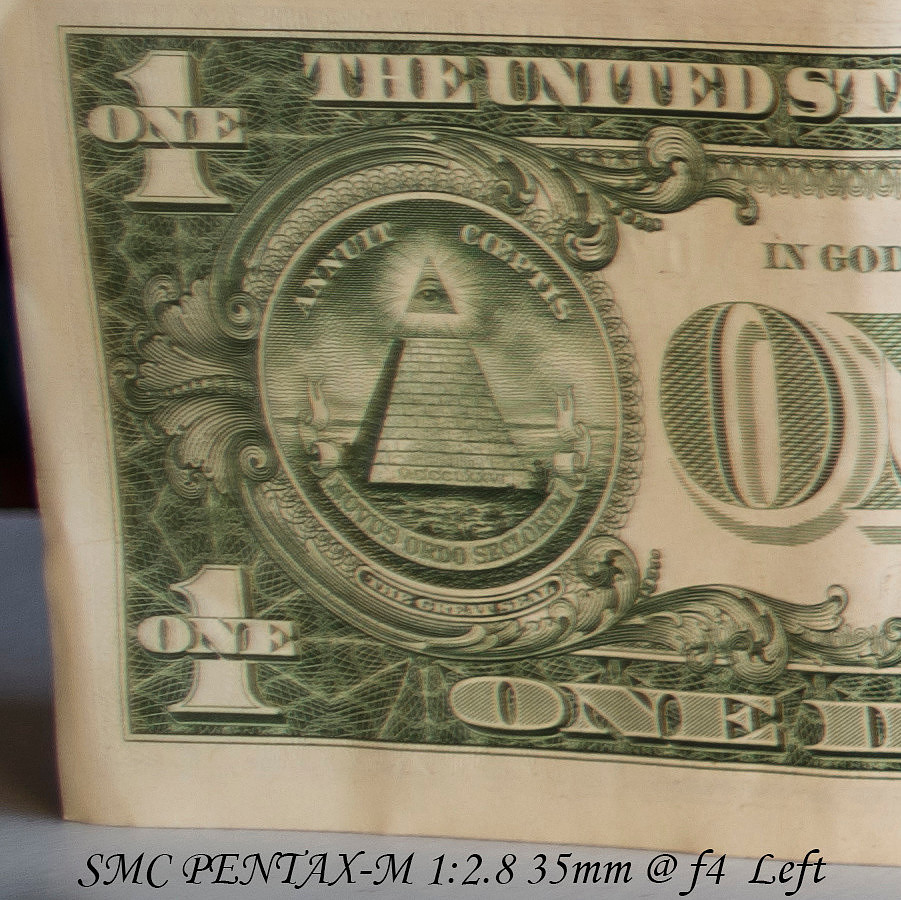
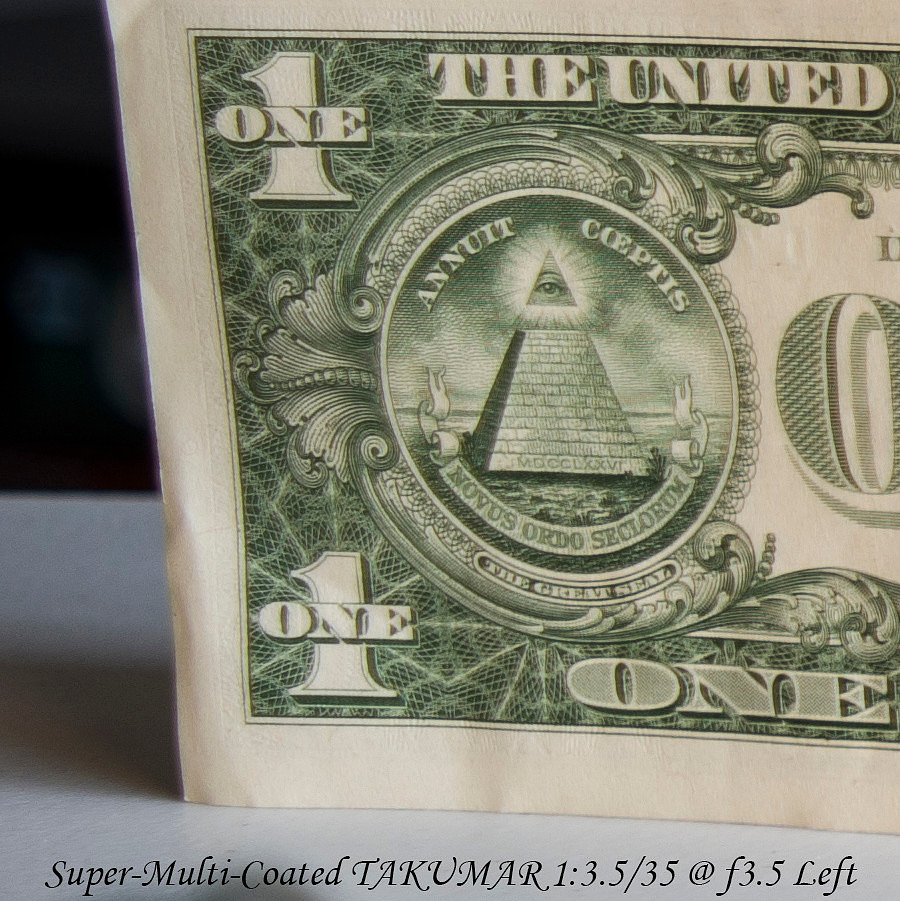
Like the other two of this same design, it was decent at f4 (now sure how the f 3.5 vs f4 was worked out, the optical designs you find online are identical) Funnily it looks a little wider than the K 35mm f3.5
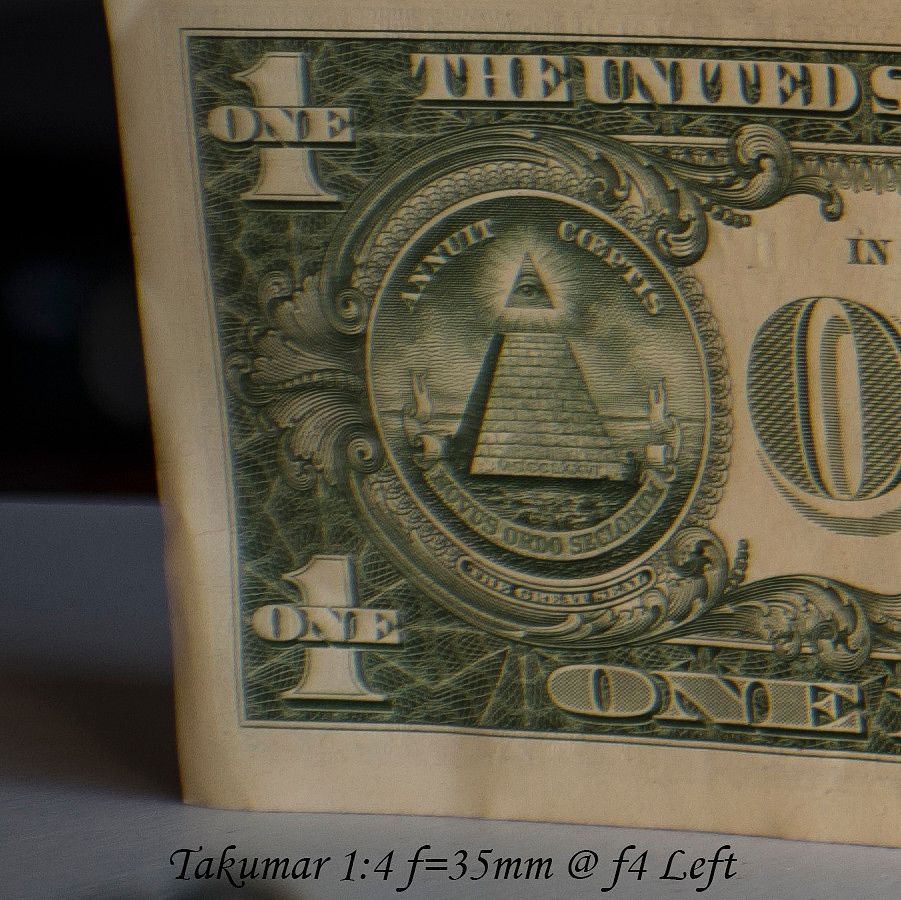
The Auto-Takumar shows it age here, I think they were reaching to get f2.3 and the compromise was not all they hoped for, it was not manufactured for long and was supplanted by two successive f2 designs.
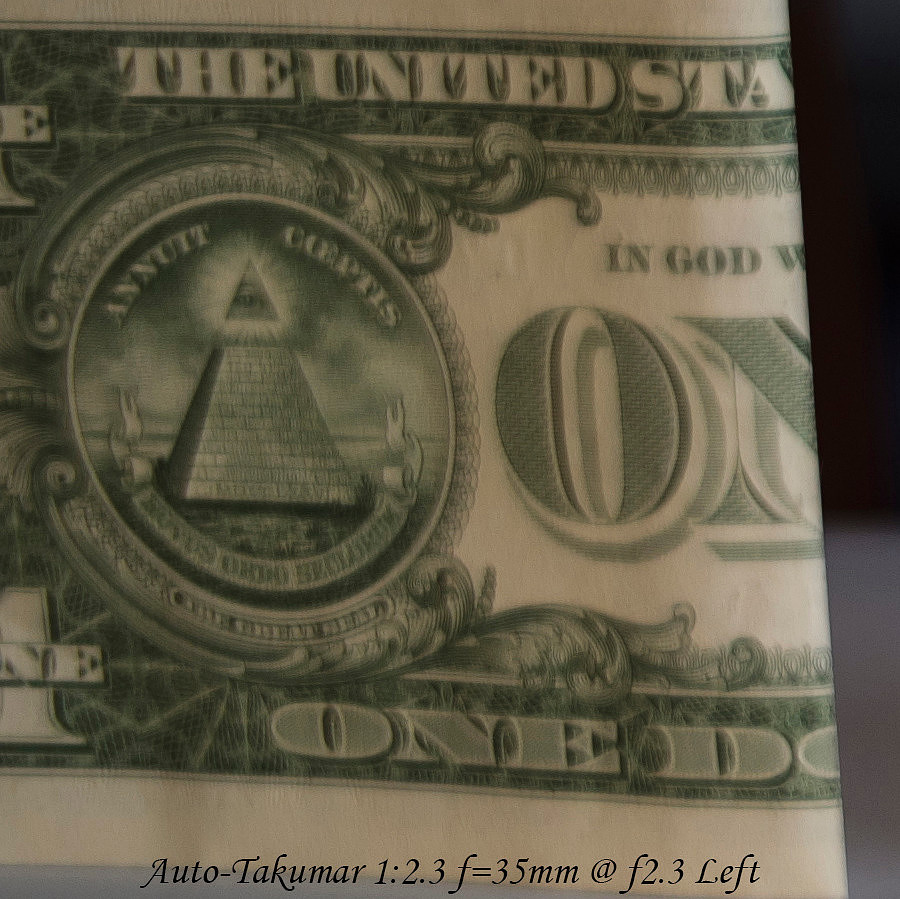
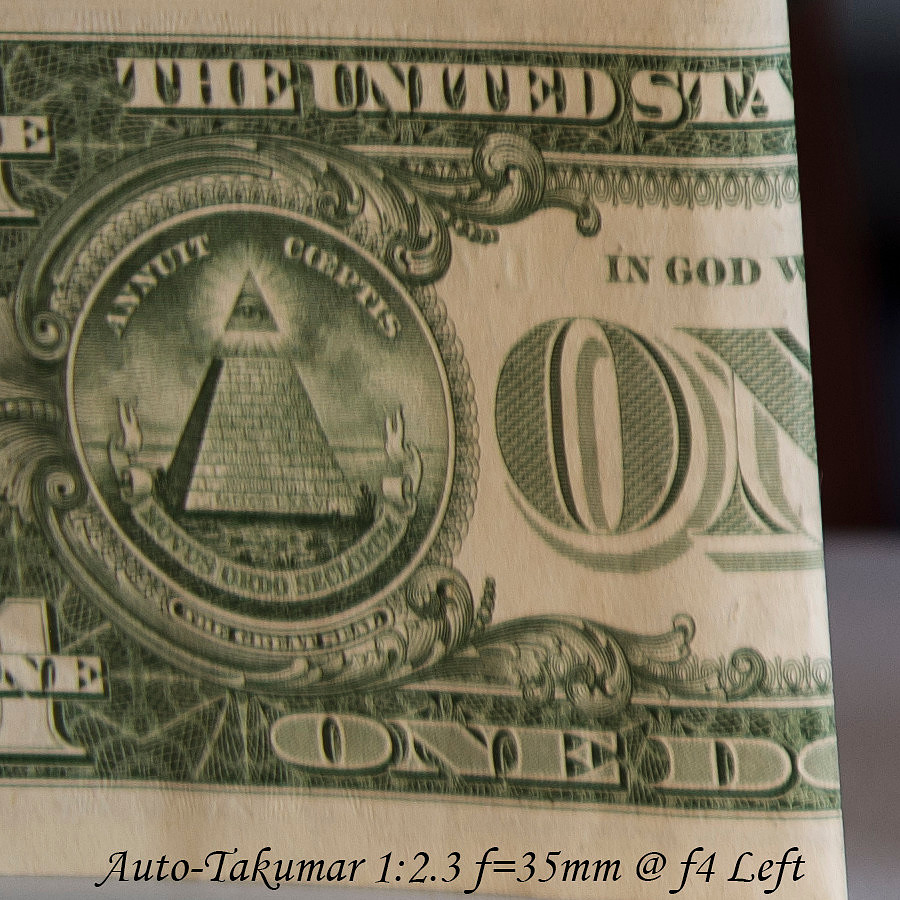
Much like the M35mm f2.8 this lens is dreamy wide open but with detail available, I am really not sure how that works.
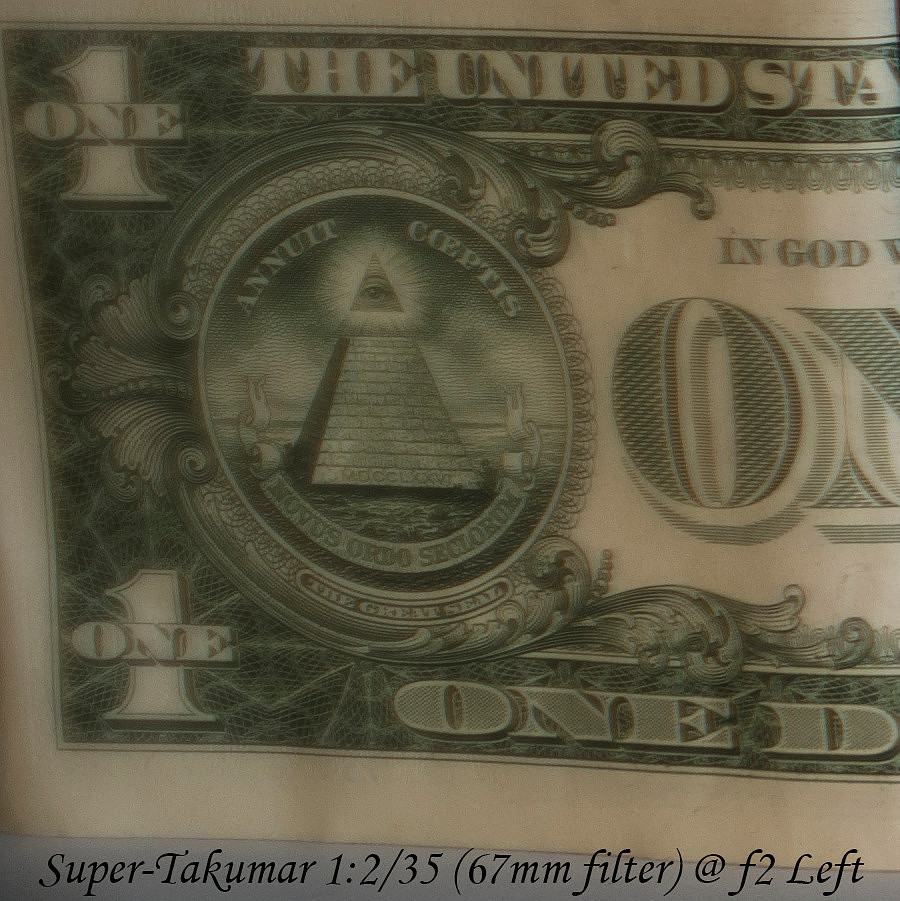
By f4 this lens really gets significantly sharper and gives good contrast as well. It is still not anywhere near the Sigma though.
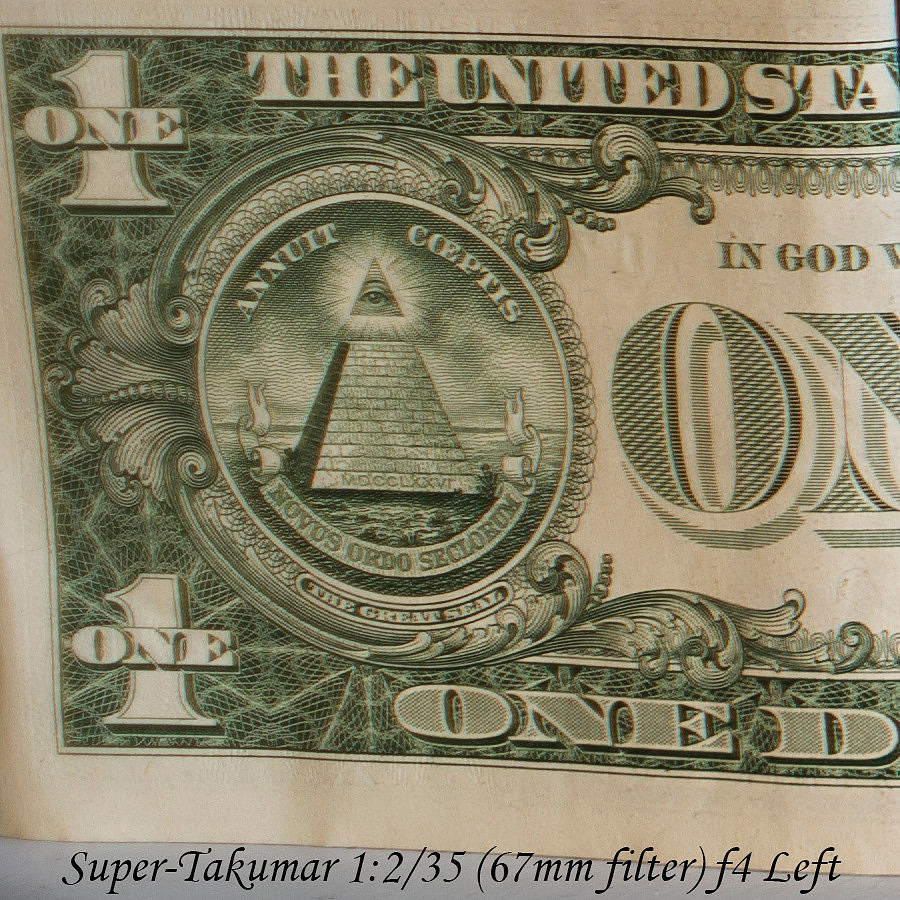
Honestly the move to the new optical formula in the 49mm filter ring Super-Takumar left me puzzled, the edge is significantly less good, maybe they just wanted a smaller lens?
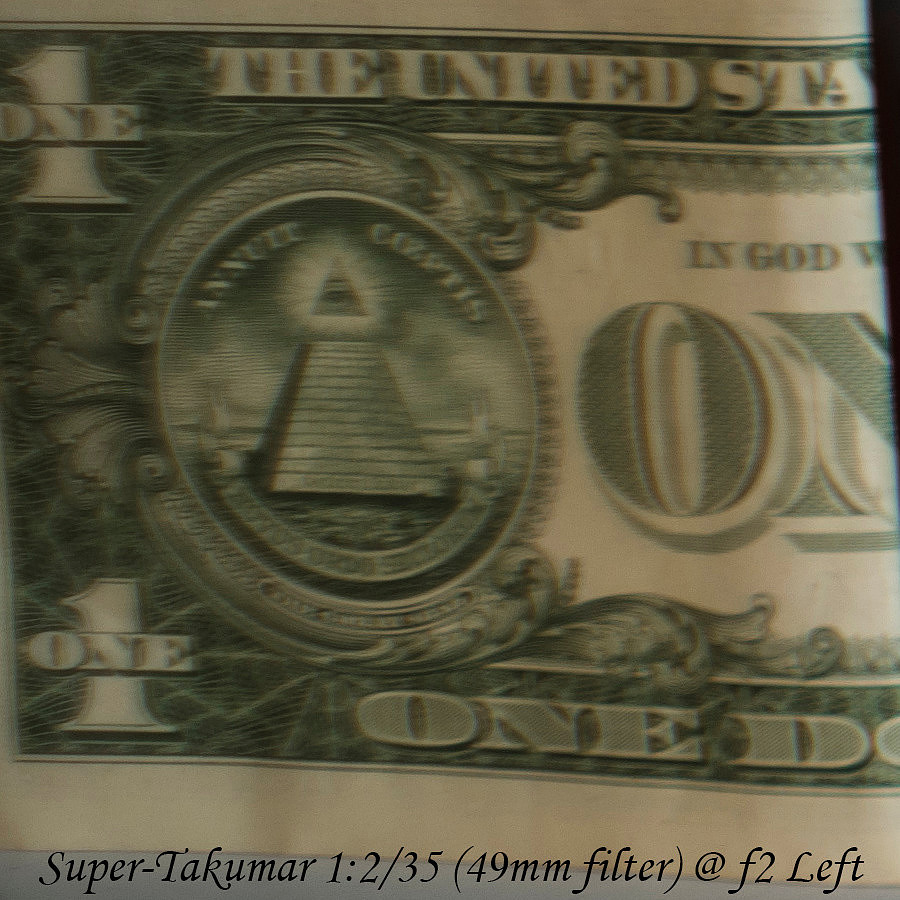
Still not feeling it here.
Like it's K mount twin this is great wide open, and got better with stopping down.
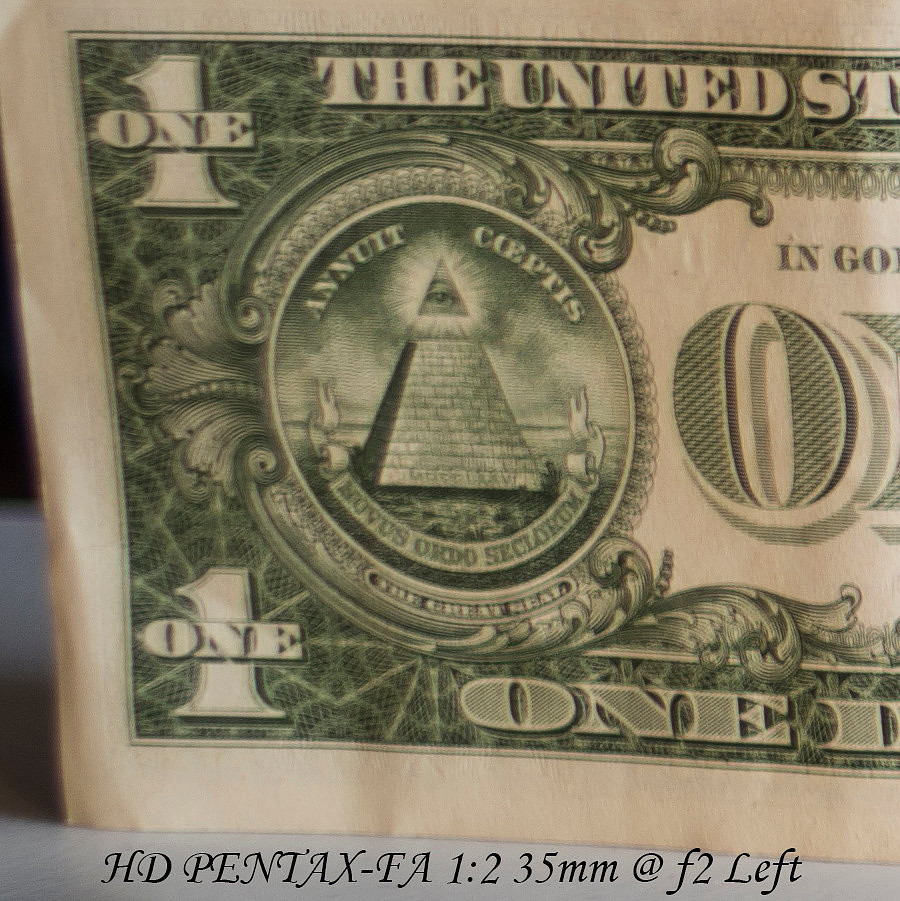
I am on the fence about this newest iteration of this lens. The optical formula is a 1999 design with new HD coatings. If you look at general user ratings on Pentax Forums, the non HD version is preferred by some, but I do not thing the resolution changed just the flare resistance. I do REALLY like the size and that it is autofocus. But aside from the f2 aperture to provide separation from the background I think the K 35mm f3.5 or the m42 versions are sharper edge to edge.
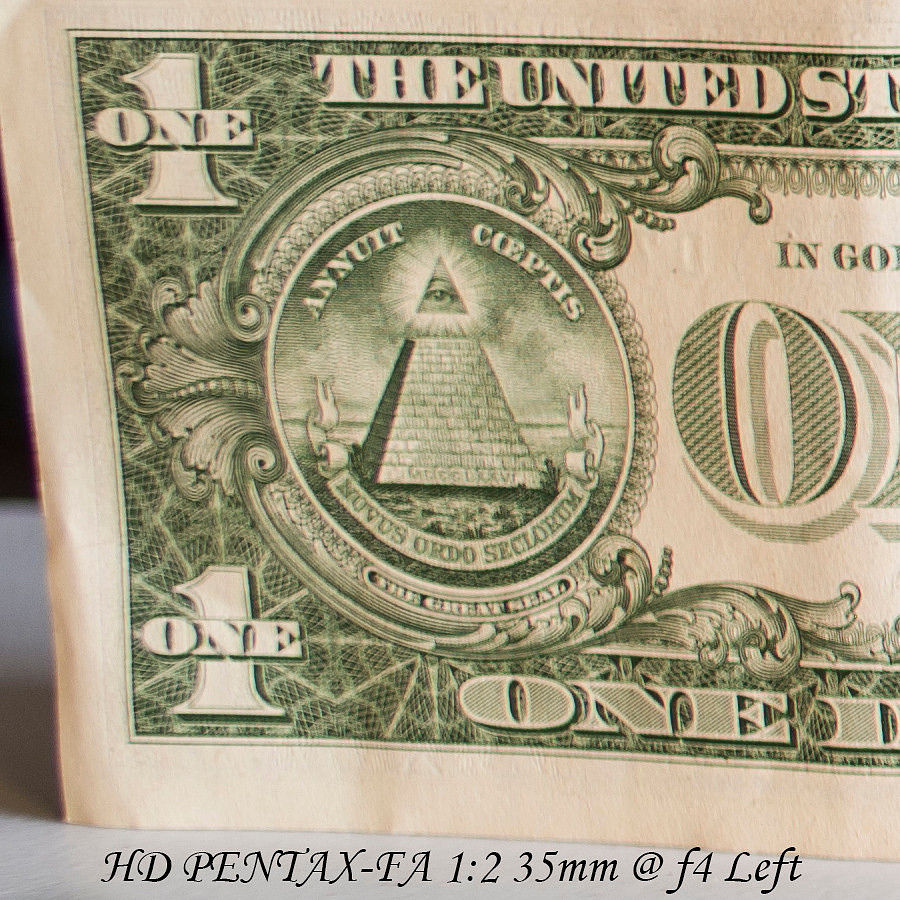
F4 is getting better but not up the f3.5 lenses.
For a zoom not terrible, I think it was stronger at 28mm in that test, but still for a zoom wide open this is acceptable edge performance.
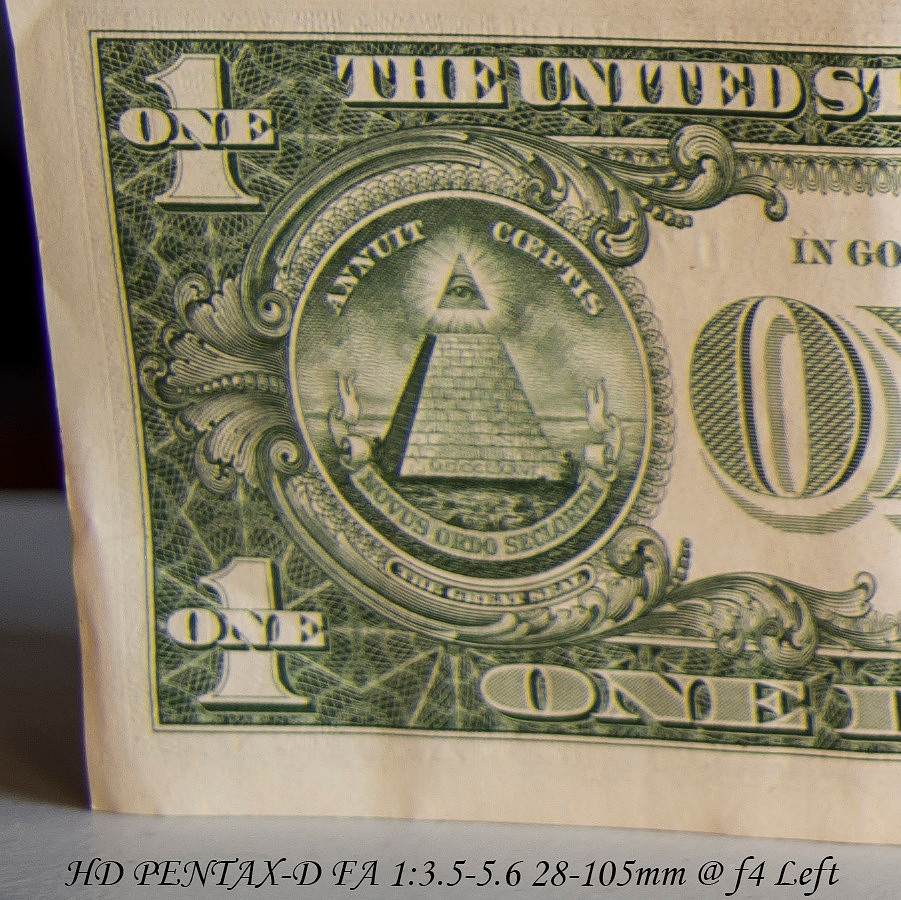
Honestly, I expected this to be much worse, but it still ain't good.
Part one: SMC Pentax 1:3.5/35 (AKA the K35mm f3.5)
Ah... Here we are, looking at a favorite lens during APS-C times now on Full Frame. The SMC Pentax 1:3.5/35, originally designed during the days of the m42 screwmount and introduced in 1959!!!! the lens formula then being unchanged except for coating changes through the transition to the K series that introduced the K Bayonet mount It was last produced in 1977. The copy I have was purchased from a Pentax forum member many years ago. (RIP BrandRx) on my K5 it was a mild telephoto joy in a small package, in my K1 it is a mild wide angle with a small aperture wide open at f3.5, and still a small package. I will freely admit that one of the compromises made to go full frame DSLR is that the camera body is... unsmall. I accept that for the IQ and the handling, I find that Mirrorless Cameras have too small of a body for me to really hold correctly especially as the lenses get bigger and full frame lenses, especially the modern ones, are quite chunky and can often make the size of mirrorless bodies look silly as well as make using bigger lenses a ergonomic nightmare. So, I find myself making the choice of big chunky body, that while heavy is solid, durable and useable as a self defense weapon in a pinch with smaller old primes that make the package manageable. I have my big zooms, but don't like to use them on the street unless traveling (See my series of posts on my trip to England/Scotland) as they are... just... bigger. Which brings us to this lovely lens, it is small, the smallest I own and doesn't get in the way much when running around town. It does not quite qualify as a pancake lens, but it is close enough for my purposes.
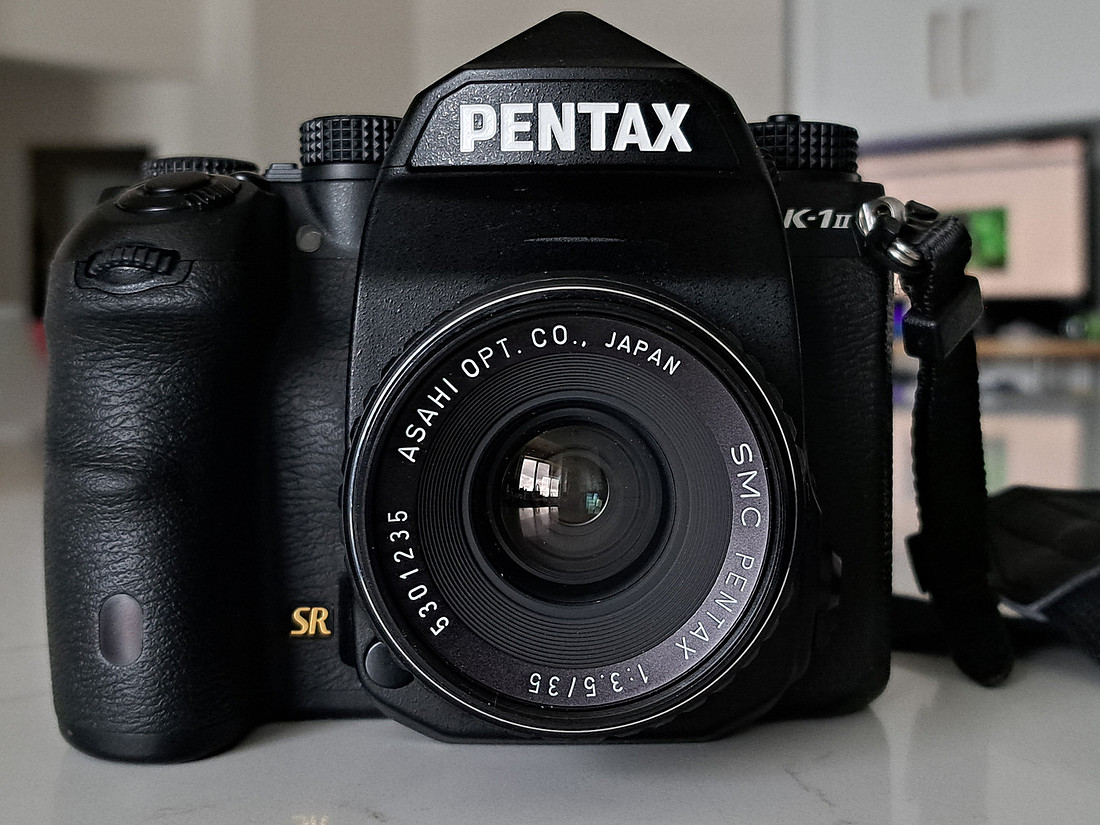
Optically, this lens is well regarded, the longevity of it's production run from 1959 to 1977 is impressive especially when it is noted that Asahi/Pentax revised most of their lens designs several times along the way but not this one. I have never found it lacking sharpness on APS-C or on Full Frame. I am working on getting some lenses together to do a direct comparison and some real world resolution comparisons, I do not have the ability to do formal resolution testing. That will be part 2.
When I got my K1 mii I started new galleries on my website where I would put photos sorted by lens for when I write these reviews up. I put the first of these sample photos in well over a year ago 2023 actually, sadly I never got around to taking many photos with it during the summer months, but got a few in the fall and then some quite recently. The first few are taken at a spot called Gallivan Plaza in Downtown Salt Lake City, UT. I have taken quite a few photos there over the years as the lights give me opportunity to test out of focus blur and starburst production. Due to the shutter speeds in these light conditions shooting off a tripod is a must.
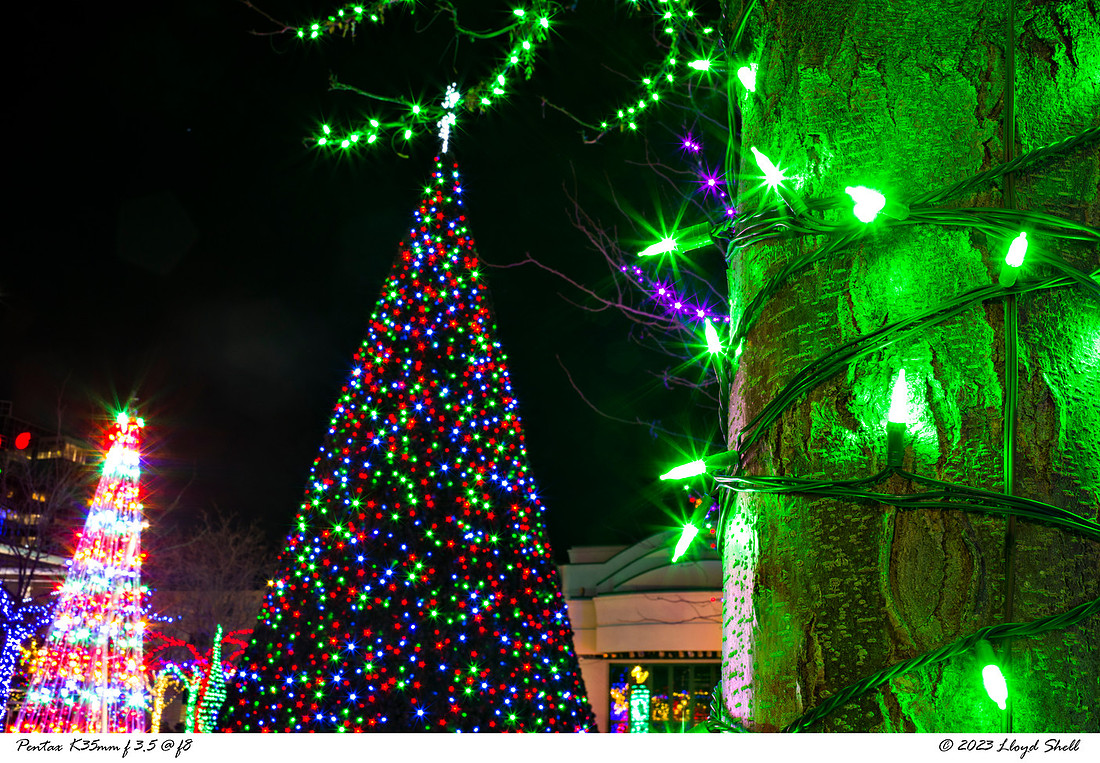
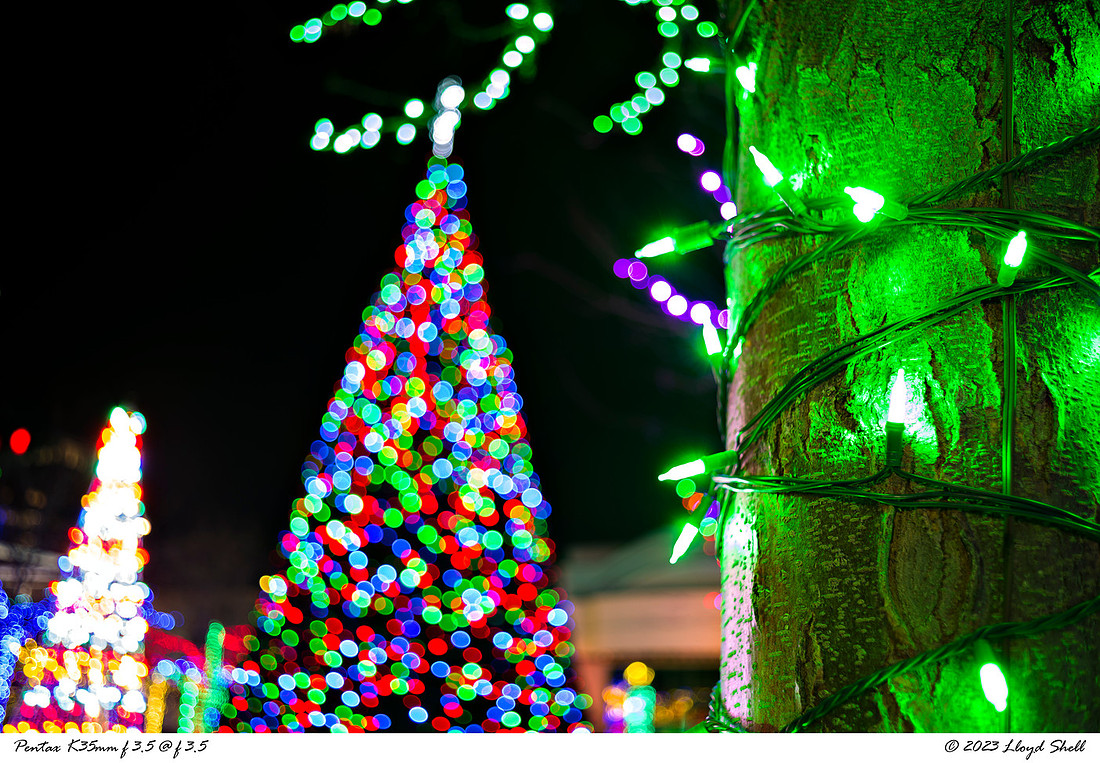
The out of focus light discs get oval towards the edges which is common on older lenses, but are pleasing, due to the max aperture of f3.5 the discs do not get as large as an f2 lens would. I have toyed with the idea of buying one, there are many manual focus and AF Pentax lenses in 35mm that are f2. Contrarian that I am I have resisted the urge and make do with what I have so I can dream of a multitude of different MF lenses instead of just one autofocus lens.
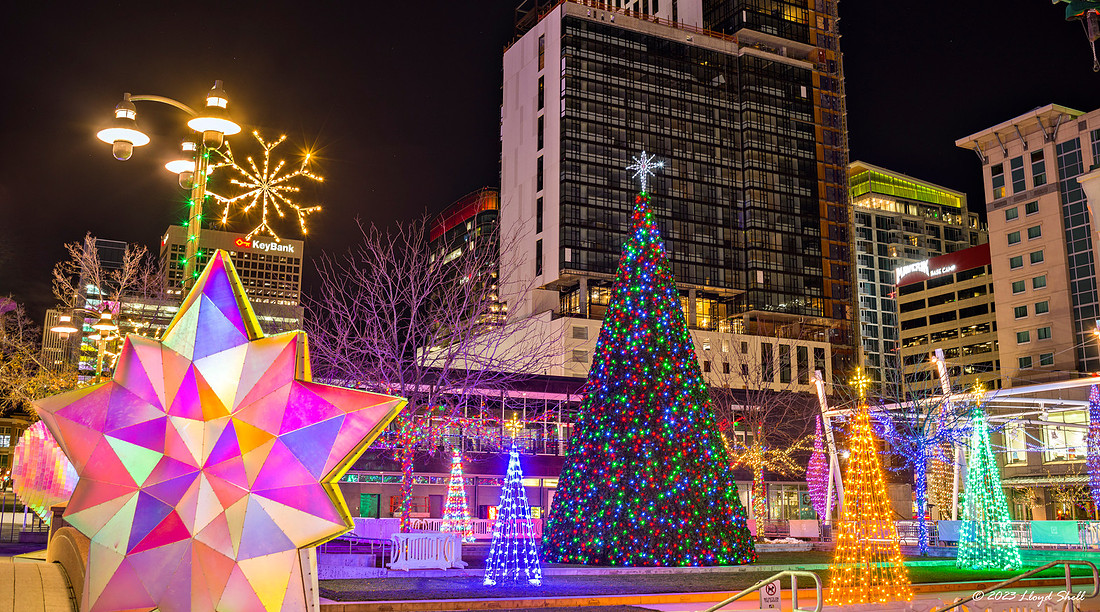
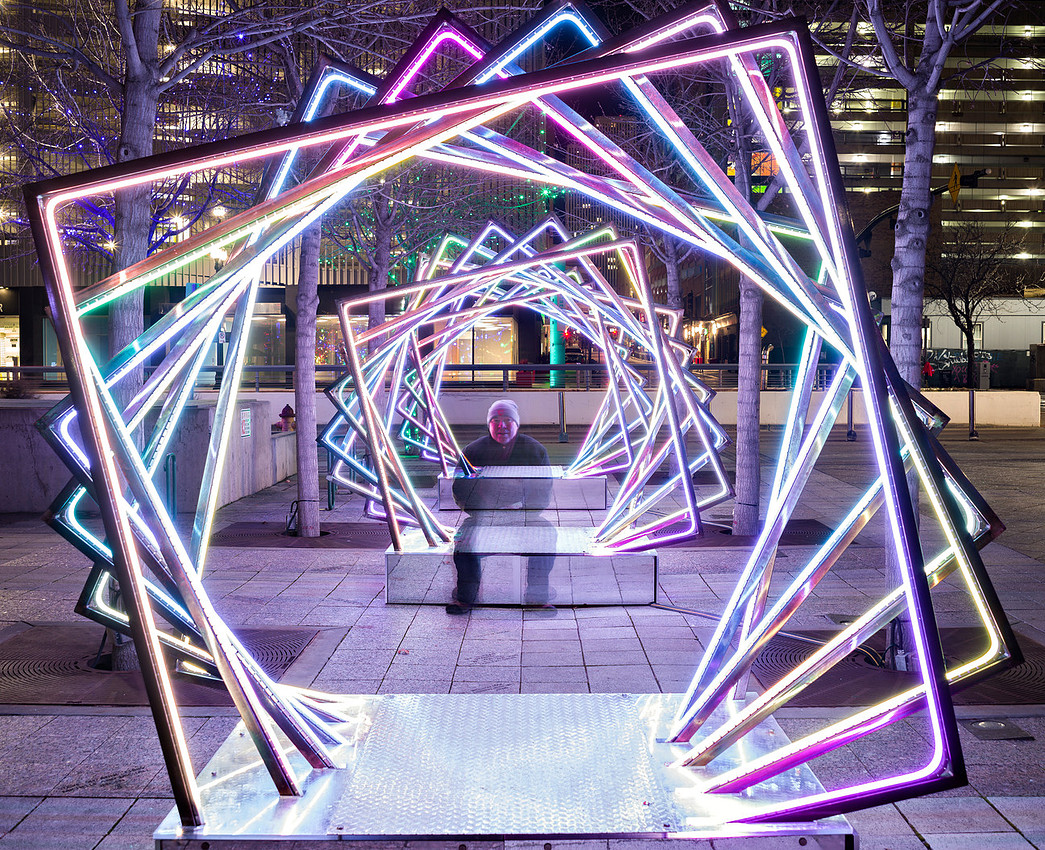
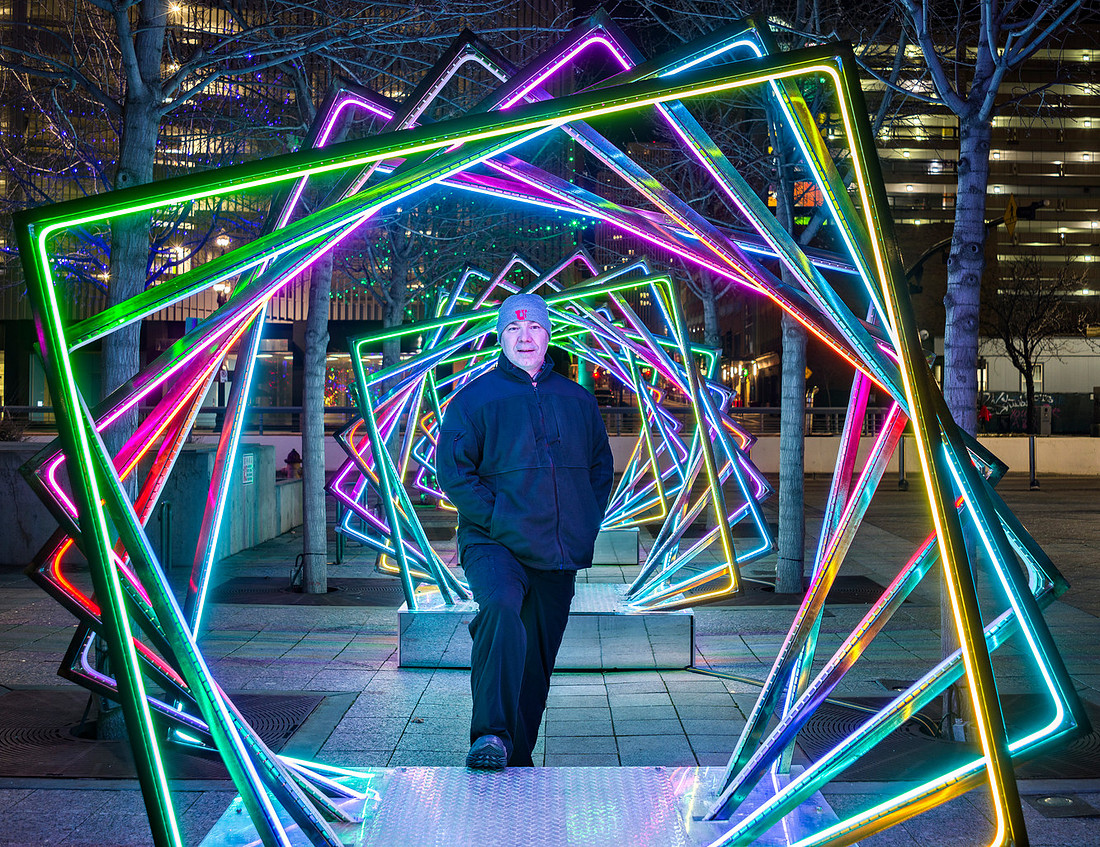
Yes that IS me,
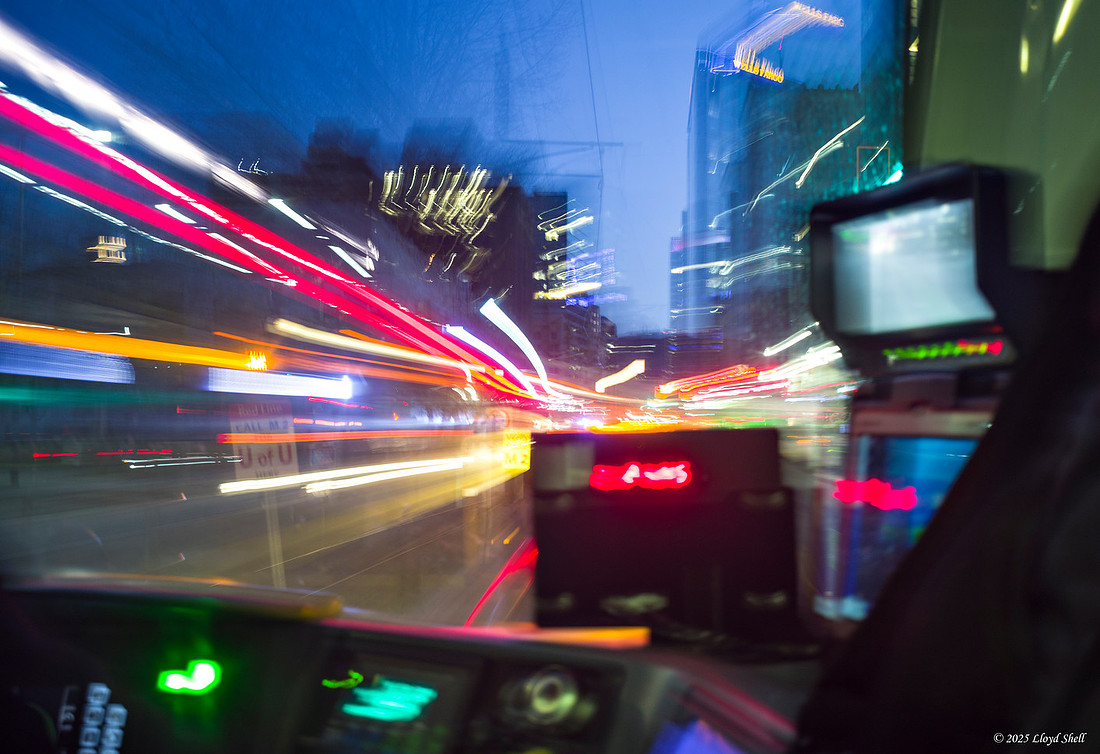
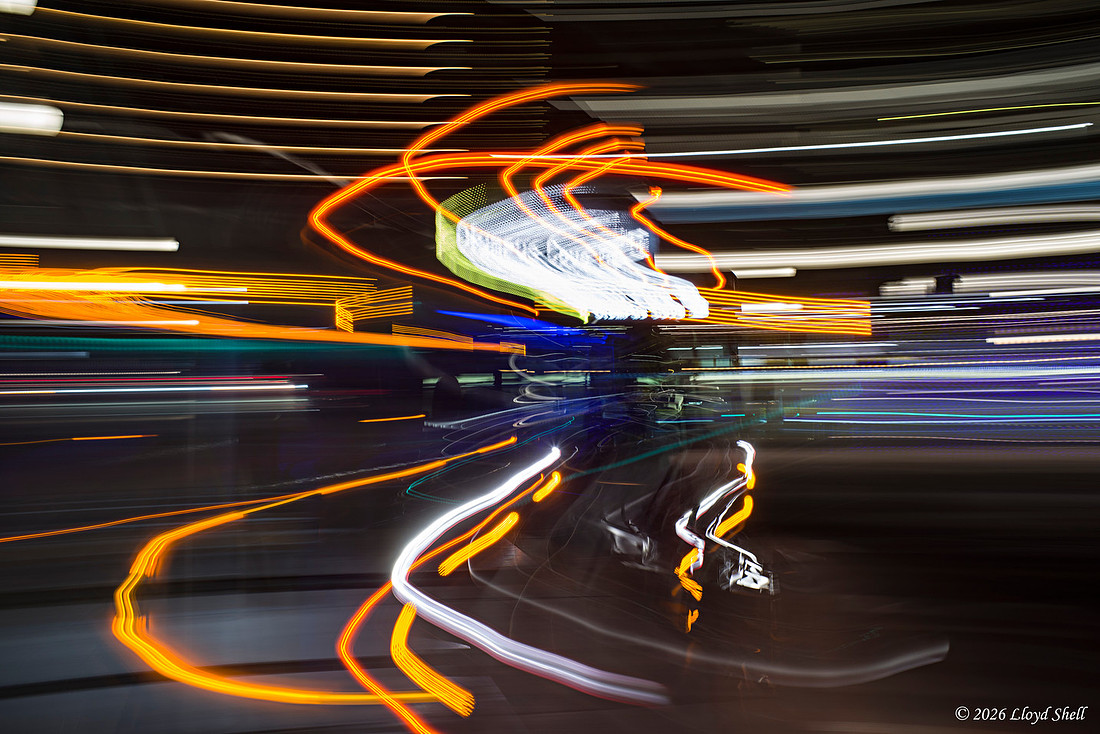
I do not know why I like these but I do, sometimes the moment is blurry and everything is in motion, especially in the morning on my way into work. This reflects to me what I see when I look through the front of the train over the conductors shoulder.
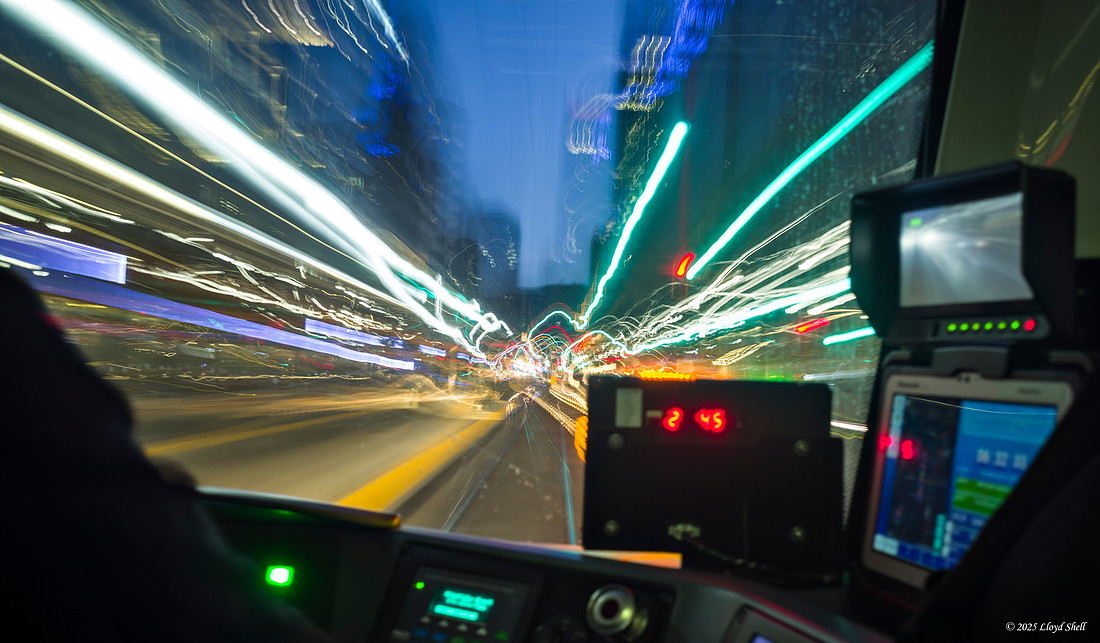
The focal length of 35mm is for me a little constricting, I have been feeling more comfortable with 28mm or 24mm of late when streetwalking. But I have been testing those lenses too, so... shrugs. I felt just... constricted here.
One of the things I actually like is the resolution the lens can achieve wide open, which is helped by the modest aperture of f3.5 which gives a larger depth of field (area in focus) the downside is a tradeoff of less separation from the background, meaning you can see more detail in the background and it can be a little nervous? or busy maybe? I don't hate it here, but have deleted a few shots that the blur was just... blech.
The aperture has 5 blades which I tend to prefer as it gives better starbursts from point light sources, in this setting and partially stopped down it gives pentagonal shape to some of the light gaps between tree branches. I think it is likely part of what contributes to the blur being busy or harsh. I can deal with it. I do not think Pentax has any 35mm's with rounded aperture blades. Sigma has a 35mm f1.4 Art lens that I would love to play with someday... but the price is prohibitive and I'm not sure the focal length deserves the money for my style.
The color rendering is typical Pentax and the light falloff in the corners is negligible for my purposes, and can be fixed in post easily anyway.
Some people take pictures of brick walls to show distortion etc... I take pictures of brick walls for different reasons. Stopped down the depth of field is quite large and I liked the perspective the focal length afforded me.
I cannot remember but I believe this was at f5.6 or f8 but at closer focus distance, getting the sign fully in focus was my aim not blurring the background out. I am struck by the way that not having the option to just blur everything out in the background changes my compositions. I remember fussing a bit on this before deciding to take the shot despite my urge to blur everything but the subject. Could be a failing on my part.
The Pentax SMC (Super Multi Coating) technology was revolutionary at the time and still holds up well, despite the sun not being directly in frame there was sunlight hitting the front element from the right. The single pentagonal flare and preservation of contrast and color is excellent. This is an aspect of this lens that I really REALLY enjoy in that I do not need to worry about flare or chromatic aberrations with this gem.
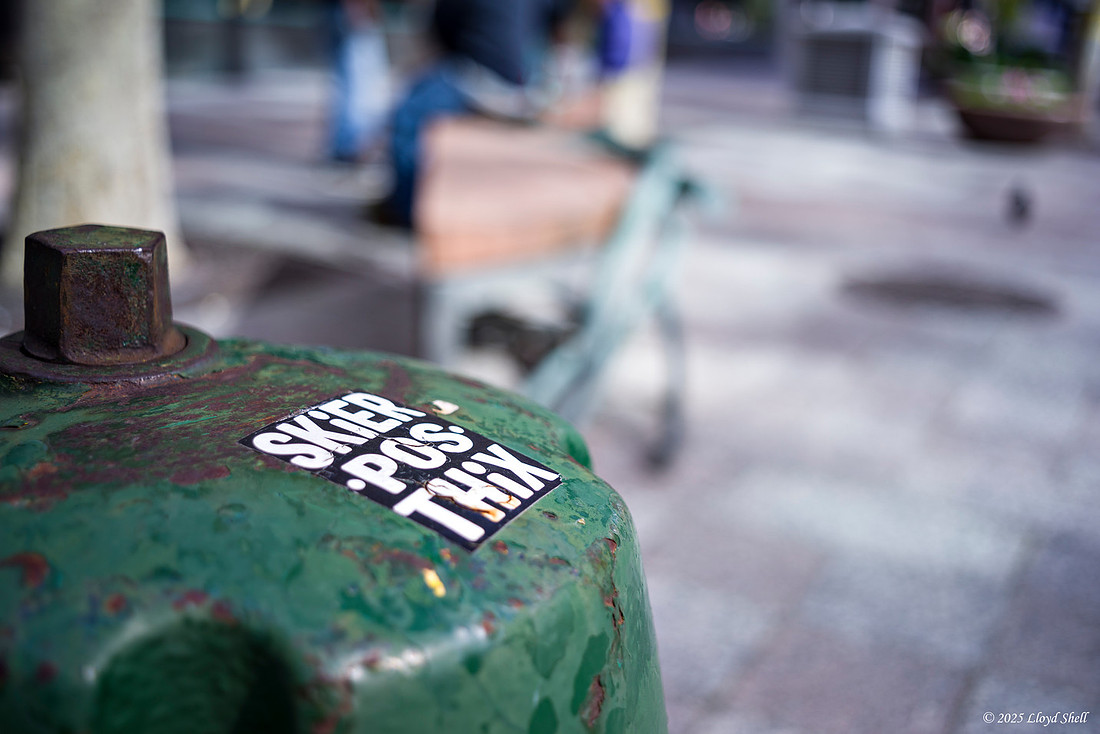
Closest focus and wide open, this is a blurred as I can make a background, not terrible. Also notice the lack (near absence but not quite) of green or purple Chromatic Aberration on the sticker. Most lenses of this era would not do as well.
What do you think of the background?
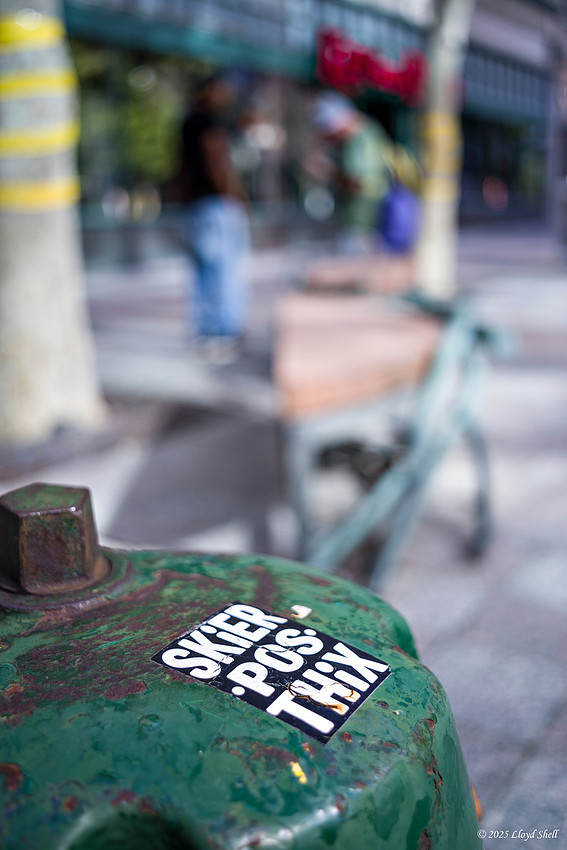
Hand held wide open closest focus distance, had to bump the ISO and this is not as sharp as I would like, but it is still kind of fun.
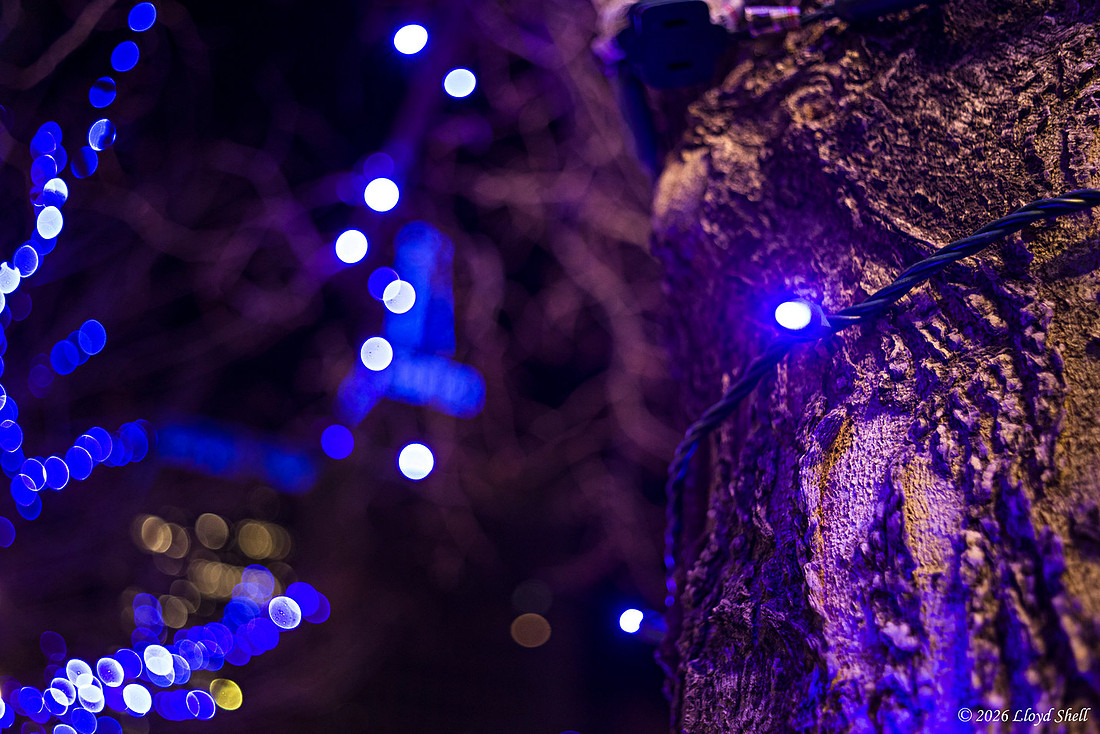
Just a few feet down the street, same settings but now at infinity focus.
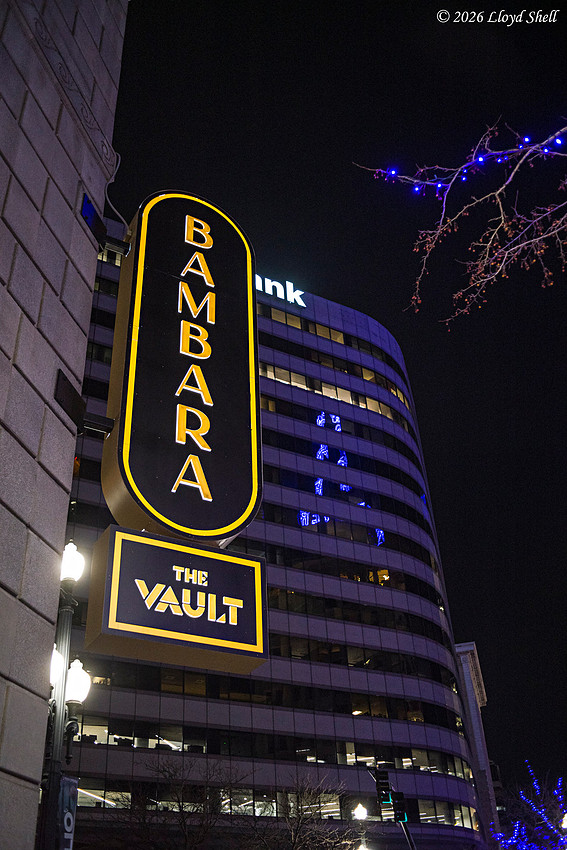
I need to practice my panning technique, this bus pulling in was a little tough.
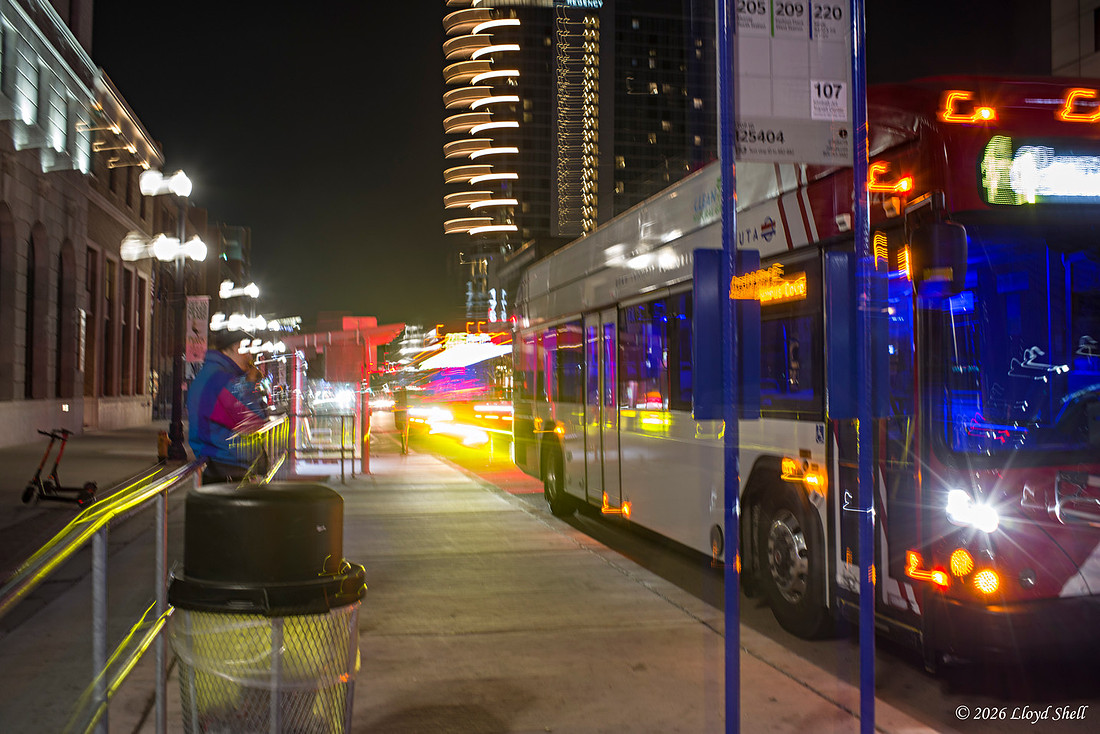
This time of year I go to work and leave in the dark. Sucks, but not as bad as when I was in school in Scotland for a couple years. That place is HARD!!!! You shoot with the light you got unless you have some to bring with you. I do have that but not when commuting. Hand Held Flashlight doesn't play well with Camera Holding.
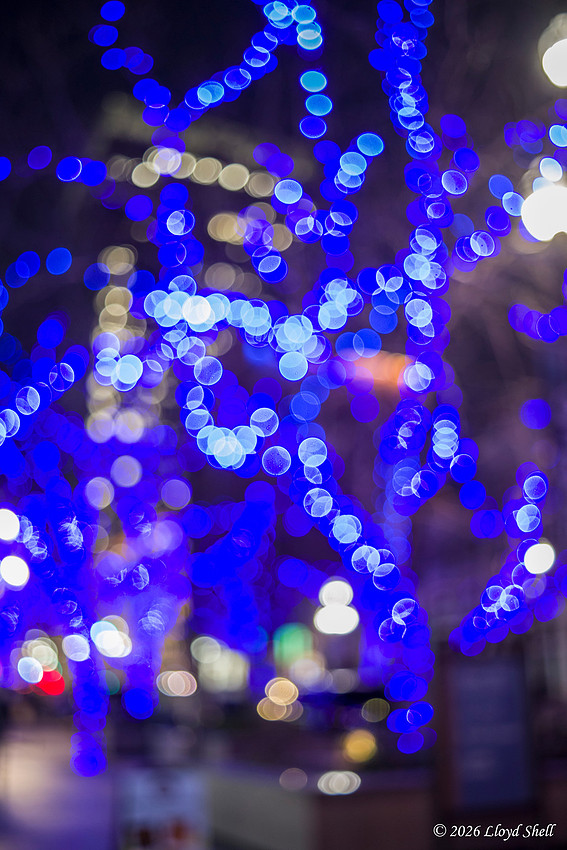
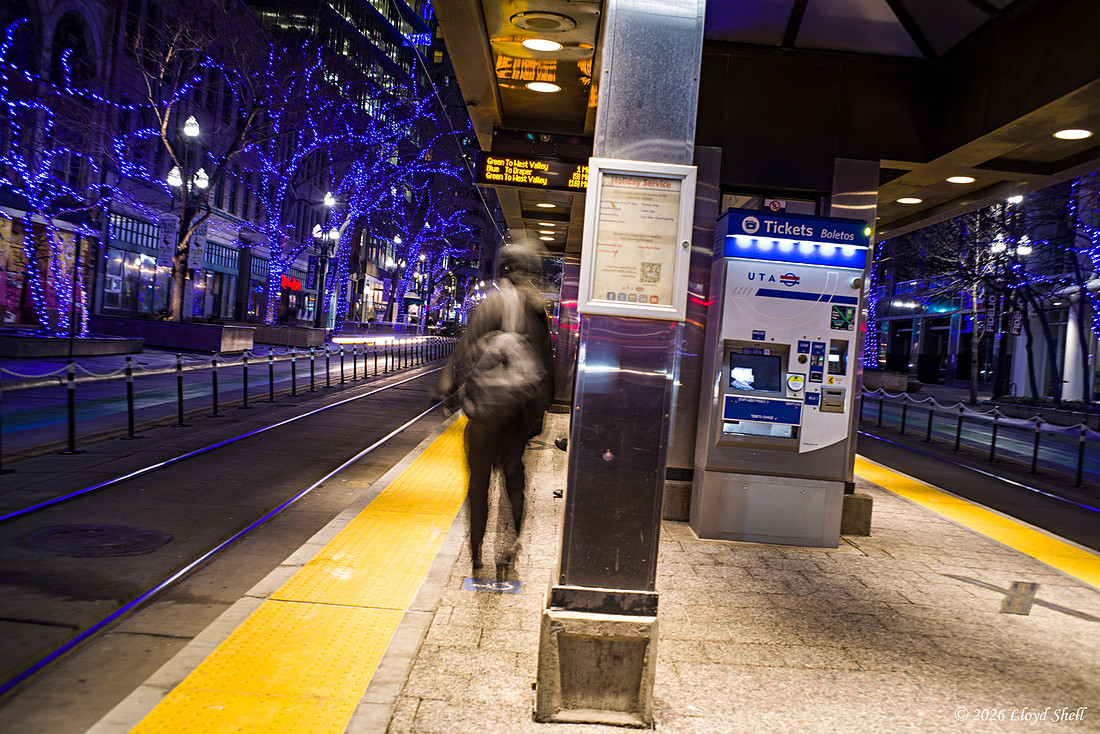
More accomplished photographers probably look at my posts and are shocked at my lack of ability to weed out the mundane. I don't worry about that too much, I'm not taking pictures for them...
Thanks for looking and be on the lookout for part two when I can arrange some indoor time to play with lenses on tripods.
Let's Focus More Closely on the SMC PENTAX 1:3.5/28 lens
My most previous post to this one came about as a off shoot of preparing for this post, asking a fellow Pentaxian for a lens to compare this one to and getting a BUNCH. You really should read that one before reading this one otherwise you may be a little lost here.
I started specifically taking a few comparison photos in late November with this lens, also known as the K 28mm f3.5 and the M series 28mm f3.5 that was recently given to me and was the next generation of this lens. Designed to be smaller and more compact the M series is well loved and regarded as being quite good optically, with some of the lenses regarded as being optically not as good as their predecessors in the K series. Having the opportunity to test the K and M head to head on the same camera and at the same time was exciting and intriguing to me. I can appreciate a smaller lens, I freely admit that the K1 is a chunky monkey of a camera and a smaller lens can help make it less unwieldy. But, I would not trade it for mirrorless, the ergonomics with a bigger lens are just terrible.
FYI, I will not put any suspense in this post at all, I really treasure this lens, it has its quirks, the edges can be iffy at times, but it is very sharp in the center and middle portions even wide open at its modest aperture, the edges sharpen up nicely when stopped down, it provides good starbursts when stopped down and there is a proper light source to induce it. And it is a good sized lens, not too big, not too small it handles well and the K1, and my old K5, balance well in hand with the lens mounted. It handles light on the front element reasonably well.
I took these two lenses and my DFA 28-105 as a trio to compare performance to a local park with lights in the town I grew up in called Draper, UT. Initially, I just wanted to look at the effect of different apertures close to infinity focus.
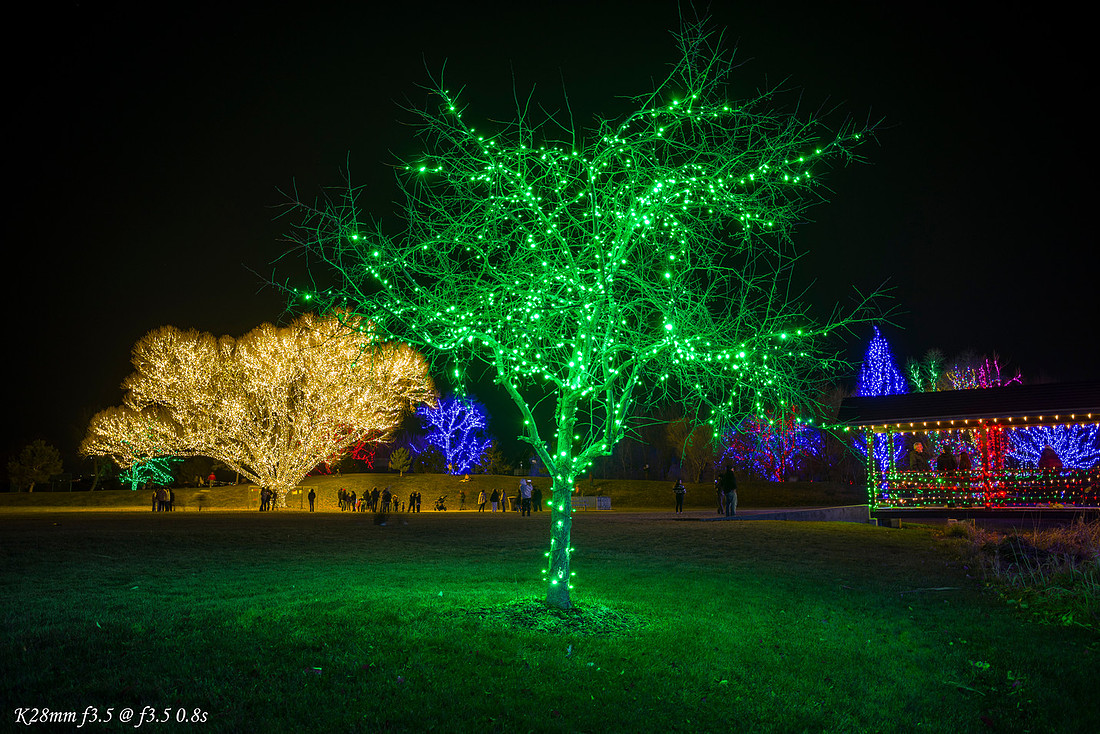
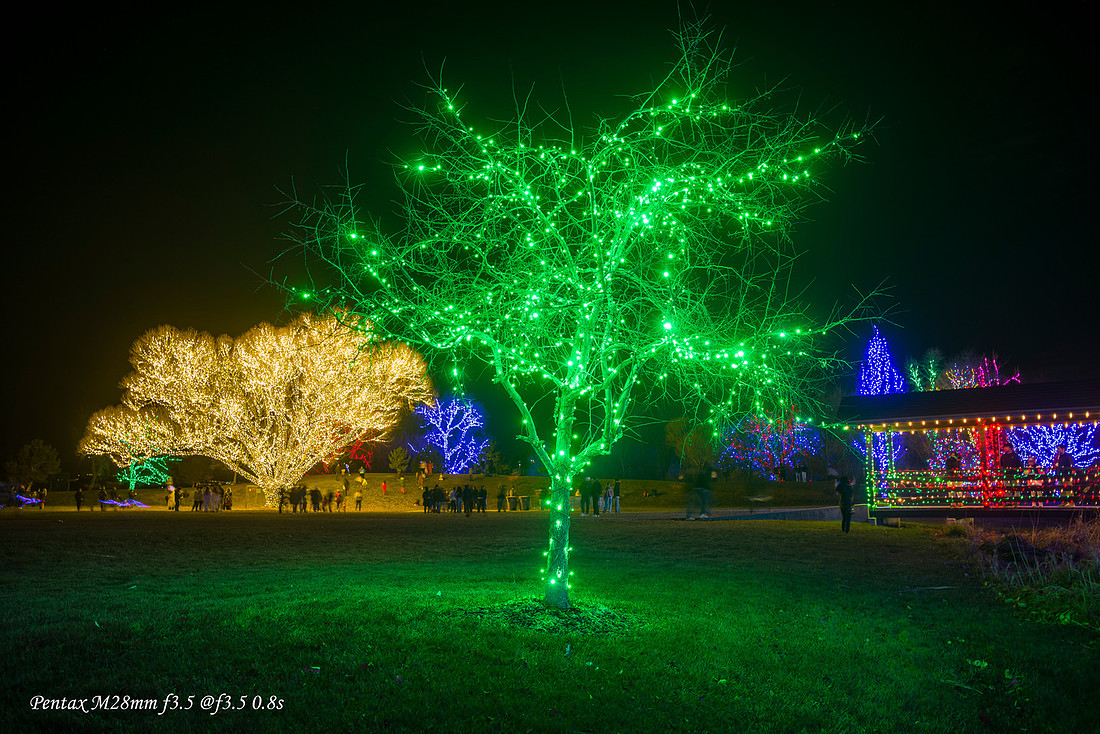
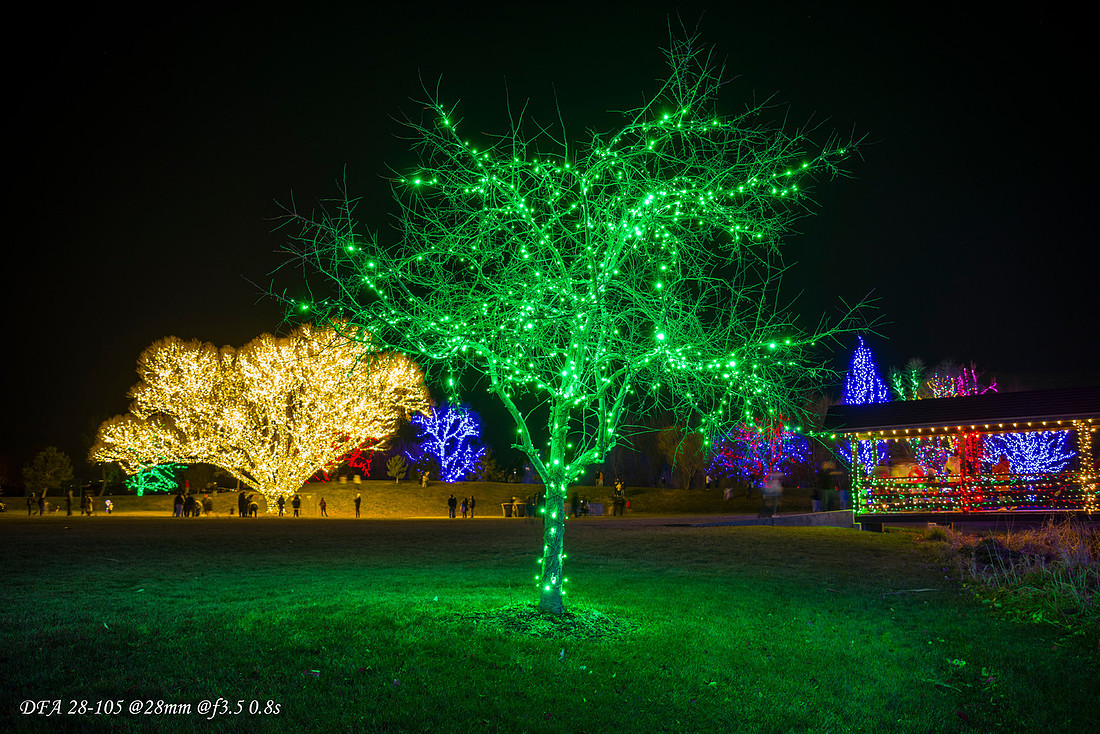 Centrally all three were really more than acceptable and provided good color and sharpness with the M being a little dreamy and less contrasty. The edge is where things varied significantly.
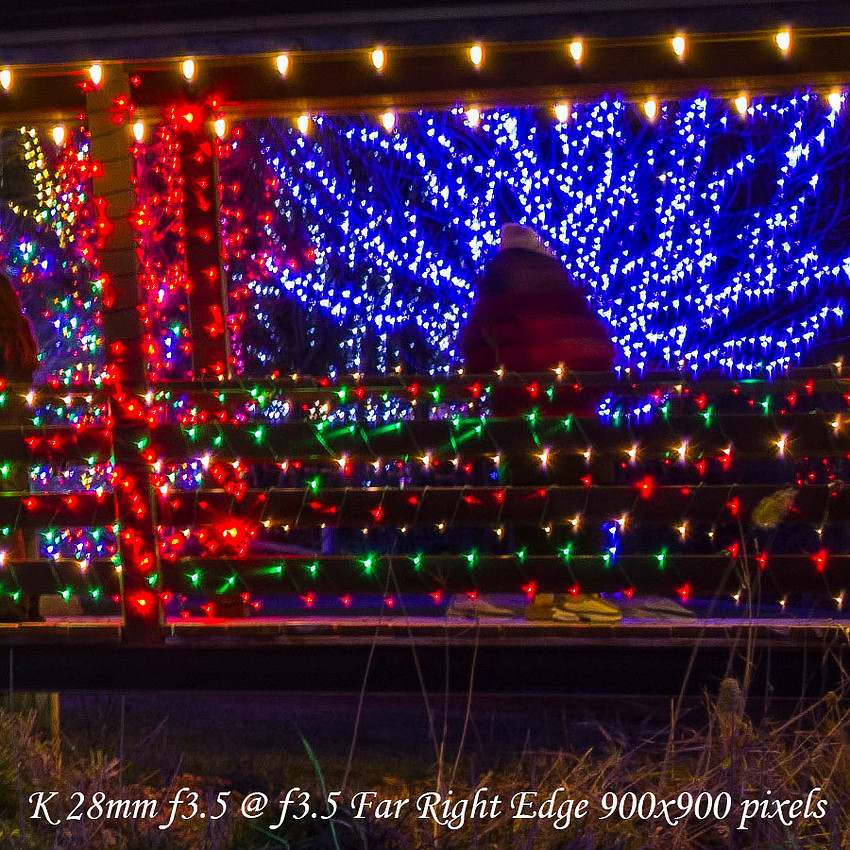
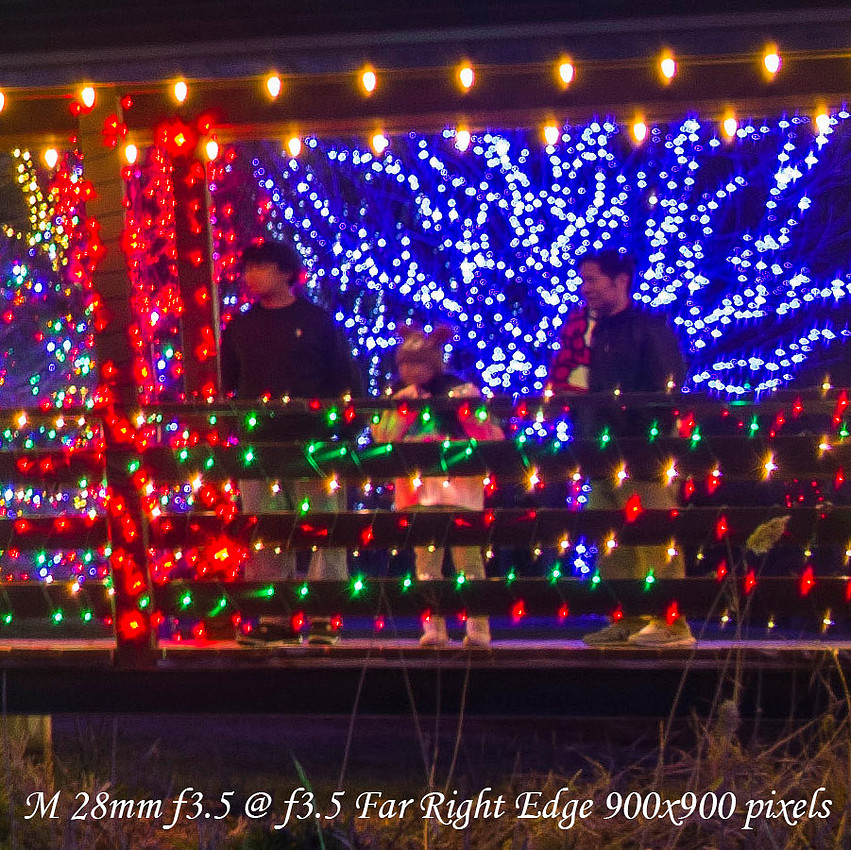
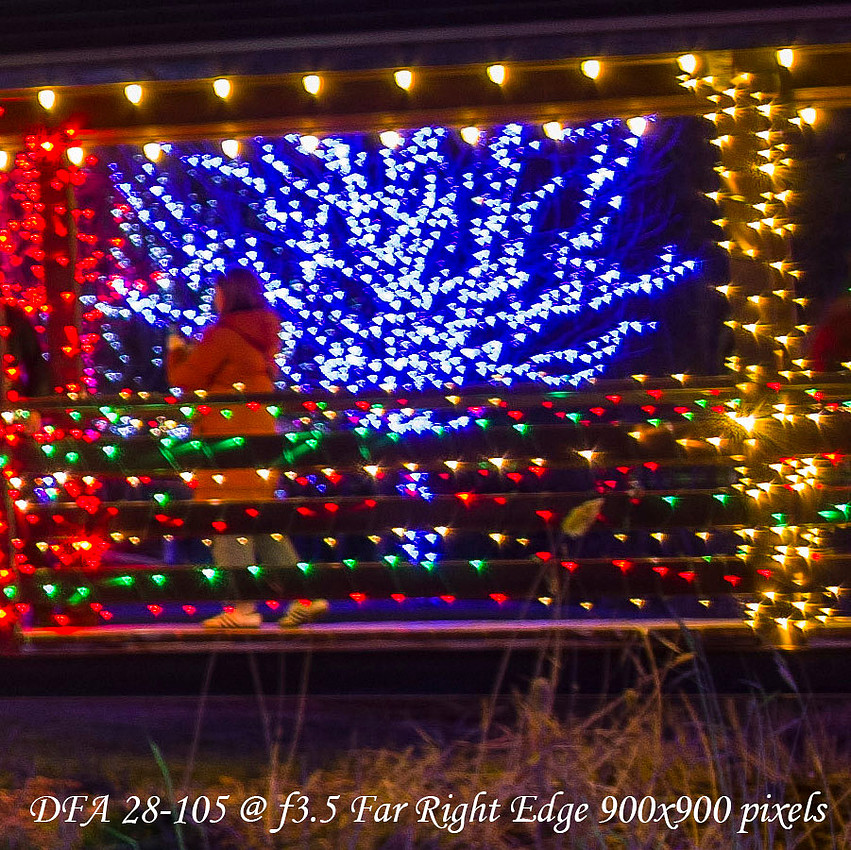
The shape of the lights in this edge crop indicates the extent of aberrations and sharpness and has an effect on rendering of out of focus blur. All three lenses are quite different. Surprisingly, based on the results in my last blogpost the 28-105 was significantly worse than the two primes.
For my style of shooting, nighttime photos like this are seldom taken wide open, but are stopped down to f8-16 range and on a tripod. At f16 things change significantly.
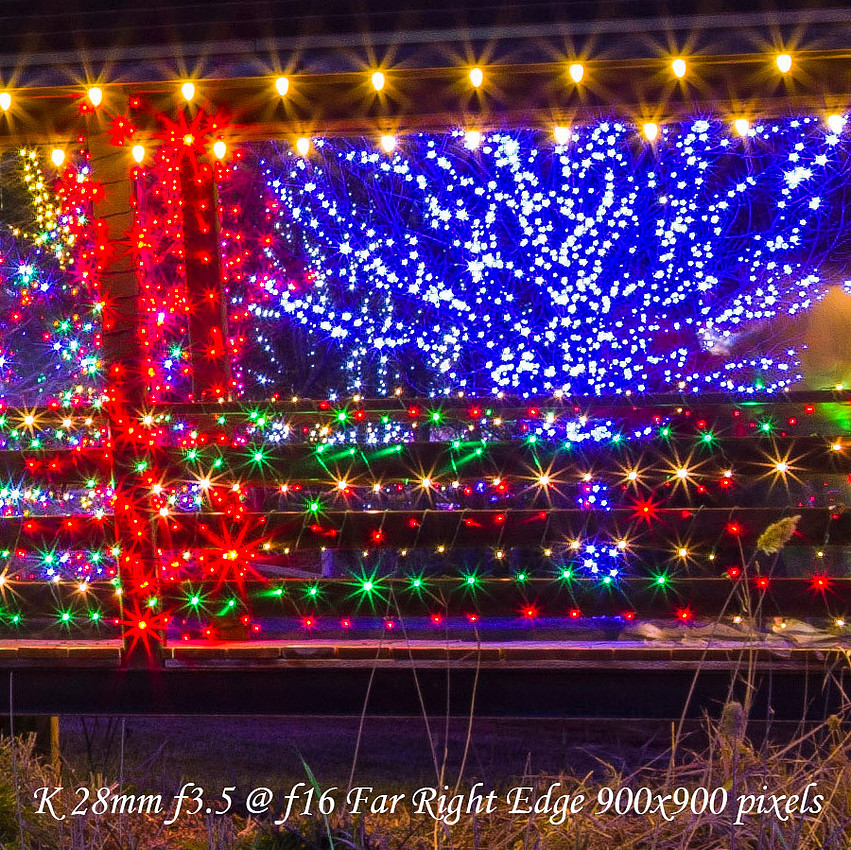
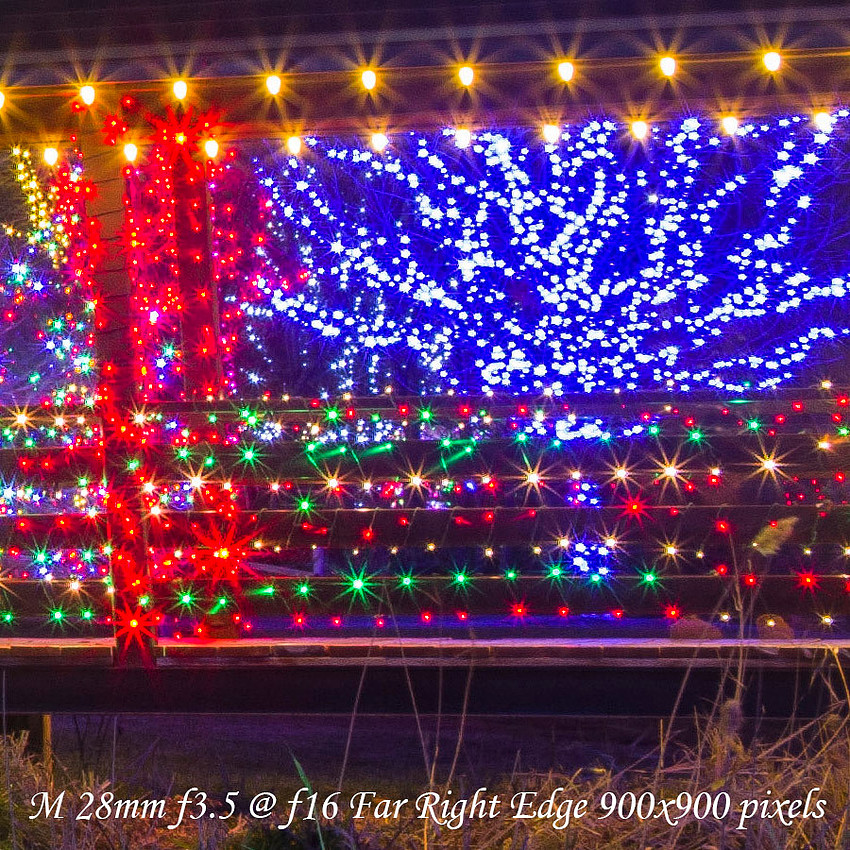
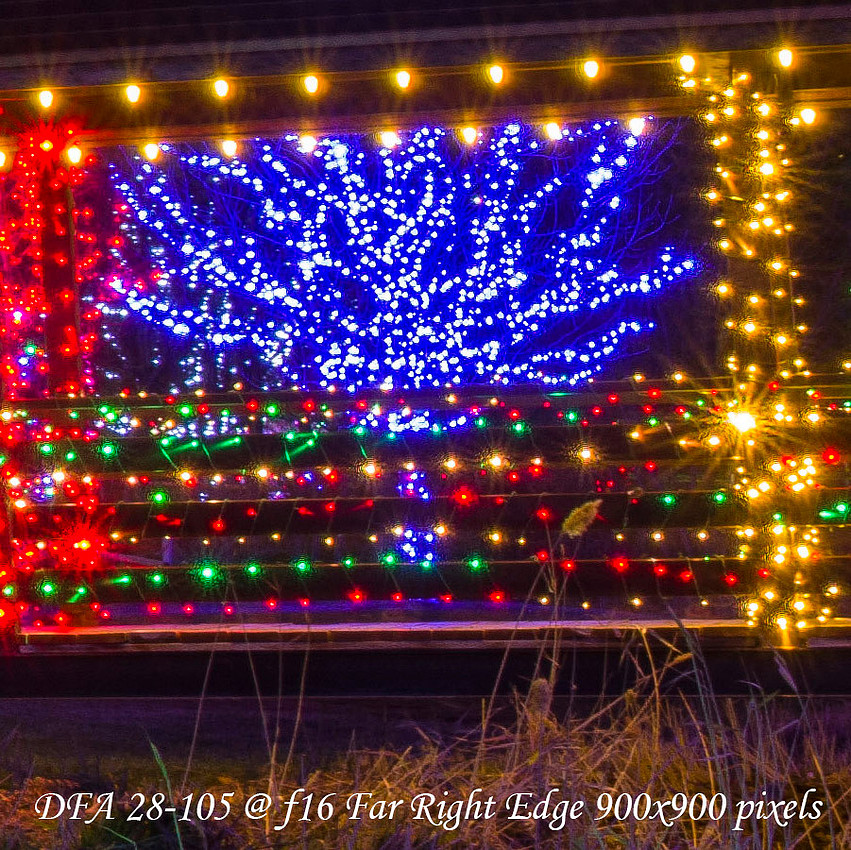
Quite the profound difference with the zoom coming out much more poorly. With the K and M nearly identical though the K seems to have a little more contrast.
Now, I don't want to belabor the comparisons too much, it is much more fun to just show what the lens CAN do. Here are a few photos from the same time but without comparisons (as I didn't take comparison shots.) and others just gadding about town. Which is my preferred MO honestly, grab a manual focus prime, and go walk around, if something looks interesting take a picture.
First are a couple more from the park. I do like starbursts in photos and these older 5 bladed lenses give you a 10 ray burst that looks different from many multibladed new lenses, I rather like it. Oddly 6 blade apertures only give you 6 rays and I am told that all even numbered apertures do that while odd numbered apertures give you double the rays as aperture blades. I really wish I knew why.
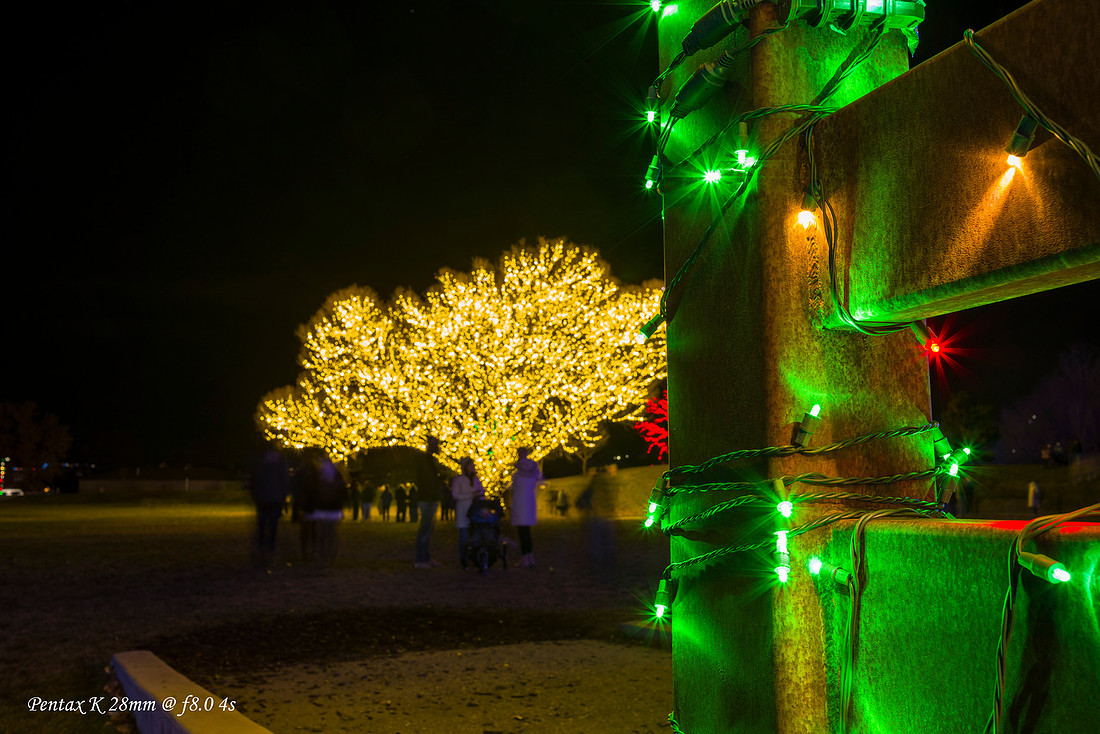
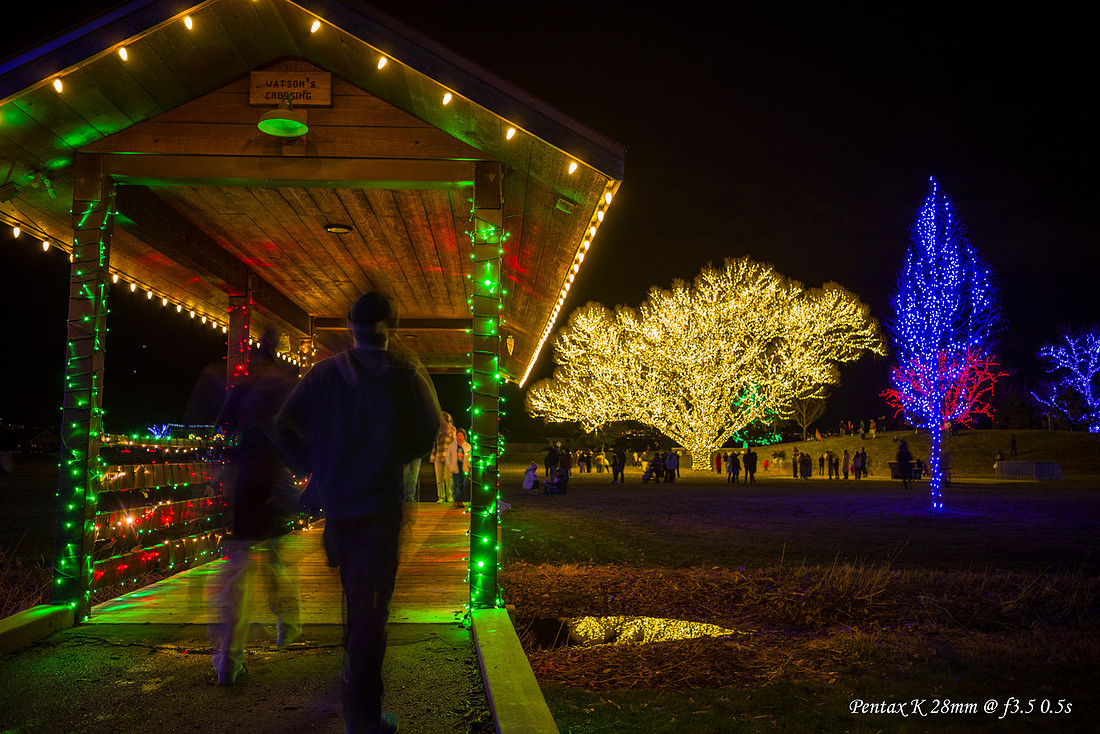
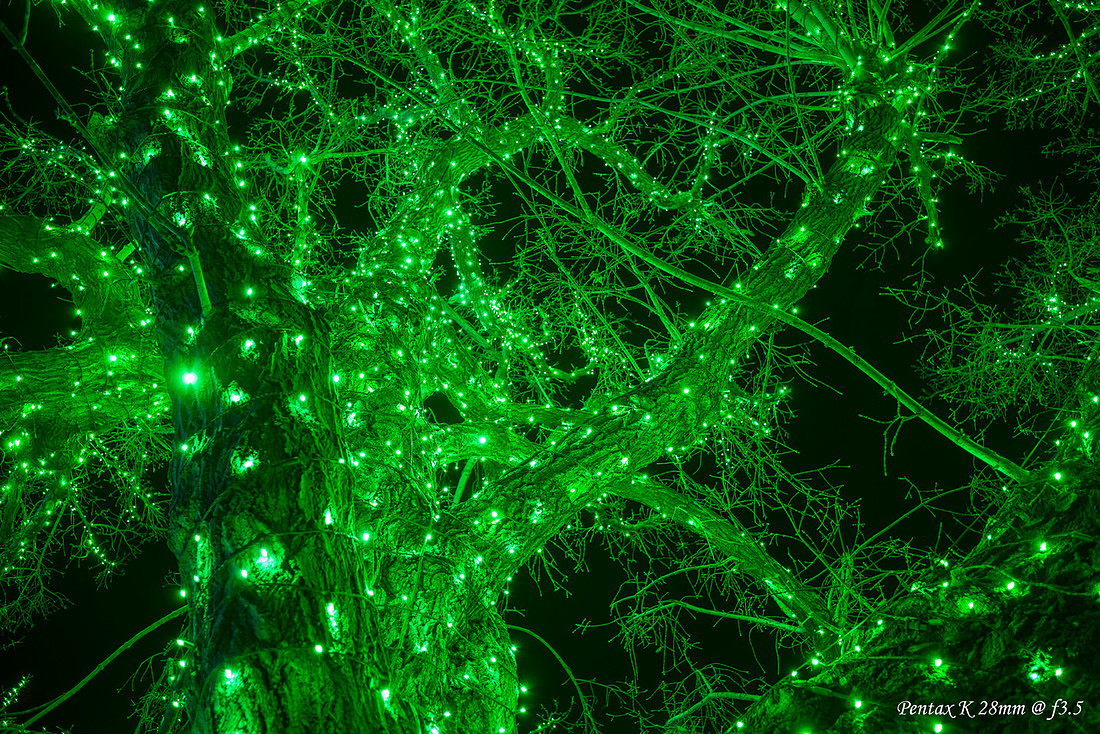
This photo shows in great detail the difference in f3.5 and f8 with this lens. I was quite pleased overall with this lens.
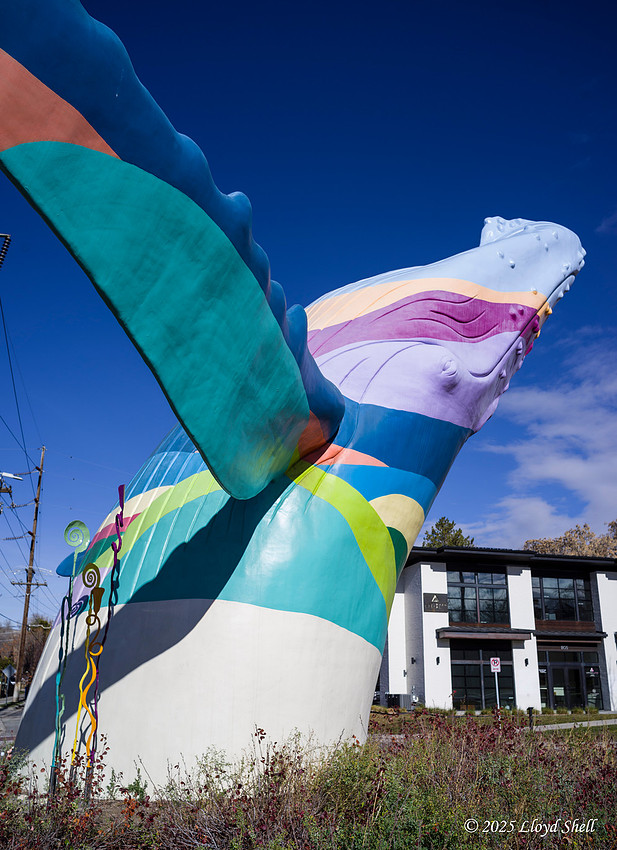
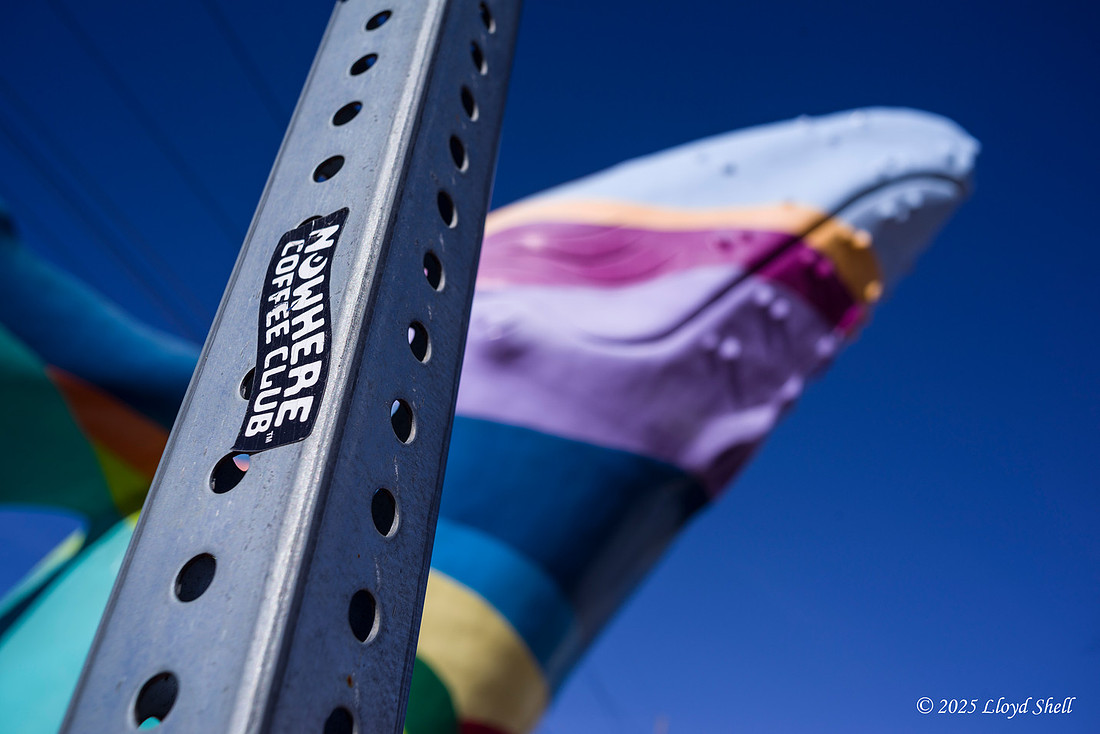
This fun oddity is simply known as "The Whale" it is an art installation inside of a roundabout in south east Salt Lake City. It tickles my fancy in a way I cannot fully describe. When I test a much more wideangle lens I have plans for a nightime long exposure.
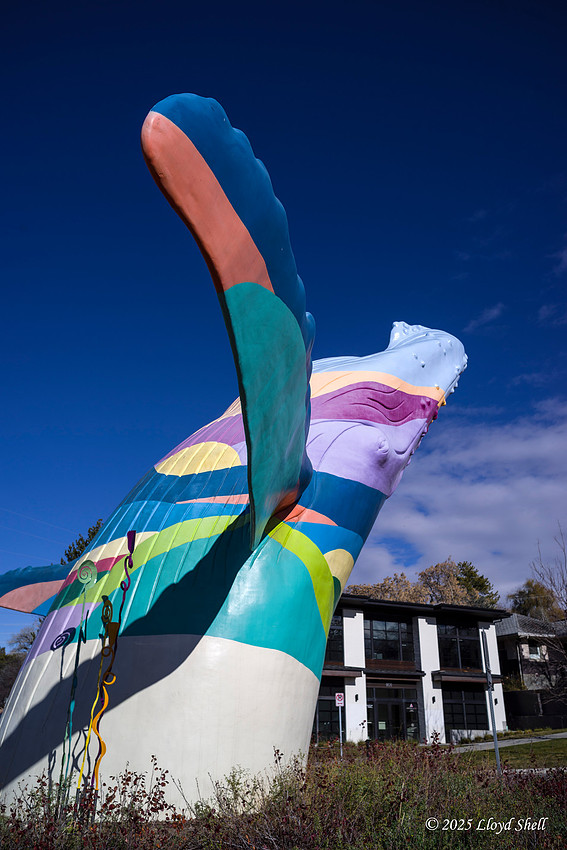
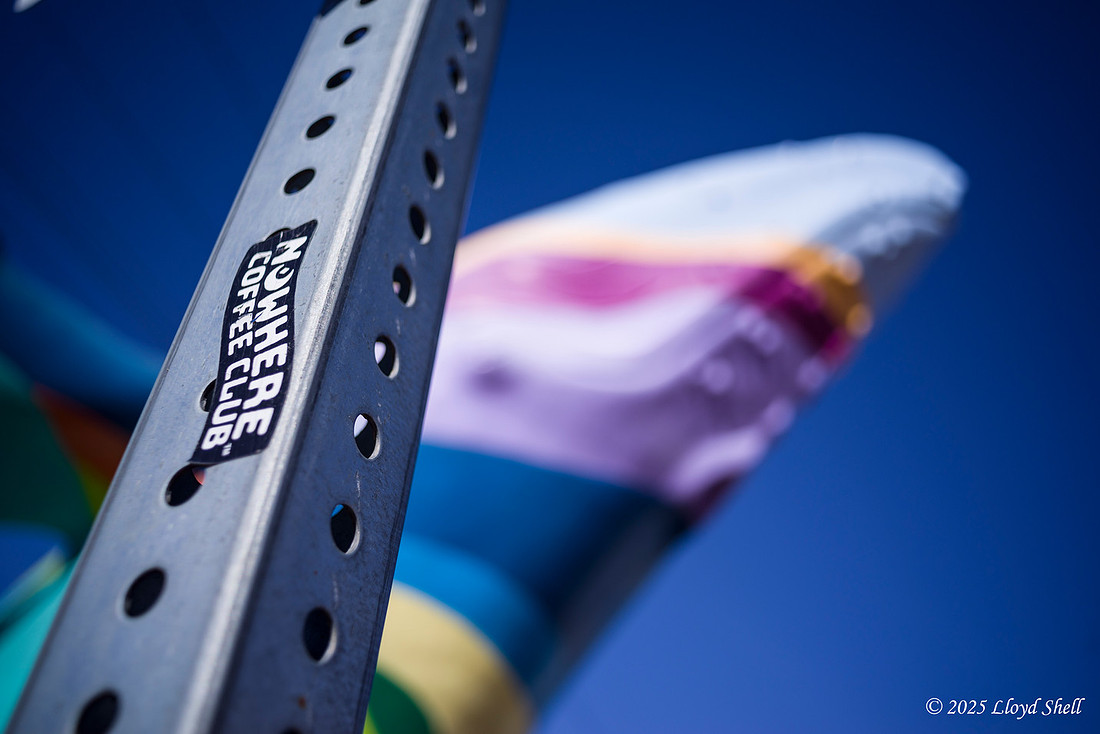
This was stopped down for greater depth of field compared with wide open like the photo above. I think wide open you can achieve adequate subject isolation.
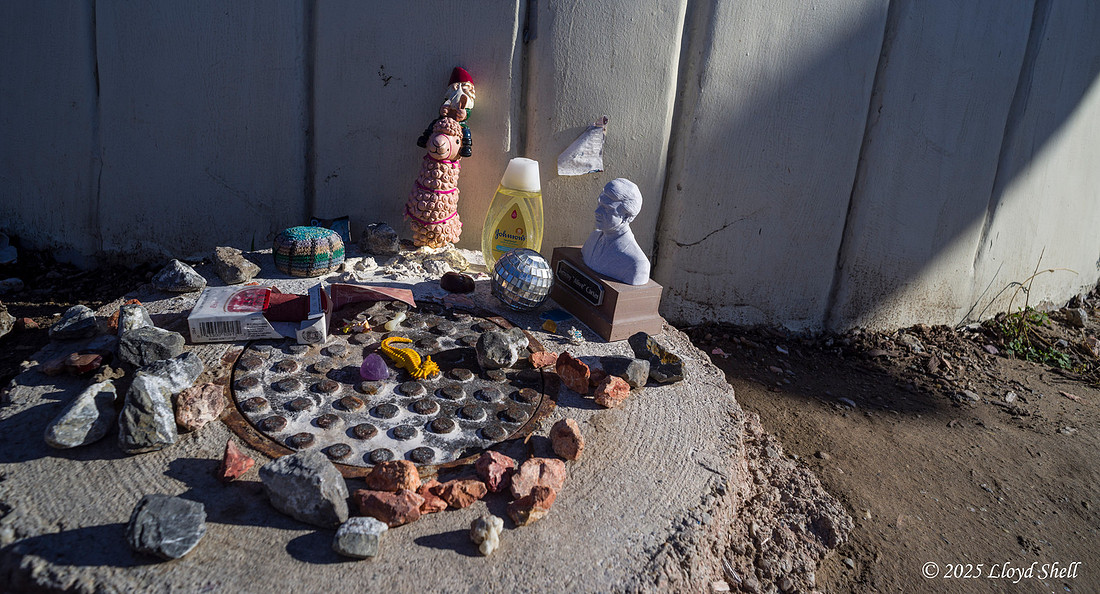
Exactly the purpose of this like shrine is I cannot say.
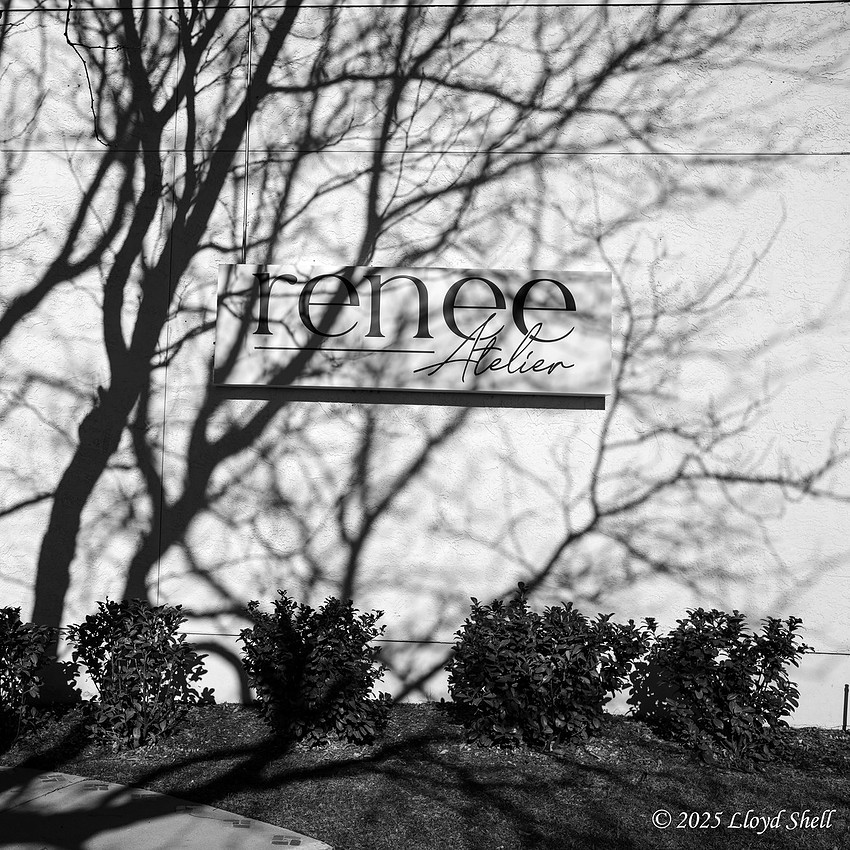


The privacy film on our front door provides an amazing effect in the afternoons.
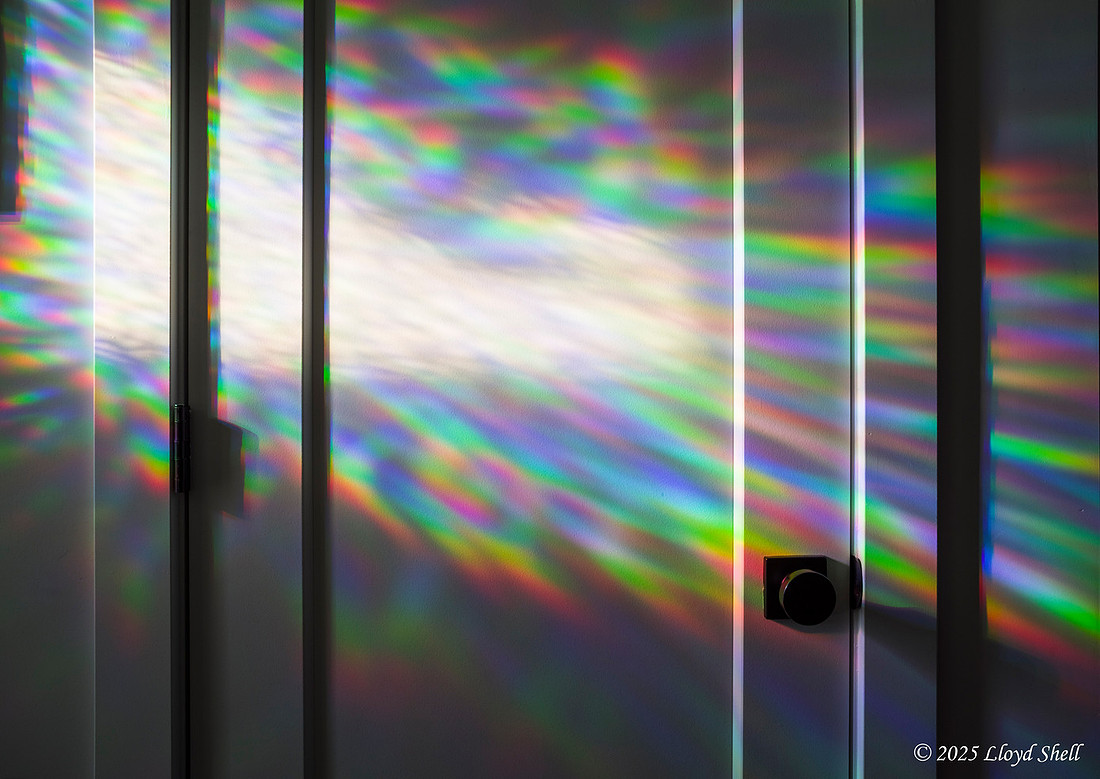
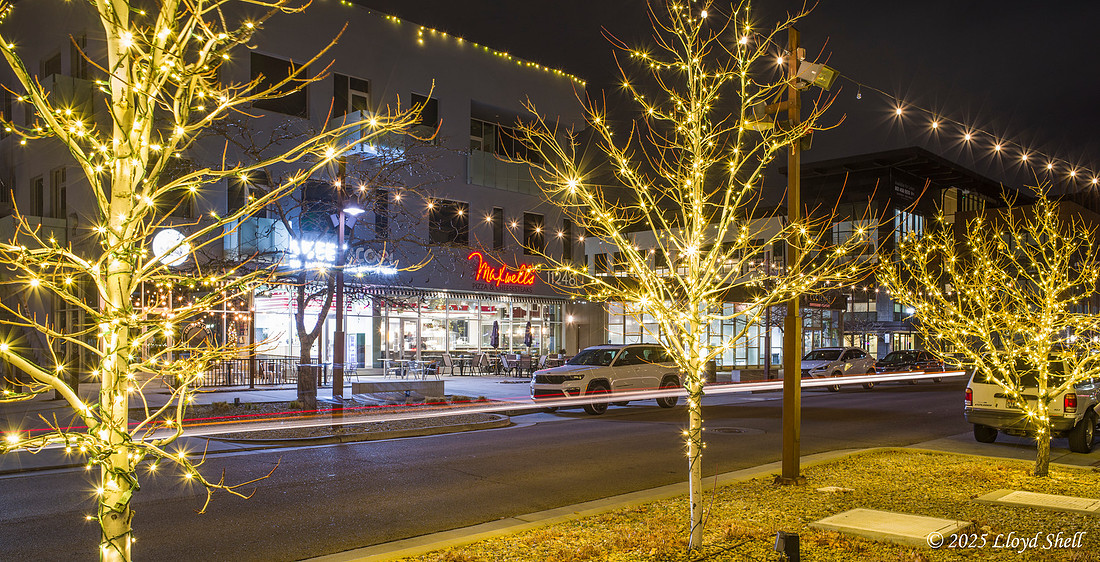
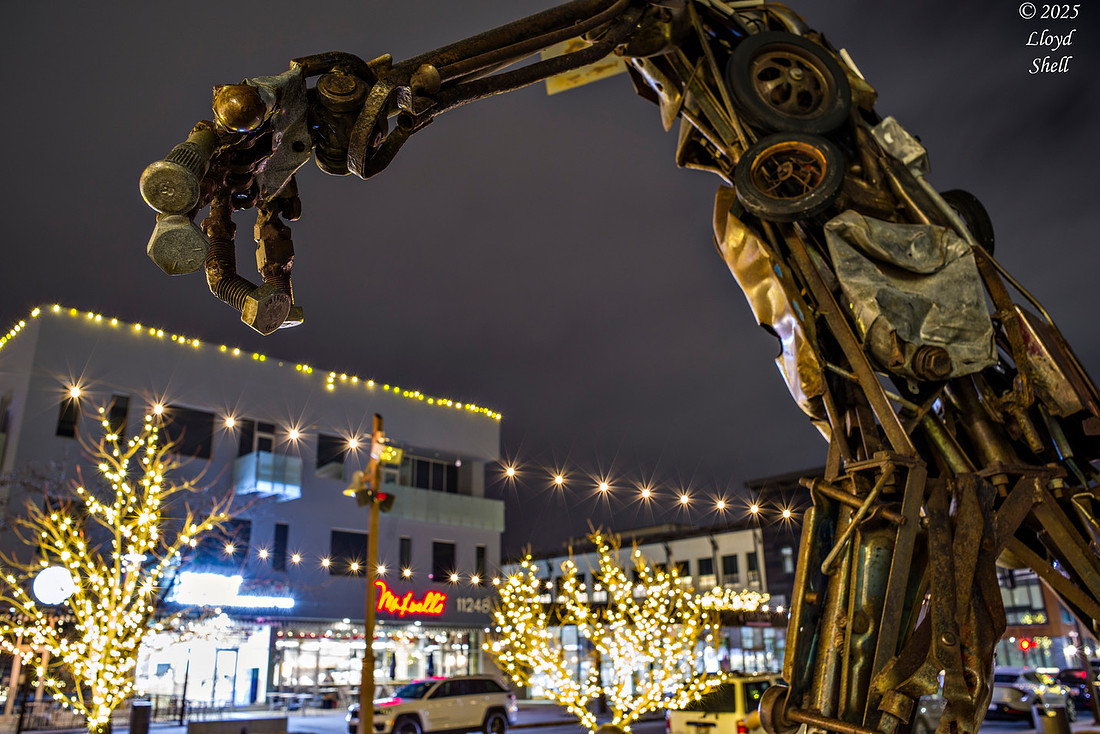
28mm can be a handy focal length, wide enough to bring in context without being overly wide, leaving opportunity for cropping to the optimal ratio when needed.
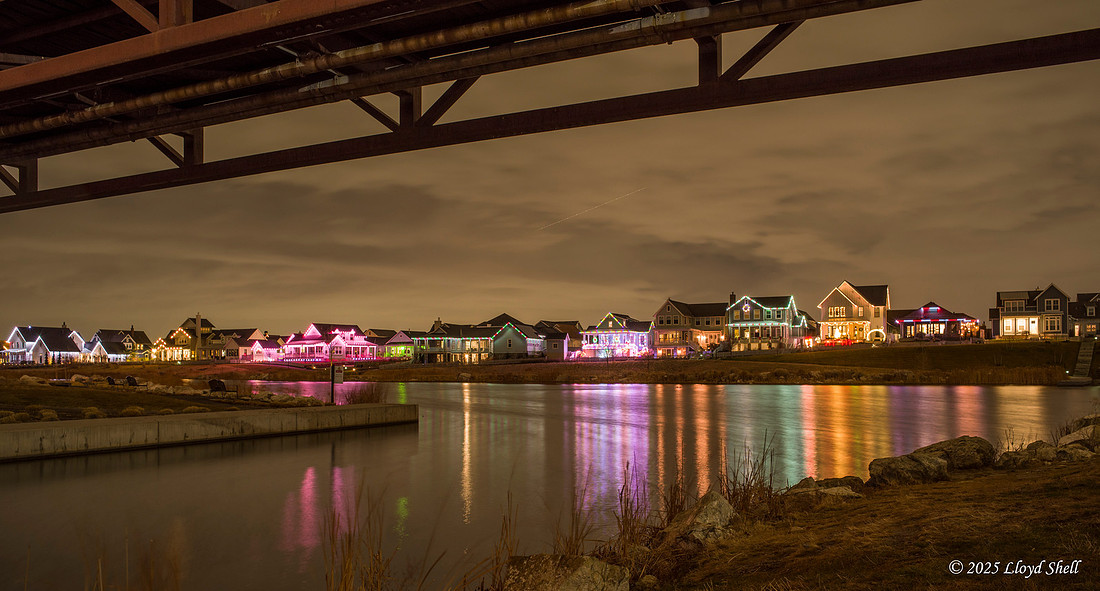
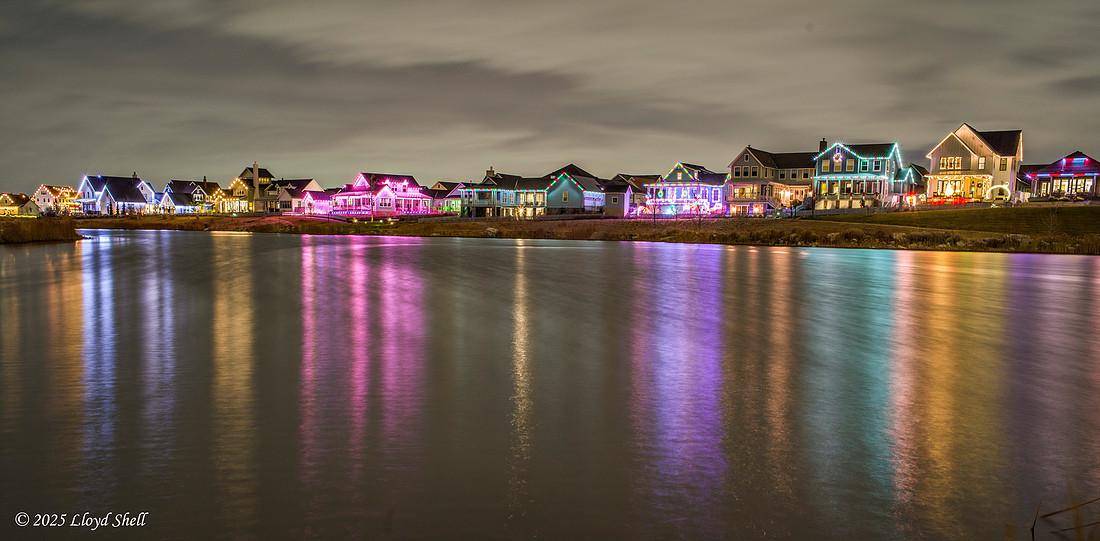
This is a composite of two photos taken from the same spot, there was too much light for a single long exposure to capture the full movement of the train.
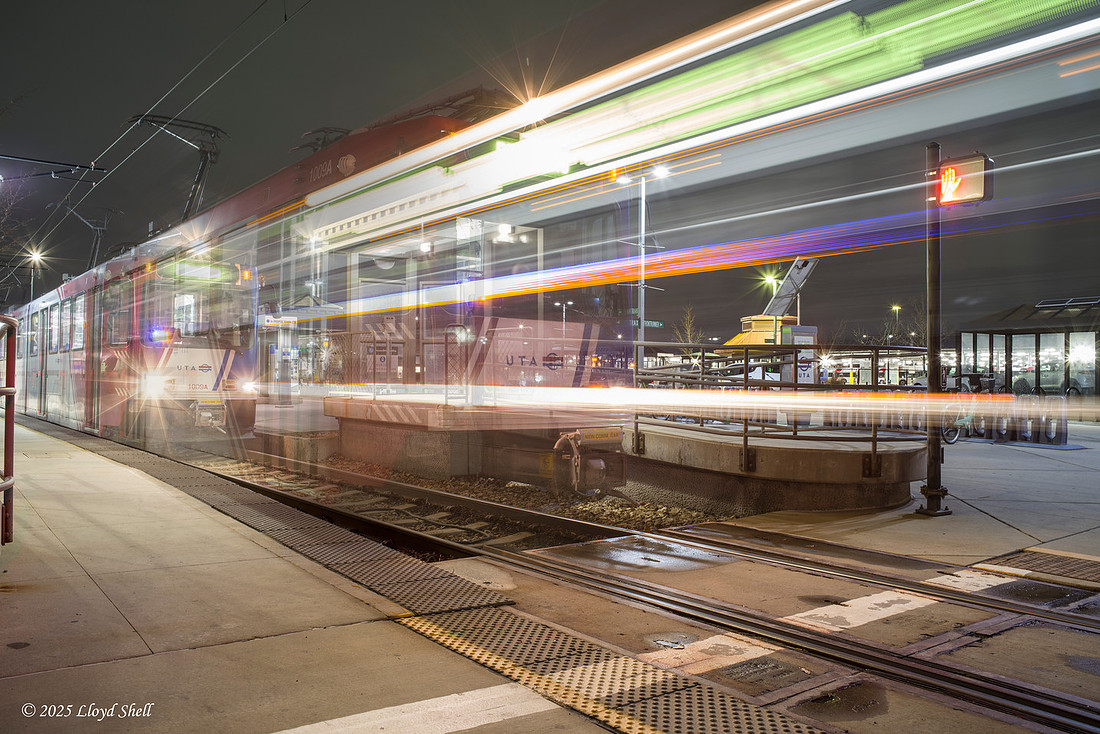
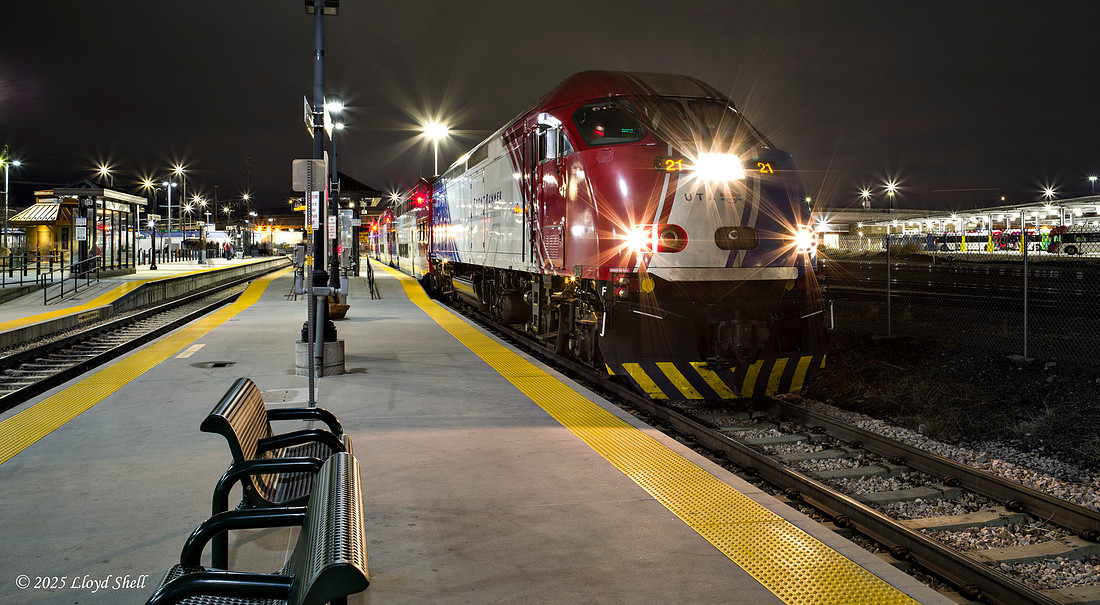
I solemnly declare that I do love taking photos of trains.
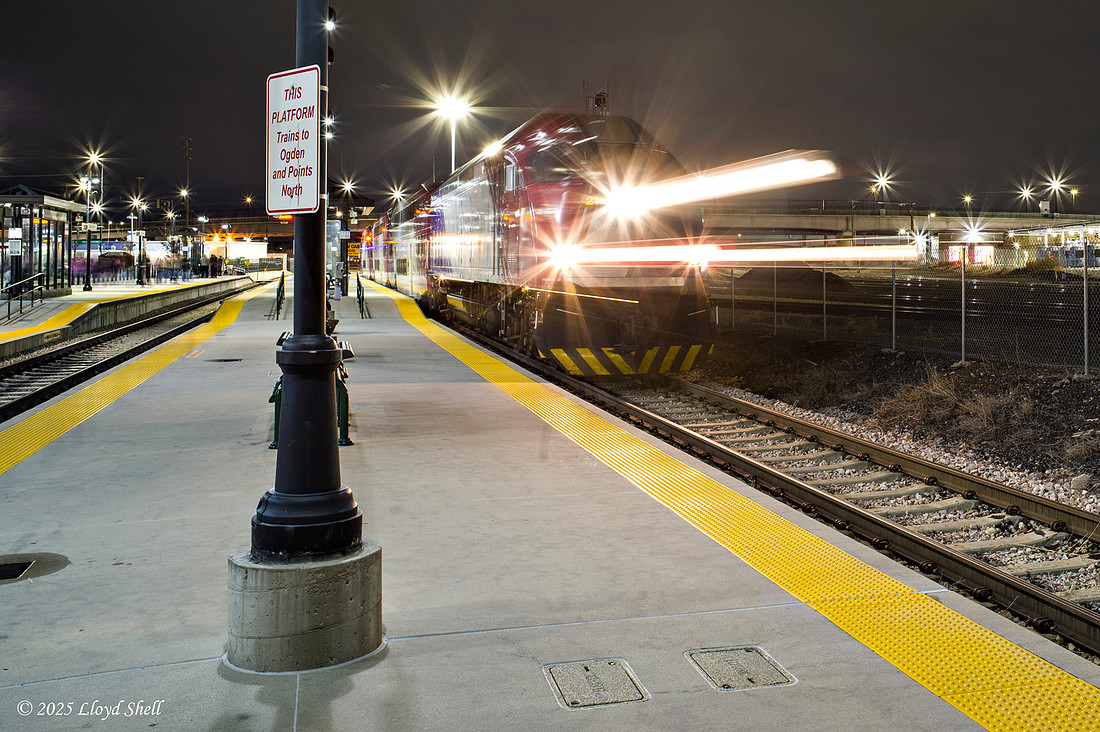
I was playing with hyperfocal distances, where you stop down the lens to f8 and put the focusing ring on the indicated spot on the scale allowing for 'Adequate depth of field", I found it unsatisfactory, upon close examination this photo is not critically sharp in the way I like mine to be. The composition is fun though. The 28mm FOV is wide enough without being disturbing like some of the wider lenses I have. I will do my 12mm fisheye one day as well as my 15-30 as well.
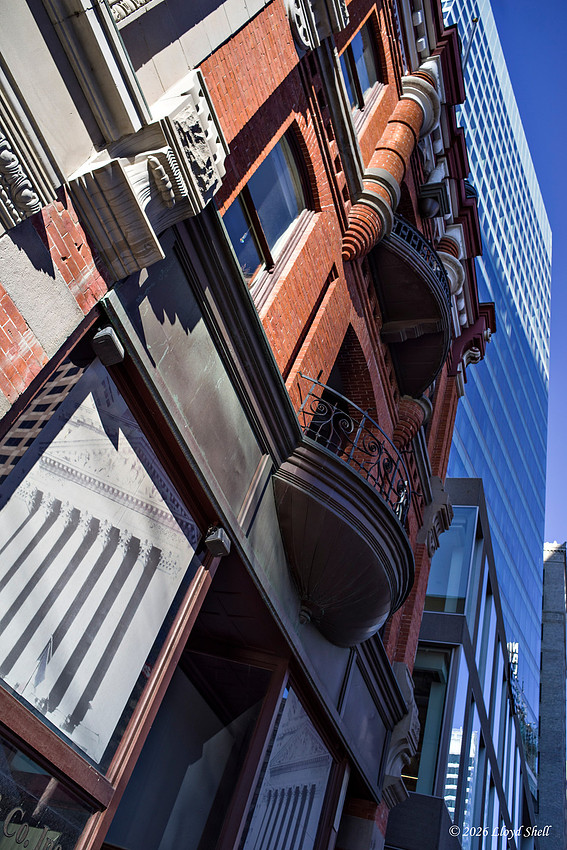
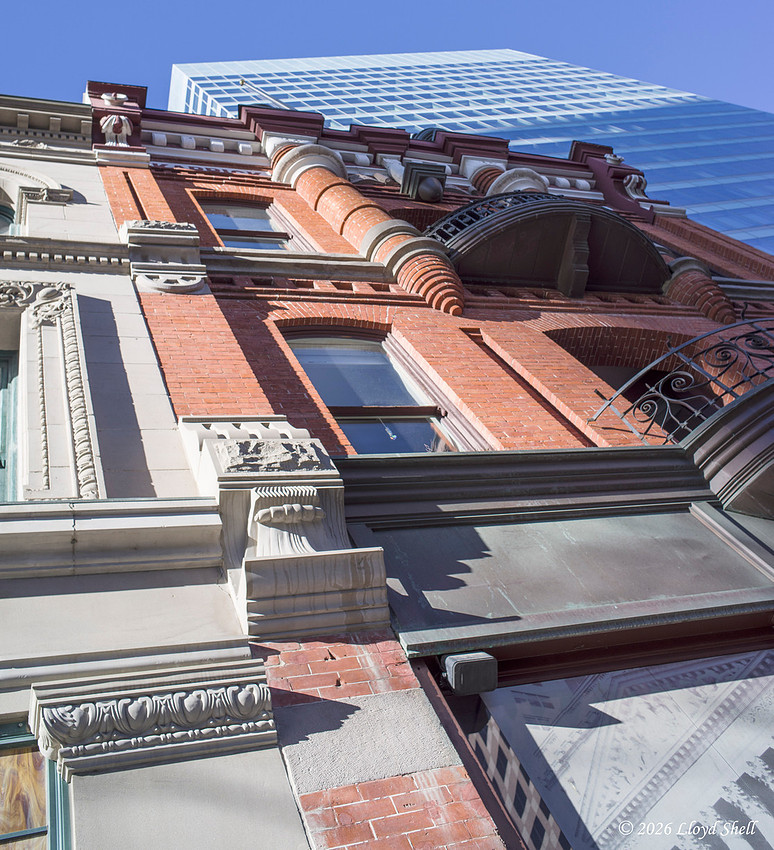
I love these types of photos, but they make me dizzy and are hard to get as you often do not get the camera level and when looking up at that angle the in camera helps are out of their range.
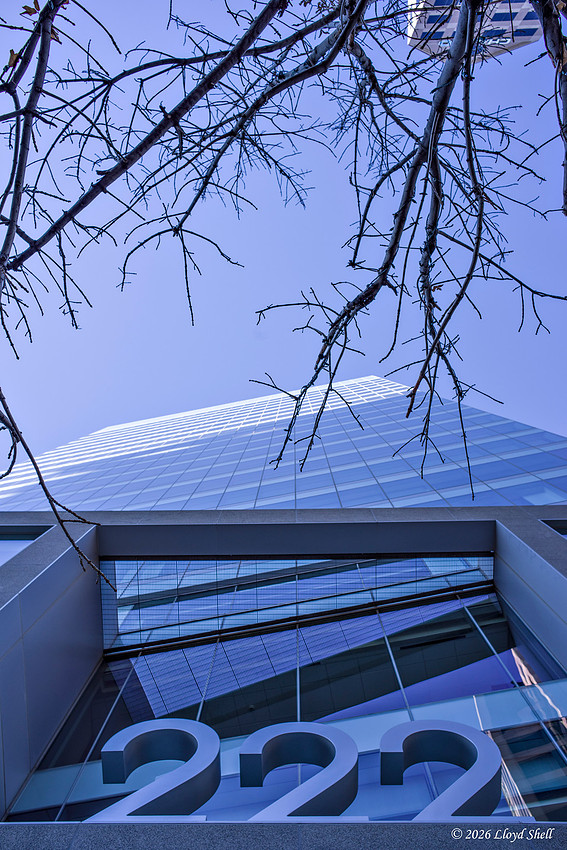
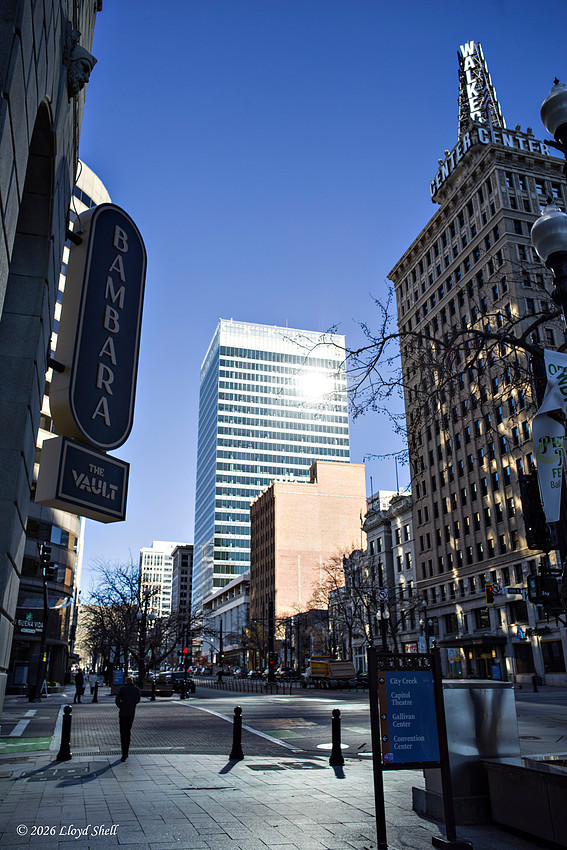
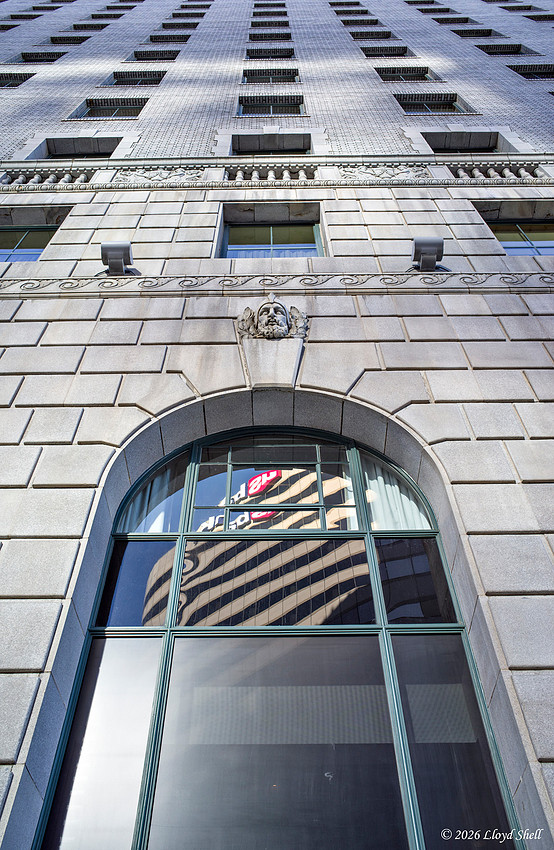
This was the shady side of the street, but was lit by light reflected by mirrored windows. I really like the quality of the light here and that double shadow.
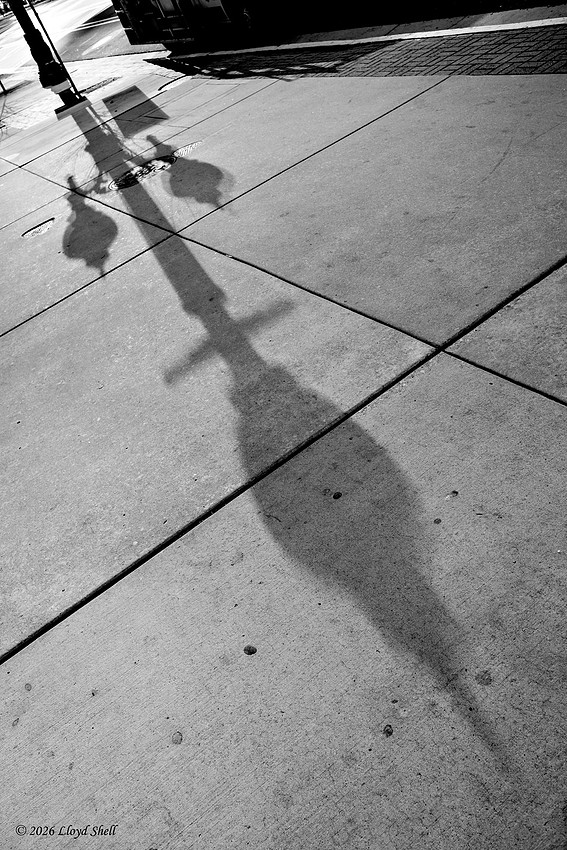
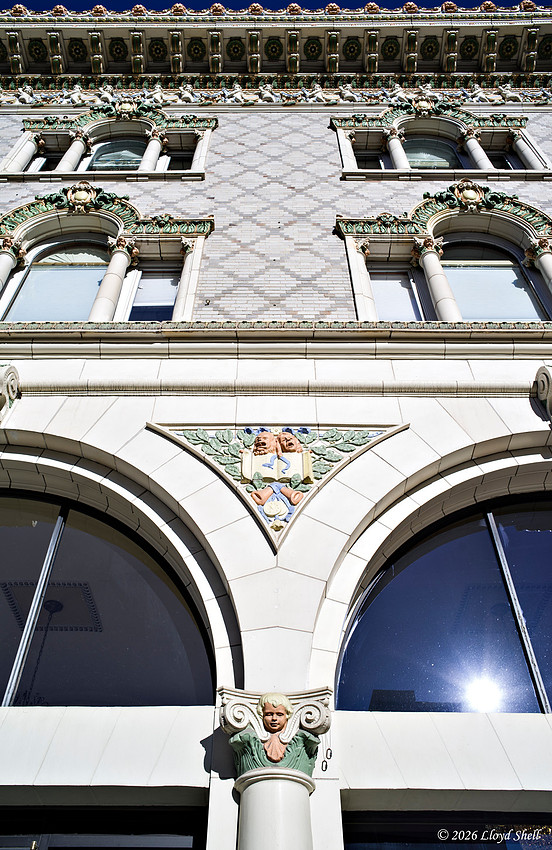
The light was a little harsh here, but I just love the textures.
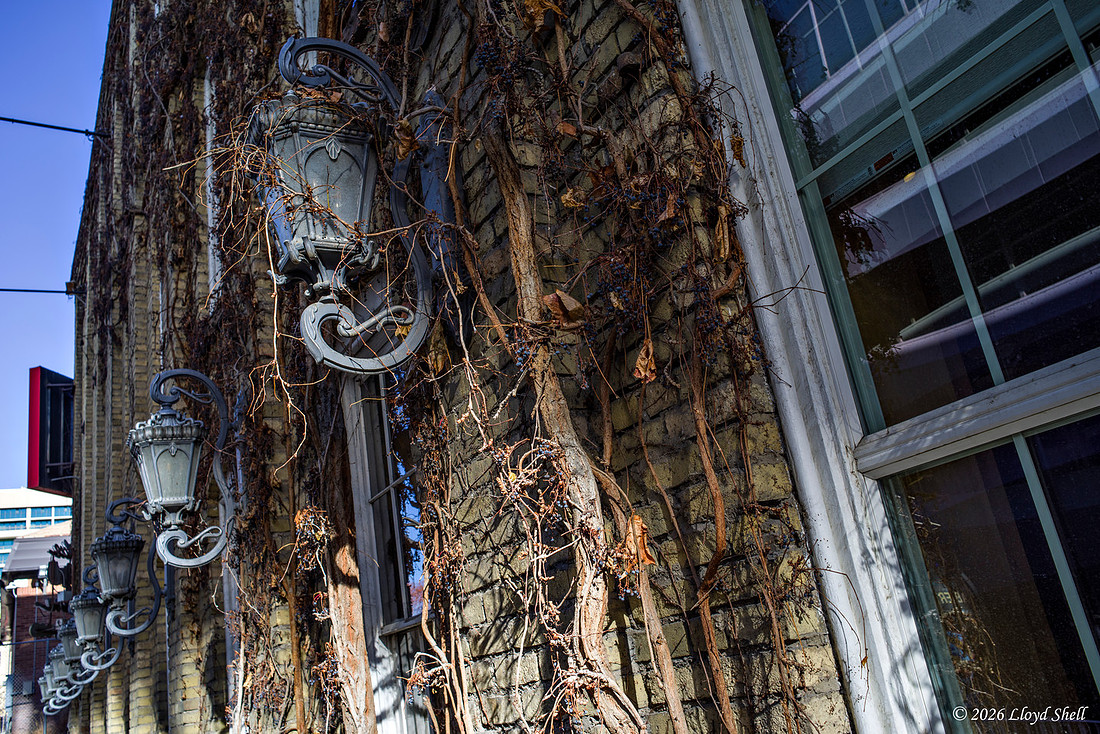
This was my favorite of the day. Monochrome and this lens do well together.
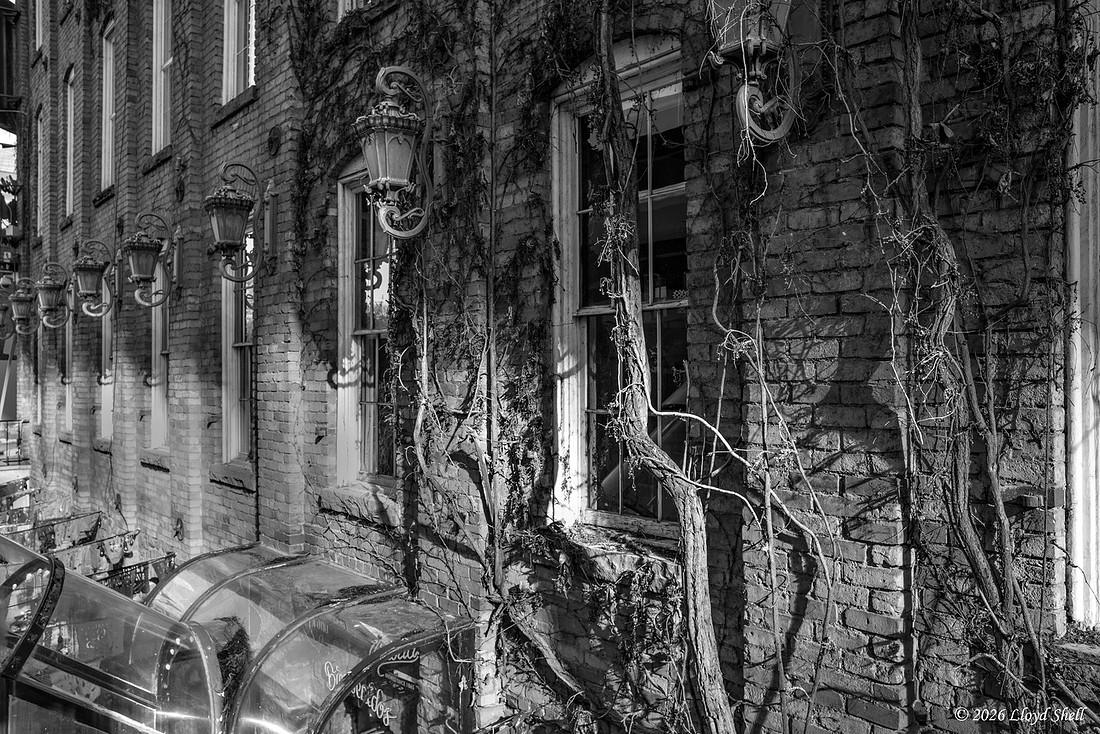
I really want to find a funny self portrait to do here someday.
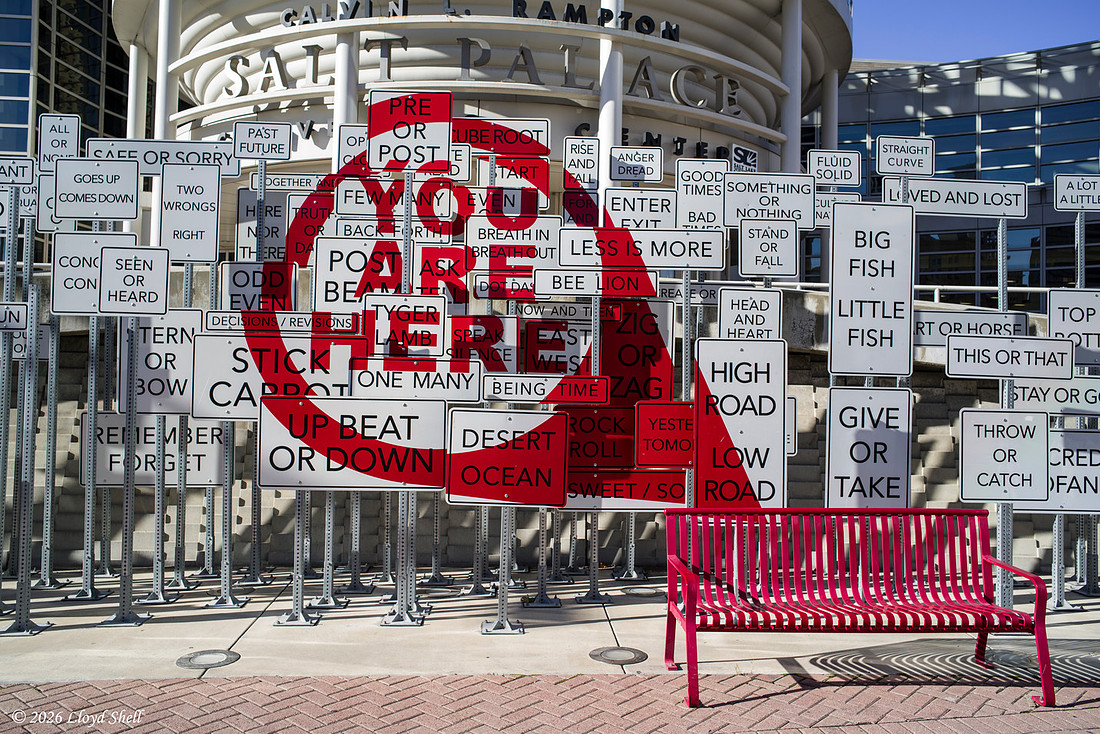
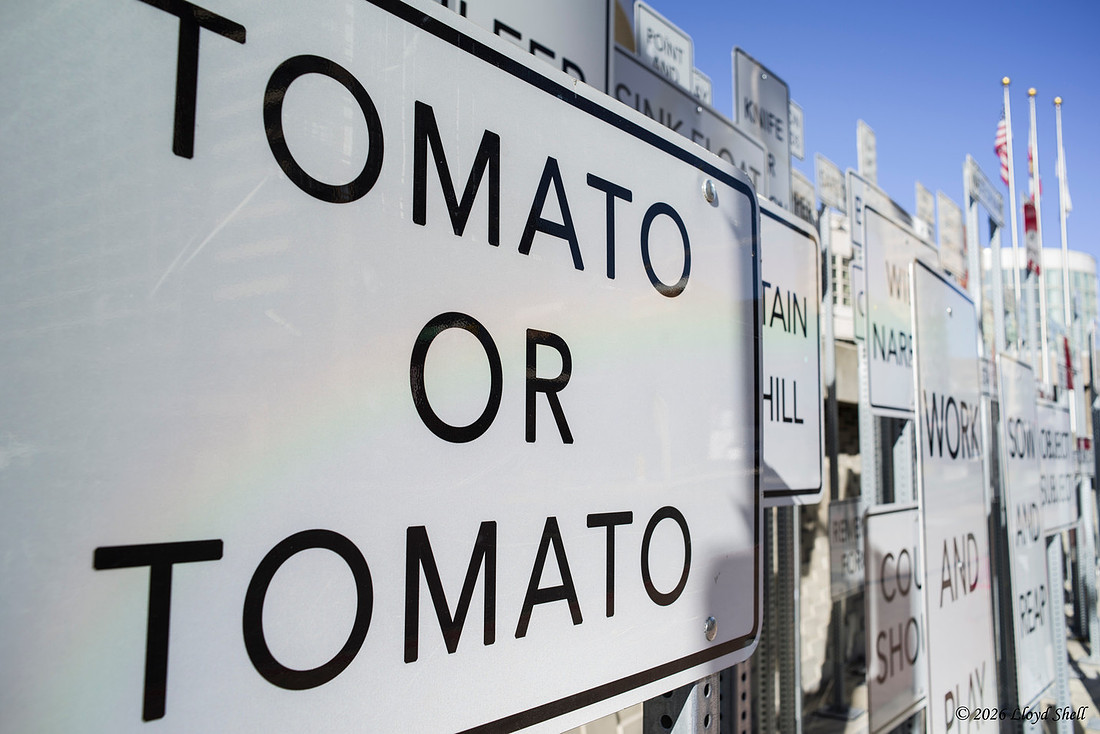
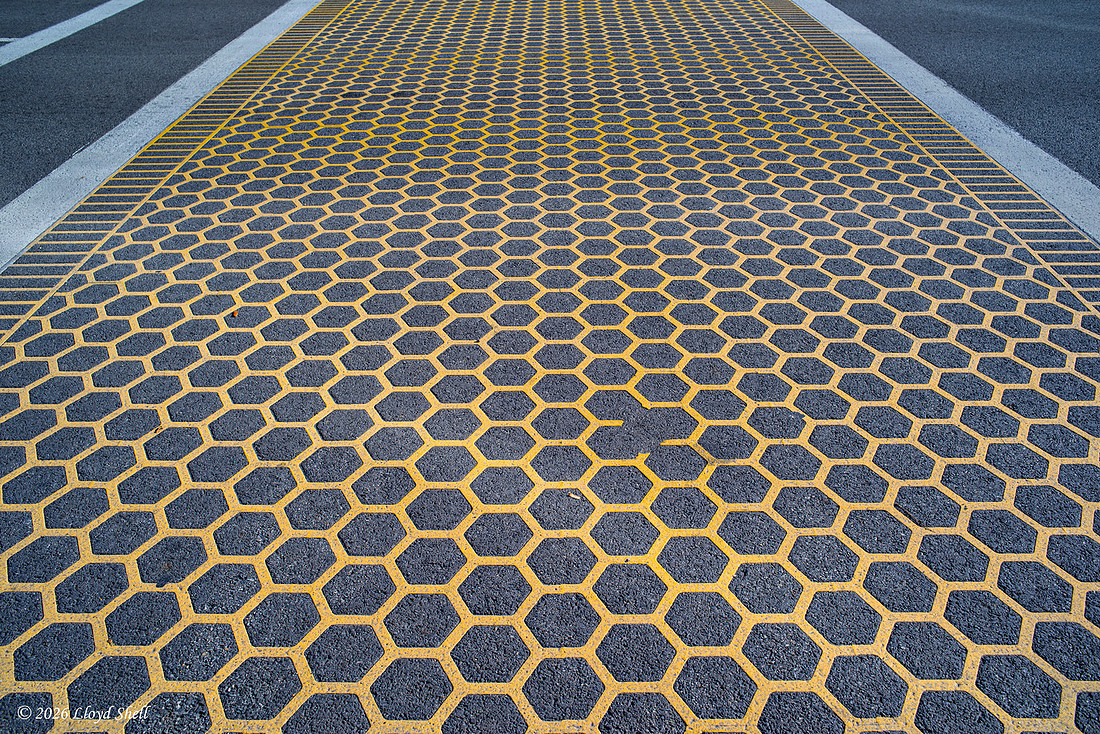
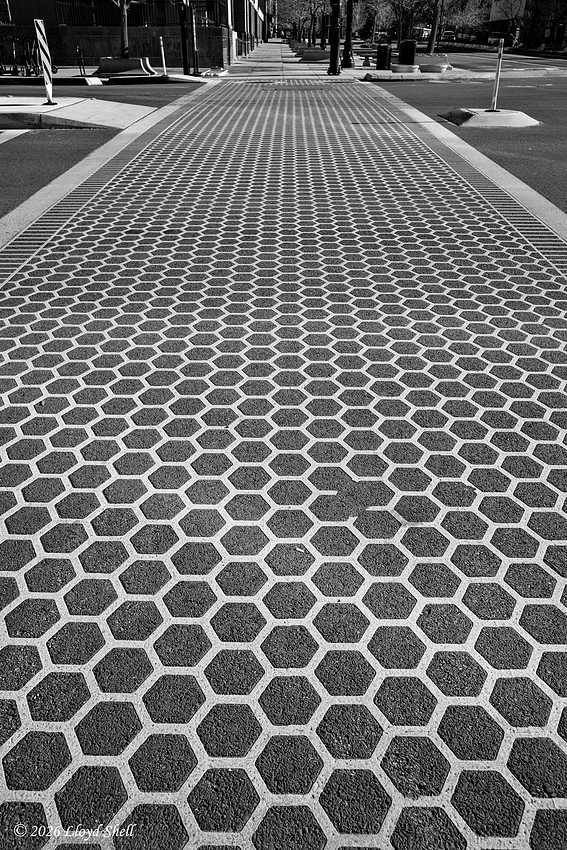
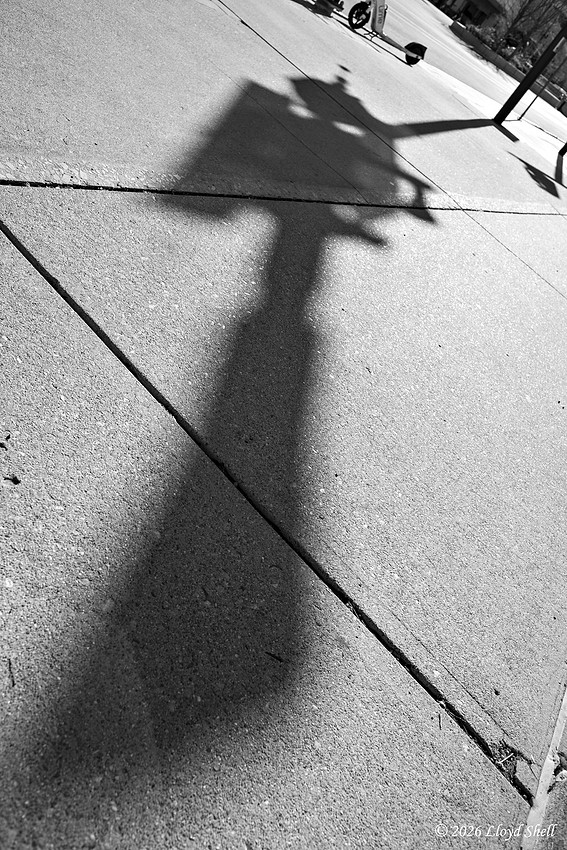
Juuuust wide enough.
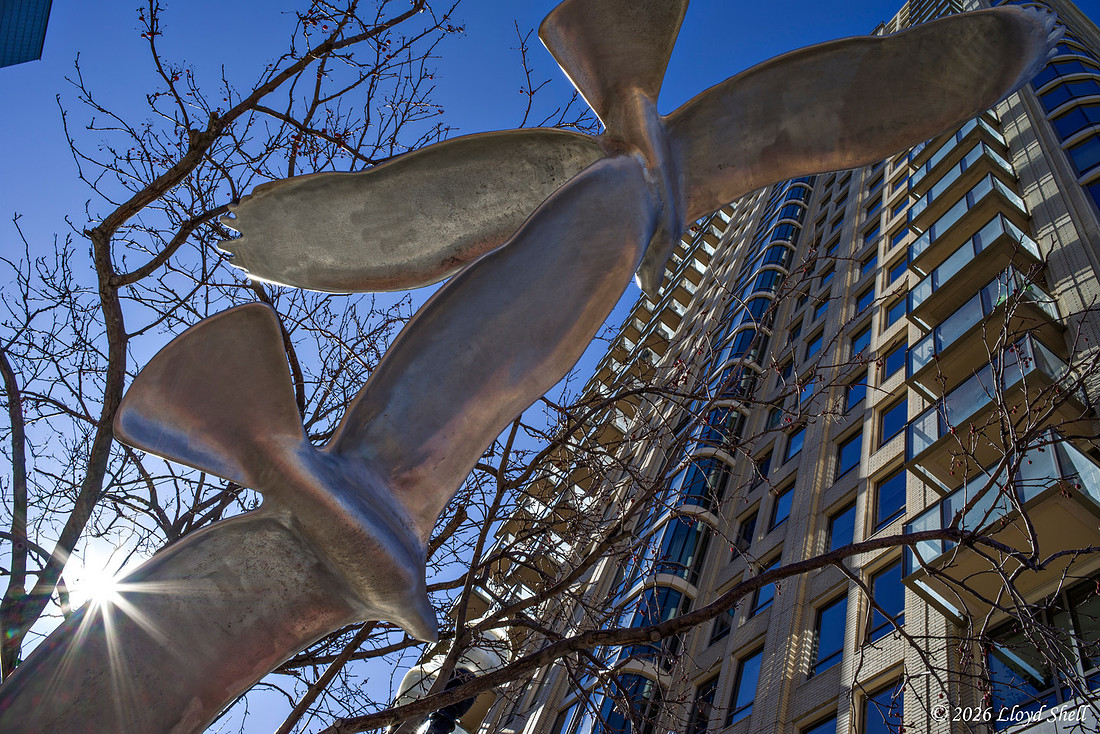
Yeah, this is a good lens in my book. Definitely a keeper... I mean... it already was one I would never part with until I am too old to take photos. But still, it is a good one!
A Bag Full of 28mm Lenses
So... a funny thing happened on the way to my next lens review. I ran into a dilemma, a challenge, a chance for fun, I asked a local Pentaxian (Yes that is what we call ourselves.) if I could borrow a lens of the same vintage as my primary lens I wanted to test.
Background: My Father-in-Law had a Pentax K2 body he had purchased while in the Air Force, when he found out I had bought a Pentax DSLR back in 2008 he asked if his lenses would fit. I said yes, that's why you buy Pentax isn't it? So you can put so many different lenses on it. As he had not used his kit in years he wanted to send it to me so I could use them. He had three lenses from the first series of lenses Pentax made with the bayonet "K" mount rather than screw mounts (M42 was what those older lenses are called.) He gave me a 28mm f3.5, a 50mm f1.4 and a 135mm f2.5 (Previously tested here on my blog). They are all good lenses with good reputations, but the 28mm f3.5 was my favorite especially on my first camera that had a crop (APS-C) sensor as the field of view was close to "Normal" which is a whole different discussion for another day. If you want you can go down the rabbit hole of sensor sizes and field of view based on focal length. Anyway, I liked the lens for that application, with the limitation accepted that the aperture at maximum was f3.5, which is rather slow/pedestrian. Pentax also made another 28mm lens at that time, developed with Zeiss jointly, it is a 28mm f2 nearly two stops faster than my present lens. It is called the "Hollywood" and highly sought after, commanding $600+ and higher for copies in good shape on the second hand market. MUCH has been written about the lens over the years and I was rather curious how it would perform in comparison to what I had.
Back to the main plot: my friend is an addict, a lens and camera buying addict and has a room of rare and wonderful Pentax stuff. Including, the SMC Pentax 1:2 28mm lens I was curious about. After some negotiating he agreed to let me borrow it IF I was very very careful with it, little did I know when I went to pick it up he would hand me a bag FULL of 28mm lenses in addition to the one I asked about. Including some older and some more modern lenses including 3 autofocus lenses. I was surprised, giddy and a little shocked. Also, a little taken aback as I now had a corral full of lenses that deserved a little more time investment and care to do them justice. Sadly, I don't have the time or facilities to really do what I wish I could: give each one a month or two of use. Undaunted, I decided to do the best I could and set up a test where I could get rough center and edge resolution information and a little understanding of the bokeh of each lens. This is what I came up with.
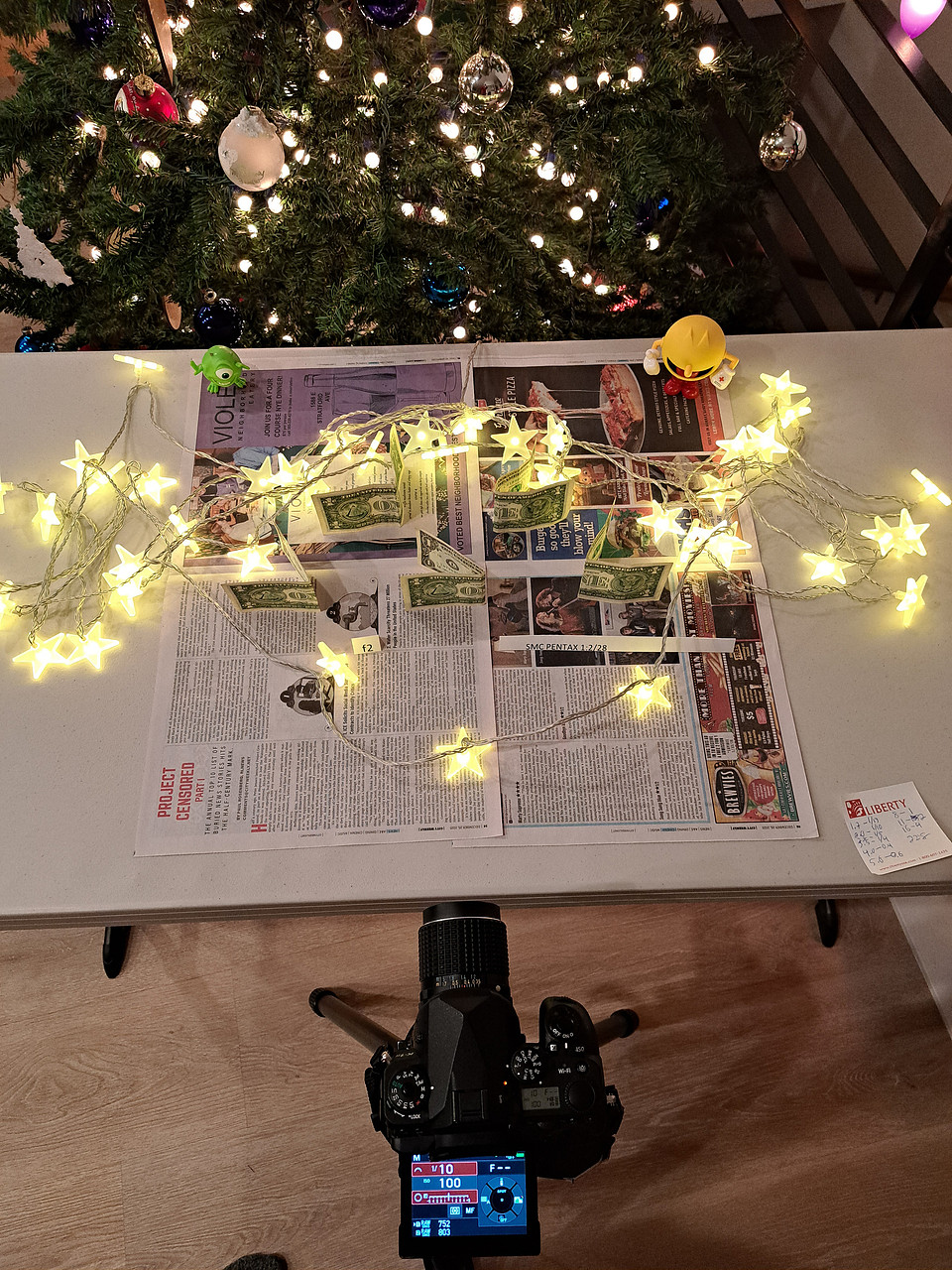
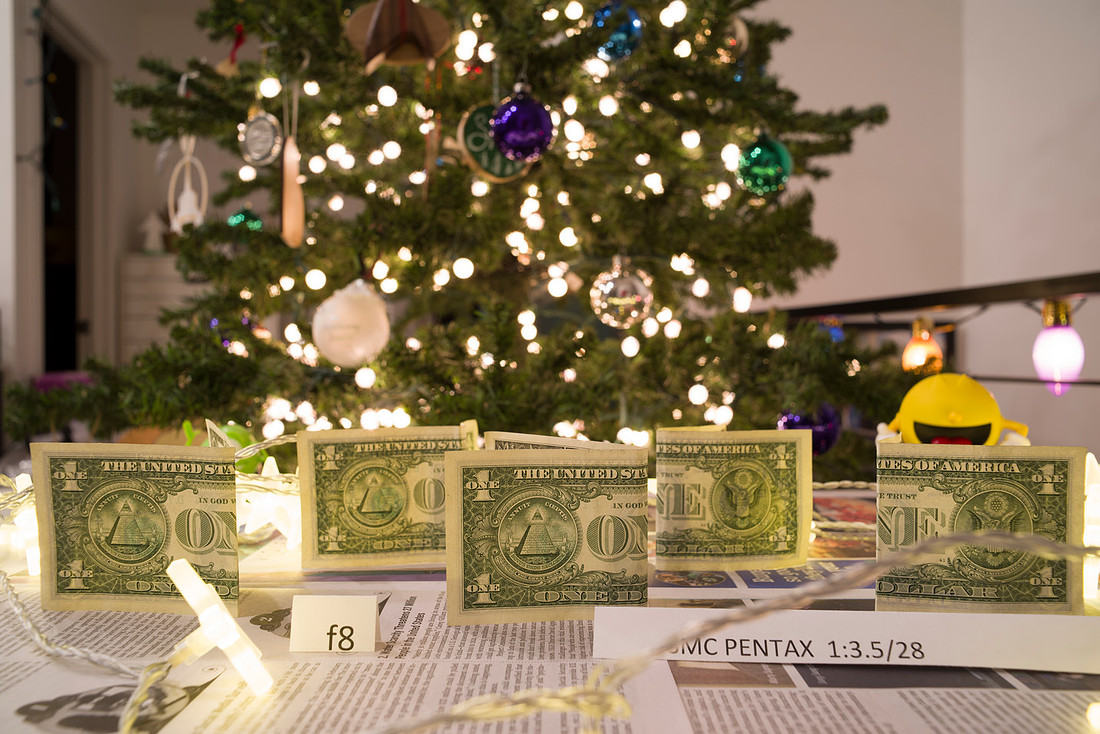
The lens on the camera is the f2 Hollywood lens, I chose a distance that was not quite closest focus and thought it was just right for the lens with the furthest minimum focus (The modern 28-105 DFA zoom which is f3.5 at 28mm just like many lenses I had at my disposal) it ended up being just slightly too close you will see that it changed when I put those test shots up. I attempted to get the focus point on the top left corner of the middle dollar bill, using magnified live view and carefully double checking. I shot each lens from widest aperture down to f22 in RAW then processed each file in ACR in Photoshop PS6 with default settings except for +.75 exposure compensation, because I didn't get my metering quite right.
A BIG caveat here: These lenses are not new, they have been used, they are decades old, there is always a chance I got excellent copies or bad copies, lens variation is REAL!
You may be asking exactly WHAT lenses I did get to test, I will show you, noting that I did also use my Pentax 15-30 f2.8 at 28mm and my Pentax 28-105 f3.5-5.6 as comparisons. Here are the rest of the lenses, I kept the SMC Pentax 1:3.5 28mm that is mine in each picture as a reference for size.
These were just quick and dirty shots taken without any fancy lighting with the Pentax K1 mii and the DA*55mm f1.4 which is a killer lens for sharpness and bokeh.
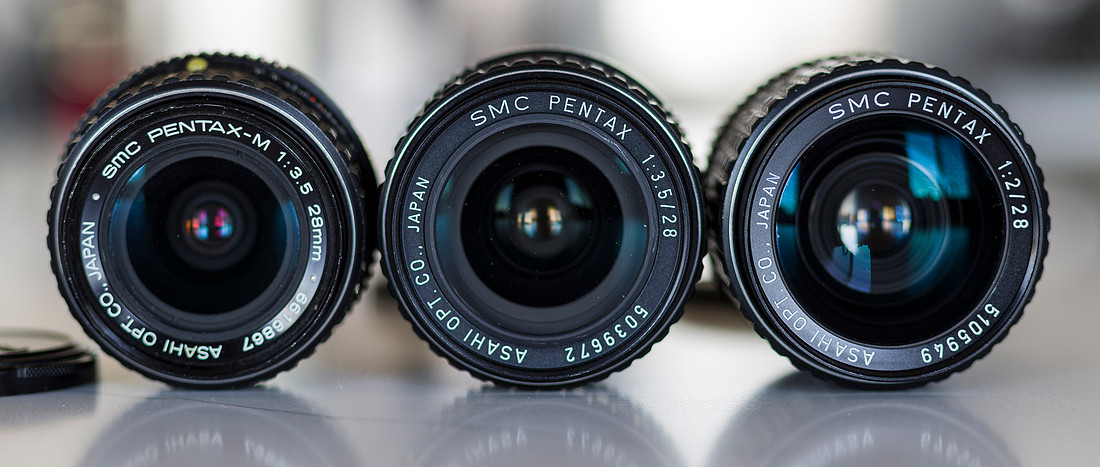
First group, L: SMC Pentax M 1:3.5 28mm (Recently given to me by another friend) C: SMC Pentax 1:3.5 28mm (K series) R: SMC Pentax 1:2 28mm (K series) the "Hollywood" The center lens is the one I got from my father-in-law and really a dandy lens IMO.
More info on each:
https://www.pentaxforums.com/lensreviews/SMC-Pentax-M-28mm-F3.5-Lens.html
https://www.pentaxforums.com/lensreviews/SMC-Pentax-K-28mm-F3.5-Lens.html
https://www.pentaxforums.com/lensreviews/SMC-Pentax-K-28mm-F2-Lens.html
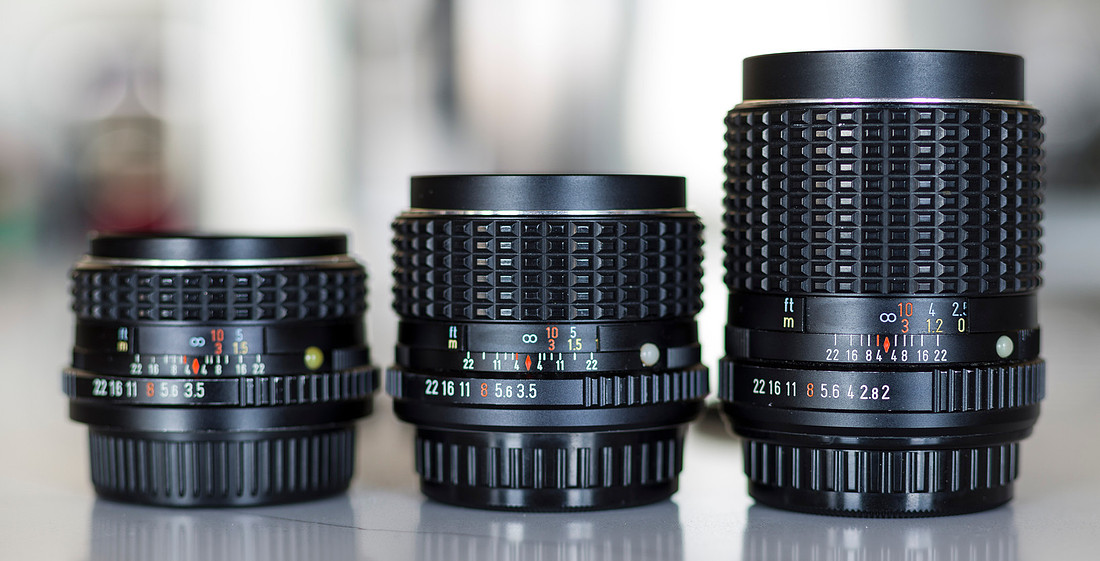
Note the different sized front elements.
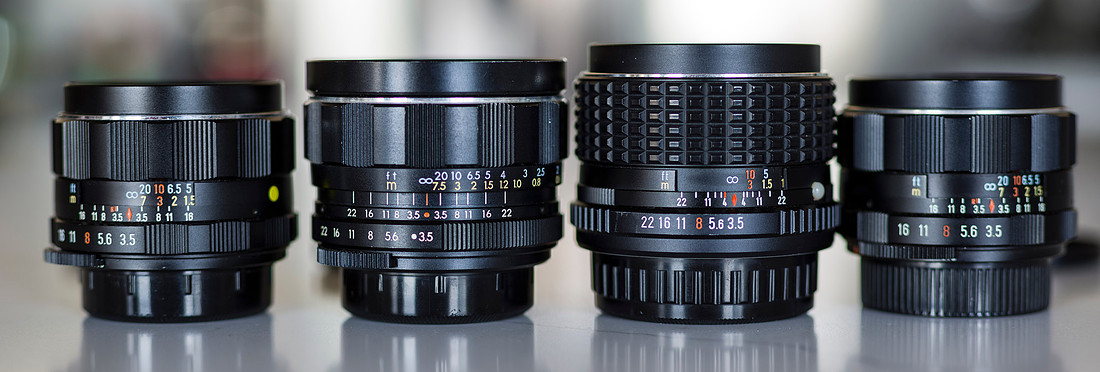
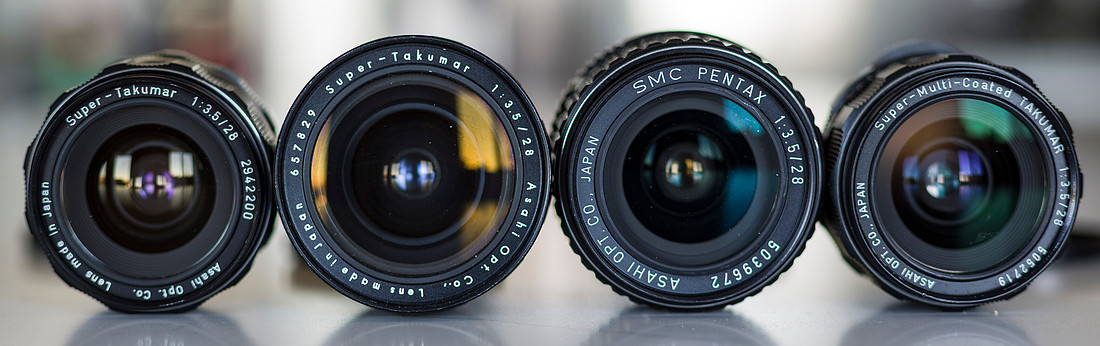
For this group I will just let you read the engraving. The second lens from the left was the first m42 mount 28mm lens I am aware of the Pentax made. I should likely have re-ordered these in order of date of manufacture, but I liked the height symmetry. Spoiler alert that lens was not manufactured for long and was replaced with the lens to the far left which is significantly better. Then, that lens got better coatings but kept the same optical formula and became the lens to the far right. That is what the Super-Multi-Coated indicated, this was shortened to SMC in the K series. At the time they were arguably some of the most advanced coatings available. (Lens coatings help to reduce internal reflections, boost contrast and color, they do make a large difference.)
These three lenses get bunged together on this database: https://www.pentaxforums.com/lensreviews/S-M-C-Super-Takumar-28mm-F3.5.html
Now we come to a couple of very interesting lenses, a Vivitar f2.5 28mm I bought it for $10 on a whim trying to replace a different version I never should have sold. Either this is a bad copy or I bought the wrong lens, as you shall see, it is a bit of a dog. To the far right is a newer but still a few years old autofocus Sigma 28mm f1.8 (reads as f1.7 in camera though) This is a lens I was VERY interested to see that my friend had, I have looked at it before and been intrigued as it can focus really closely and is reputed to have very nice out of focus blur wide open. It also has a reputation as not being the sharpest lens in the world.
https://www.pentaxforums.com/userreviews/vivitar-28mm-f2-5.html
https://www.pentaxforums.com/userreviews/sigma-28mm-f1-8-ex-dg-aspherical-dg-df-macro.html
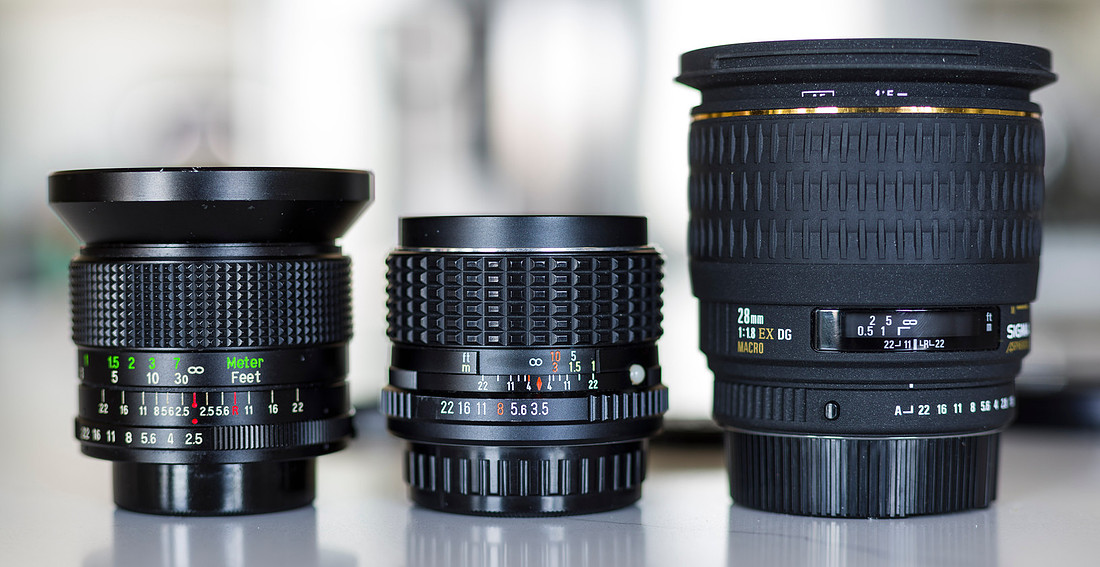
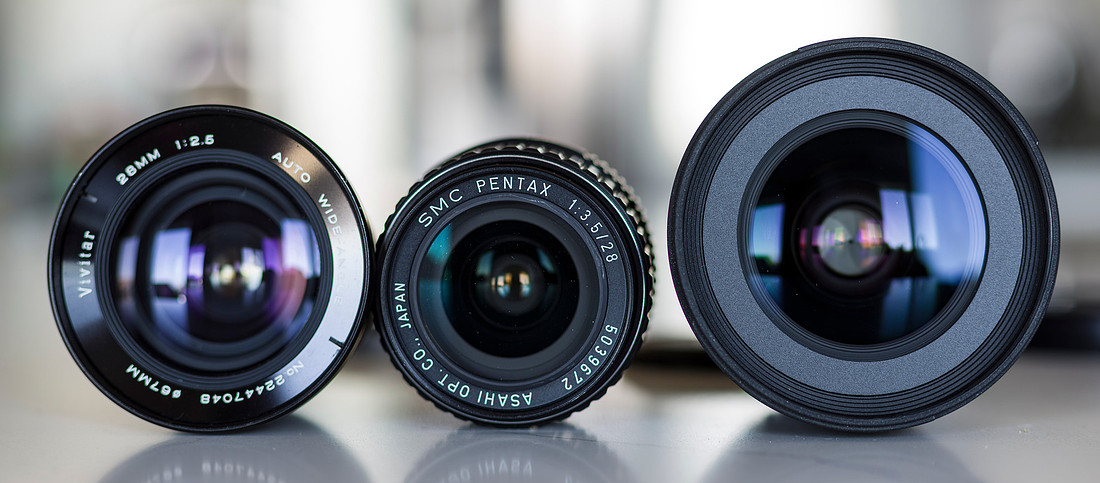
Adding to the interest here we add the M series f2.8 lens, surprisingly it is smaller than the f3.5 lens it was sold alongside. I was VERY curious regarding how this lens would perform. I has a smaller front element than the f3.5 as well...
https://www.pentaxforums.com/lensreviews/SMC-Pentax-M-28mm-F2.8-Lens.html
(I believe this is the early formula as it appears to have different distortion profile in side by side comparison to the A 28mm f2.8/Non SMC Takumar 28mm f2.8)
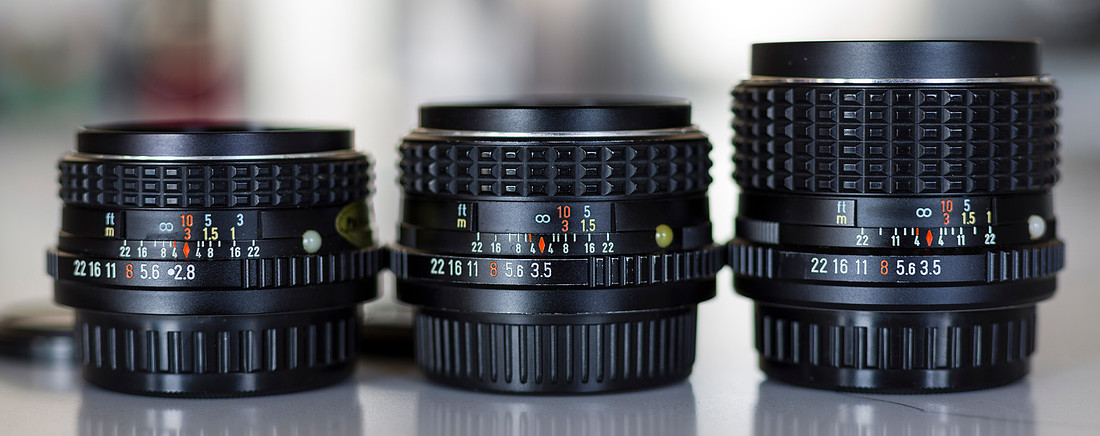
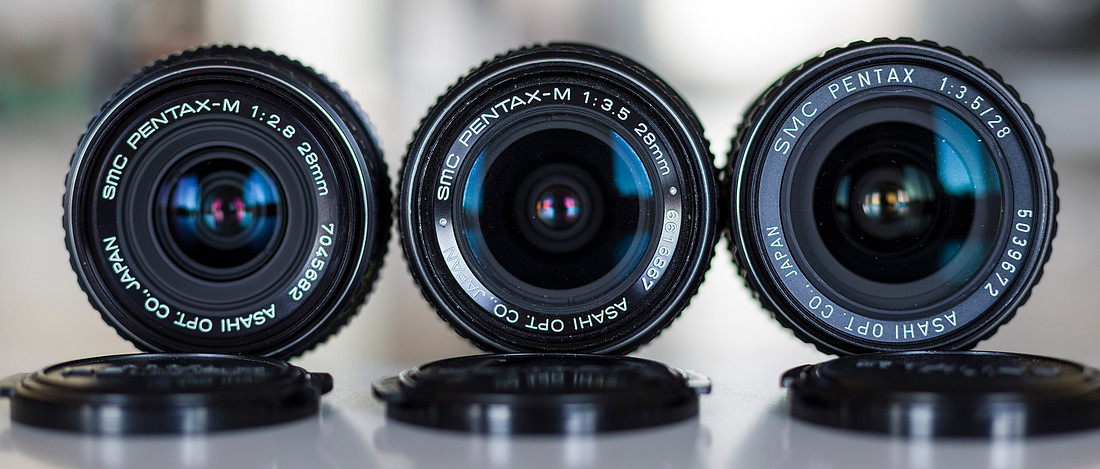
This group is more modern, the two on the left are both autofocus, and as my eyes are not what they were when I was younger that is starting to appeal a little. Interestingly, the non SMC coated Takumar, the A and F are the same optical formula, but in different bodies.
https://www.pentaxforums.com/lensreviews/SMC-Pentax-FA-28mm-F2.8-Lens.html
https://www.pentaxforums.com/lensreviews/SMC-Pentax-F-28mm-F2.8-Lens.html
https://www.pentaxforums.com/lensreviews/Pentax-Takumar-28mm-F2.8-Bayonet-Lens.html
https://www.pentaxforums.com/lensreviews/SMC-Pentax-A-28mm-F2.8-Lens.html
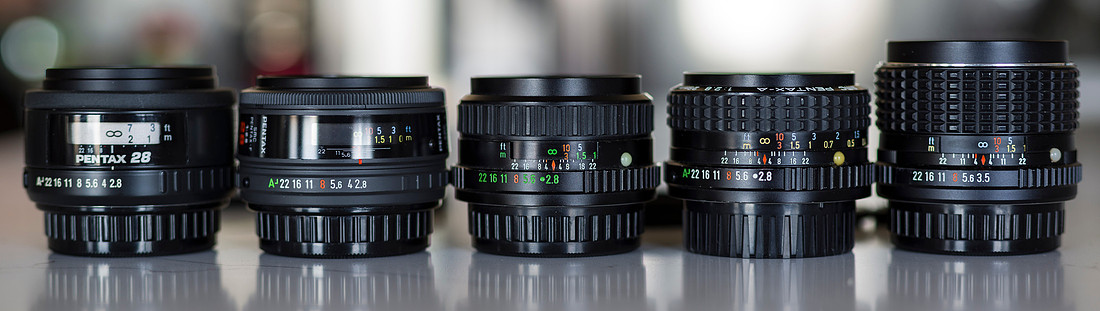
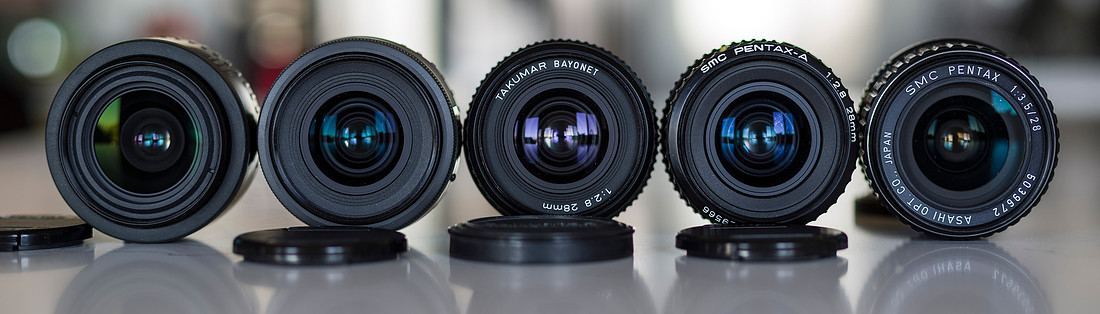
At this point before I post a bunch of photos and blather on, if you want to skip to the photos you can do so here: https://www.lloydshell.com/p487753277 If you ask nicely I may even let you download full resolution photos to make your own comparisons.
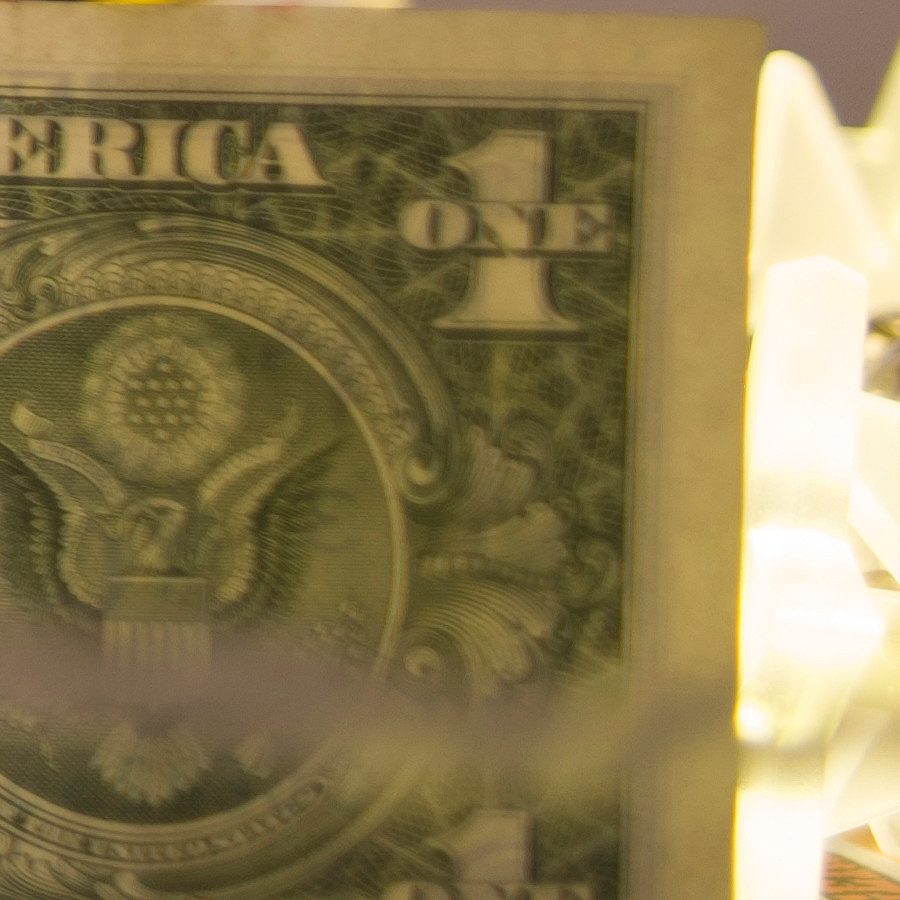
For each lens I plan to only post the largest aperture photo along with a photo at f8 so you can see the bokeh change. Along with 900x900 pixel crops (which SHOULD appear pixel for pixel on your screen) of left, right, and center on the dollar bills to help you gauge resolution. The bills were placed using the K28mm f3.5 so that the areas cropped are in the plane of best focus, yes there are likely field curvature variations between lenses, but I simply did not have the time to make those kind of adjustments for each individual lens, and honestly the edge performance for most of them did not justify taking that kind of time. I will also note I am MOST interested in wide open sharpness as that is where separation from the background occurs the most and when using them on the street I like to shoot wide open or with the widest aperture I can. That is me, and what I value.
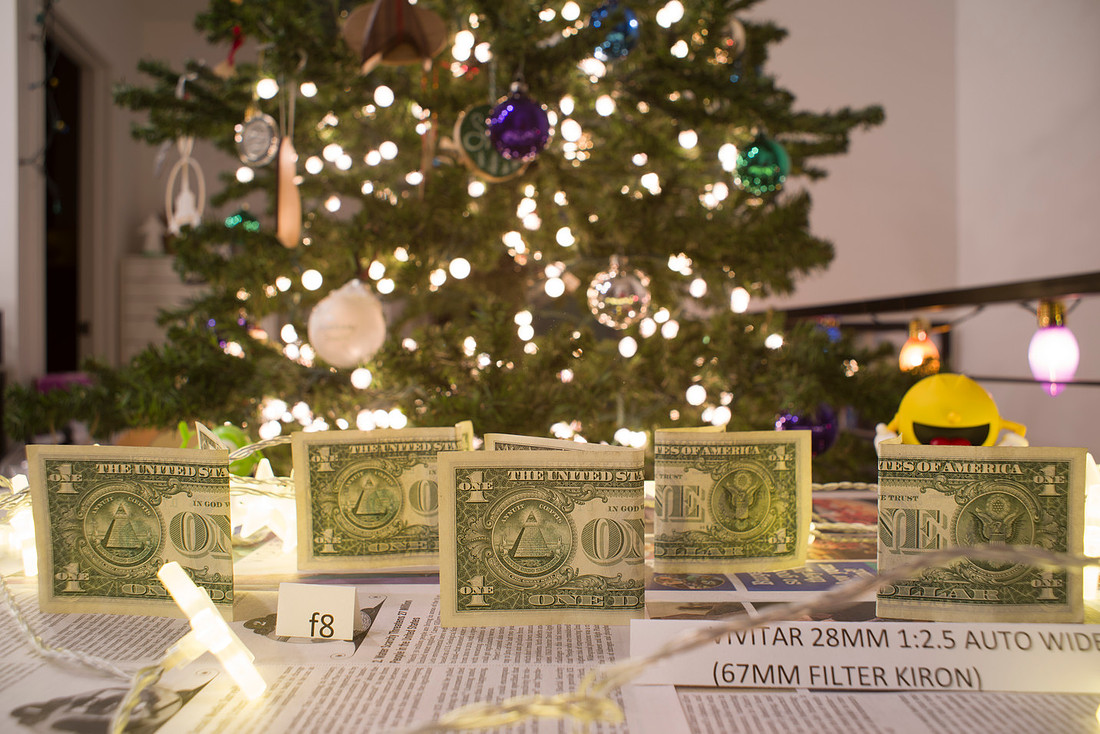
I will commence with what I think is quite possibly the worst lens of the bunch the Vivitar 28mm 1:2.5 Auto Wide with 67mm filter (made by Kiron according to this amazing resource: http://photografica.robinparmar.com/vivitar.html ) I do wish I had referenced this as well as the PentaxForums review listed above when I was looking at replacing the previous Vivitar I sold. I should have avoided this clinker.
The bokeh is actually fairly nice here the shape of the light balls becomes more oval towards the edges which is to be expected IMO in lenses of this vintage. The contrast is lacking though and so is the sharpness.
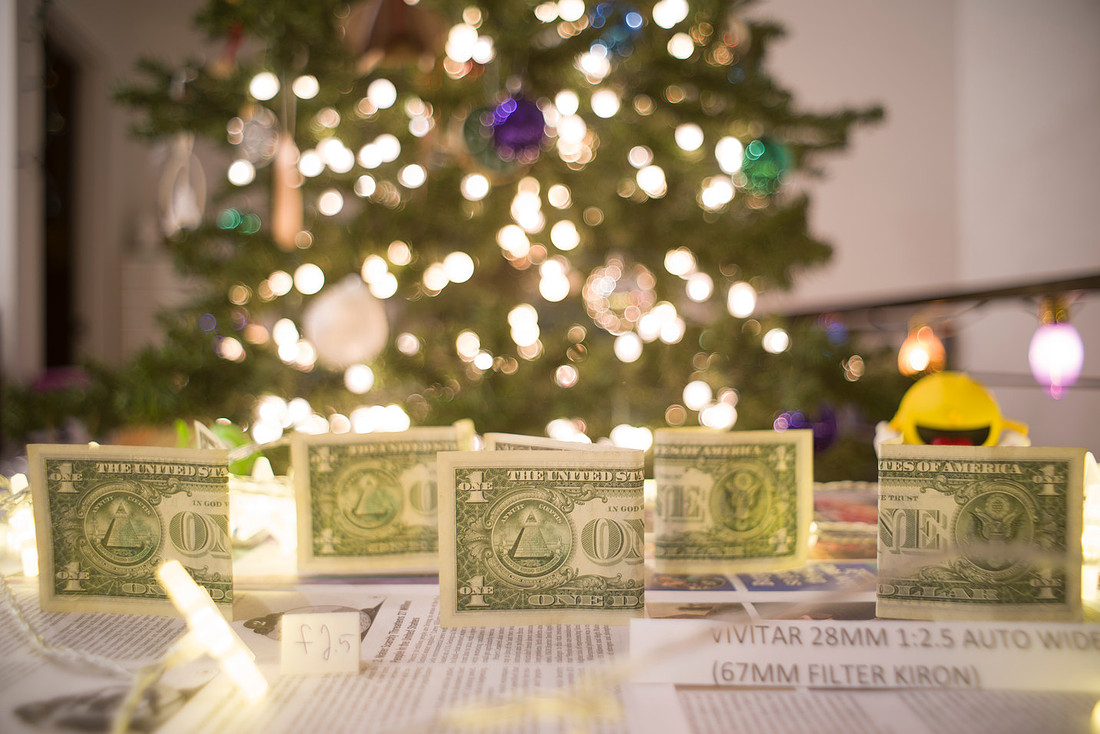
It started sharpening up with stopping down, but didn't get decent until f5.6 with significant improvement in sharpness, and contrast here at f8.
 This far right edge shows smearing and very poor sharpness but surprisingly little chromatic abberation, I would have expected that from a f2.5 lens of this vintage.
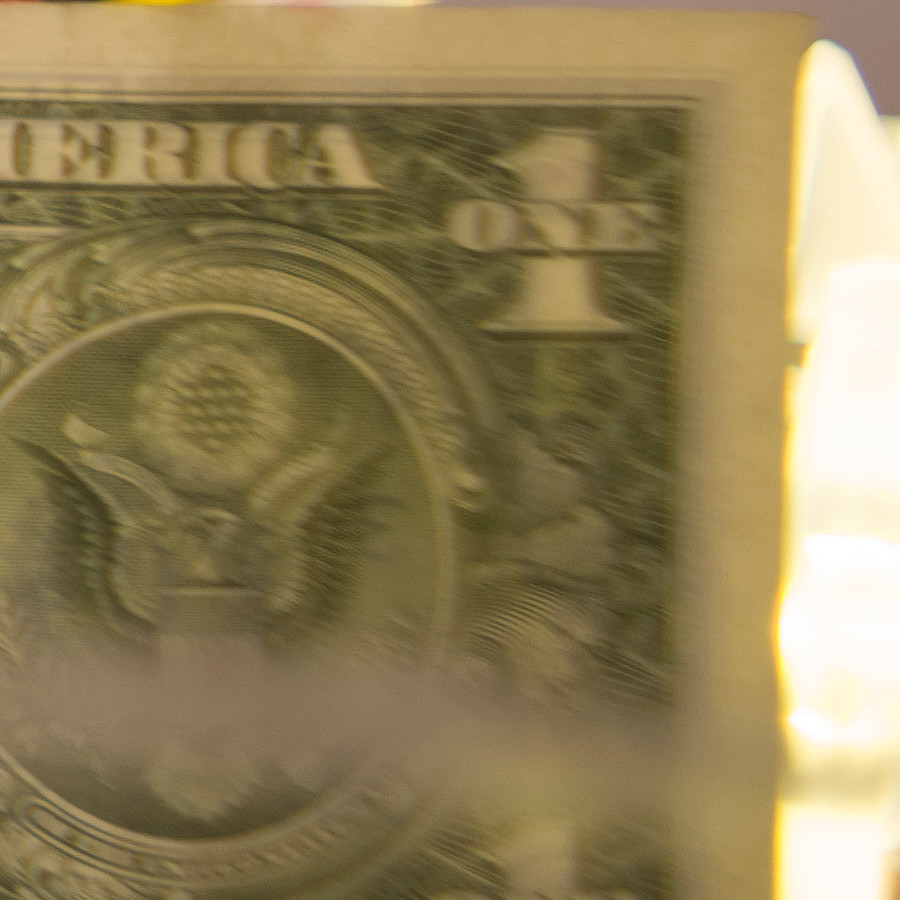
Far left edge is a little sharper but still dreamy, CA still acceptable.

Center is sharper but still not acceptable.

From here on out, I will try to place everything in order of date of manufacture.
Next the Super-Takumar 1:3.5/28mm, this is the earliest version with the 58mm filter threads it seems to be widely regarded as a poor lens, and showed that here. Wide open the bokeh is OK, the light balls seem to have more distortion especially towards the edge of the frame and are less pleasing. Of important note, the handling of this lens and all the old screwmount Takumar lenses is just... superb. It is a tactile delight, they feel so solid and pleasing to turn the focus ring and click through the apertures.
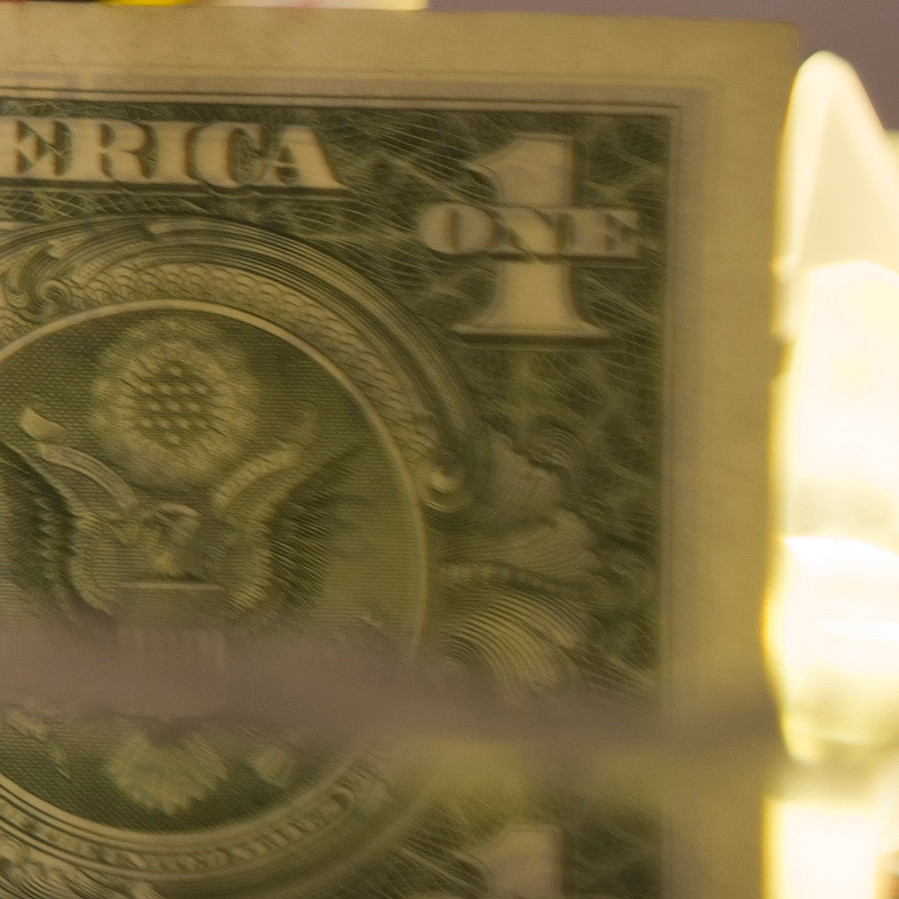
By f8 centrally things have improved and most of the way to the edge, but the far edges of the bills are not all that.
Right edge, not as smeared as the Vivitar
This lens was poorer on the Left than the Right, it is 40+ years old and could be decentered a little, things happen over the years.

The center is definitely a step up from the Vivitar, but seeing all the results, it has nothing to recommend it over the other two slightly newer M42 Lenses.

The redesign provided MUCH improved performance, it has the same name but with a smaller filter size (49mm) it is significantly better in contrast, sharpness and rendering the out of focus lights. The field of view appears to be slightly wider than the previous lens as well.
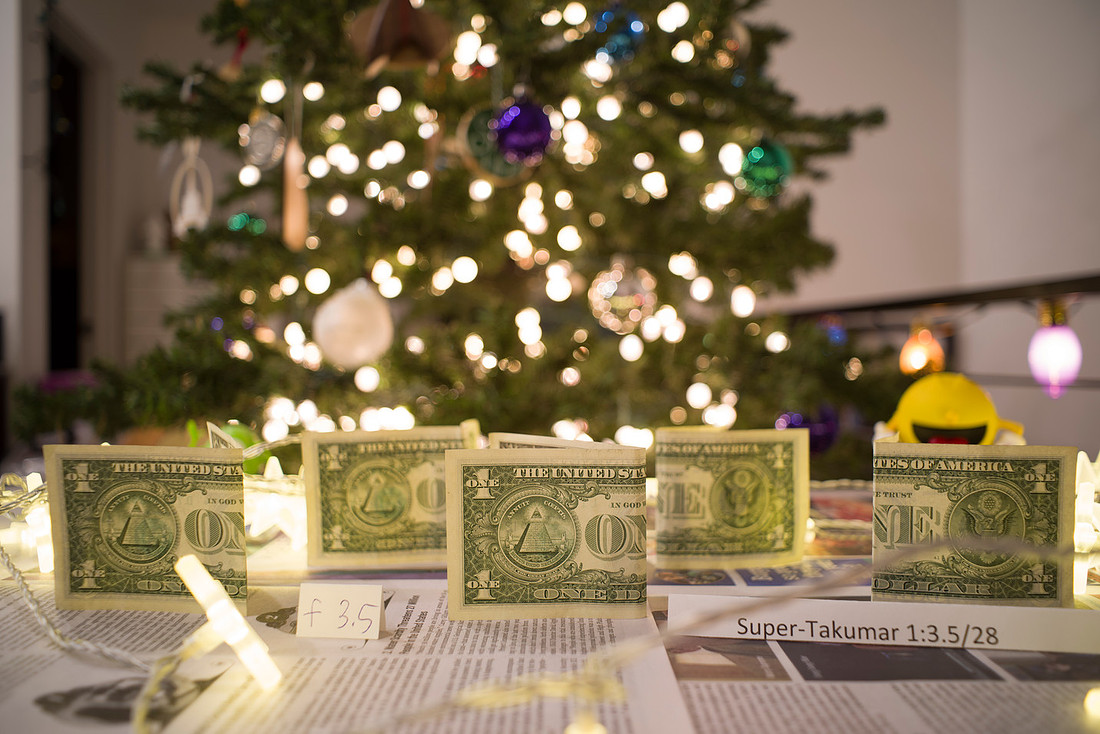
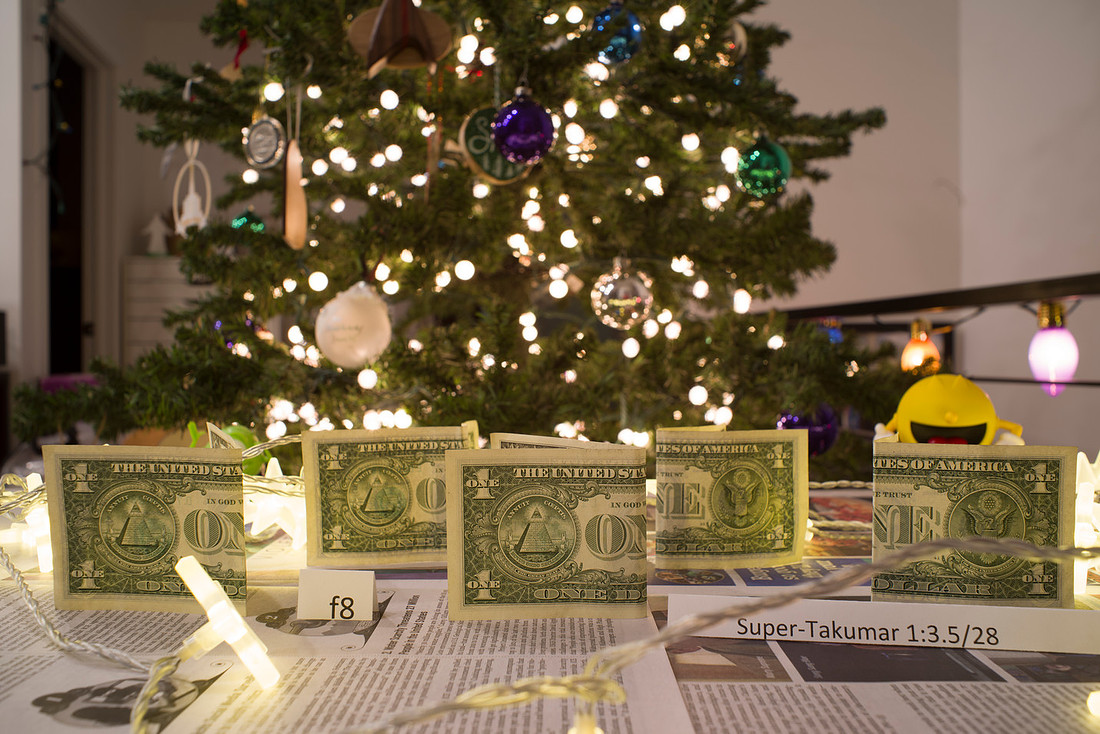
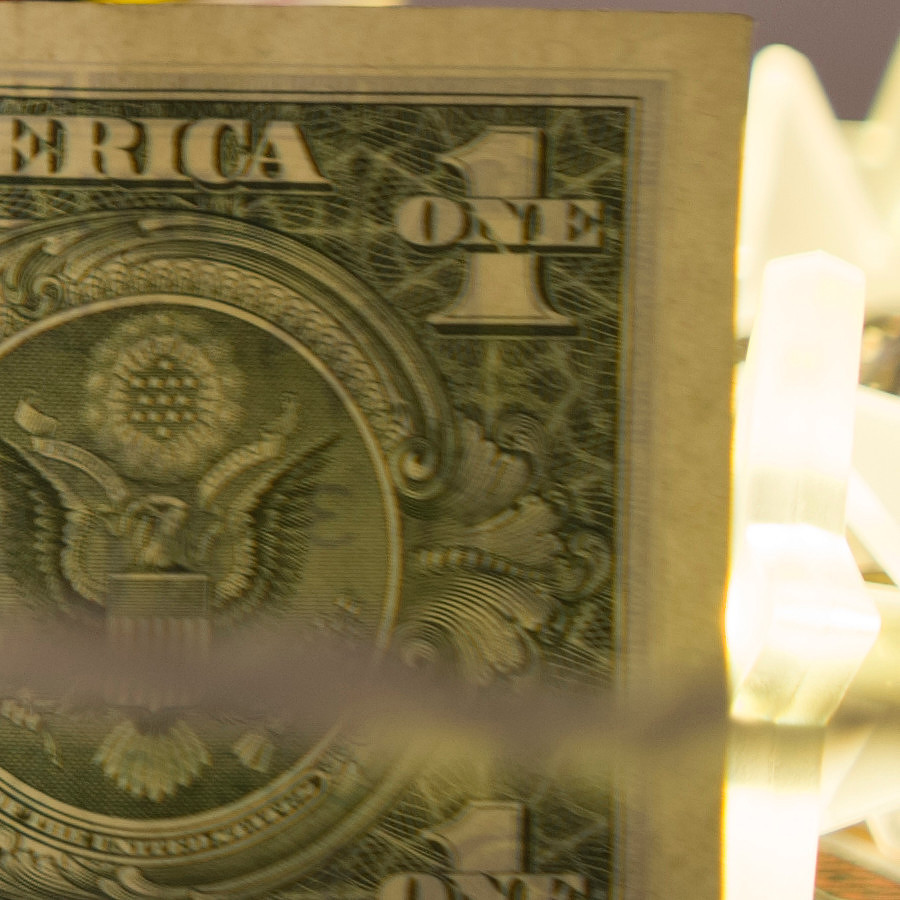


The only difference between this lens and the lens above is the new Super-Multi-Coated lens coatings. The optical formula is the same. I think micro contrast is maybe a little better and you don't see the light bleed around the edge on the right side crop as much, but the differences are subtle. I would need a lot more time shooting with sunlight hitting the front element to likely see a difference.
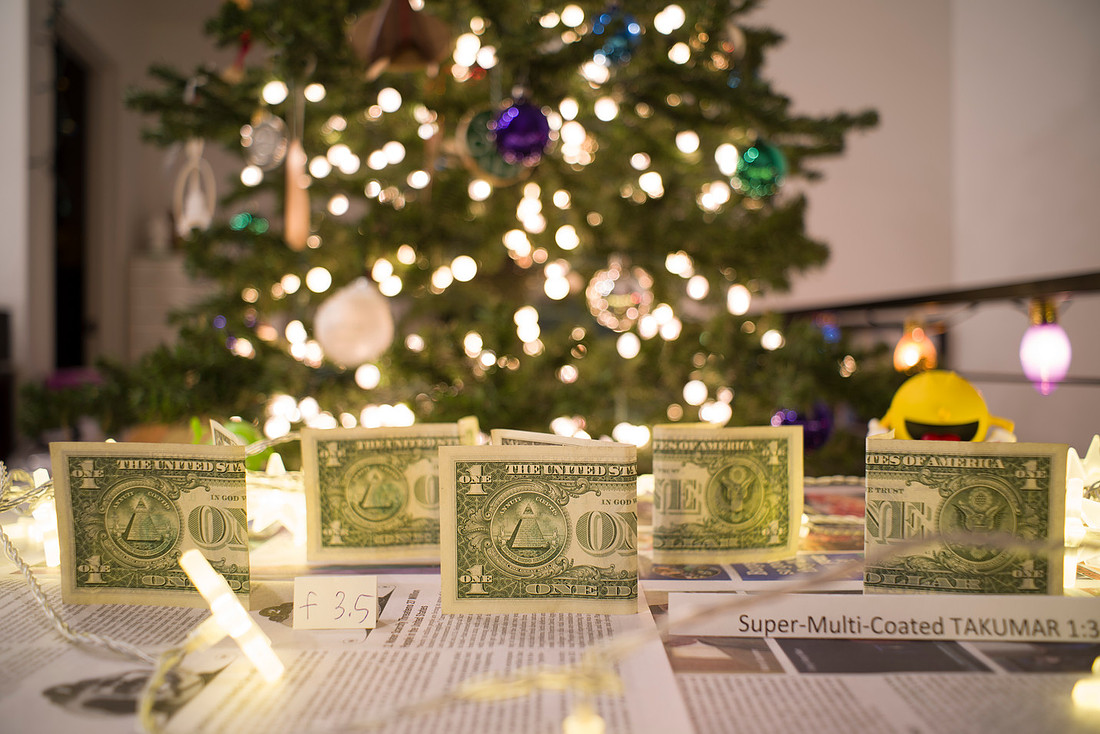
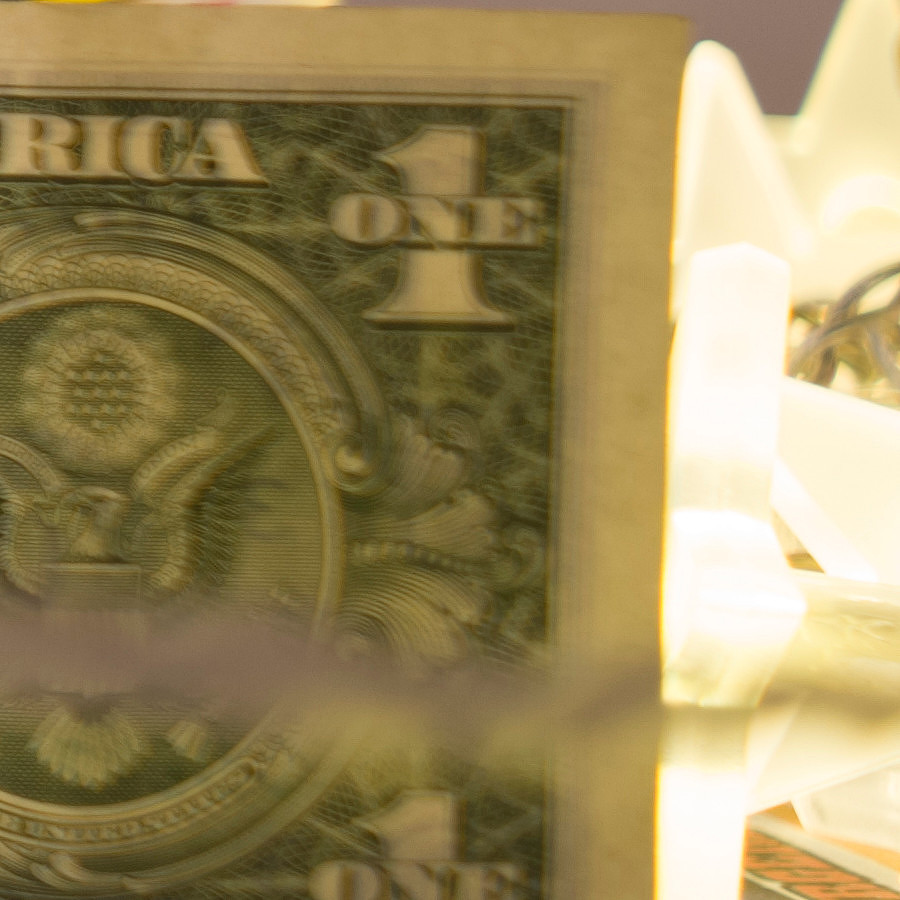
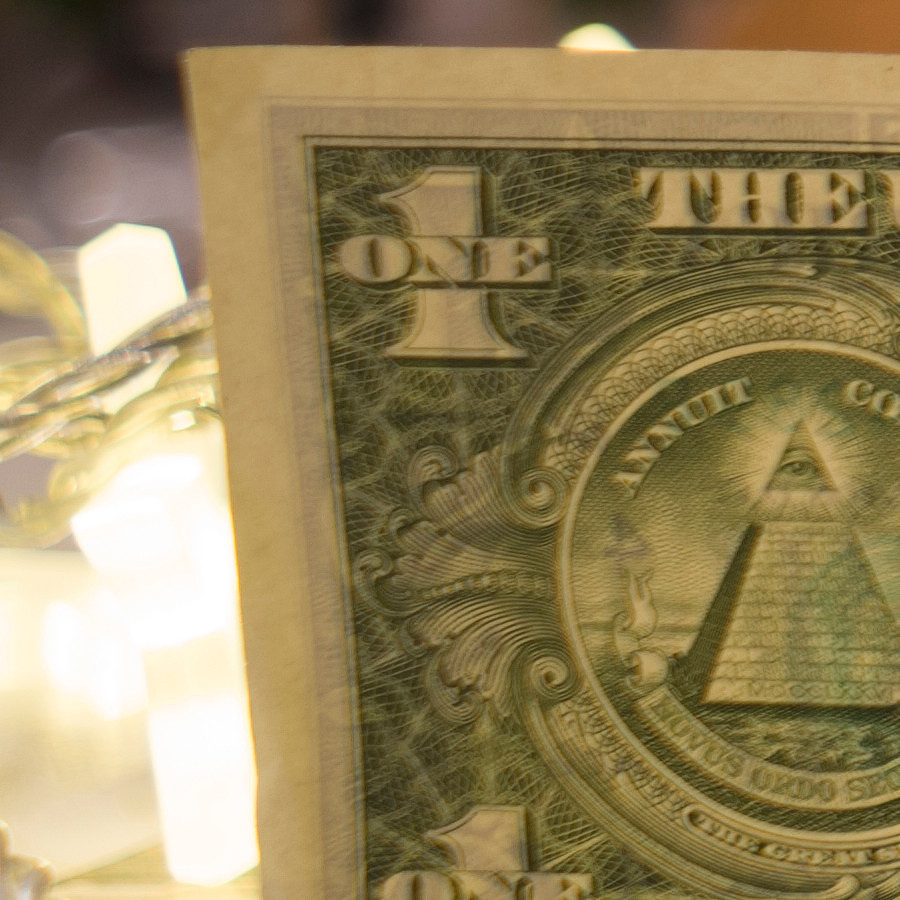
Center sharpness wide open was quite nice!

OK, next in date of manufacture is my SMC Pentax 1:3.5 28mm that I got from my F-I-L (You know, the reason for all the testing?) It is generally very well regarded. I think the central sharpness, contrast are very good, background blur is good for a f 3.5 lens and I was pleased with how it compared, I placed it in my top tier.
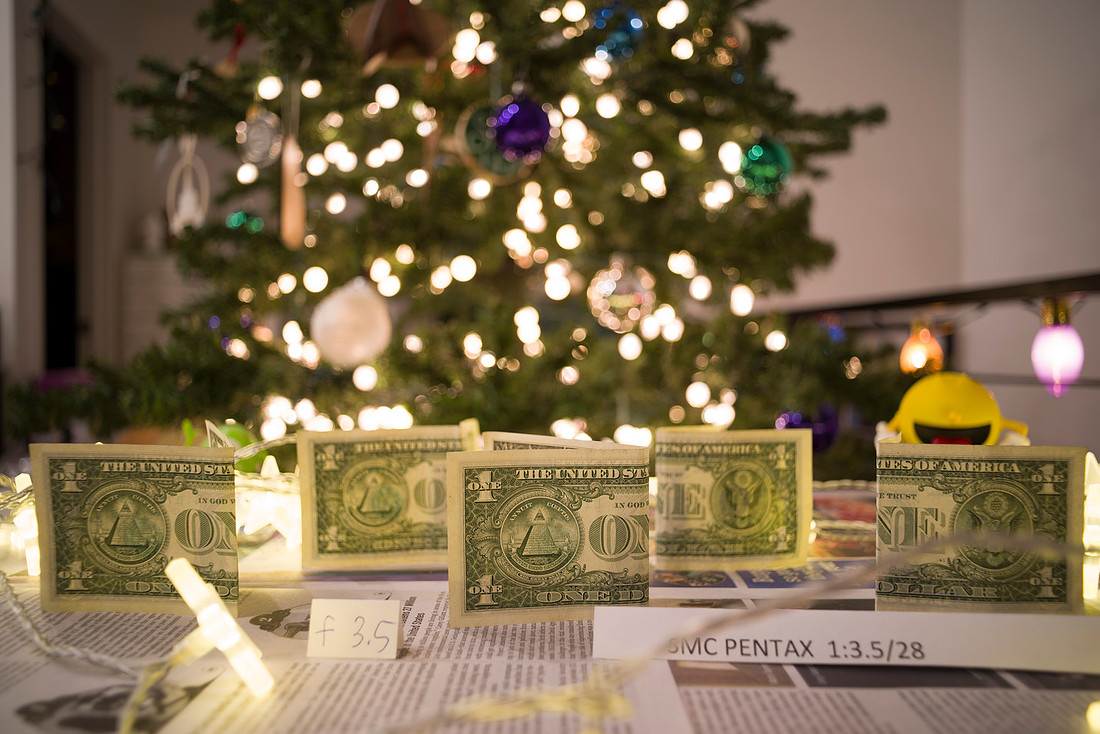
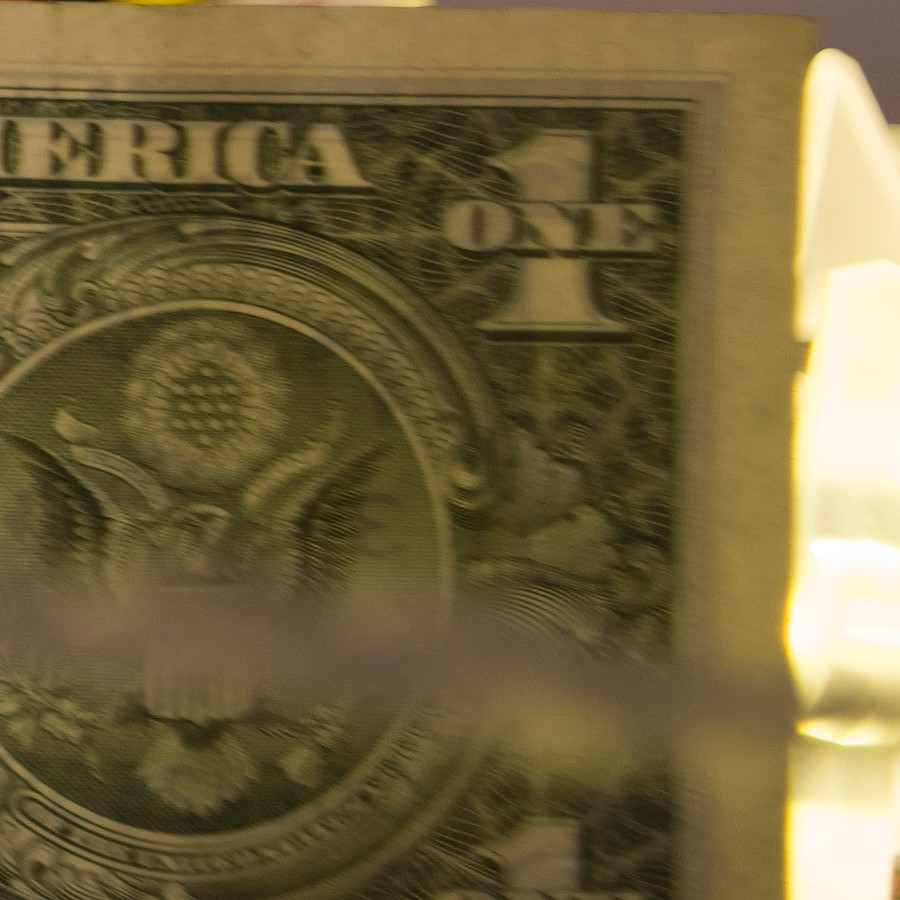
I was a bit disappointed with the edges of all these primes, I think this one had a little larger sweet spot in the middle, but these far edges were just... meh which surprised me.

Center sharpness was significantly a step up from what we have seen to this point. For wide open this is more than acceptable!

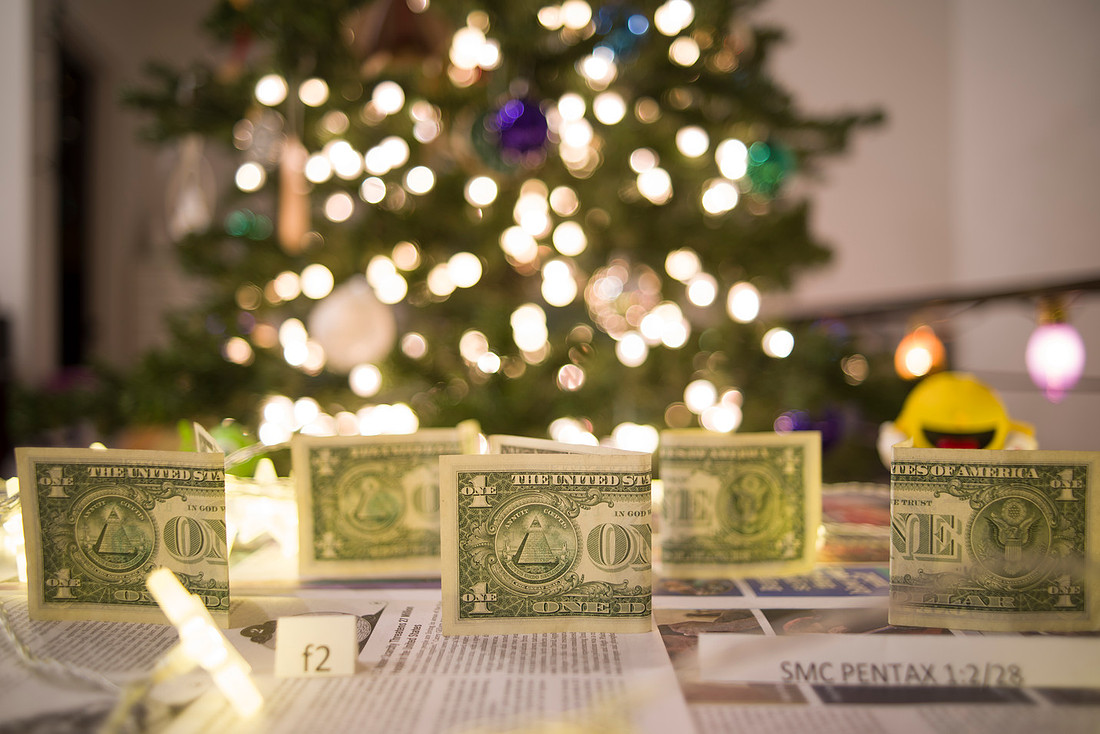
Excepting the Vivitar f2.5 dog from earlier, here is our first departure from f3.5 apertures with the Hollywood f2 lens. The background blur is significantly more pronounced, as you would expect from a lens with 1 and 2/3 stops larger aperture. The depth of field is certainly thinner than previous lenses, but the color and contrast seem to be holding up well. I have to confess I messed up exposure by 1/3 stop I think on the shutter speed, so this looks just a little brighter. If you compare with the f3.5 above you will notice that the field of view is slightly narrower which shows up on the right edge where those lights are not visible past the bill. This lens is physically longer and that may make a difference, but it could be the focal length is closer to 29mm, or the other lens is closer to 27. I am not sure how to test that. Overall, the subject isolation is much higher with this lens, and if you value that, and have the money this could be your best an option. (There are other f2 lenses in the Pentax line up from the manual focus area, both in the M series and the A series, maybe some day I might track one down, but I really want to stick with the K series as that is what I am collecting. Besides, you can't have everything, where would you put it?)
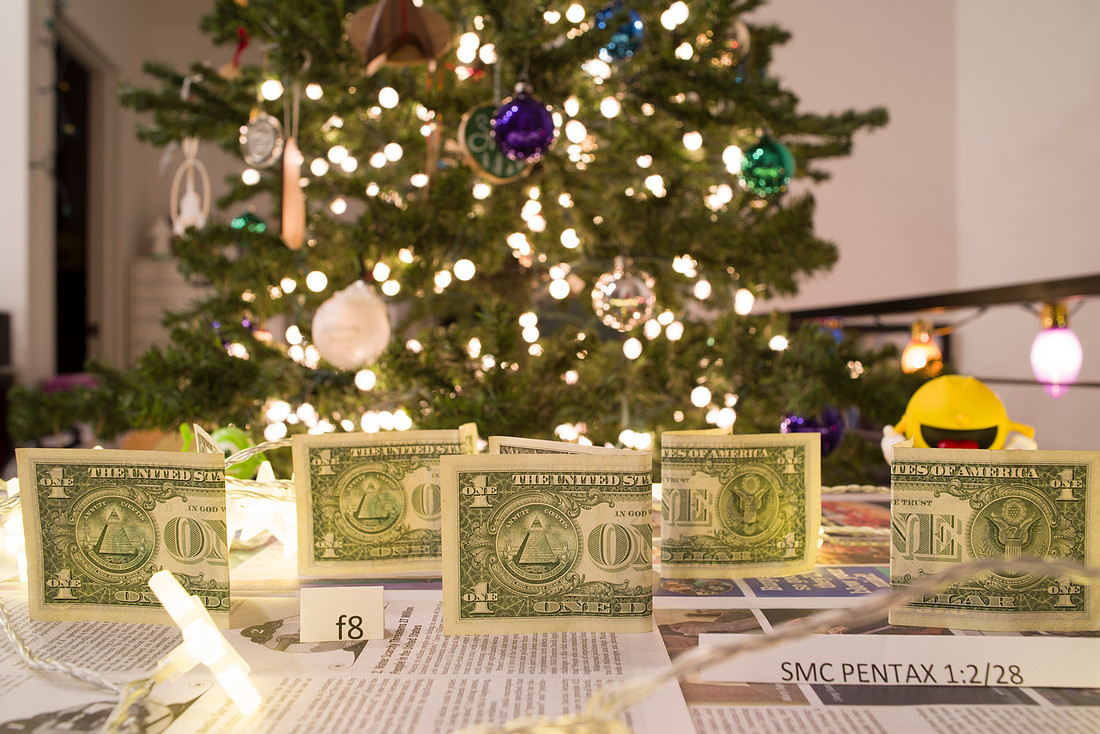
at f8 the lens is superbly sharp until the very edges, but overall everything you would expect from a legendary lens like this with the edges better than the f3.5 version marginally.
I think that the f3.5 lens wide open beats this lens wide open at f2, but... it IS at f2 so not a surprise, when both are at f4 this lens is a little sharper I think, but it is close.

This M series f3.5 lens is new to me, and I have not really used it at all until I started this comparison (You will see more in a future post more focused on the K version. I have shot it directly against the K version more than any other lens, and it is really quite comparable and is physically smaller than the K f3.5 lens and especially the K f2, you can look at it in the earlier photo with the three of them together, the difference is quite profound. The M series was designed to be as small as possible, at times sacrificing fast aperture for size. Funnily we will be looking at the M f2.8 after this and it is shorter physically with smaller glass elements so I don't know that works. This lens also appears to have an even wider field of view than the K f3.5 lens, again it could be the physical size as this is significantly shorter than the other two. Aside from that they perform nearly identically.
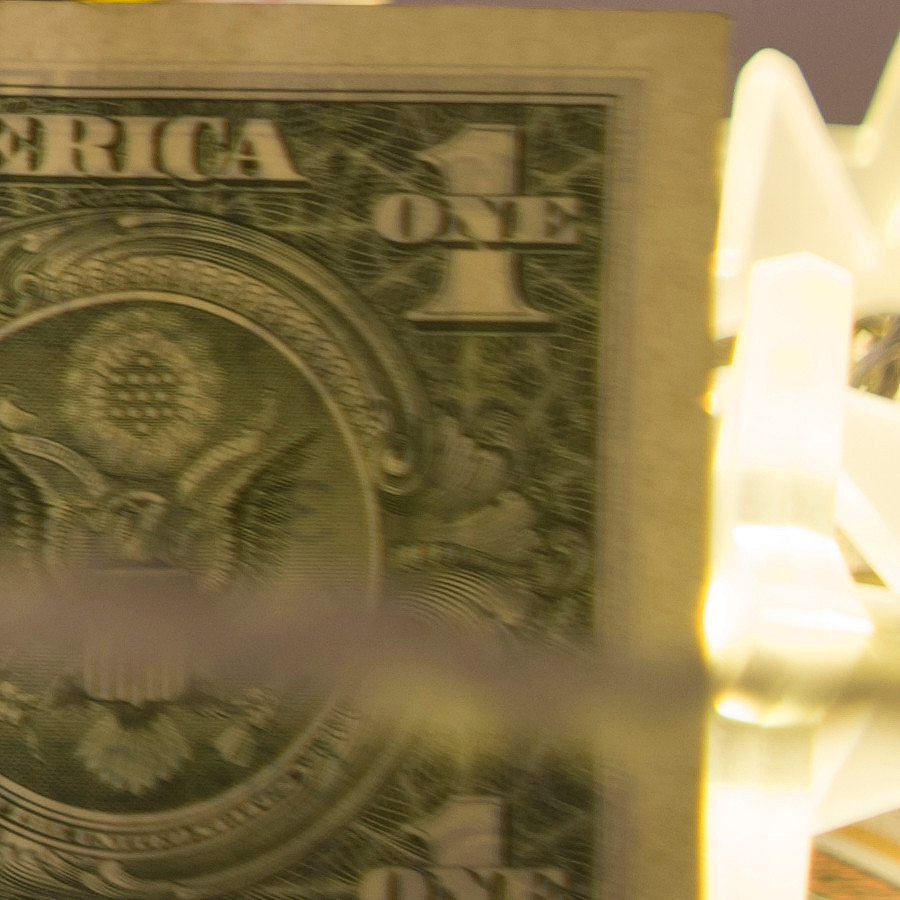

We have progressed to the point that center sharpness is excellent and it would likely take a optical test bench to differentiate the absolute resolution these lenses can achieve. Which sadly, I do not have access to. This is really good here in my opinion.

The M 28mm f2.8, is the smaller, faster brother of the f3.5 we just looked at (Which is weird as usually faster lenses are usually bigger), the most telling difference for me is in the light balls in the background, they are more round and it really gives pleasing bokeh due to that. It does get a little more busy on the silver ornament just right of center, but I don't hate it. This is a nice lens with good overall performance in regards to sharpness centrally but with a drop on the edges compared with the rest of the better end of the group, you can get a decent amount of separation from the background wide open and close up.
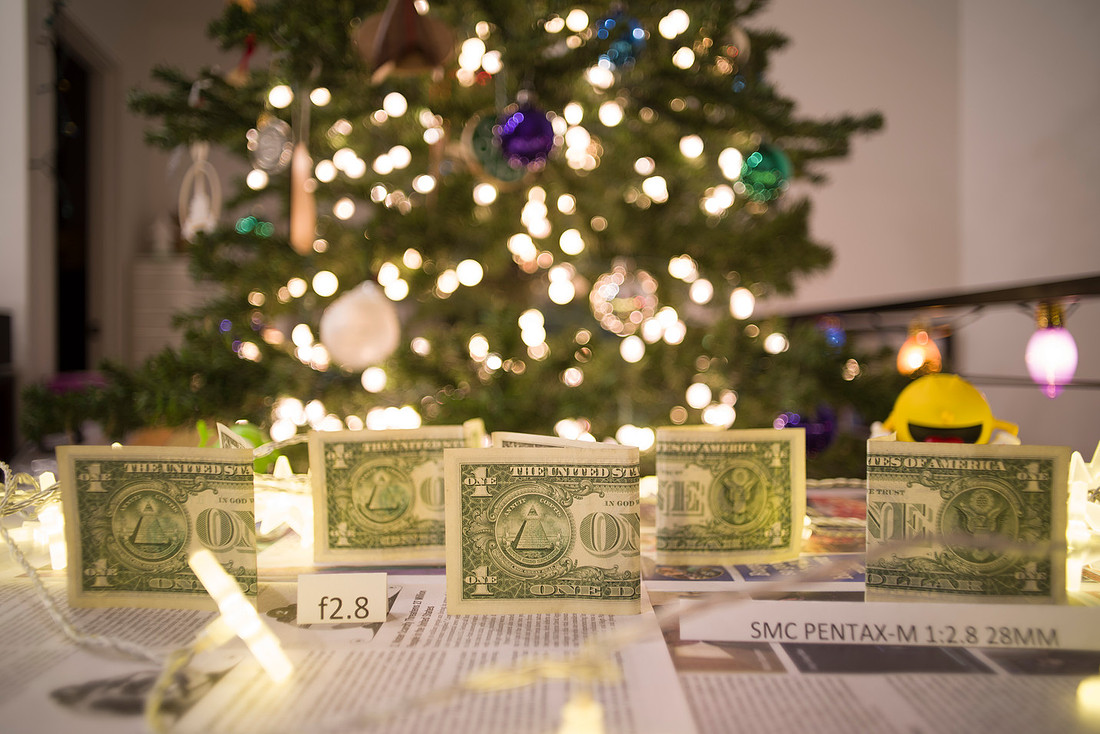
at f8 the edges are better but really need f11 or 16 to get good.
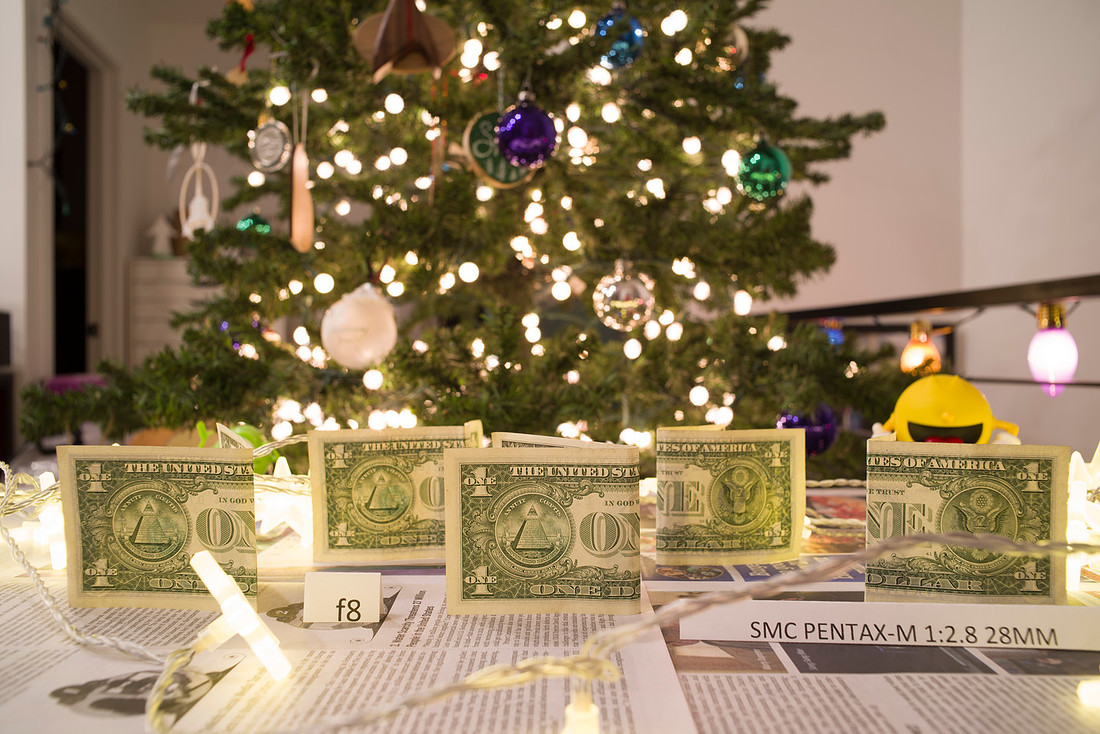
Definitely a step back, contrast is good, but it is just not sharp enough compared with the K or M f3.5's
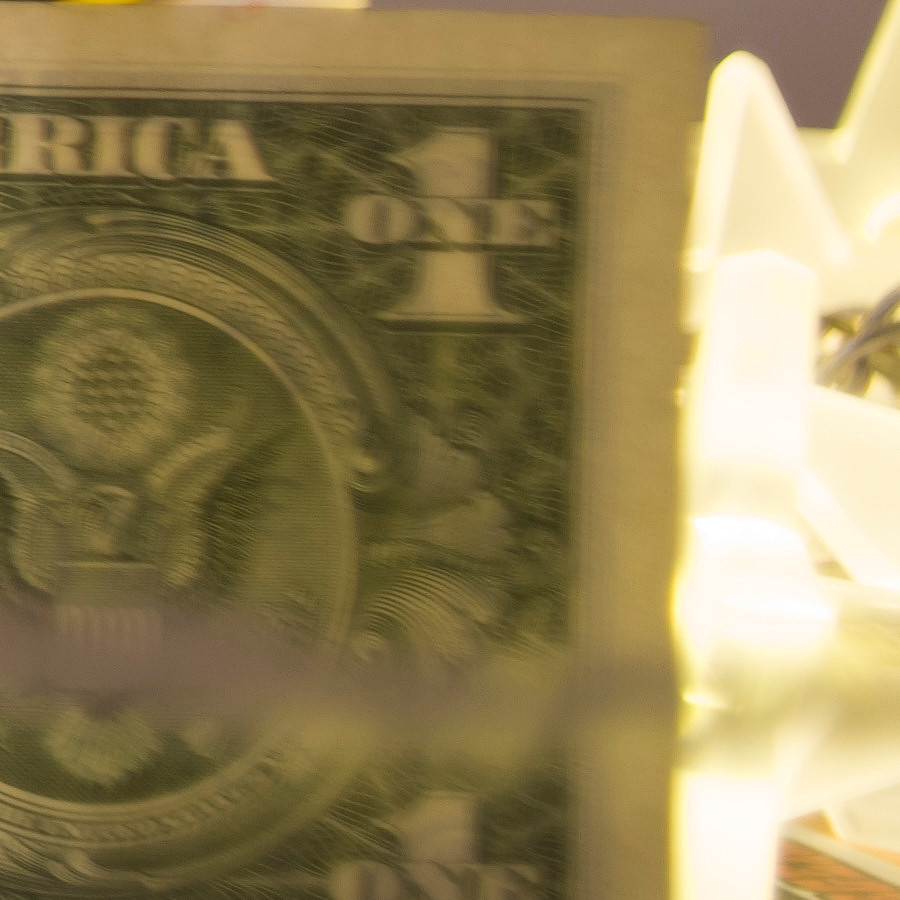

Nothing to complain about here in the center.

This was a "Budget" offering that is purportedly the same optically as a second version of the M f2.8 lens (Not the one I have tested here) but with fewer to no coatings the A 28mm f2.8 appears optically the same but with SMC coatings. As a budget lens designed for film not a 36 MP digital sensor I think it was a steal. The performance is not quite as good as the M, or the A thinking it is due to the coatings, but if I was penny pinching back in the day I would have been just fine with this lens. I really am curious how this would do in daylight with the sun in the frame, I think it would likely show it's weaknesses there.
The edges I would put on par with the M f2.8, but again, budget lens built to a price.


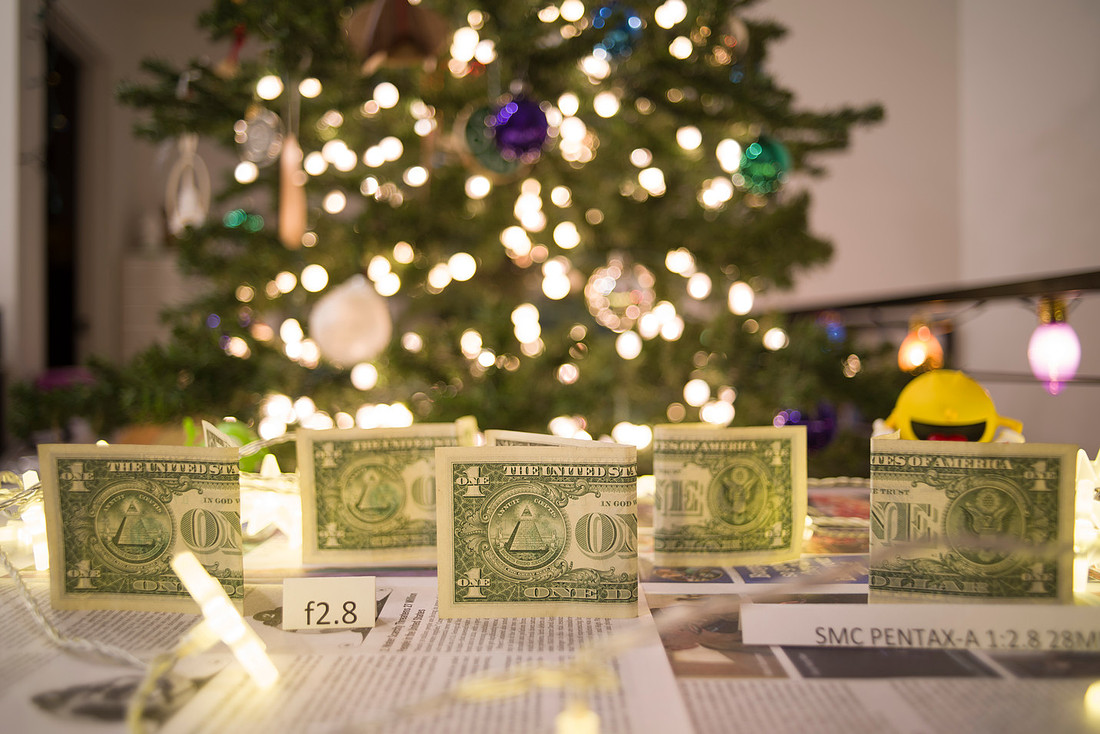
The A series, now you can set the aperture on your camera! I had really considered collecting the A series and selling my K series lenses simply for that making it easier to record aperture and making metering easier, but I really don't like the A series build, which is more plastic and just not as fun to handle. As I said earlier, this appears to be identical to the Takumar Bayonet optically and looking ahead to the F series autofocus lens as well. Flipping back and forth the distortion and rendering appear identical. I think the M series has the best controlled out of focus light balls so far, but this group is better than the two K lenses or the m42 Takumar lenses in regards to the shape.
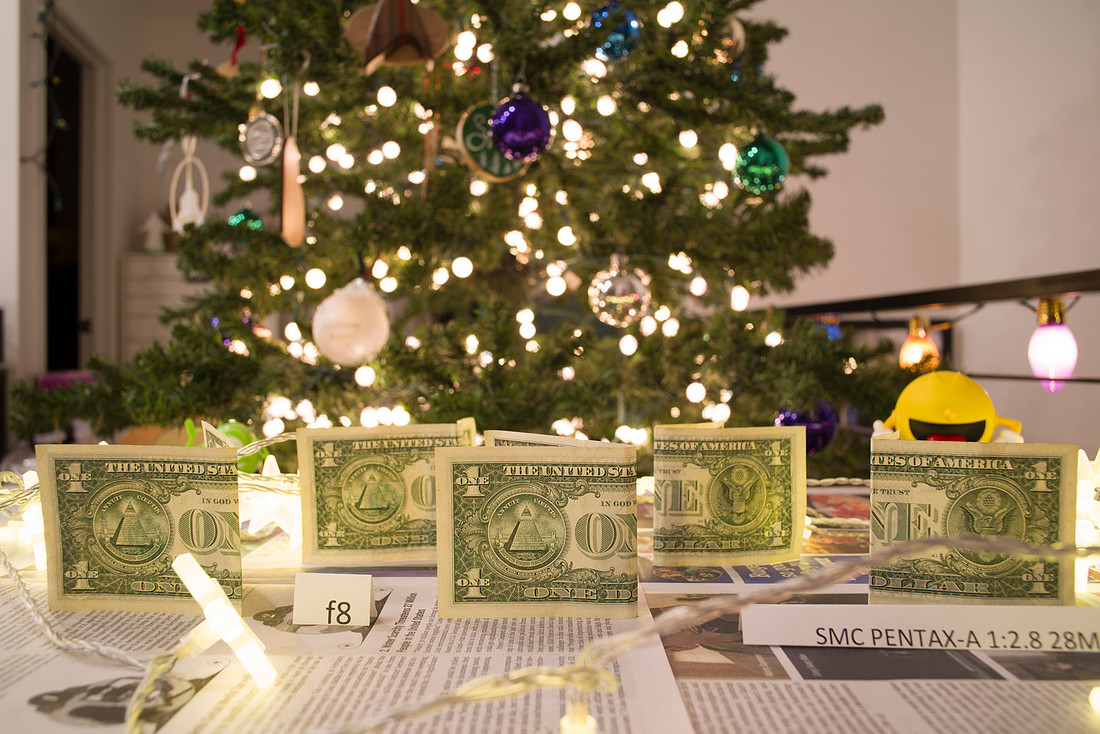 By the time you get out to the edges, they are really falling off, this may be a bad copy, I remember really working to make sure the center focus was dead on, OR there could be some field curvature, but I really think it is just what the lens is.
Left is a little better than the right, so maybe a decentered copy.

Centrally it is quite acceptable, but not on the first tier.

The next generation from auto aperture A lenses is auto focus, these are called the F series of lenses, they were replaced by the FA series, some were optically identical some were changed the 28mm lenses were changed significantly between the F and FA lenses with the addition of an apochromatic element in the FA series and a whole new optical design. This F lens, while optically identical to the A series and the Takumar Bayonet budget lenses, performed quite a bit better in regards to sharpness though I am not convinced that despite my best efforts I didn't have it slightly front focused (meaning the field of focus was just a little closer to the camera than the other lenses.) I like the build of this lens better than the FA and I think the background blur is better and I would likely buy it over the FA just due to how the lens body looks, the F series is prettier.
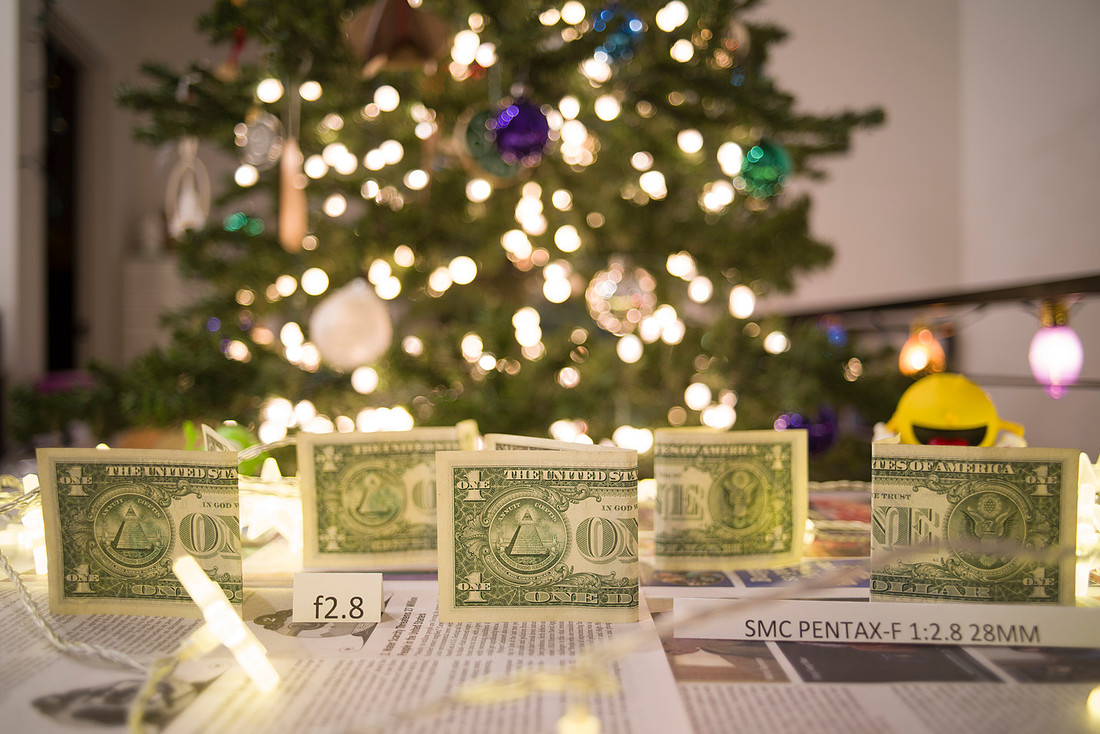
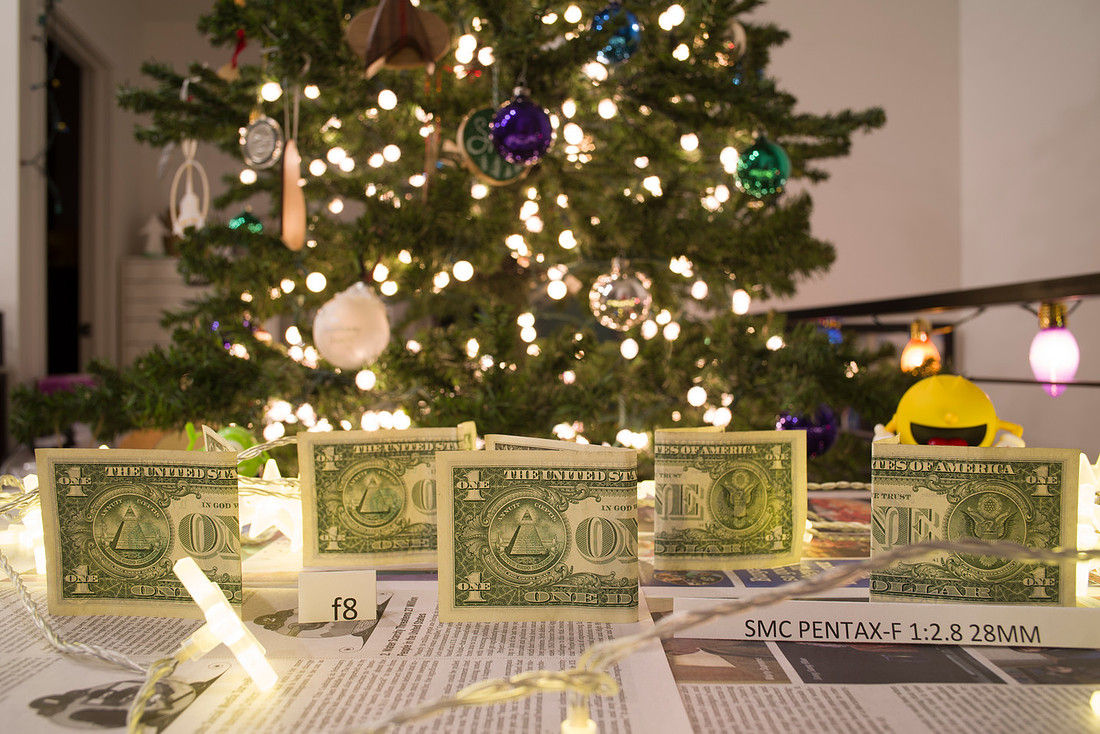
Not perfect, but pretty good.
Pretty good centrally, I think this lens is more even all the way across than the others so far, as I said I may have slightly missed focus.

New lens design, FA series, build quality now plastic for a lot of it. Optically it is pretty good, maybe a little more even across the frame than the F or earlier series. It really gets better the more you stop it down. The light balls in the background are very different from the F and A lenses.
Central sharpness on par with the best, but lacking a little contrast wide open.

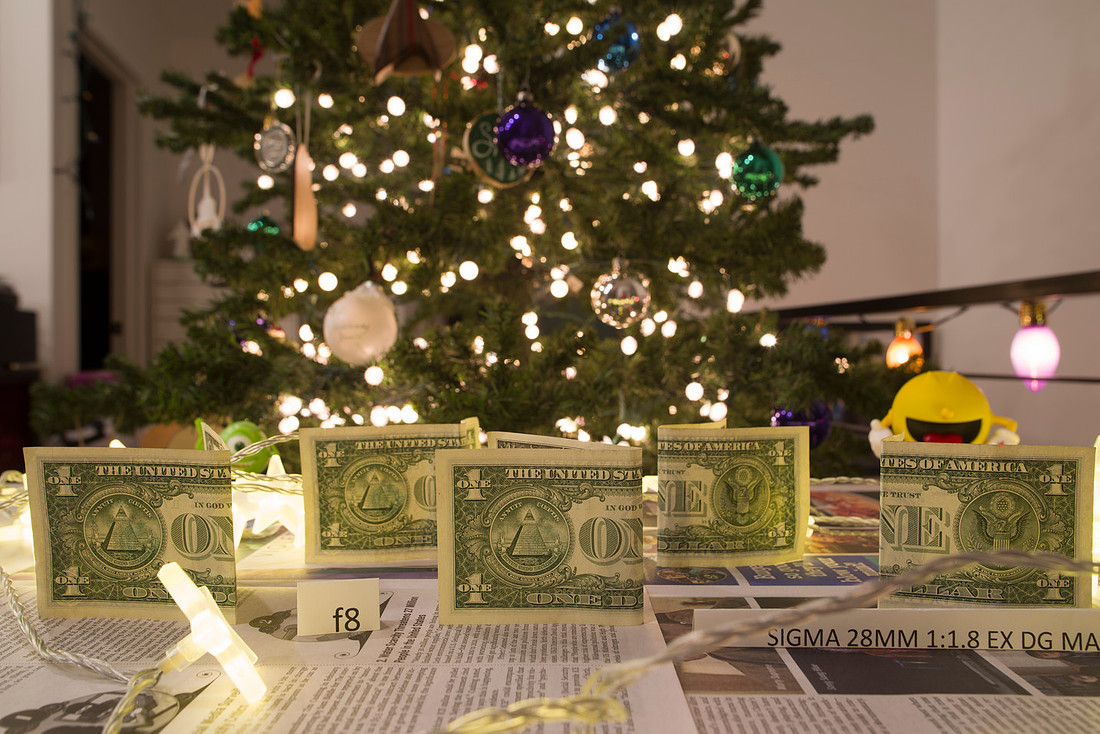
Now, with the Sigma f1.8 lens things get interesting, a more modern prime with the largest aperture of the bunch, as well as 9 rounded aperture blades, all of the prior lenses have had 5 or 6 blades, I actually prefer the star effect of the 5 bladed apertures vs the 6 bladed ones. I have not had the opportunity to provoke starbursts with this lens, but with an odd number of blades and what I have seen here I am willing to bet it will do nicely. The large aperture shows significantly more background blur that is really quite pleasing and I would think once you learn the lens it could be used to great effect. If you look closely you will notice that the light balls are nearly perfectly round even close to the edges. This is great performance and really makes me want to not give it back... The colors are not quite Pentax due to different coatings, but they are acceptable certainly.
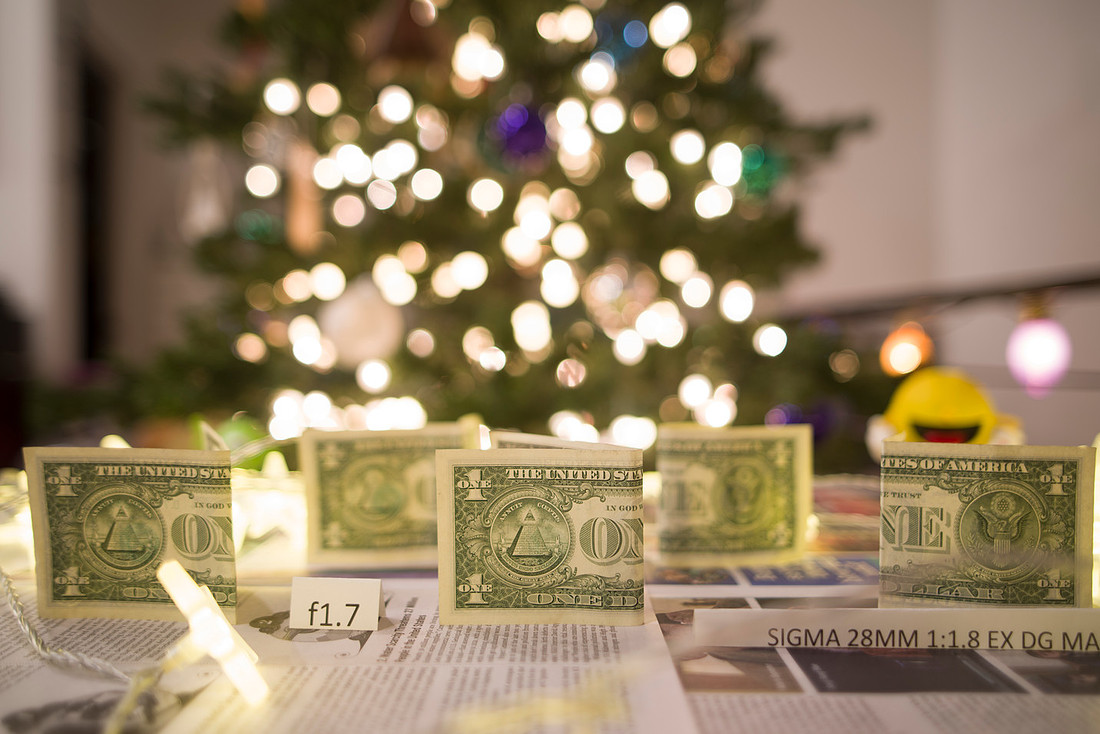
Stopped down the sharpness increases across the frame and while there is a subtle difference from the two K lenses and the M f3.5 that I cannot put my finger on I am pleased with it. My only nitpick, is in the rendering of the out of focus light balls which may come from the newer lens elements where the light is less smooth across the effect, that I believe is referred to as onion ring. I really don't notice it unless I pixel peep and I think it is a trade off I can live with. I do seem to see it more with modern lenses, and I think it may be due to the types of glass and the overall lens designs.
The field of view also appears ever so slightly narrower than some of the other lenses, but as with the K f2 lens, this lens is physically longer and that may have change the FOV at this close of a focus distance.
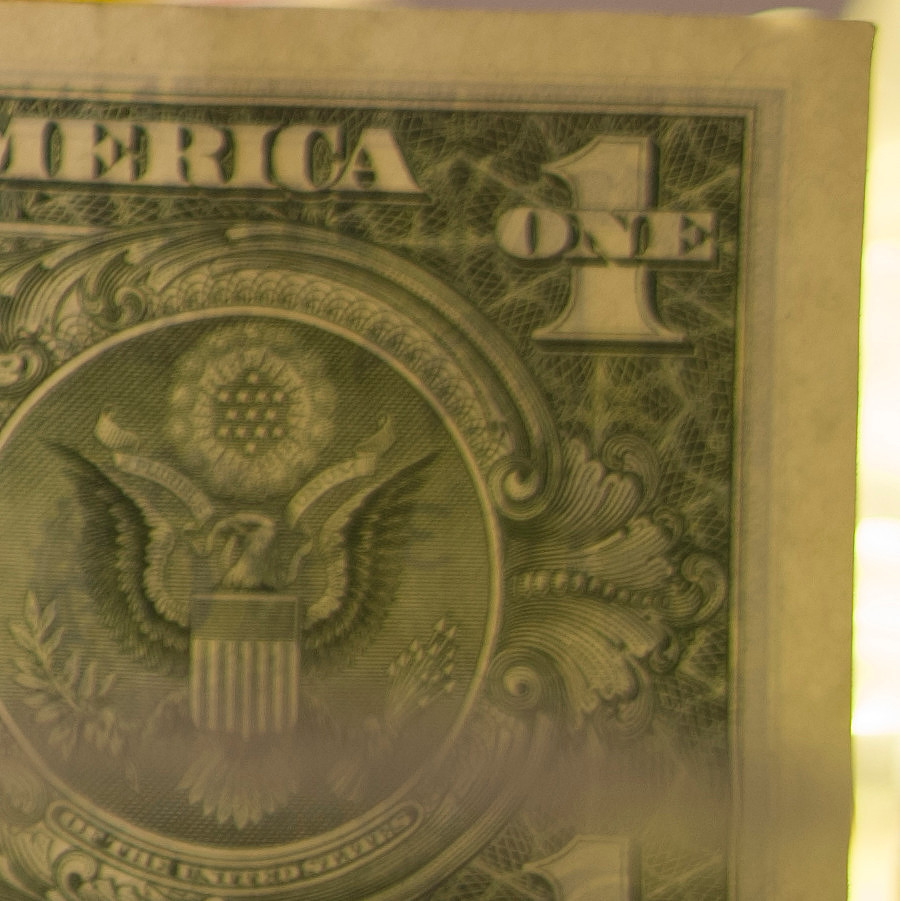
For f1.8 (1.7 is what it says on the camera....) this is really quite acceptable edge performance, I do see a little chromatic aberration on the edge of the bill and there are a couple of spots where the brighter light behind the bill appears to bleed around the edge, which I think is a component of flare, however as a trade off for f1.8 I am OK with that, it reduces as the lens is stopped down.

Not as sharp as the K f2 centrally or the f3.5 K or M for that matter, but that also improves as you stop down. At f4 it looks quite good and I could see myself setting it there and leaving it there all day.

That ends the prime lenses, I wanted to use my modern zooms as benchmarks for comparison, in some ways this next lens is quite a bit better than the older primes, but in other ways it lacks. This 15-30 f2.8 is a big lens, designed for landscape use stopped down, and on the wider end, and astrophotography at 15mm and infinity focus. Wide open at 28mm is not what it is designed for IMO. That said, the bokeh is actually pretty good, the light balls are very nearly perfectly round, though there is some onion ring to it, it is not terrible. There is a little more distortion, being a zoom that is expected and the resolution is not top tier. However, stopped down to f5.6 or smaller, the resolution improves a great deal side to side, not surprising. For landscape use I seldom go below f8-11.
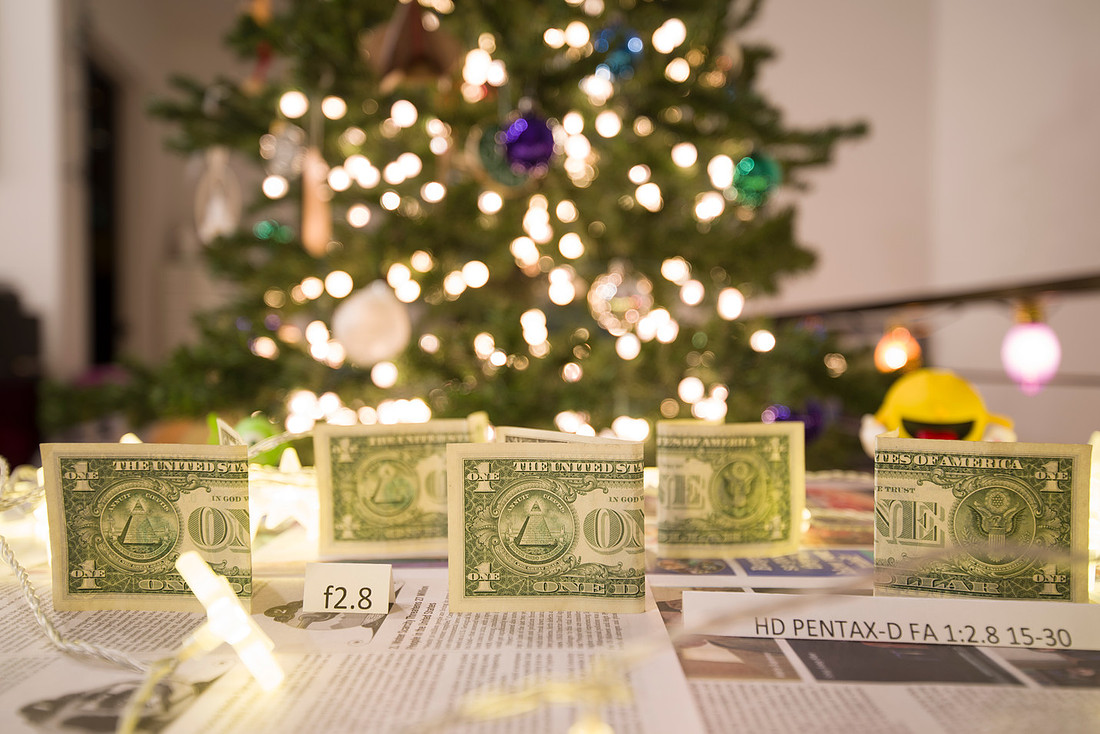
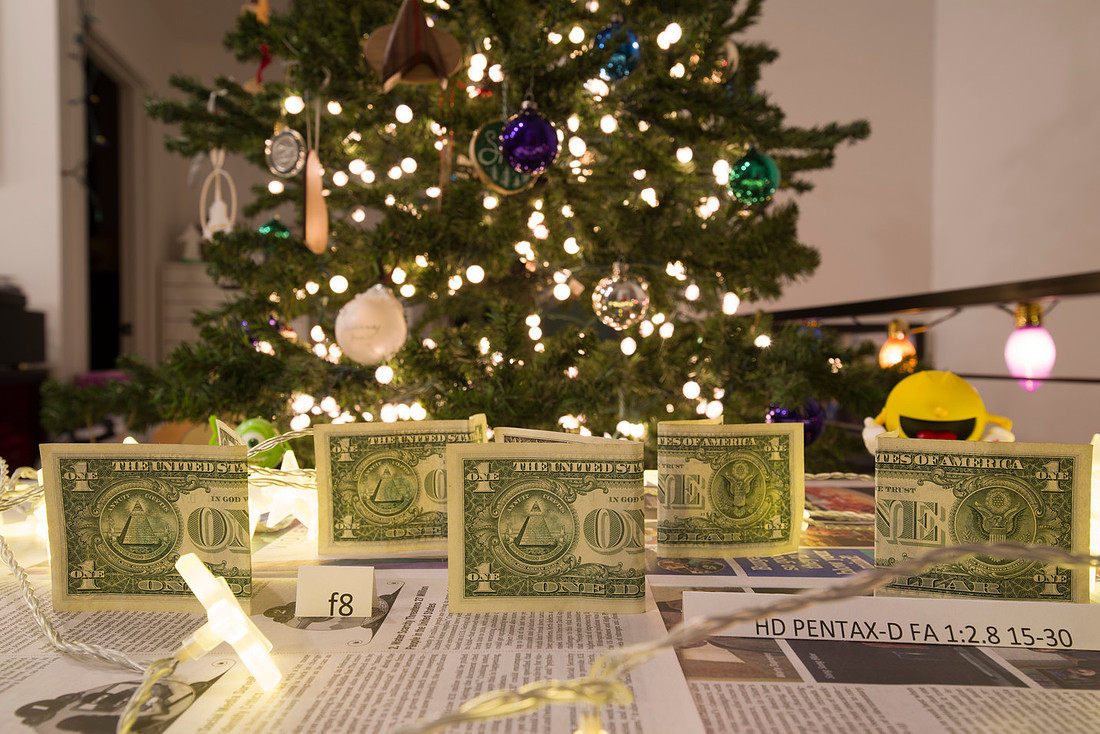
Not terrible wide open, but just OK.
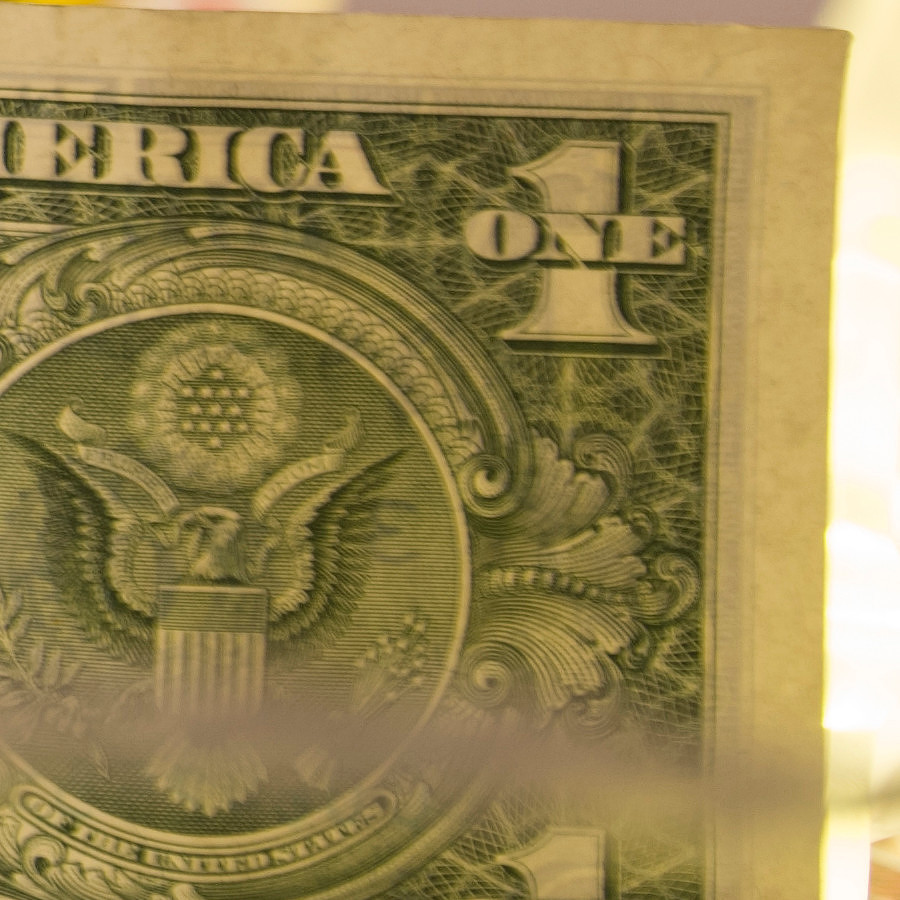

Just OK centrally wide open.

Last but not least, I HAD to try the DFA 28-105 f3.5-5.6, it is f3.5 at 28mm this has been a solid lens for me since I got it with my K1, it has always delivered high quality, sharp images and has never let me down. My first surprise was that I missed setting up the tripod to where the lens was just a centimeter too close to the subject to focus properly, so I had to scoot it back just a little bit, which is noticeable in the framing. The second surprise was how sharp the silly thing is especially edge to edge even wide open. It blows even the Hollywood f2 out of the water in across the frame sharpness especially when you stop down a bit. The bad? The out of focus blur is not nearly as good as the other lenses, the light balls are not round, but it isn't terrible. It IS a zoom lens so I can live with it.
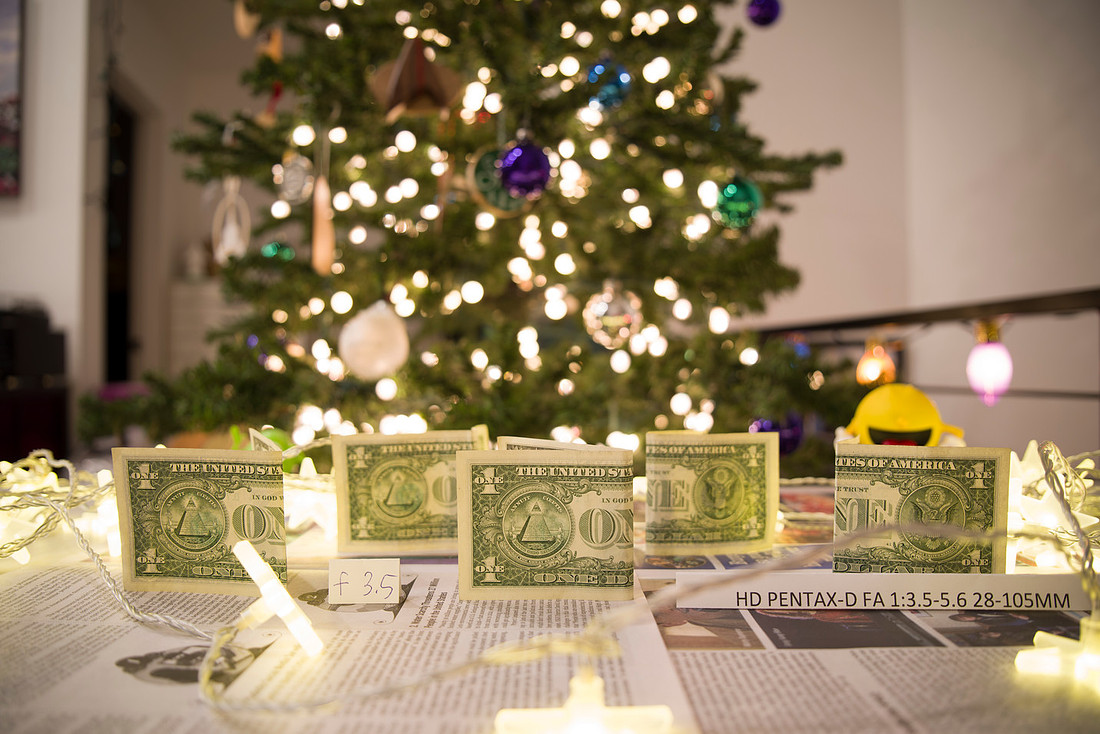
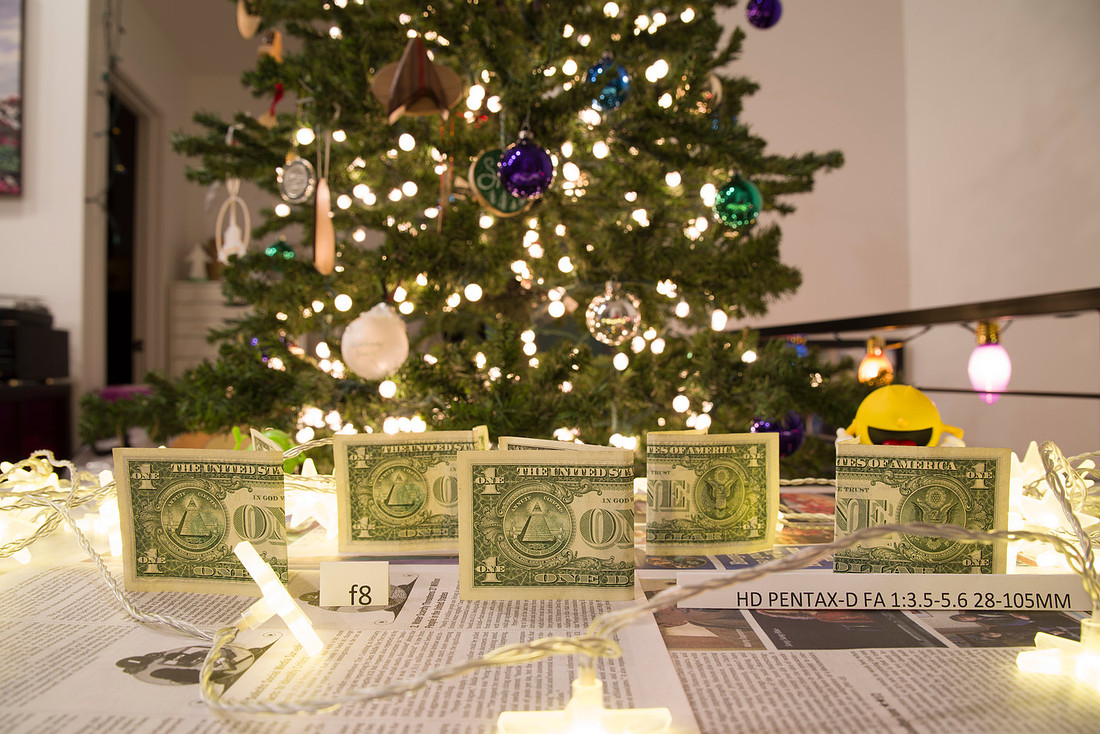
Look at it though. That is really good for wide open, I will have to test more to make sure it wasn't a fluke of having a little closer to the center, but... I am gobsmacked!
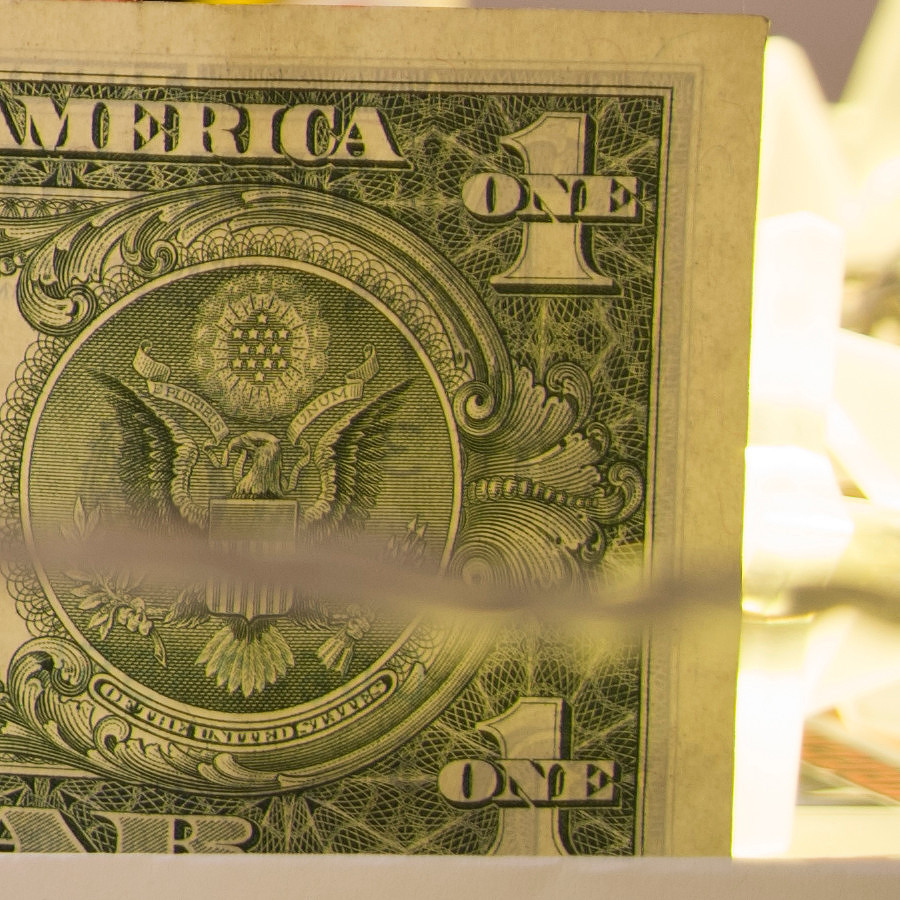


In conclusion, I set out to see how my 28mm f3.5 K series compared to its f2 brother and to the M series f3.5. I very luckily got some bonus lenses to compare them to as well, which ended up being a lovely thing, despite making this a much longer and bulkier post.
I ended seeing these lenses shaking out as follows.
Tier 1: K series f2, f3.5 and M series f3.5
Tier 2: Super Takumar and Super Multi Coated Takumar 28mm f3.5 m42 lenses along with the M f2.8 (though it may deserve to be Tier 1.5) and the FA f2.8. The rest of the f2.8 lenses are Tier 2 but still acceptable.
Tier 3: Super Takumar f3.5 (58mm filter thread) and the Vivitar f2.5 You got to stop them down to get much.
Between the modern Pentax zooms, the DFA 28-105 was the winner for sharpness, not to dog on the DFA 15-30 but this is NOT what it was designed to do.
I cannot decide about the Sigma 28mm f1.8, it is a bit dreamy wide open but sharpens up really quiet nicely, it also has a near macro capability that I want to explore. It can be had for significantly less than the K f2 lens and is auto focus/auto aperture. It sits outside of the ratings for now as it's own unique thing, I may have to work hard to keep myself from buying one, I don't need it, but I kind of WANT it. I have included a couple shots I added to the end of the shoot to demonstrate how it focuses a LOT closer than the other lenses.
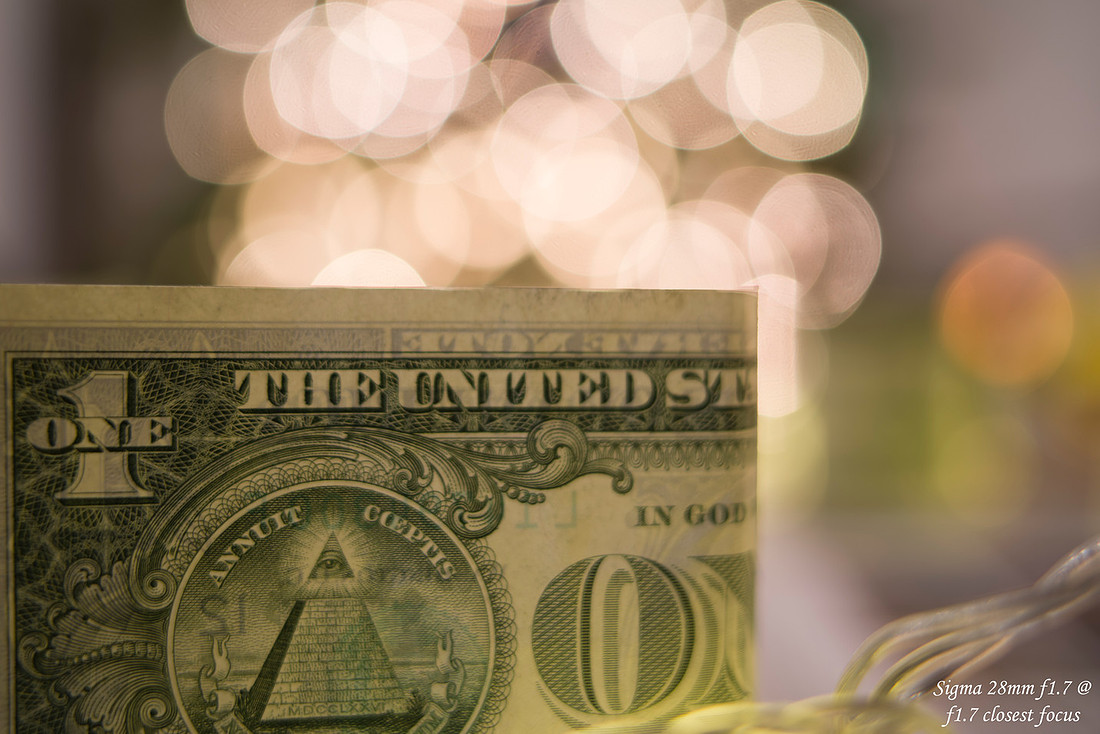
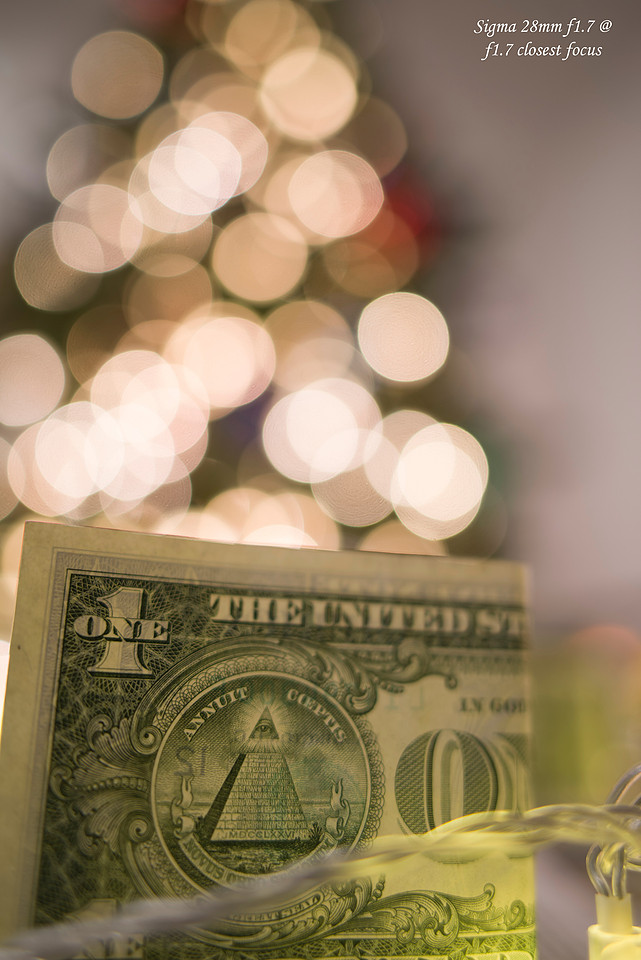
This lens is significantly COOL!
The last thing I wanted to do as both of the K lenses have the same minimum focus distance of 30cm was set them up at that distance and just swap one for the other to show the greatest background blur each lens is capable of. Sadly I think the tripod moved as I was swapping lenses so the framing is not the same. There is a big difference between f2 and f3.5 though.

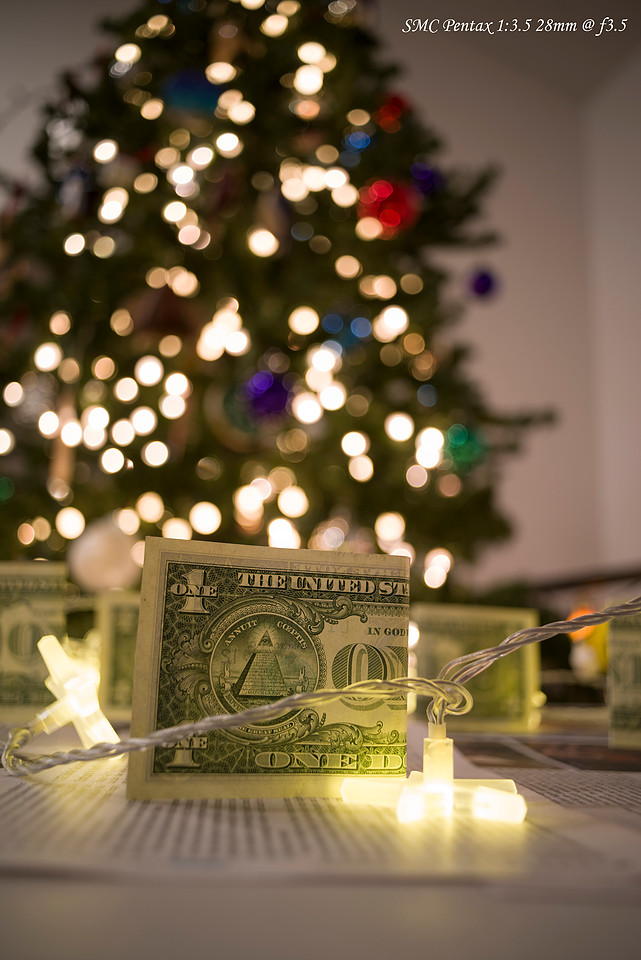
Certainly there is a huge difference between the two. But I don't think that the difference is worth the hundreds of dollars in price difference. Then there is the Sigma, that is intriguing... If you offered me a choice between them as a gift but I could only take one I would likely take the Hollywood just because I covet the K series lenses. If I am paying, likely the Sigma, though I am never giving up my K f3.5
Thanks for reading! And congratulations on being persistent! As always comments are welcome and should you want to see full resolution copies of the photos I can be talked into giving access.
Lloyd
SMC PENTAX 1:2.8 24mm Tested and a little compared.
Time for another post! I believe I mentioned in my last one that I was going to be testing this one next, but if you missed it, here it is.
The SMC PENTAX 1:2.8 24mm on my full frame Pentax K1 mii.
This is an old full frame manual focus lens, from the same series as my other old Pentax Lenses. You can read more about it here if you wish: https://www.pentaxforums.com/lensreviews/SMC-Pentax-K-24mm-F2.8-Lens.html
My history with this lens, is murky as I cannot remember where I bought it, I am pretty sure I got it off ebay many years ago, but I really cannot recall. It may have been off one of the photography forums... hmmmm... Anyway, I have it, really liked it on APS-c (Pentax K-5) where it was less extreme wide angle and more medium wide and used the sharper center of the lens cropping out the edges. It is quite sharp wide open at f2.8 and I used it a fair amount as a walk around lens equivalent to 36mm on full frame.
It is quite compact and easy to carry around, not unduly heavy at all. Like the rest of the K series (first Pentax lenses with bayonet mounts instead of screwing onto the camera) this lens is built of metal, no plastic, and is a solid chunk. The focus ring moves with the right amount of dampening and it is a tactile pleasure to use.
The field of view is quite wide on full frame, not as extreme as some of my other lenses like my 15-30, but for it's time it was pretty wide. That will be a theme as we get into the end of the review, should you stick around that long. "For it's time" it was a good lens, the early 70's was a time where lens quality was really REALLY good for some lenses and focal lengths, like 50mm, there are many 1950's lenses in that focal length that are still really quite good. 35mm and 28mm were getting better designs, but wider than that there was less quality and fewer lenses. The 70's and into the 80's saw the increasing use of computers to enhance optical designs and as time has gone on, lenses have gotten sharper, or faster with f1.8 or even f1.4 lenses in the wider focal lengths being designed in the last few years. We are truly spoiled in modern times, to have lenses that are fast, sharp and optically excellent. There is something to be said for older lenses like these though, they are quirky and have optical performance that would be considered poor in modern testing, but that add... quirk... a feel, or just some kind of a difference that modern lenses lack. They are also easier to use on Extension Tubes and other weird gizmos that allow for closer focus. Eventually I will do a blog post on those too. Part of why I love photography is there is always something different to try.
We are going to jump into an initial dump of the photos I have taken recently then get technical at the end. Should you want to look at all of these photos and ones I didn't post here you can view my gallery here: https://www.lloydshell.com/p633889536
This was one of the first photos I ever took with this lens on full frame, wide open and at closest focusing distance. Just to see what it could do. The colors are excellent.
This is a 100% crop from the photo just below, this is wide open at f2.8, in the right conditions this lens can make full use of the resolution of the sensor.

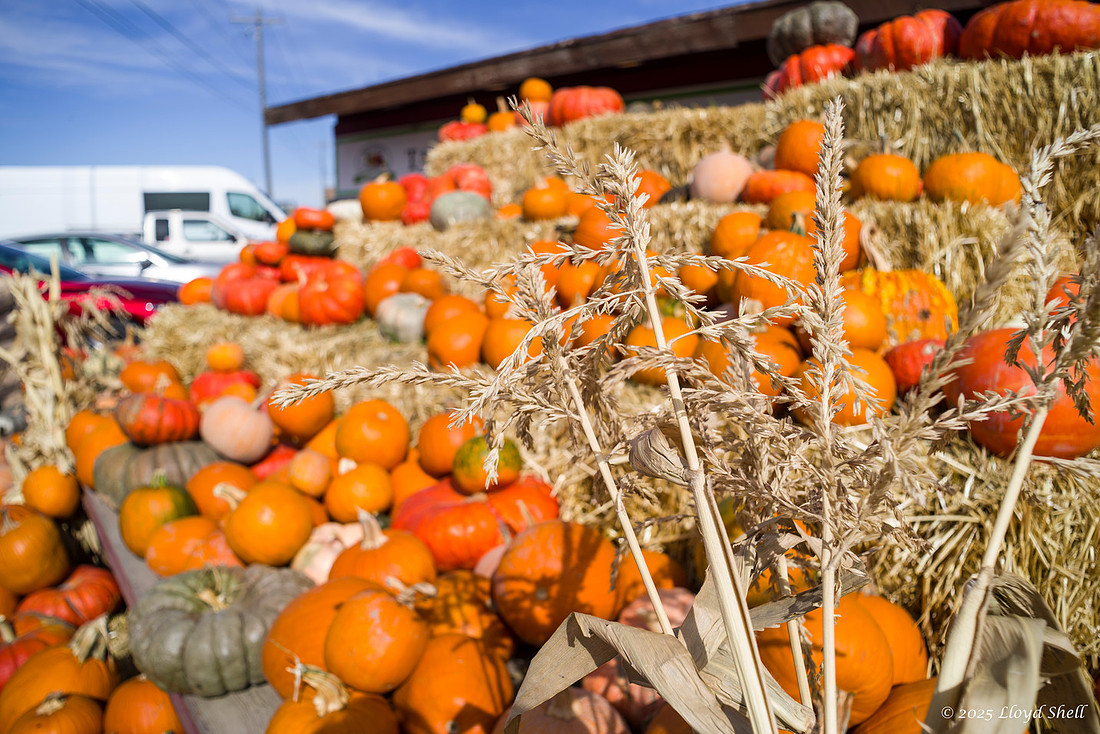
The bokeh can be a little busy.

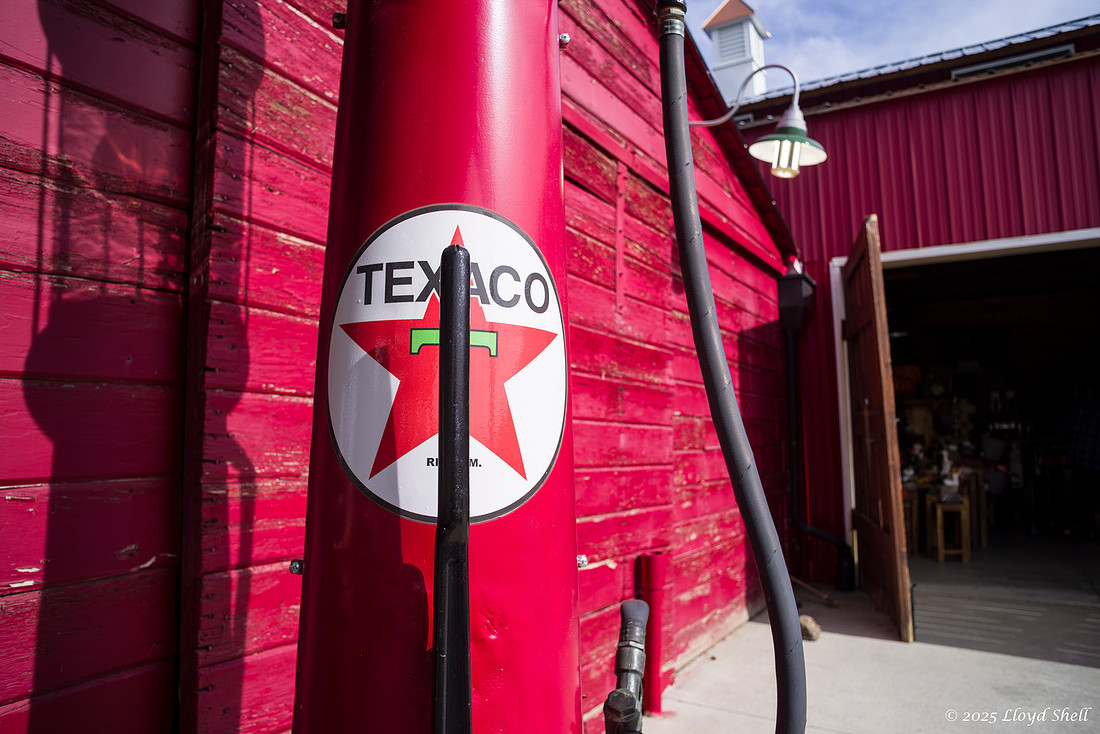
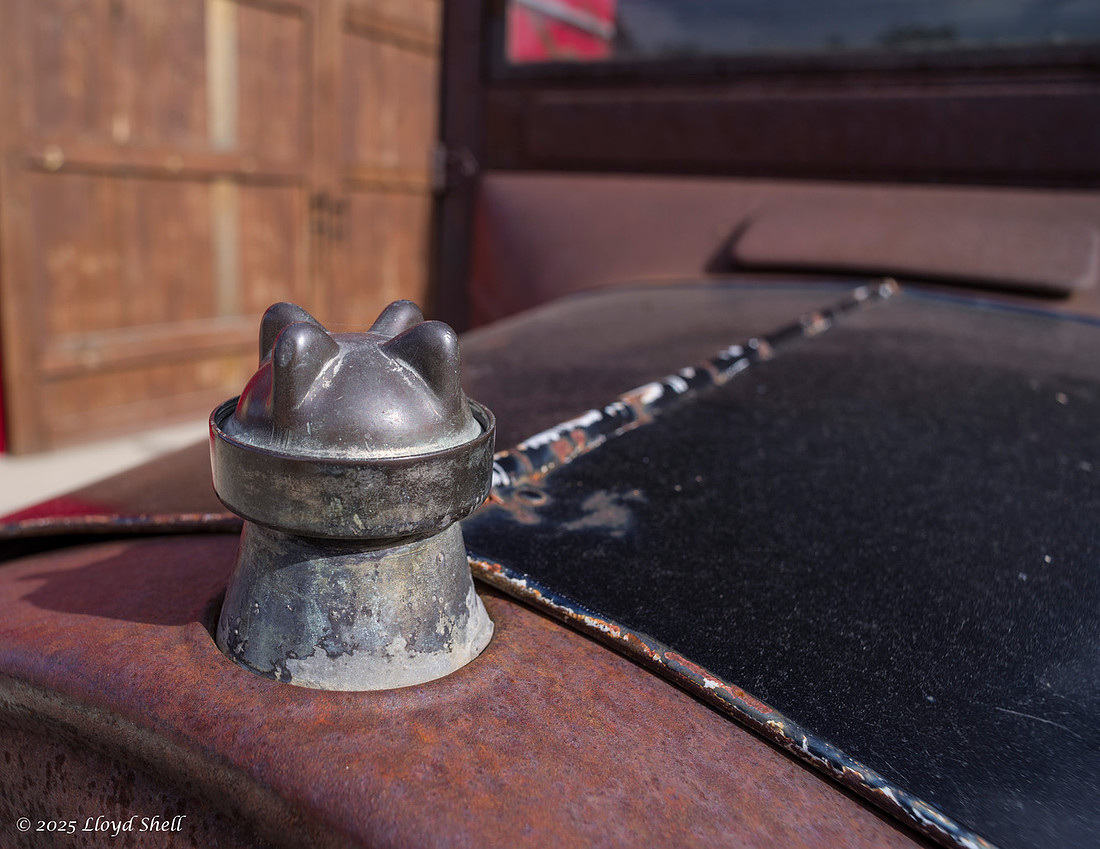
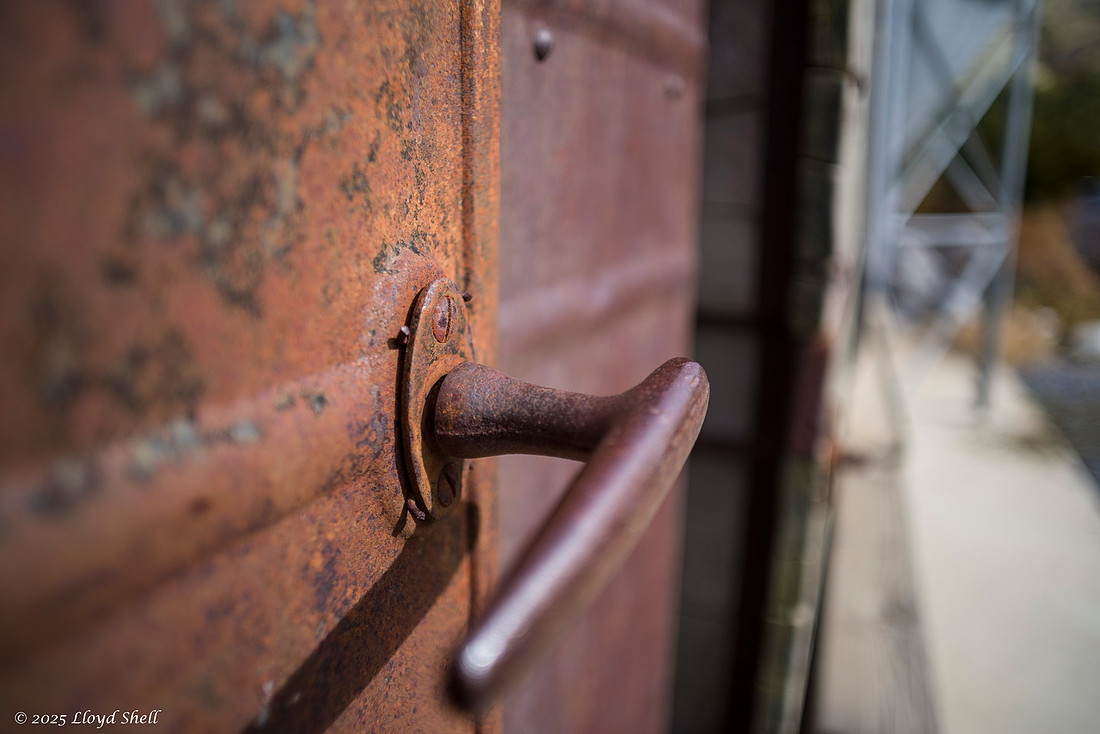
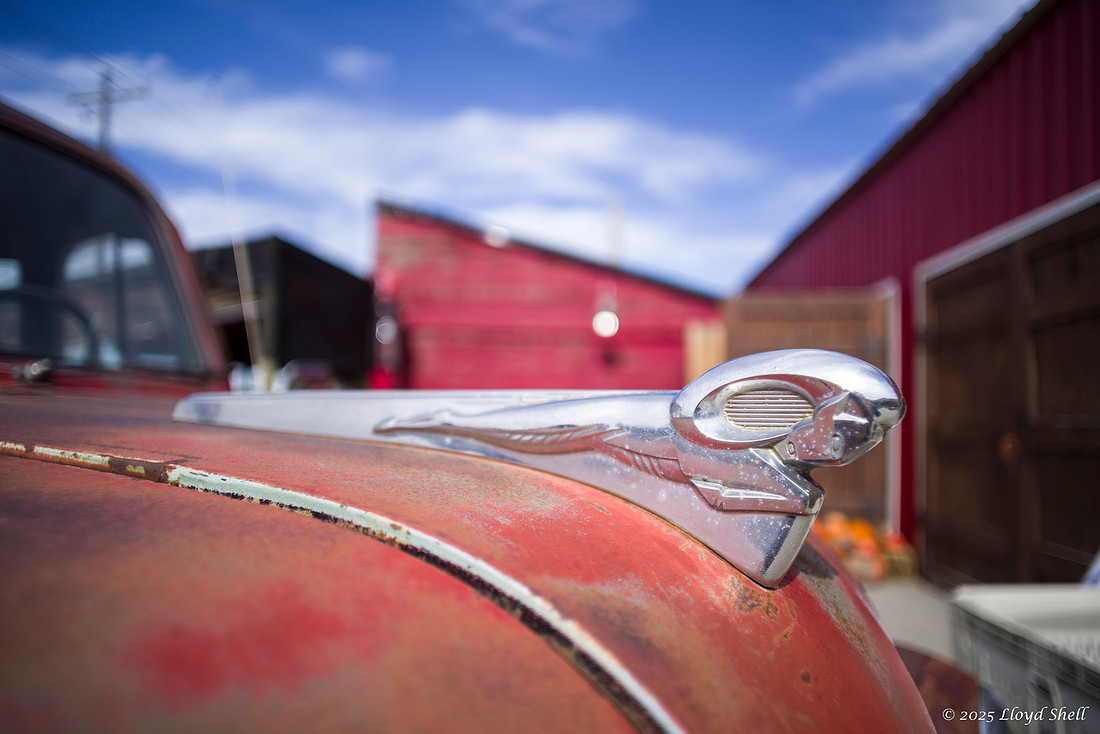

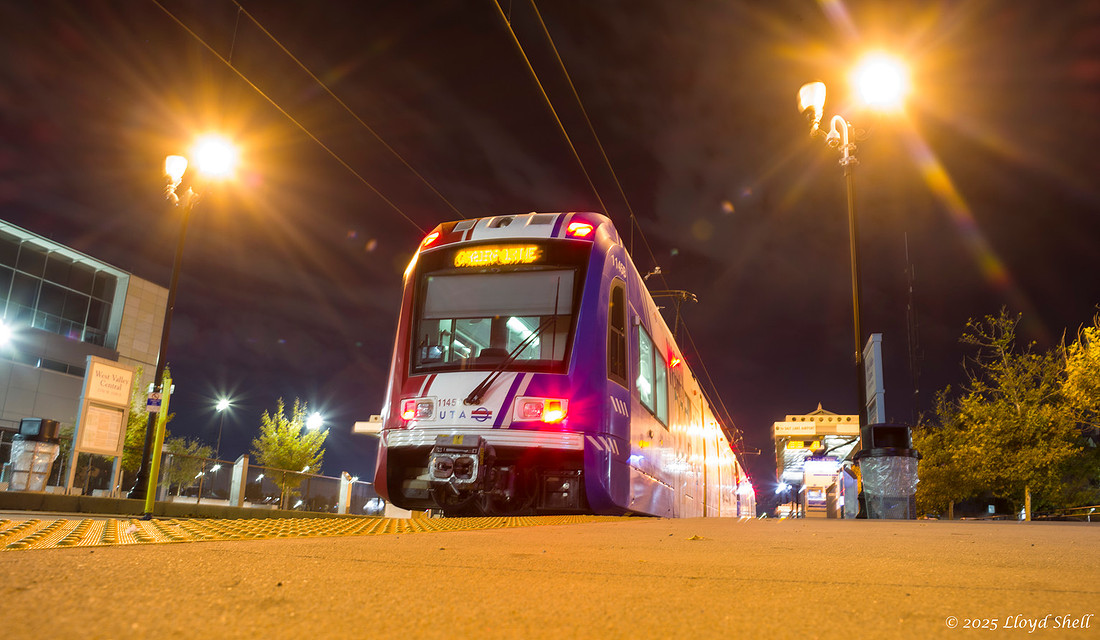
With a bump of ISO handheld is easily doable at f2.8 even in the early morning gloom. Focused on the building and not viewed pixel for pixel this is pretty good for street shooting.
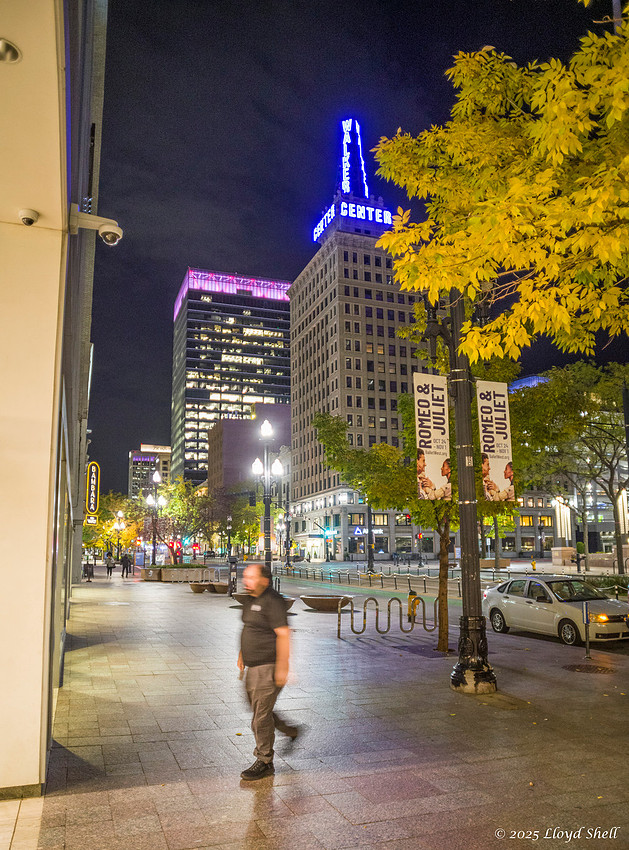
Strongly backlit, I did have to bring up the exposure a bit but the purpose was to see about chromatic abberation in this type of light and it handled it quite well!
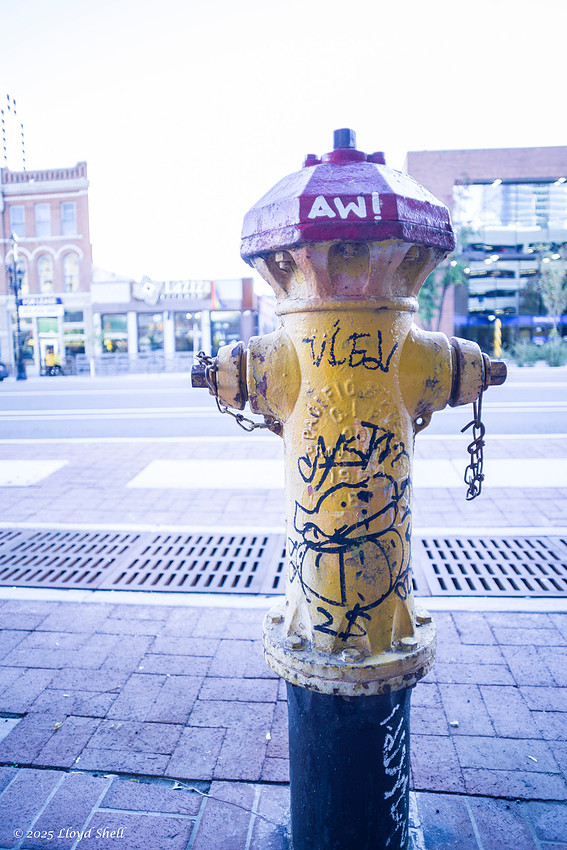
Some people take pictures of brick walls to test distortion, I'm less worried about that and more about getting a cool shot. Not entirely sure this qualifies but I like it. f8 gives great depth of field.
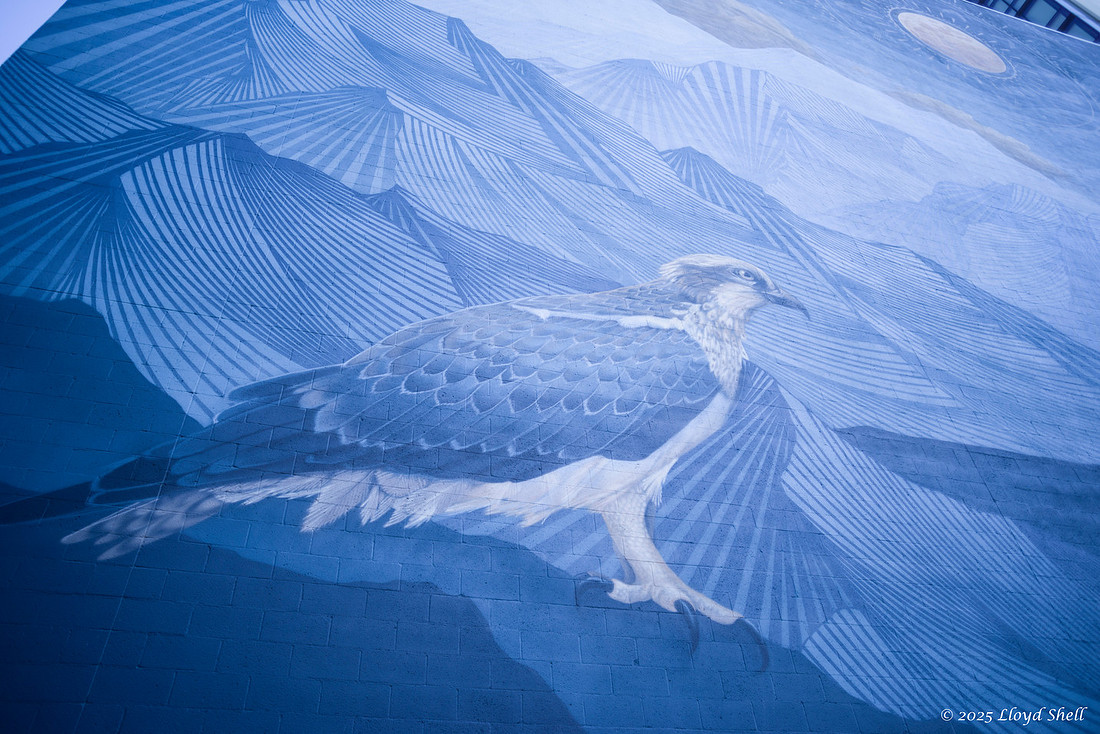
Back to wide open f2.8 at medium distance focus and the background looks much better.
I had to pump up the exposure on these two, I underexposed them more than a bit. I should have been more careful with my settings, there is some motion blur as well. BUT, what this does show is the strength of the lens as a tool to put objects into the larger context they are in. You can blur the background like I did here, or stop it down and get more depth of field. Were I to go back and try this again it would be with a tripod and f8 or f11 which would change this significantly. This was at close to closest focus distance IIRC.
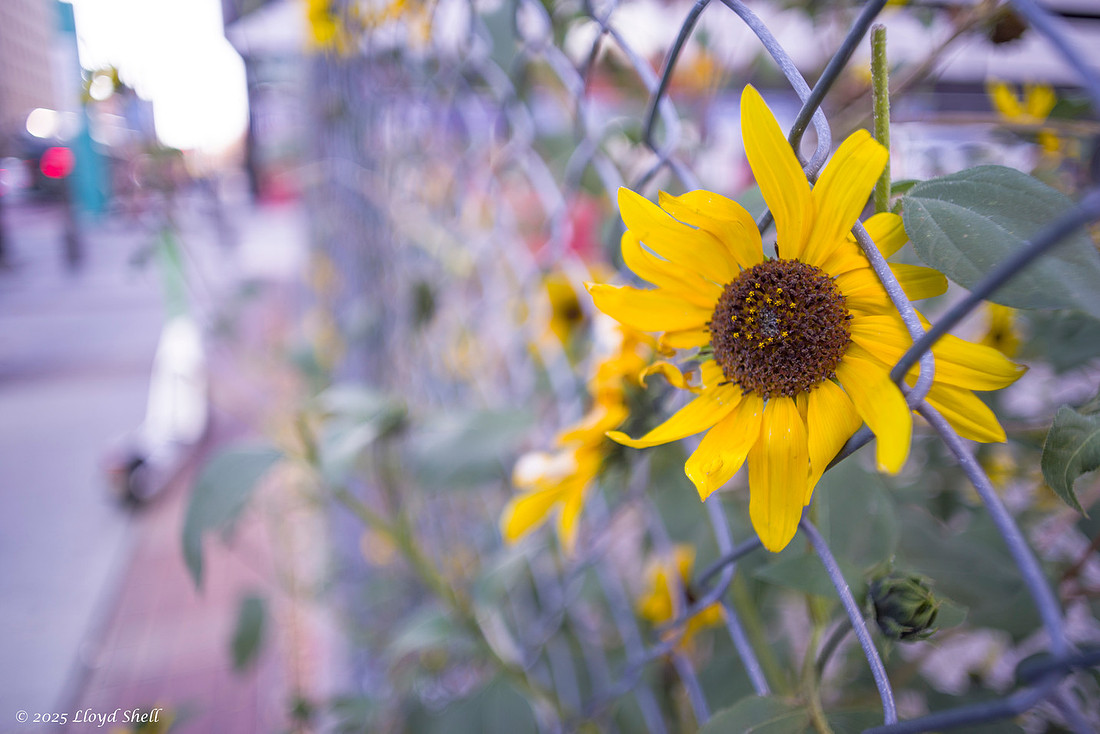
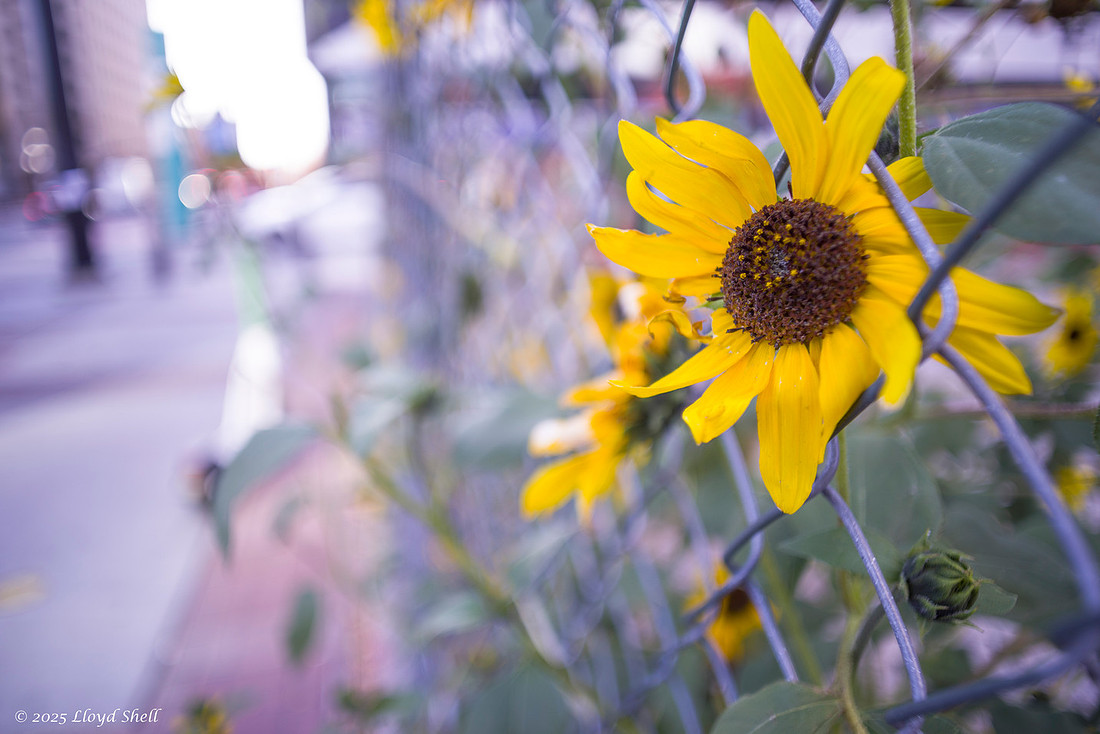
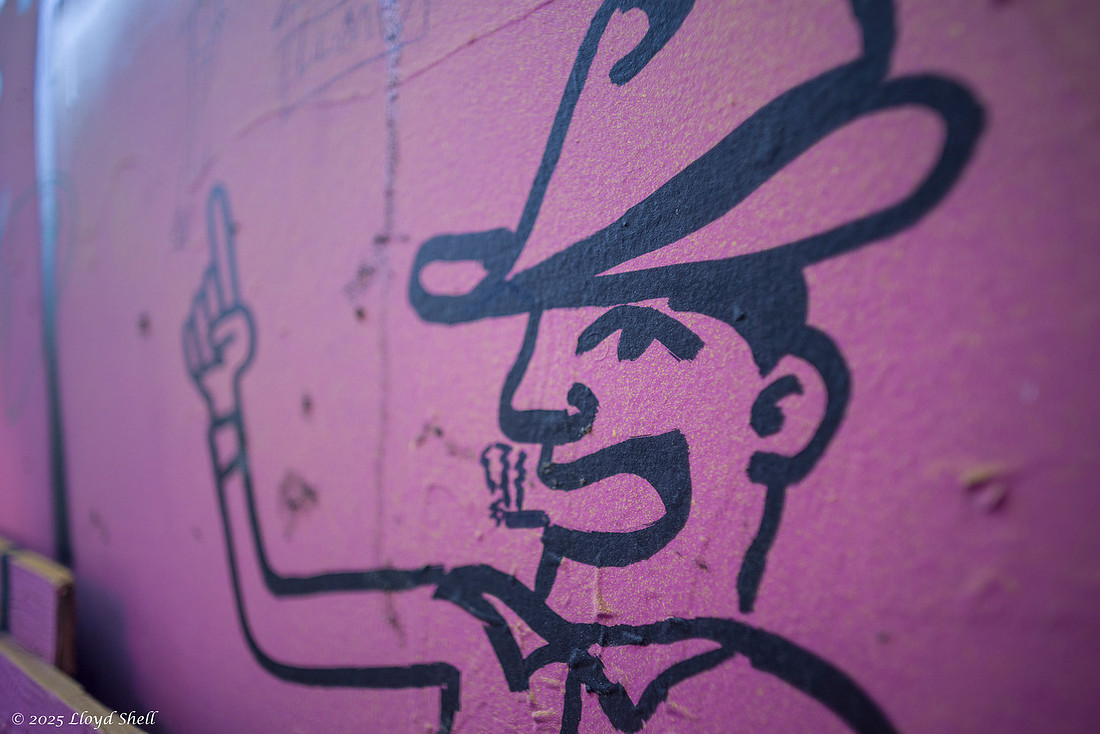
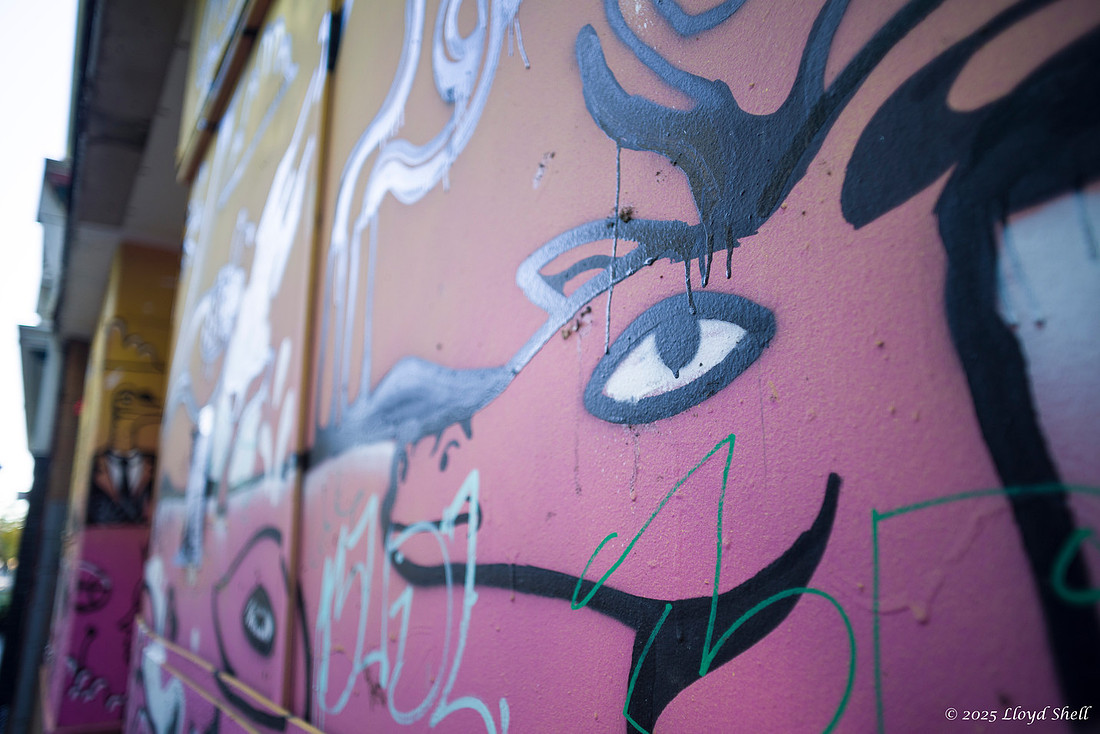
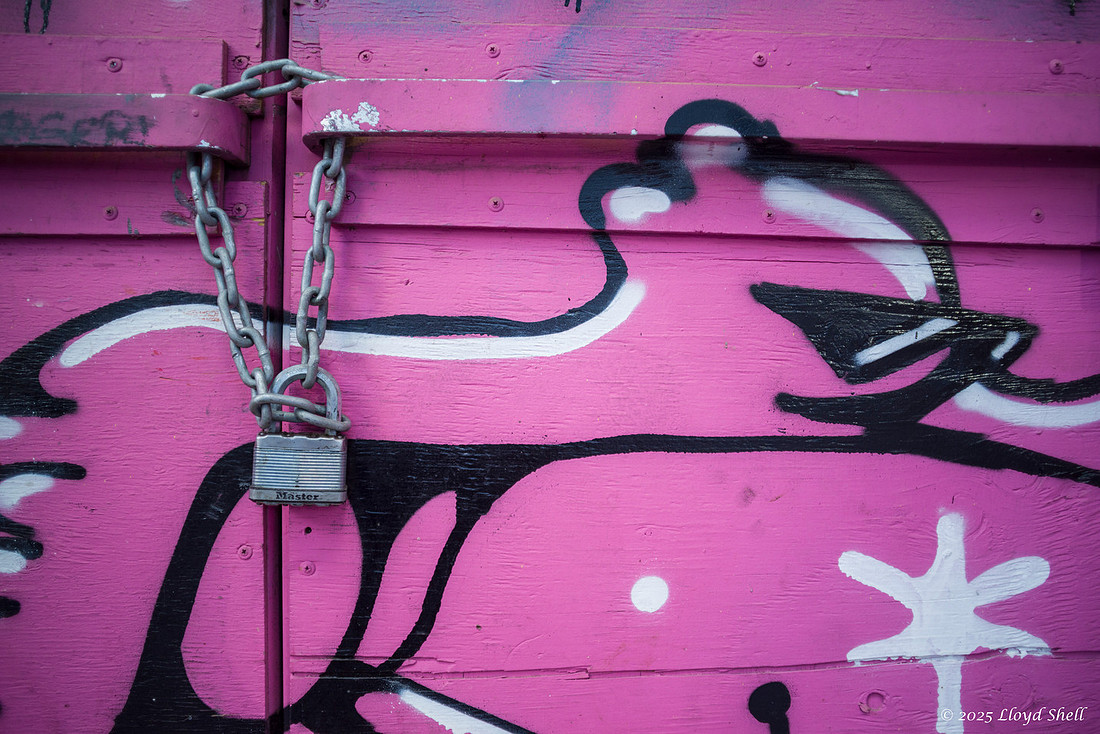
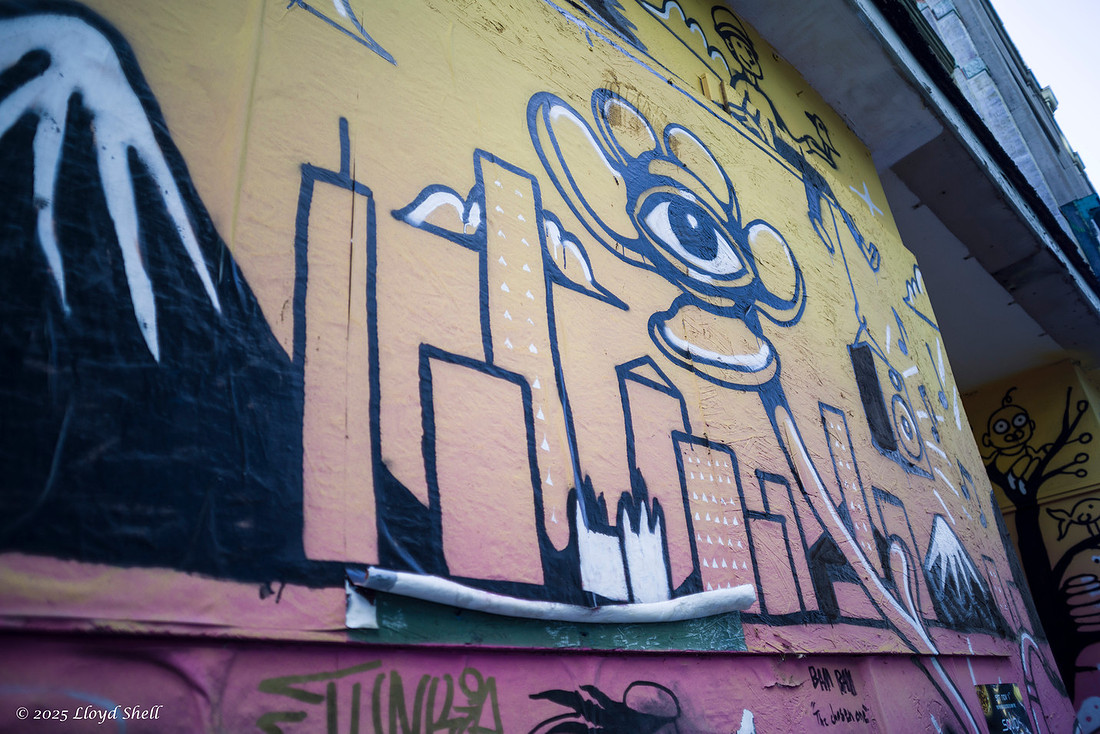
If you go back to my Vivitar 20mm review this fire hydrant was in a few of those photos. It is likely to be a prominent feature in other reviews as well as it is right by my train stop and will give me some opportunities for comparison between lenses. This was at f2.8 and closest focus distance. I think the background is actually quite pleasing with the out of focus bokeh contributing rather than taking away.
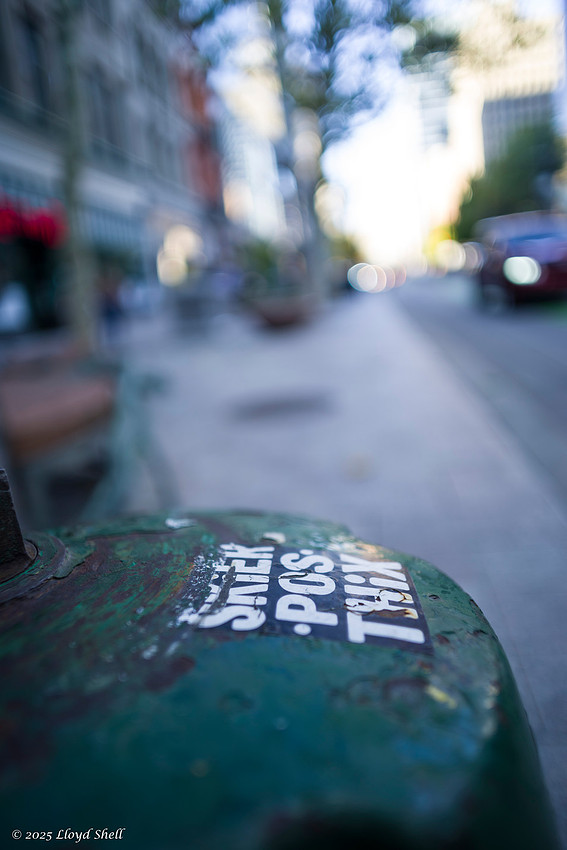
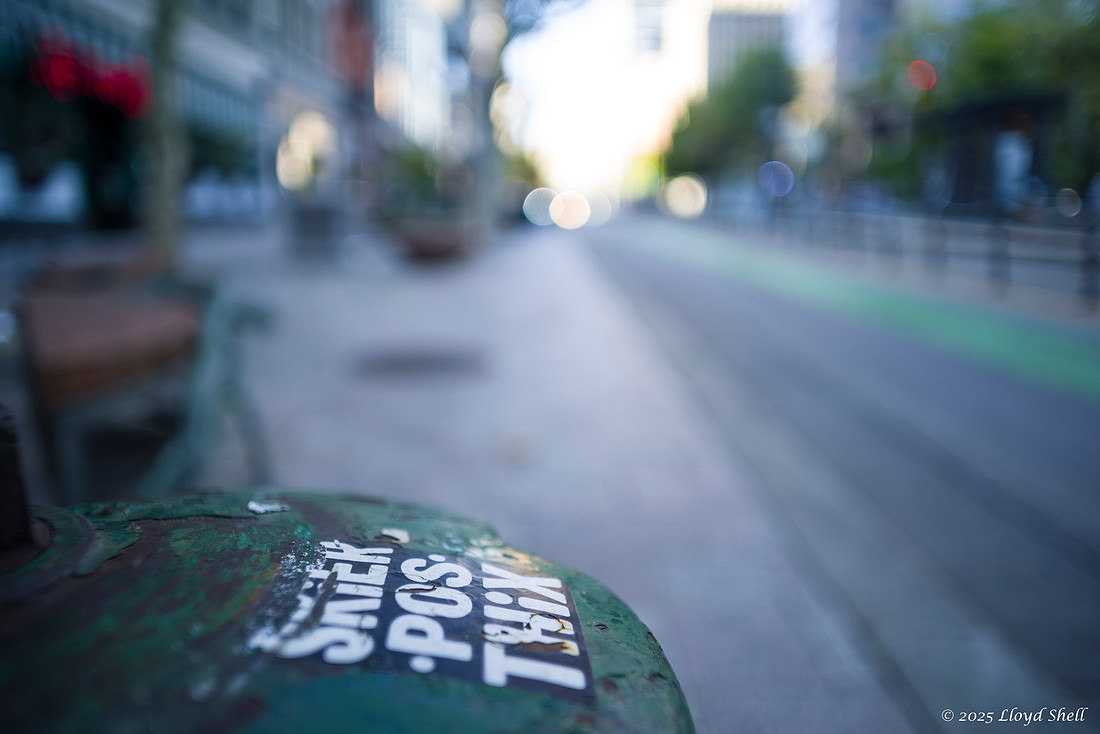
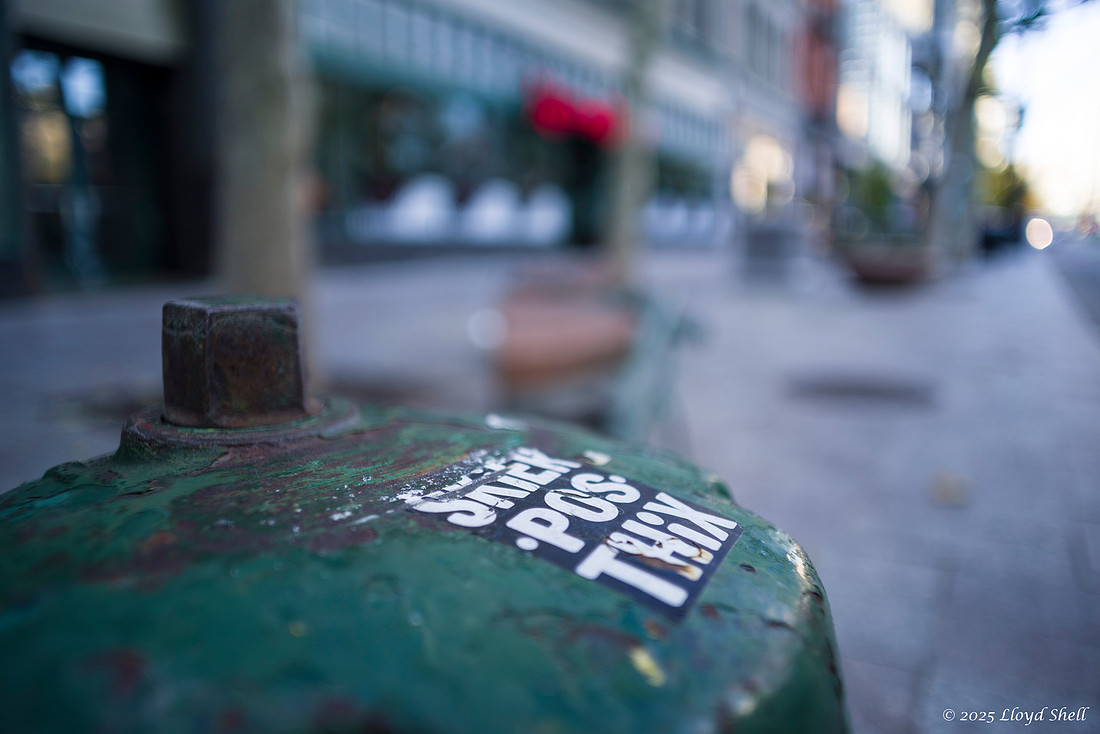
This is a 100% crop from the center of the photo below it. At f8 there is excellent practical sharpness, I have no way to scientifically test the lens, but it is good enough I think.

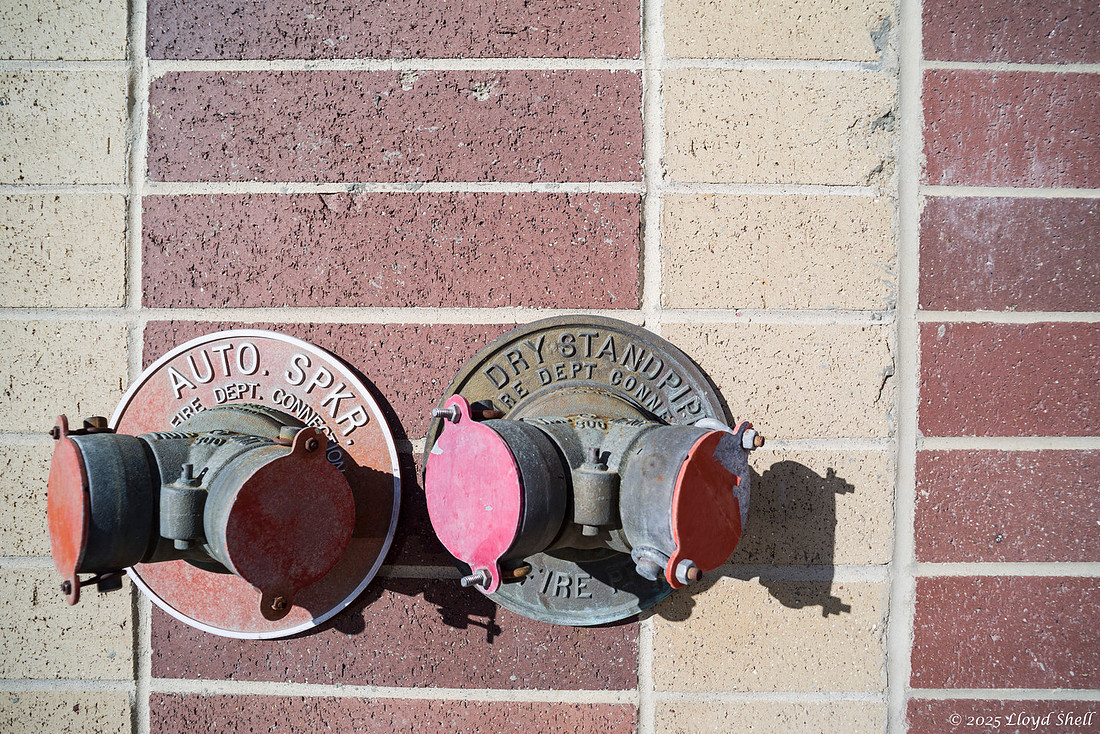
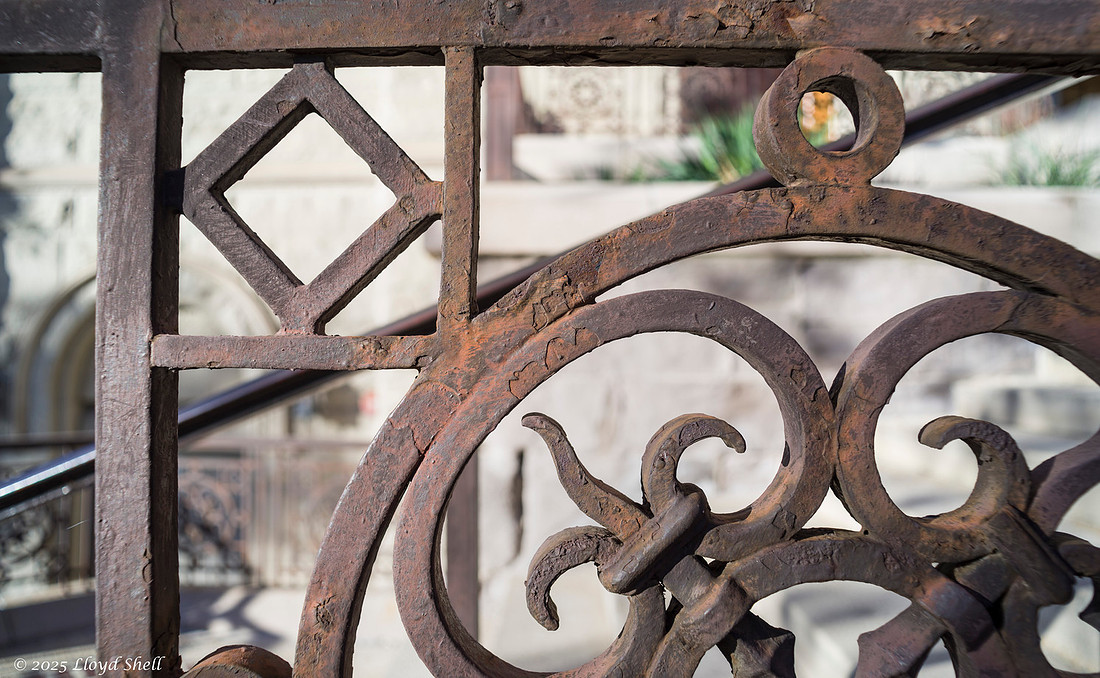
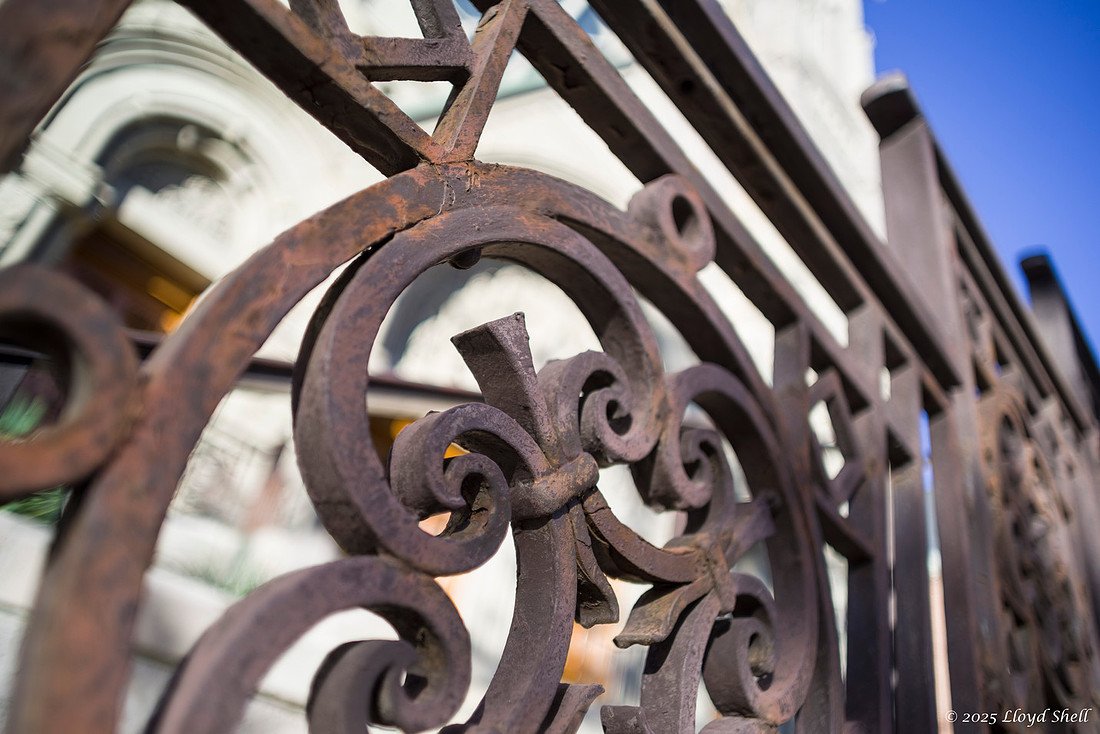
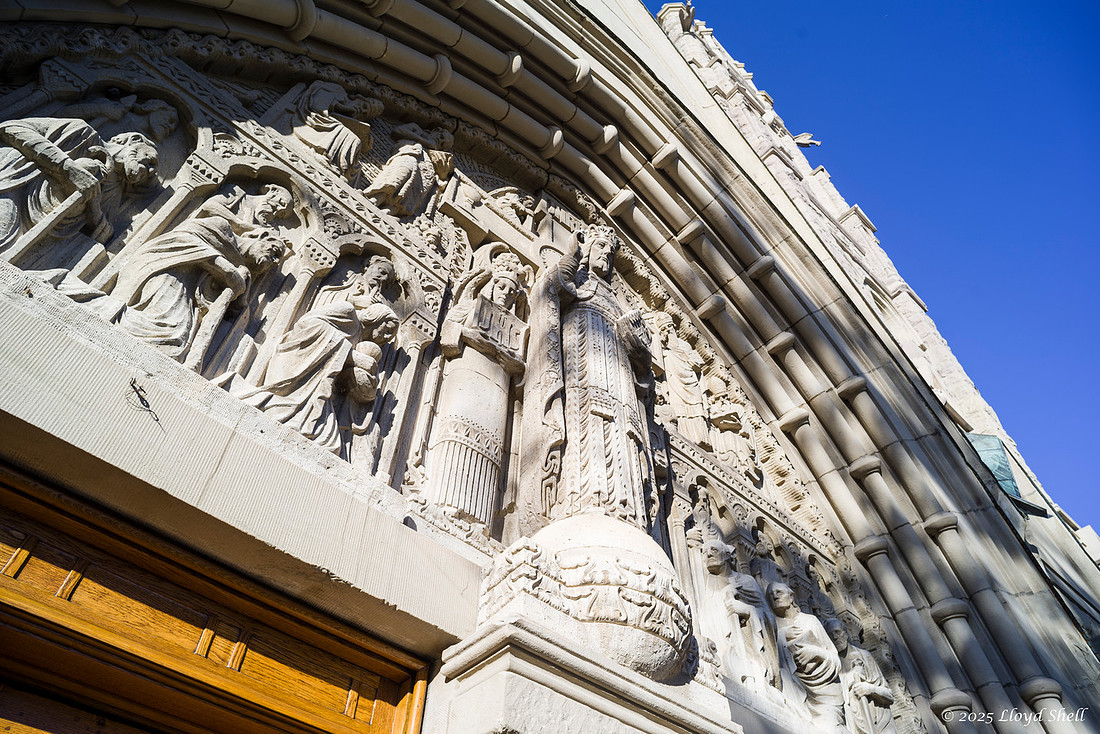
Here is where this lens really begins to shine, stop down to f8 put the focus ring on the hyperfocal point and go. Decent stars from the 5 bladed aperture and minimal CA, though there is a single blue spot on the building on the right. I would normally just clone that out, but I wanted to show the truth of the lens.
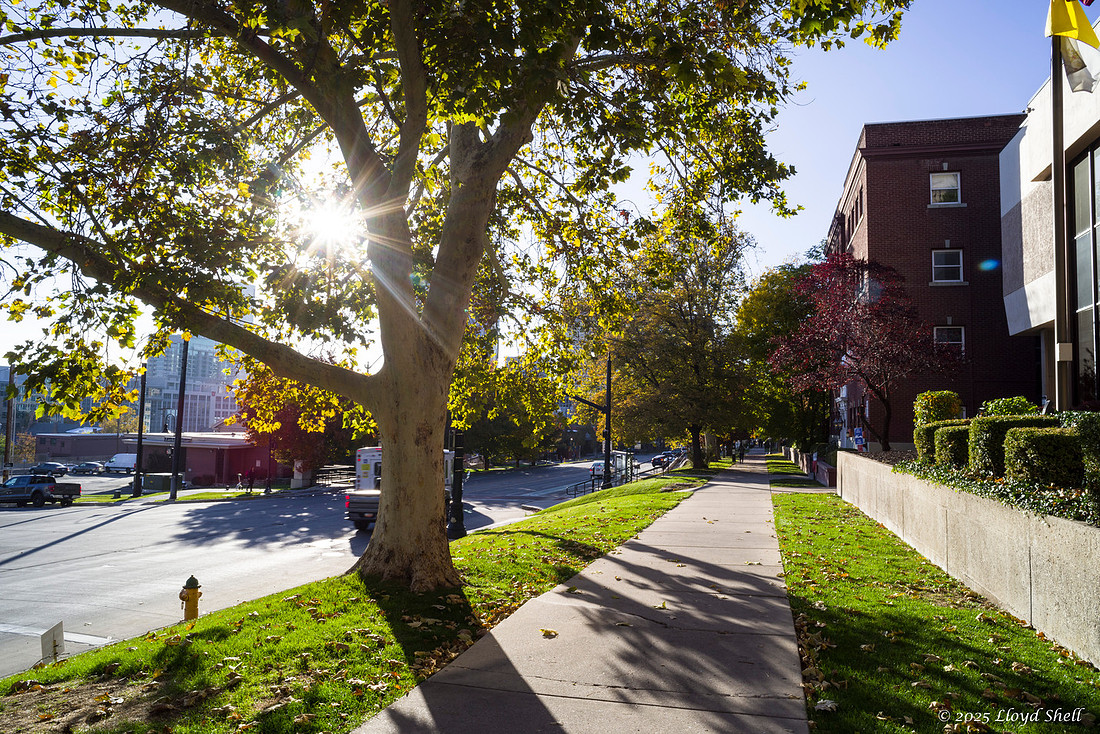
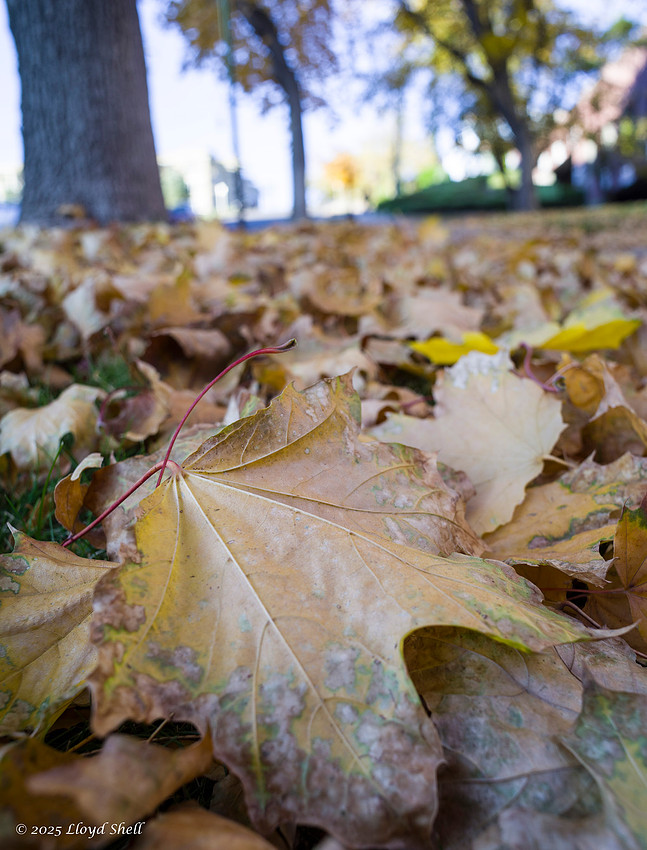
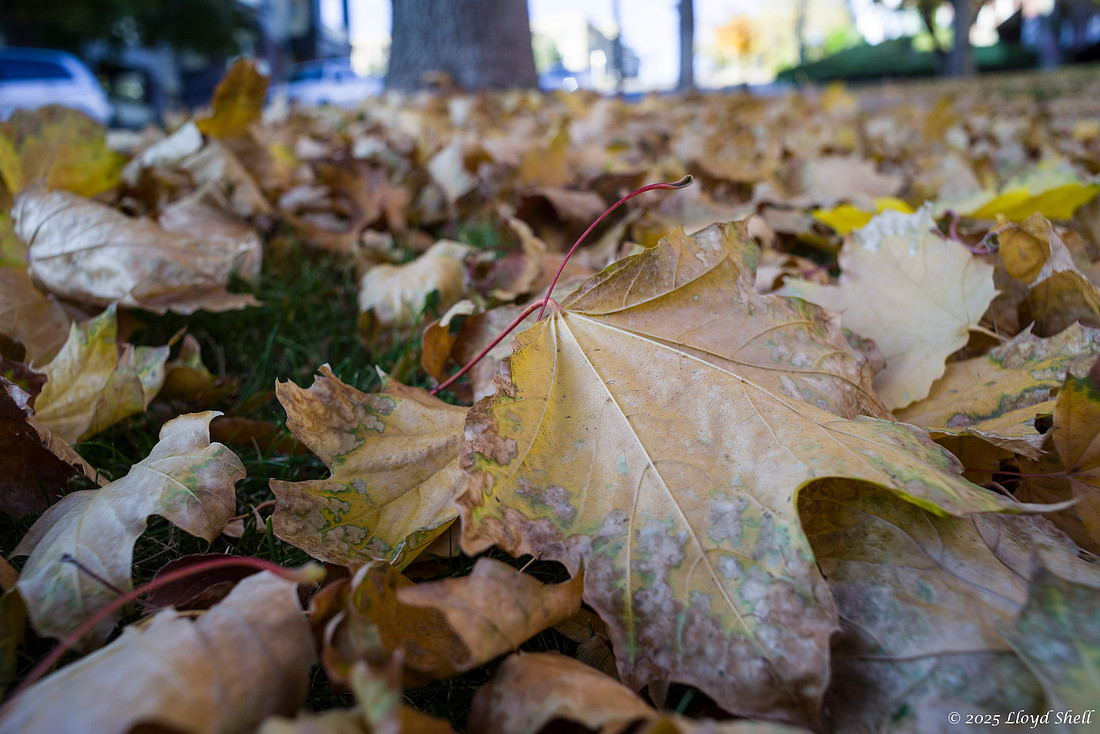
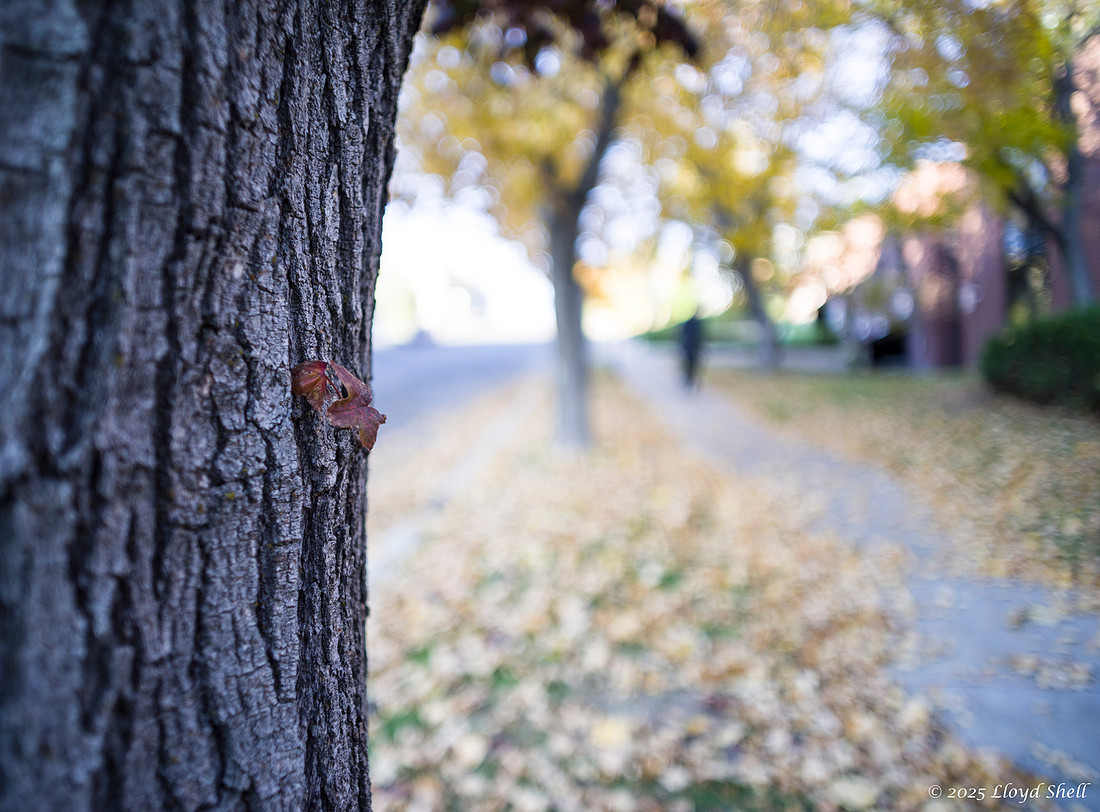
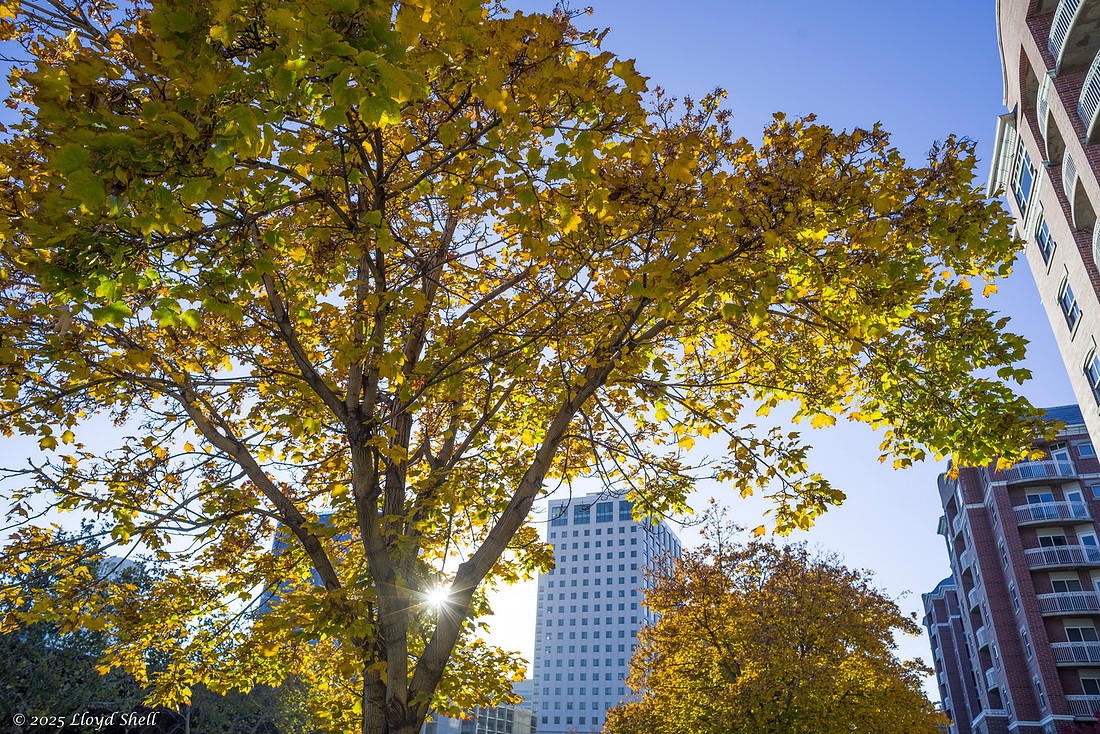
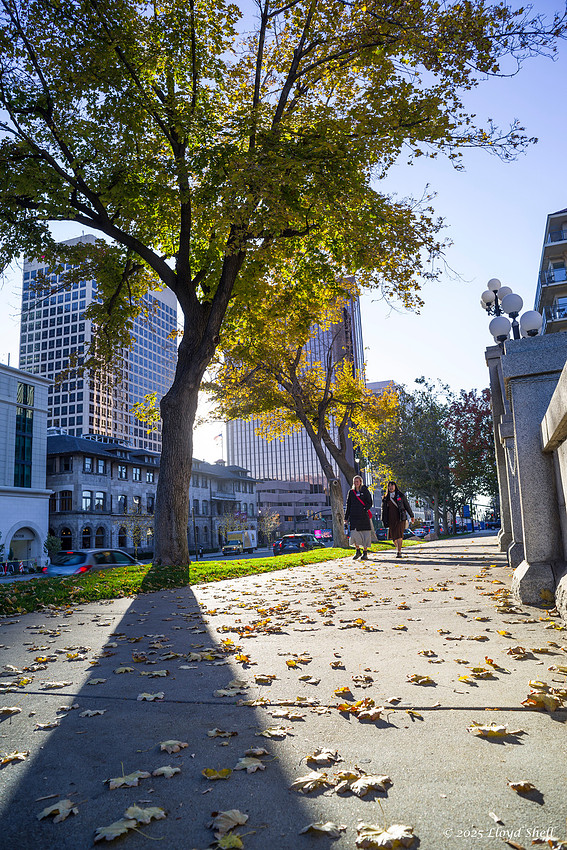
This shot was a deliberate torture test with the opportunity to show what the worst possible outcome would be. Sometimes lens flare can be artful, sometimes it can be overdone, like in the Star Trek Re-Boots with Chris Pine, while this is pronounced, I don't find it truly poor if you use it correctly. FYI I did crop off a little from the bottom, it was just too boring.
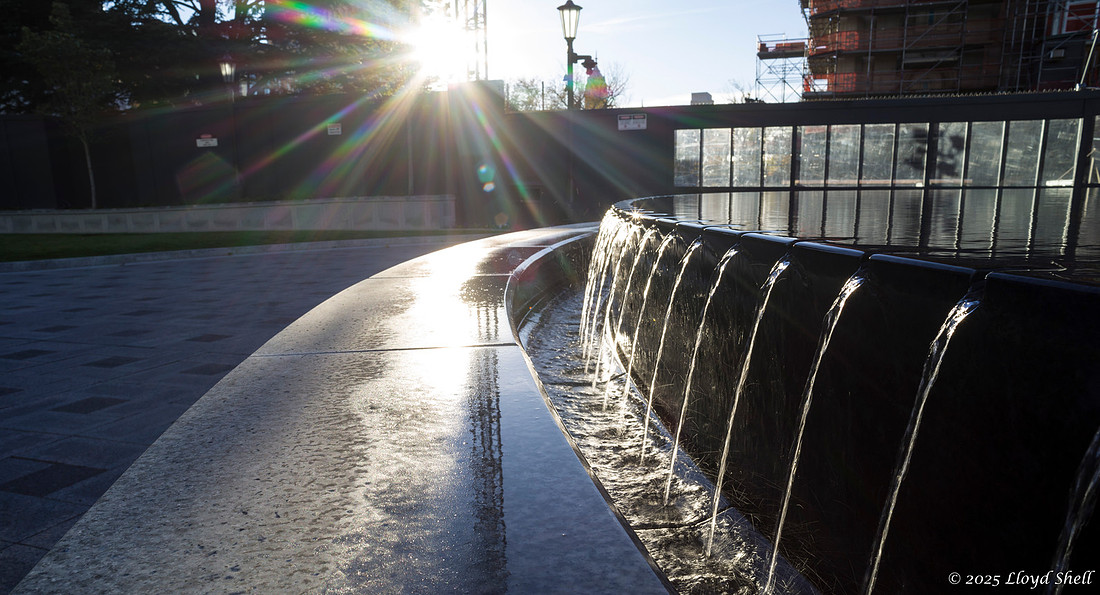
There is some barrel distortion but I didn't notice it much, if you really try to find it you can.
Street shooting done, here is a general summary. The sharpness is good in the center wide open, and gets better with stopping down. The edges are less good wide open and get OK stopped down. BUT I seldom require edge sharpness when shooting street stuff, and this lens is good enough. Sizewise it is just about perfect, and would work well as a pocket lens on a day out. I'm looking at this, my 35mm f3.5 and my 50mm f1.4 as a trio with a lens in each jacket pocket and one on the camera slung over my shoulder. It would likely be a perfect combo.
Now, on to some more technical stuff. I have two other lenses that cover this focal length, a Sigma 24-135 f2.8 that was a gift and my Pentax 15-30 f2.8 BEAST. There is a photo of all three together at the end of the post, the sizes are laughably different. That said, you will see as we go on that the 15-30 is an amazing lens, and the K24mm can come close in the center stopped down.
Here is the subject for this part of the test, I live in Utah and yes I am a member of the predominant religion and I take pics of temples frequently. I chose this as a way to test central sharpness in a subject I am familiar with. Following this photo you will see 900x800 pixel crops of part of the center with each lens that should display pixel for pixel on your screen. They are all labeled. I also just added 500x500 crops of the steeple as it illustrates the more marked differences.
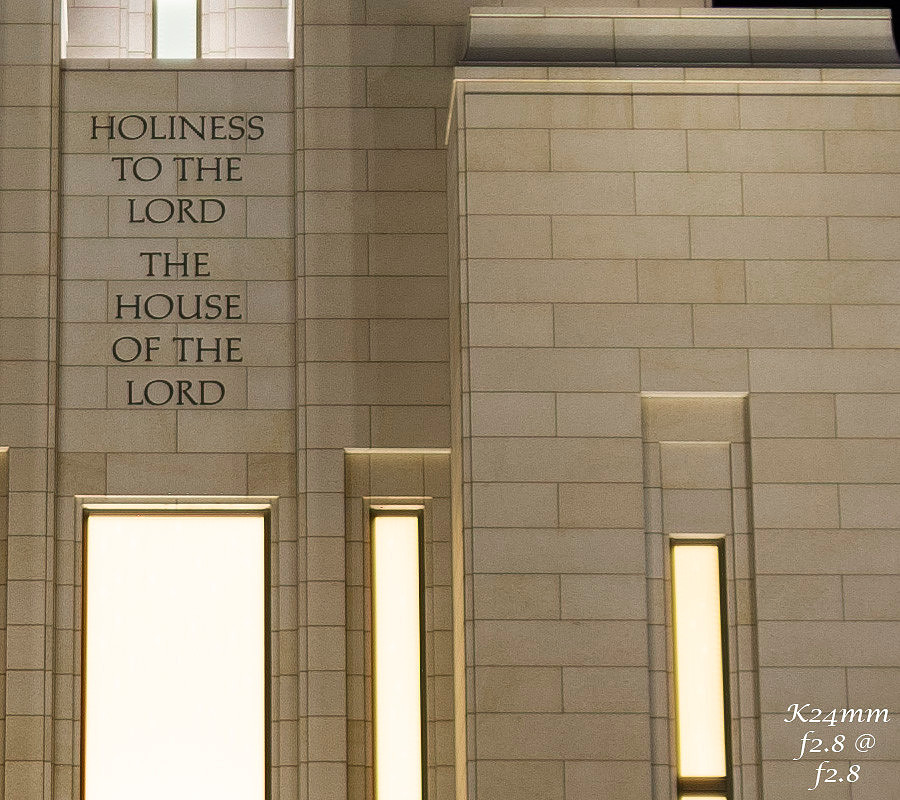
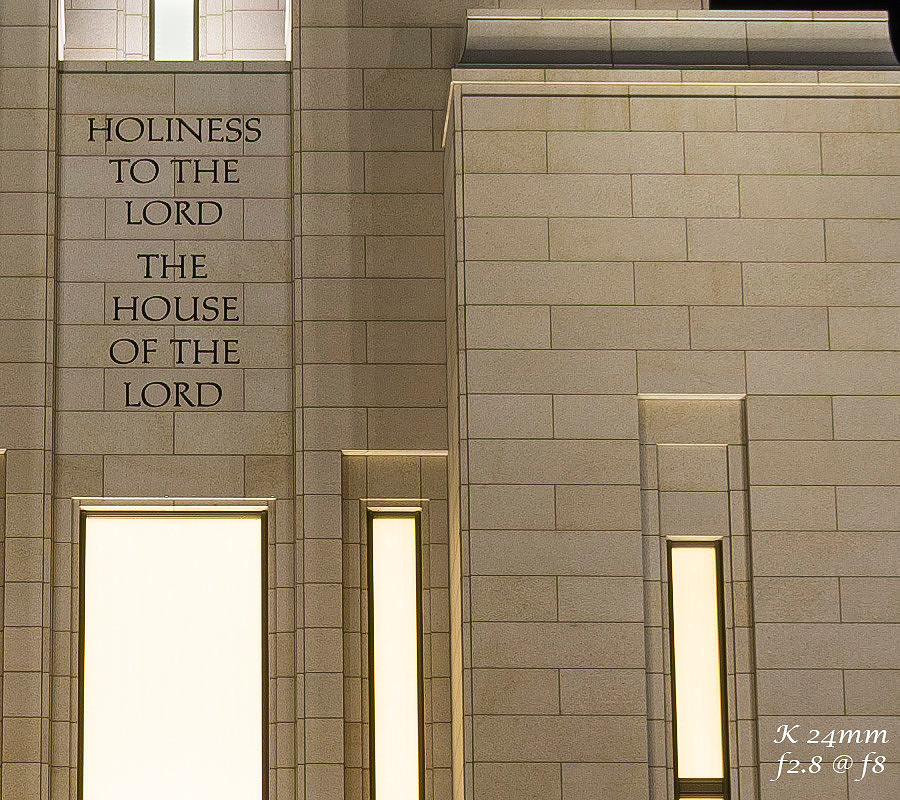
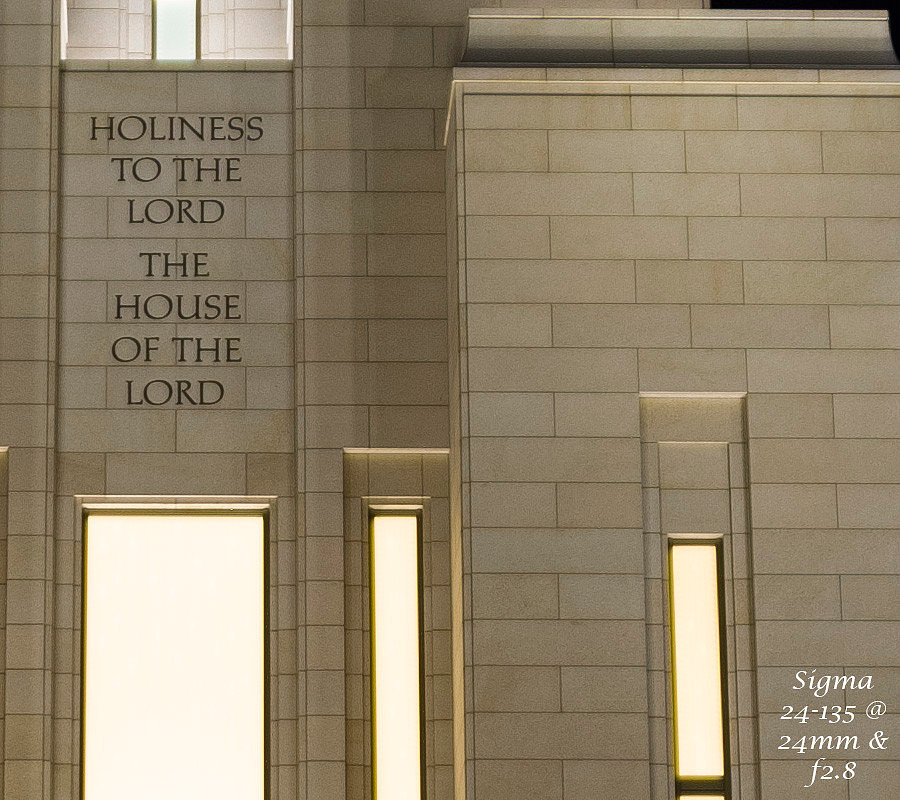
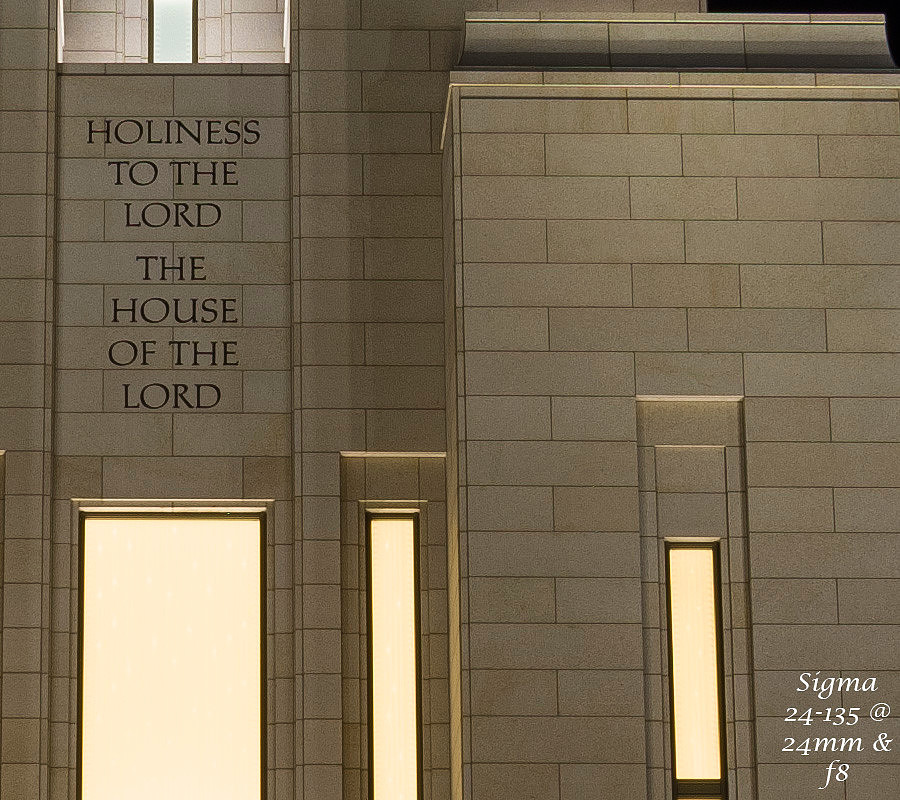
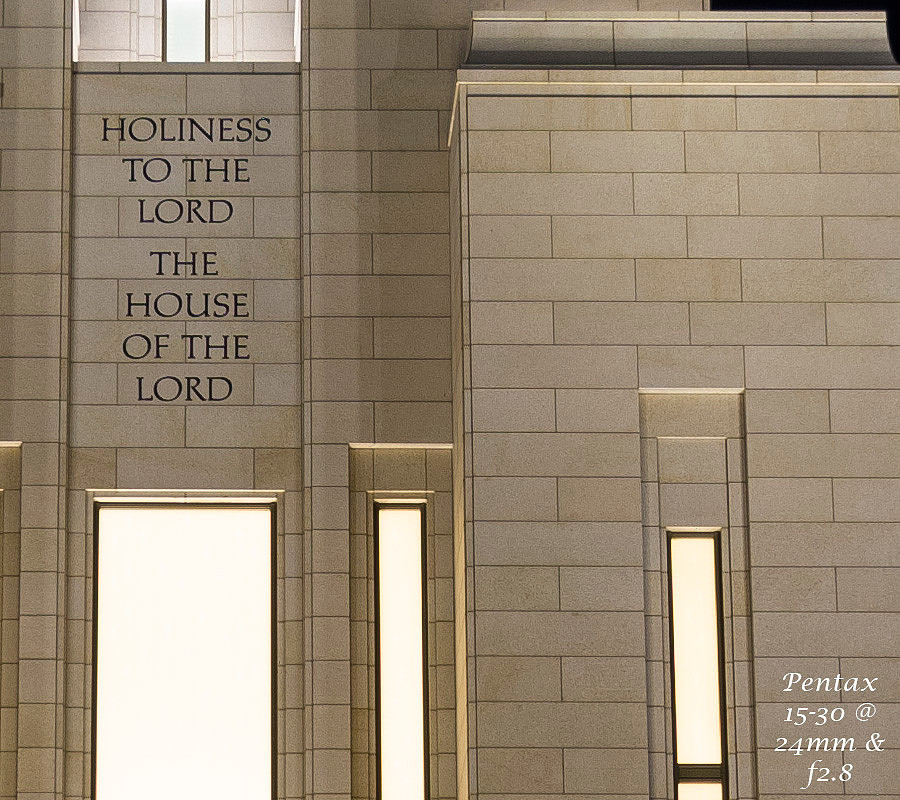
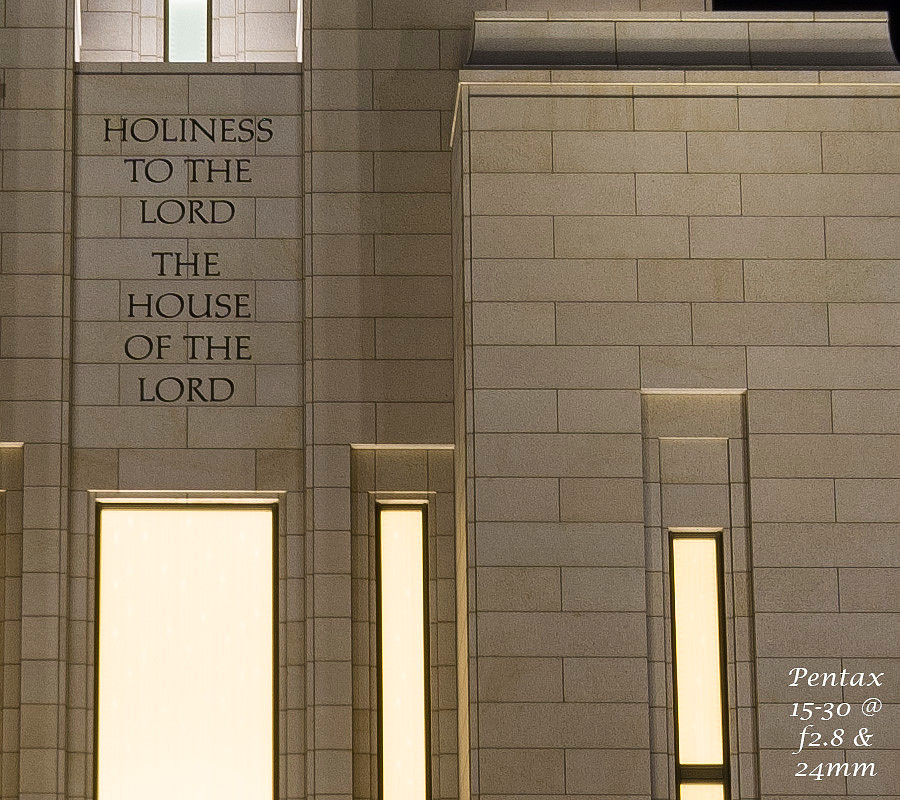
FYI the last one is mislabeled and was at f8. Looking closely you can see the 15-30 has an edge, with the K 24mm close behind and the Sigma definitely last.
Here are crops of the steeple which shows the very stark differences closer to the edges. All at 500x500.
K24mm @ f2.8, you can make out the lightning rod, but there is smearing/astigmatism on the brighter spots.
Pentax K 24mm f2.8 at f8 better but not as good as the Pentax 15-30
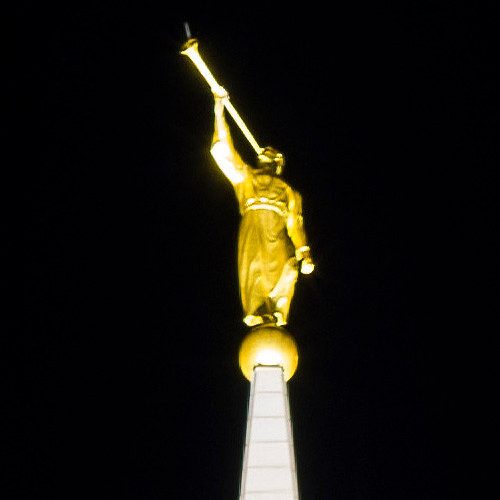
Sigma @ 24mm & f2.8, much less sharp and even more astigmatism
Pentax 15-30 @ 24mm & f2.8
Pentax 15-30 @ 24mm & f8 best of the bunch.
Next portion of comparisons: Point light sources.
Point light sources in the frame can be rendered very differently by different lenses. Based on the number of aperture blades, focal length, distance to the light source phase of the moon, who knows, etc... Frequently in movies you will see distant lights rendered as large balls of light when the lens is wide open, in some photos you will see them rendered as starbursts when the lens is stopped down. My goal with this series of photos was to see how the K 24mm rendered them at different apertures and when the focus point in changed from up close to longer distance. This first Set is @ f2.8 and focused on the bark of the tree. The second photo is a crop of the center of the image and the third on the far right edge. The crops are either 900x900 or 900x800 so you are seeing a full resolution image on screen, depending on the screen you are viewing them on. Notice the shape of the lights on the far edge image, that is fairly extreme in appearance. As a side note, once I got this whole series of images on the computer they were a little dark so they all got +1 of exposure compensation but otherwise no editing.
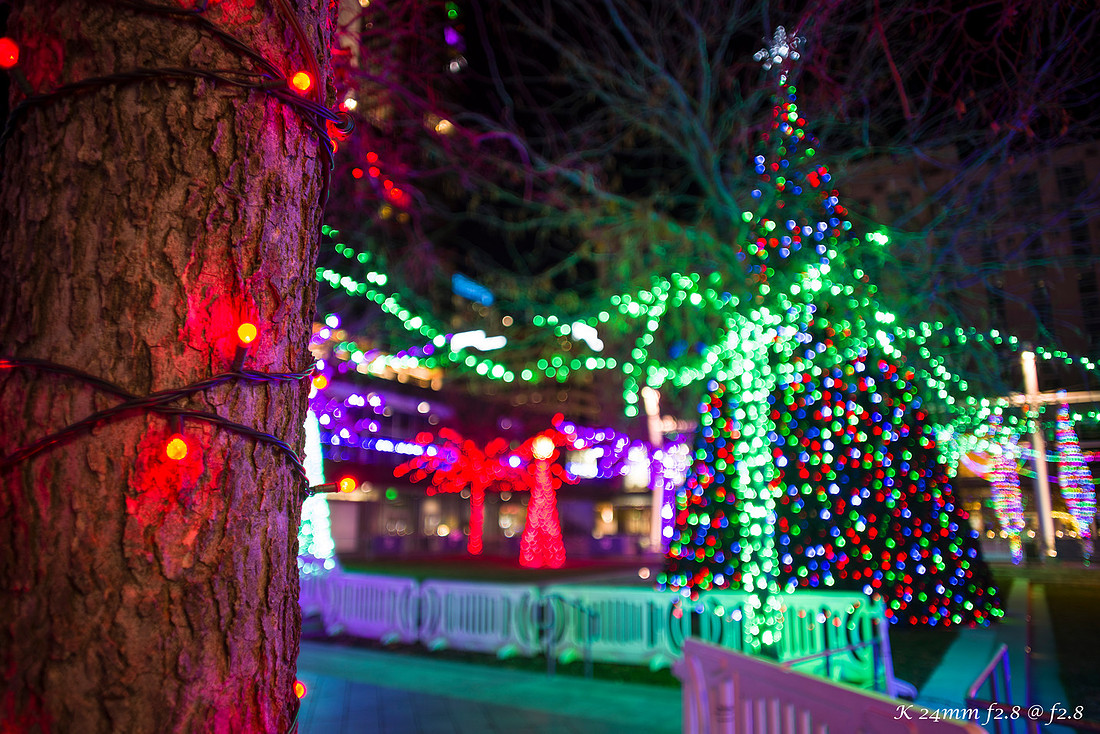
The only thing changed with this group was stopping the lens down to f11 and increasing the shutter speed accordingly. DOF improved and you can see the starbursts in the distance. Note the edge of the frame photo.
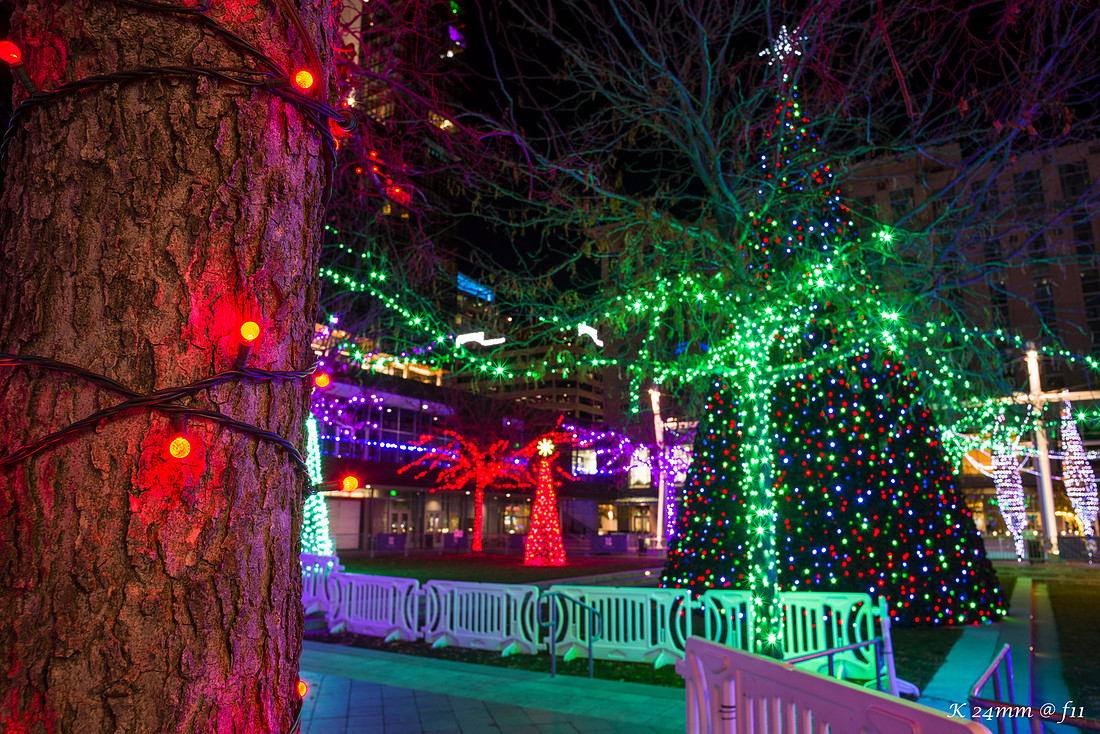
This lens has a 5 bladed aperture, and you can see the effect on the starbursts.
These look very similar to the center now.
Now with the focus point moved to the infinity marking on the focus ring, things change quite a bit as well on all images.
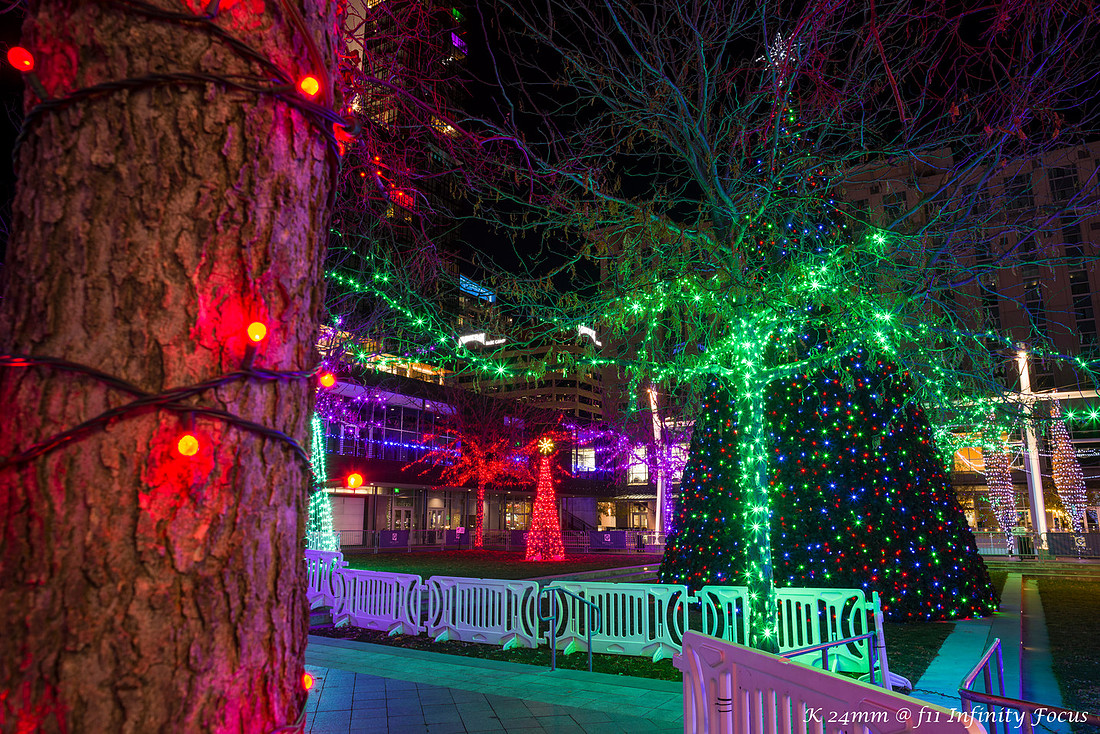
The starbursts even out a lot and look quite good to me!
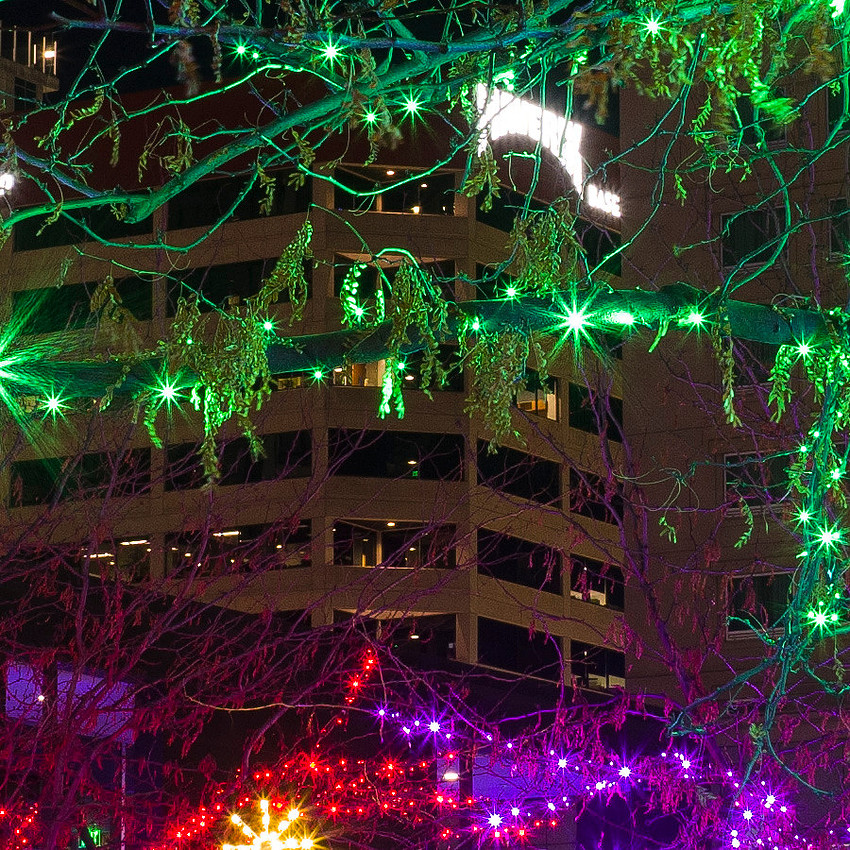
Even at the far edge things are quite sharp and the starbursts look good to me.
I opted to forgo the Sigma 24-135 images, they are worse than the K24mm. As usual they can be available upon request.
Now for the Pentax DFA 15-30 f2.8 which is significantly different than the K24, most especially in the edges the light balls remain circular and are much more homogeneous, just what I would expect for a modern lens. I tried to have the same focus point as the K24, I think I got it pretty close. Another point to remember is that there is a different level of distortion between the two lenses, the 15-30 is not supported in my old version of PS so unless it is critical that I correct for it, I just let it stay there. If it is critical I process the DNG file to a TIFF in camera where I can apply the built in corrections.
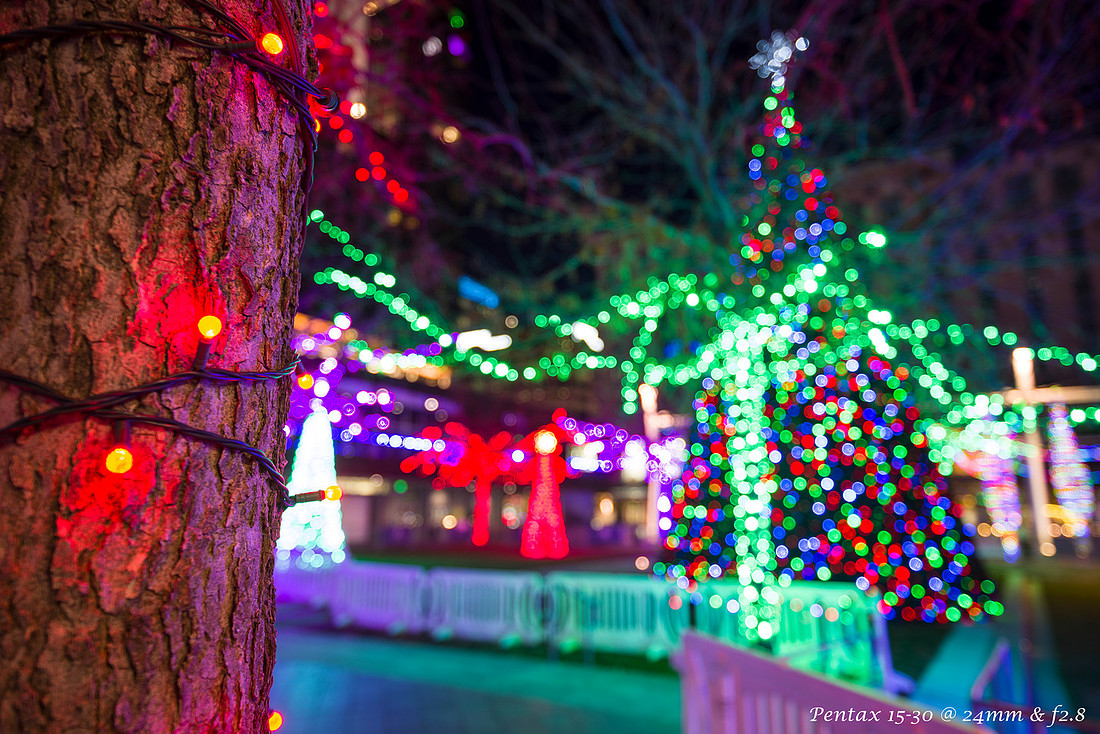
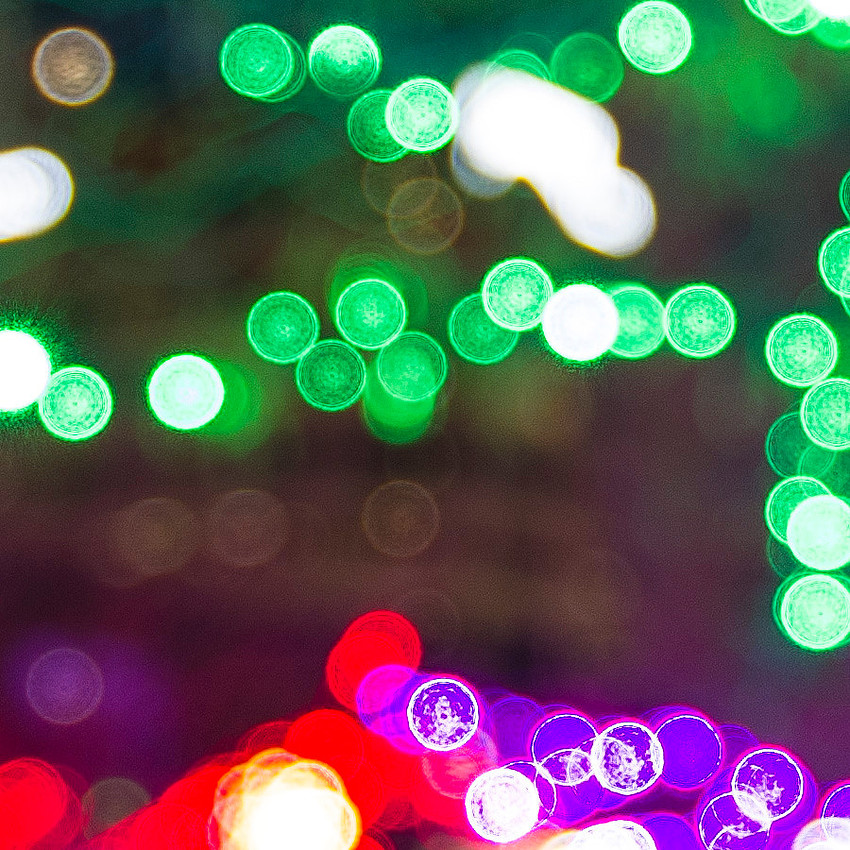
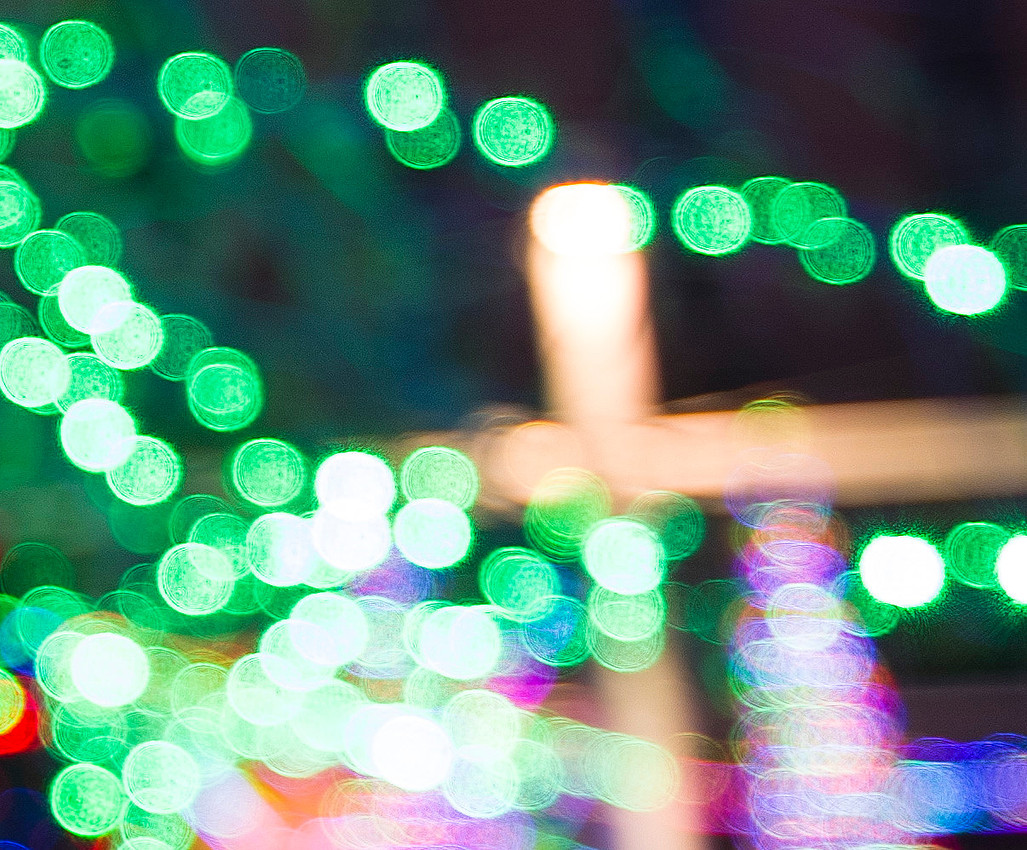
Now at f11, same focus point.
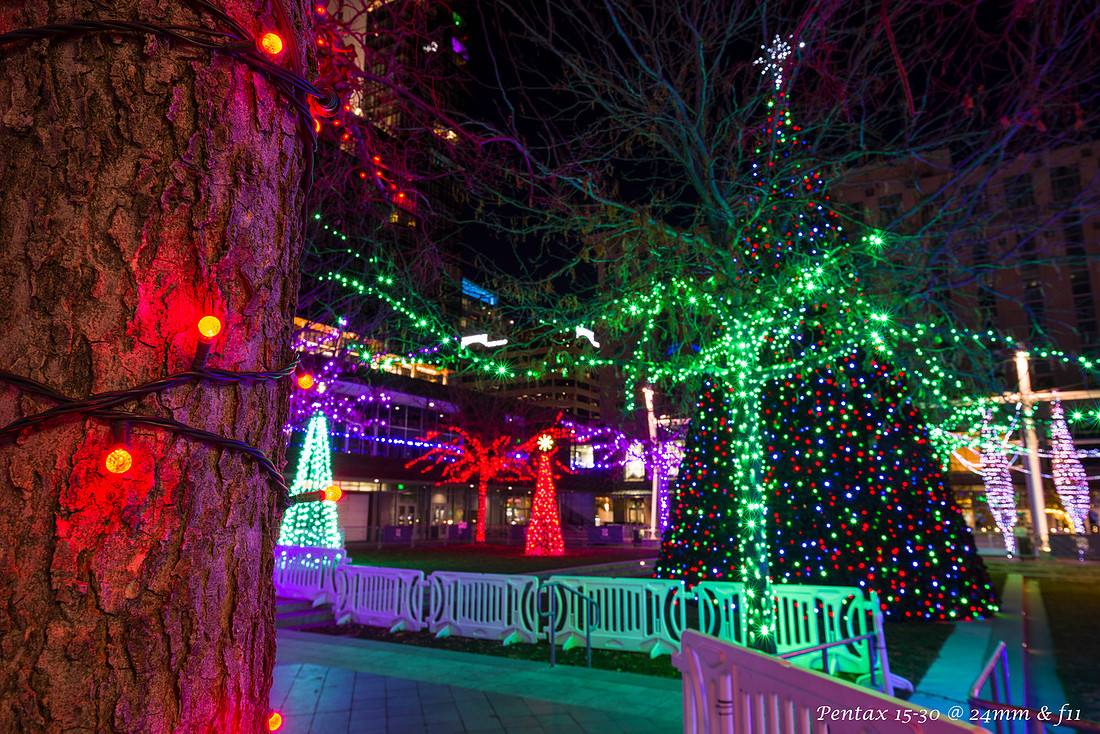
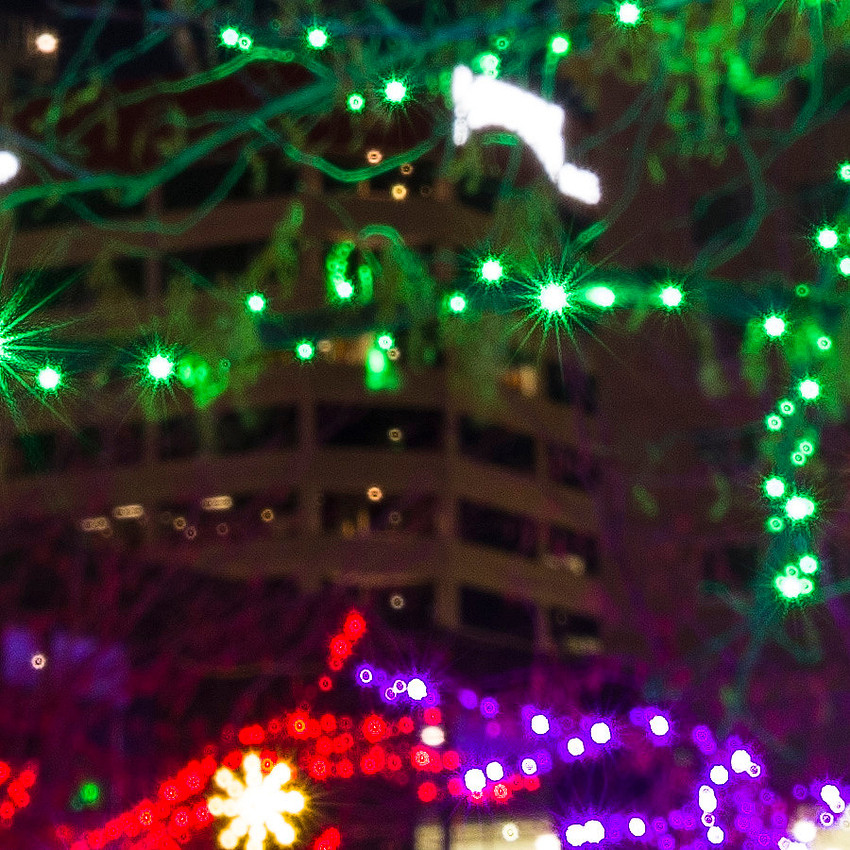
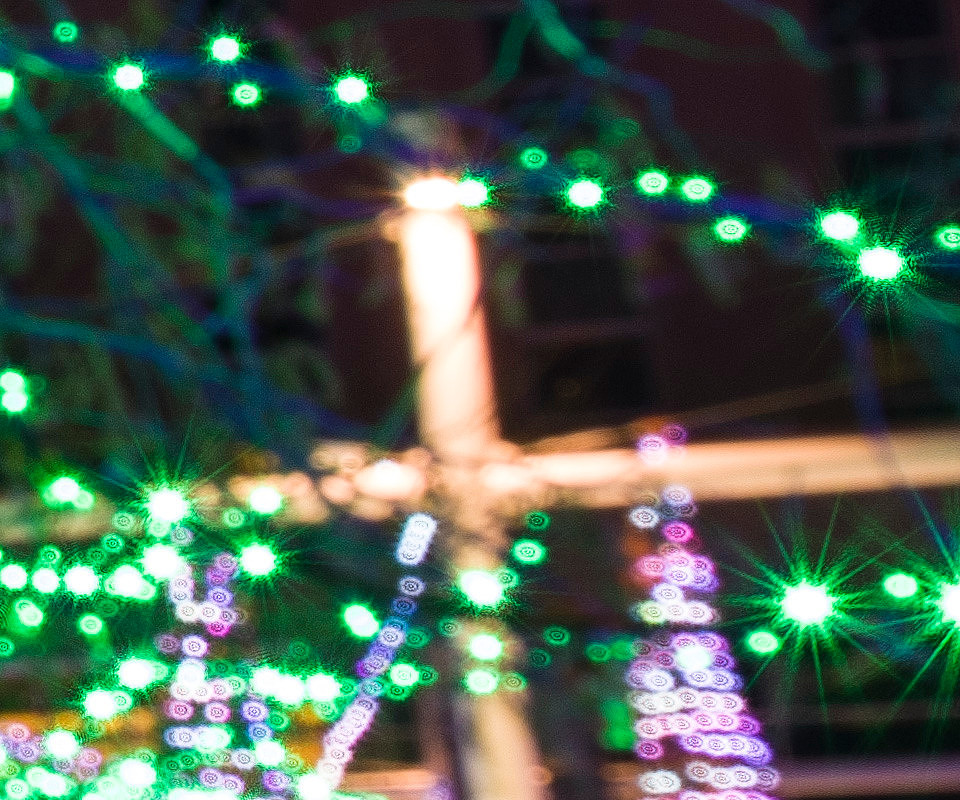
Now at infinity Focus
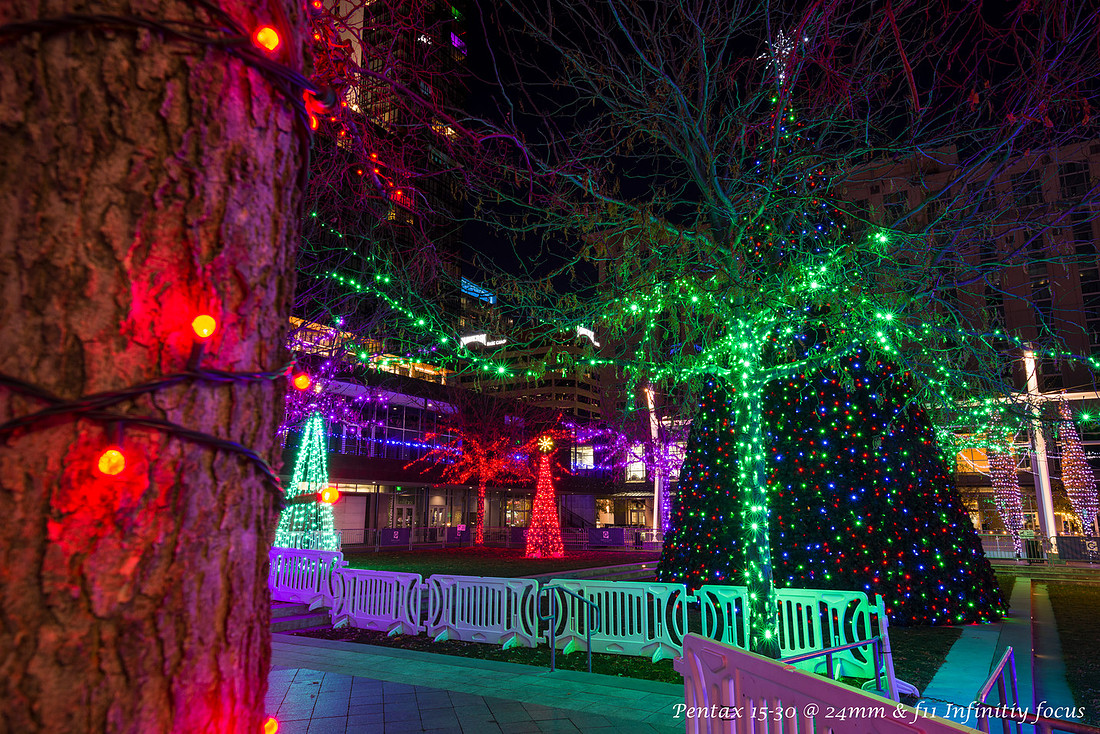
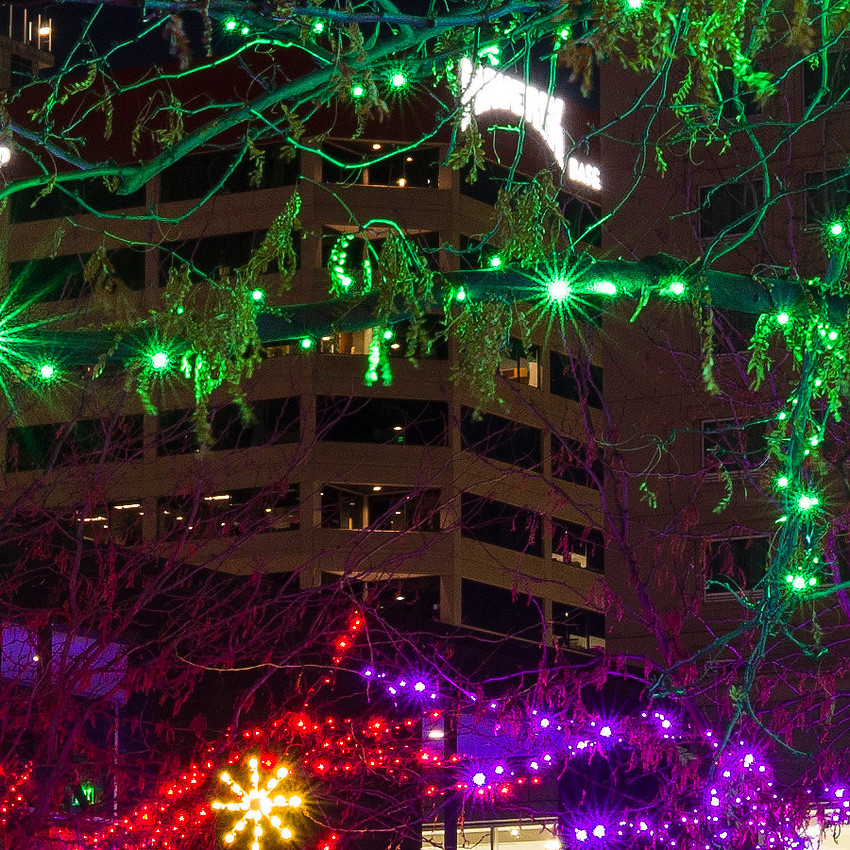
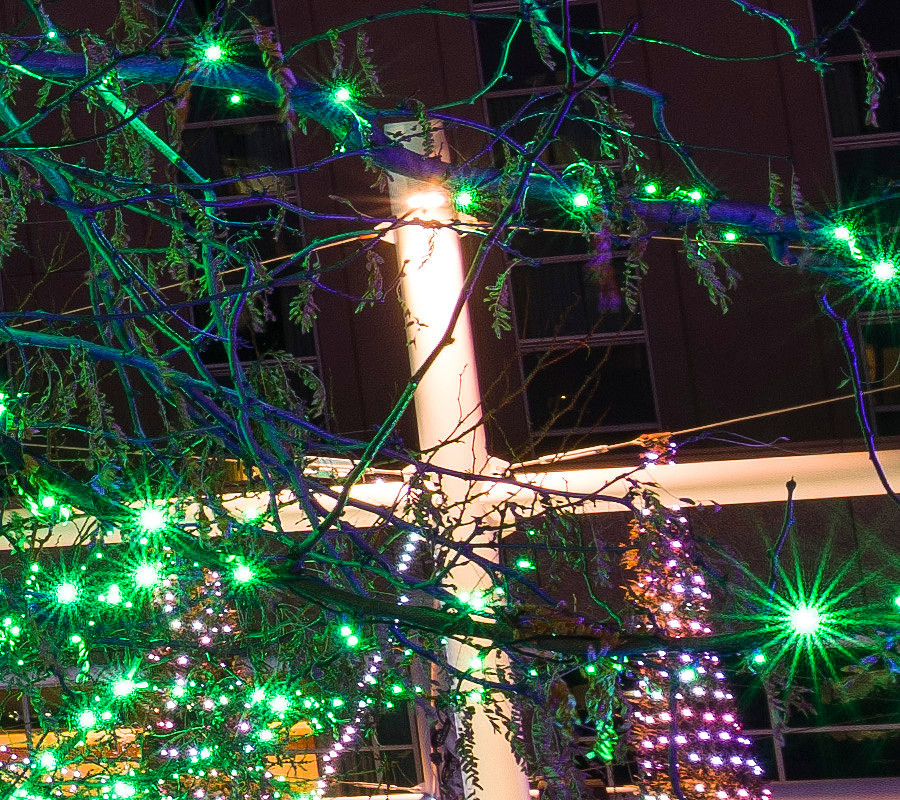 Overall, as expected, the 15-30 f2.8 produces, in my mind, a better quality image and more pleasing starbursts that are more symmetrical, that said, the K 24mm f2.8 is not terrible at all, and the starbursts are unique and the sharpness is good enough. The big difference is the size and weight of the lens, the K 24mm being much smaller and lighter, the 15-30 much bigger and, you know, it IS a zoom so there are other focal lengths available should you want them providing flexibility. If I were going on photo safari I can state I would MUCH rather carry this lens than the 15-30 for a full day adventure.
Is the SMC PENTAX 1:2.8 24mm a good lens? In my estimation yes, absolutely especially for the time it was manufactured. Does it have weaknesses? Yes, off center sharpness wide open is not so good and edge sharpness is definitely not good. It IS manual focus and manual aperture so you have to do more to use it on the camera than an autofocus lens, but that is a split benefit, where yes it is more work to use, but it also puts you in complete control not the camera, that I do like. It is not a dog of a lens and will definitely be a desirable lens to grab if I plan to go out for street photography.
Here are a few quick cell phone shots for size comparison. Amazing how much smaller it is!
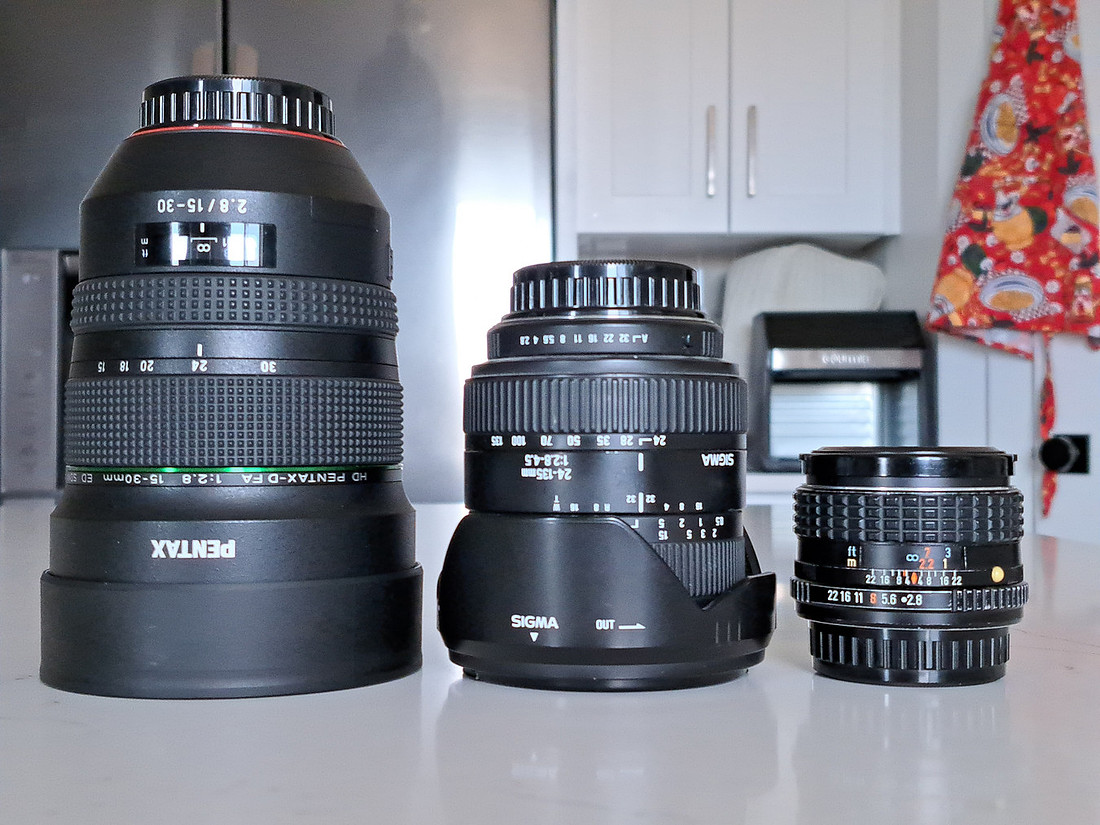
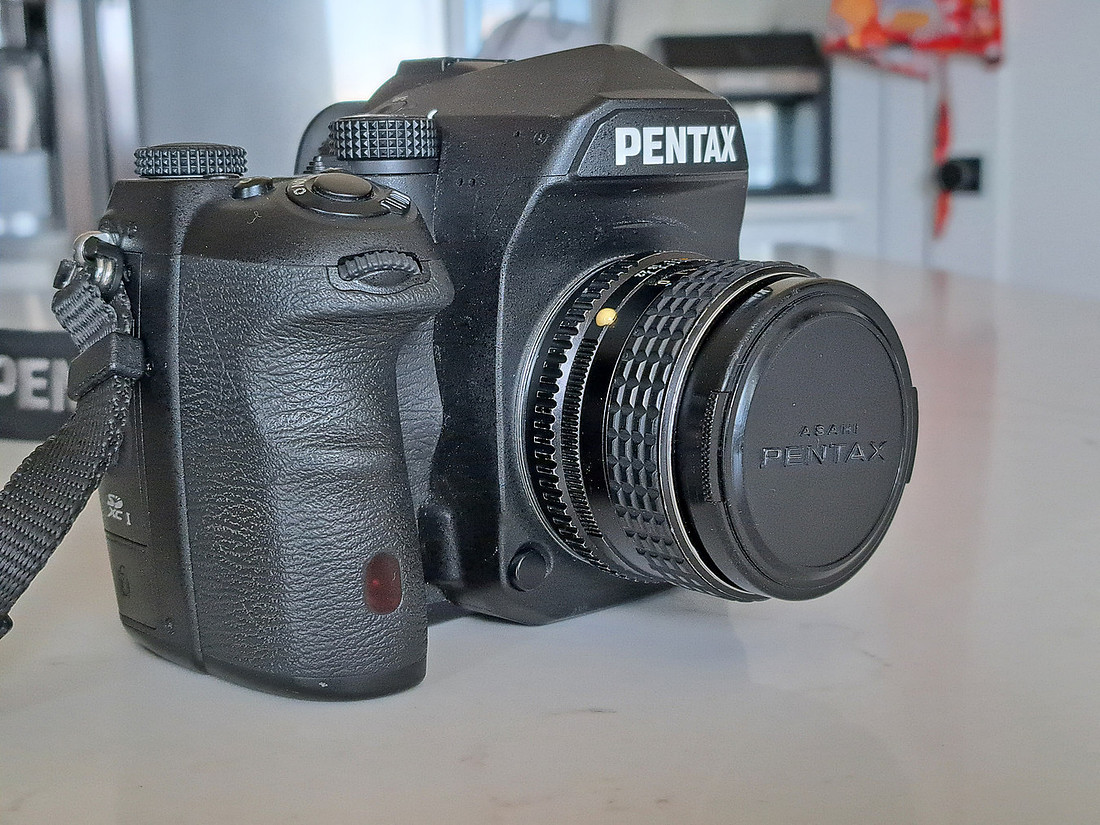
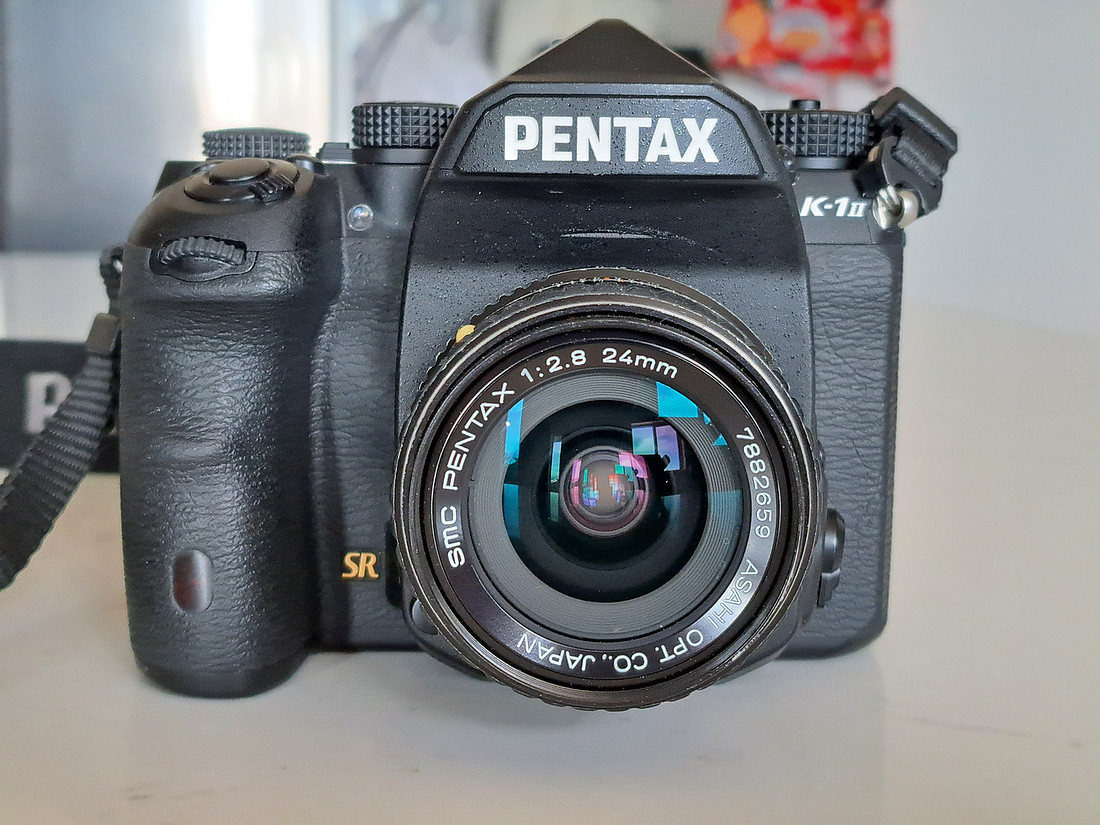
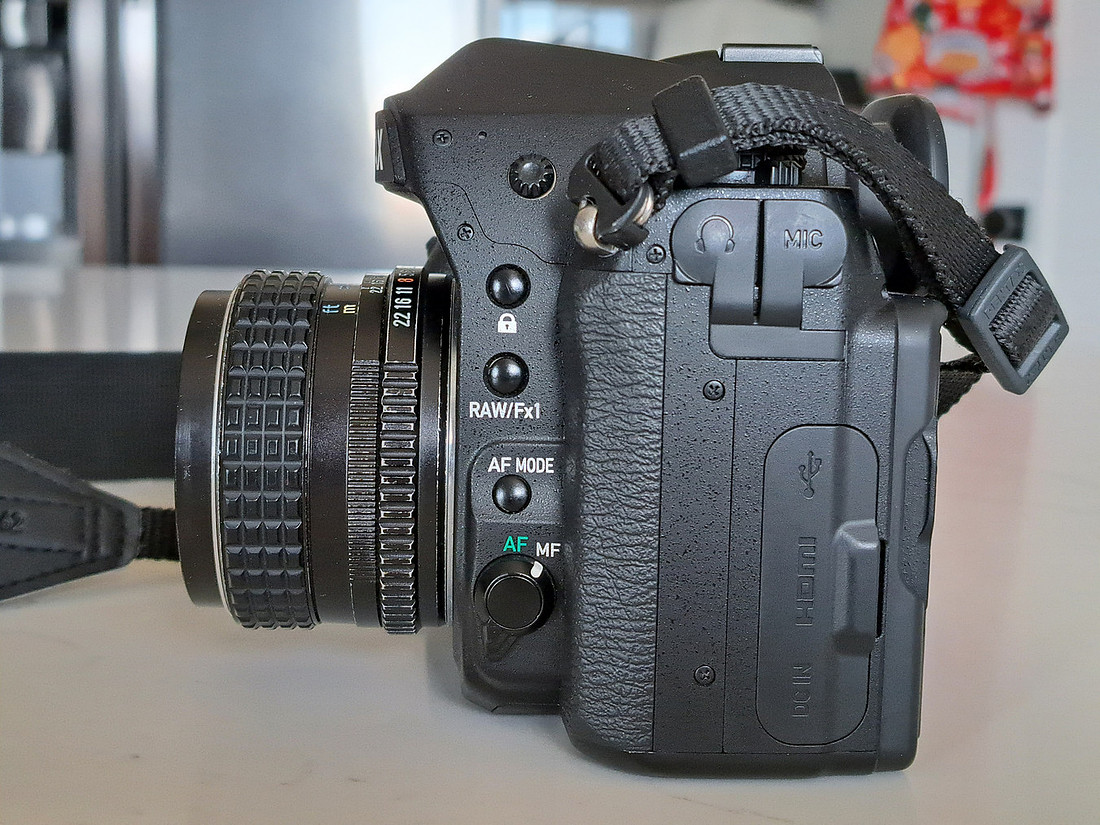
As always, thanks for reading and appreciate any comments you may have!
The Good, The Bad & The Chromatic Abberant Pentax SMC 135mm f2.5 on Full Frame
After a little break, back to the blog!
On a personal note life has, as always. been busy between work, and yard and a student at work that I am mentoring. Did I ever mention that I am a Physical Therapist by profession, and a very much hobbyist photographer? Well, many of my photos for testing lenses and just general street shooting are taken on my way into work or on my way home after work while riding the bus and/or the train. My practice area is in Critical Care where I am helping the sickest of the sick, it is stressful and part of what helps me cope is this kind of stuff. Seeing the world through the viewfinder can change everything, you can pick out a detail, or focus on a shadow rather than an object. It changes me and allows me to step back and decompress.
The main event: Another old lens on my Pentax K1 Full Frame DSLR, this is a Pentax branded 135mm f2.5 lens, medium telephoto focal length, it is a well regarded lens that is from the early 70's. It was given to me by my father-in-law when I purchased my first DSLR a Pentax K200d and he noted he had an old Film Pentax SLR, a K2, and I was welcome to have the camera and lenses he owned. Which was incredibly generous and has been a lot of fun, as the lenses from that era are fun, character driven optics, that have reasonably good optical performance in relation to modern lenses and were considered very good optics in their day. By character driven I mean that they render the image differently than a modern lens, they have a character to them that can charm or leave you cold. Many people on line and real life can get a bit... over the top regarding which lens is better. But, I would argue better is subjective and it is more important to simply note the differences and use them to your advantage. I have a fairly decent selection of these older lenses and will be working my way through them over the next year or two simply as a way to drive my photography and have a little fun While trying to avoid the desire to buy more of them.
First: This lens is a JOY to use, it is a solid chunk of glass and metal that just feels good in the hand, it doesn't overbalance the camera and you can walk around with it attached and it doesn't feel awkward or too heavy. The focusing and aperture rings are well damped with solid clicks for changing the aperture. For me there is a lot of pleasure to be had in the tactility of manipulating this lens, it just feels SOLID. For the focal length it has a fairly wide aperture range at f2.5 a third of a stop faster than f2.8. There are more modern lenses that are faster one Pentax @ f1.8, a legendary star lens in the A series that is really hard to find and still quite expensive despite being manual focus, and Rokinon is currently making a f2.0 lens in this focal length, but it is... unsmall. I was gifted one but it is broken and the cost to fix is prohibitive. I do not feel that this lens is not fast enough for me, smaller apertures mean thinner depth of field (DOF) and combined with a medium to longish focal length you can struggle to get what you want in focus.
While I was working on my prior Rokinon 85mm f1.4 test I took this lens along and tested it on this fence at the same time. What I wanted to test is the quality of the out of focus blur (AKA Bokeh) and the minimum depth of field at f2.5 and how that changes with stopping down. This is, to this dorky geek, a fascinating aspect of lens design and how it affects using a lens. The photos are labeled with the f number as you scroll through them note how more pieces of the fence come into acceptable focus as the aperture gets smaller (i,e, stopping the aperture down, or making it smaller). All shot with the camera on a tripod, remote release and manually adjusting the settings.
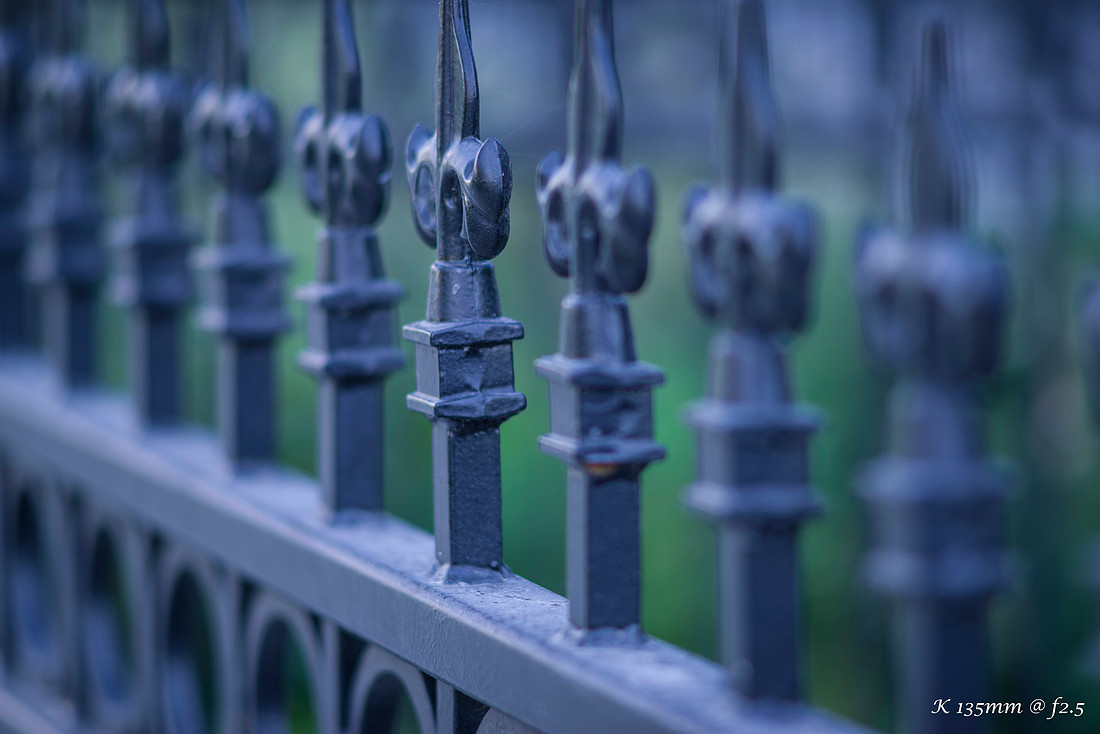
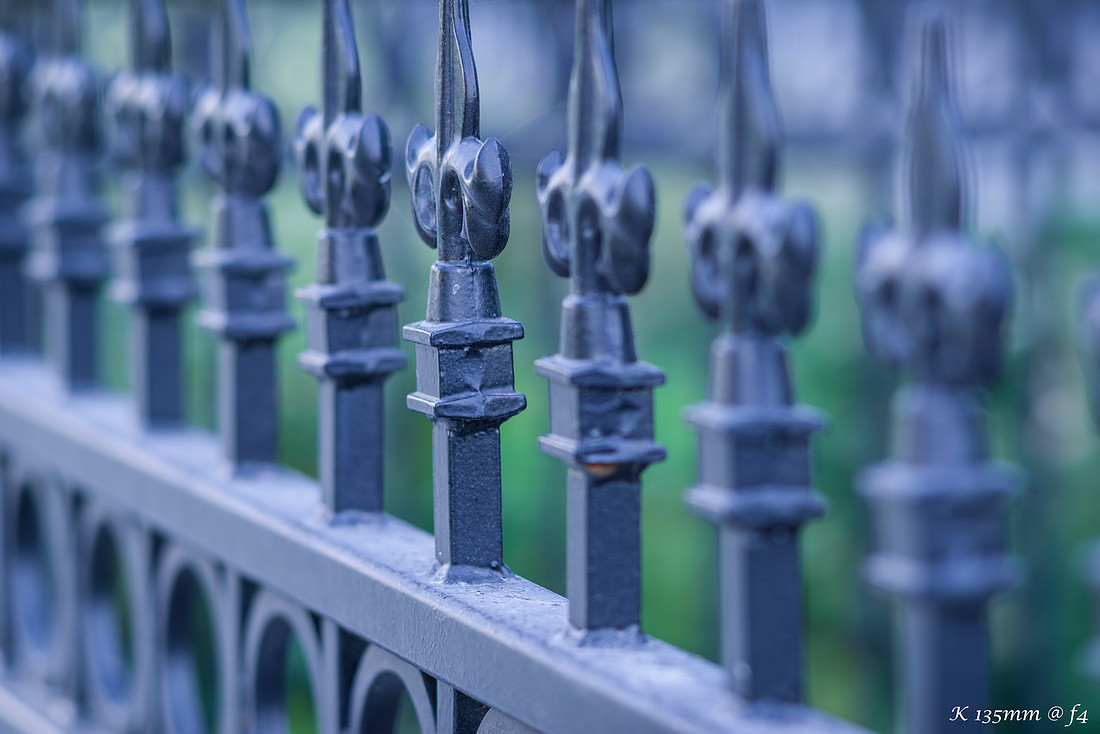
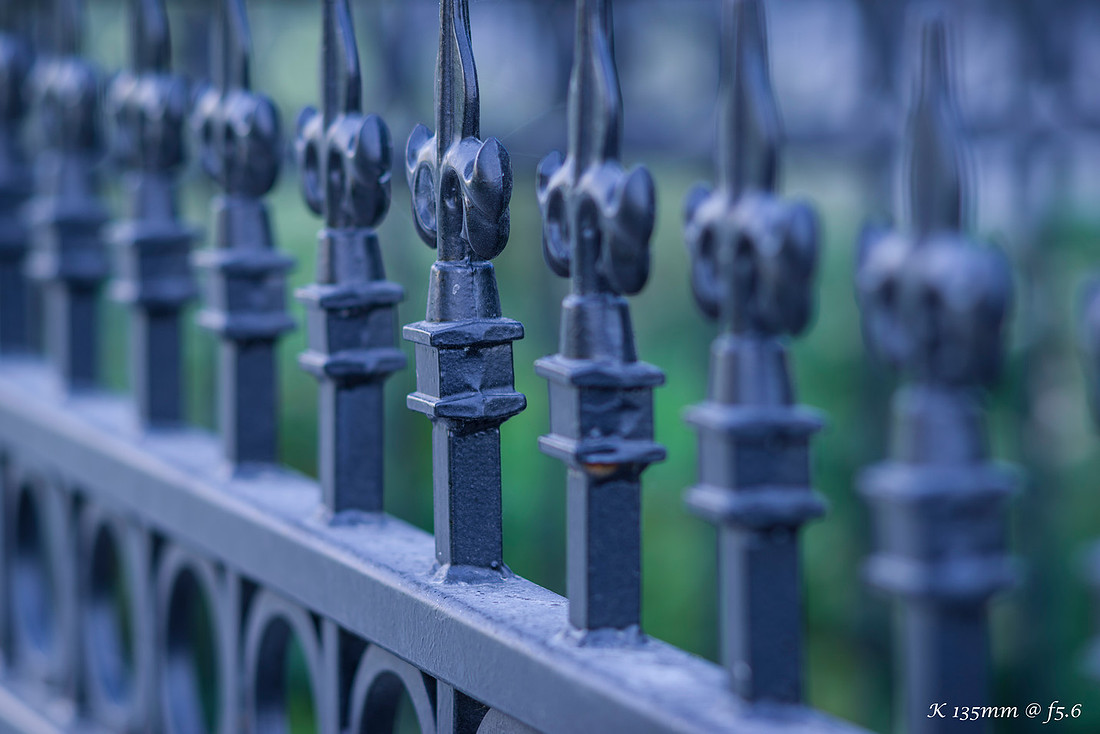
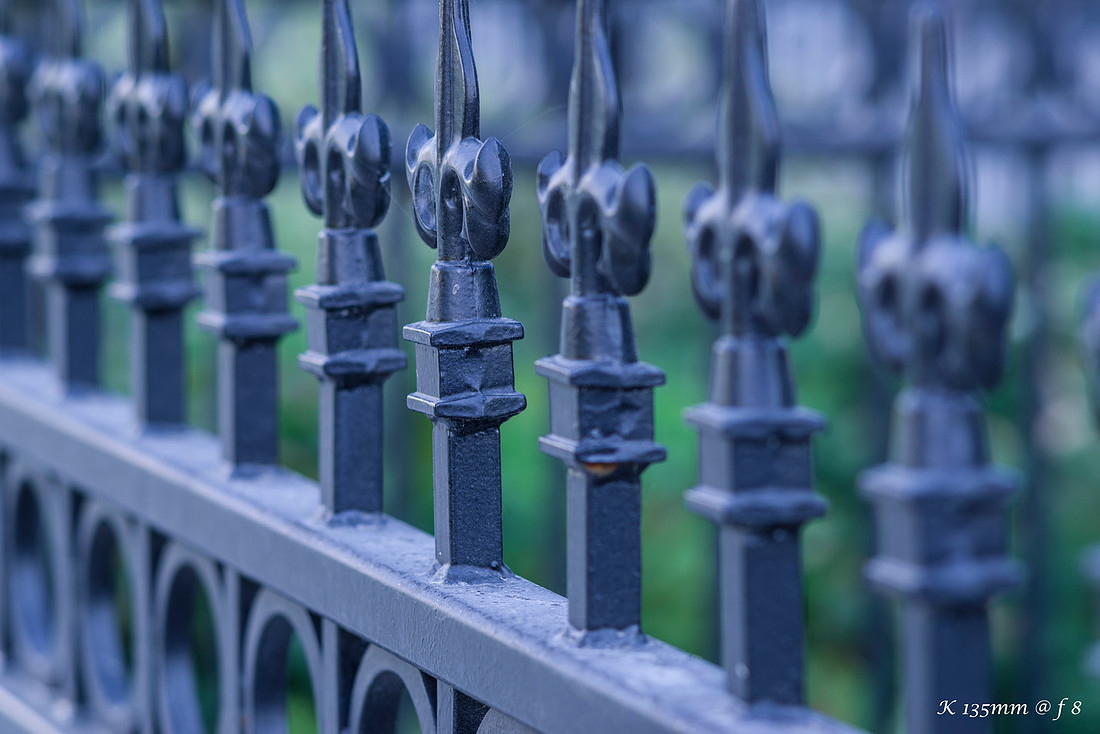
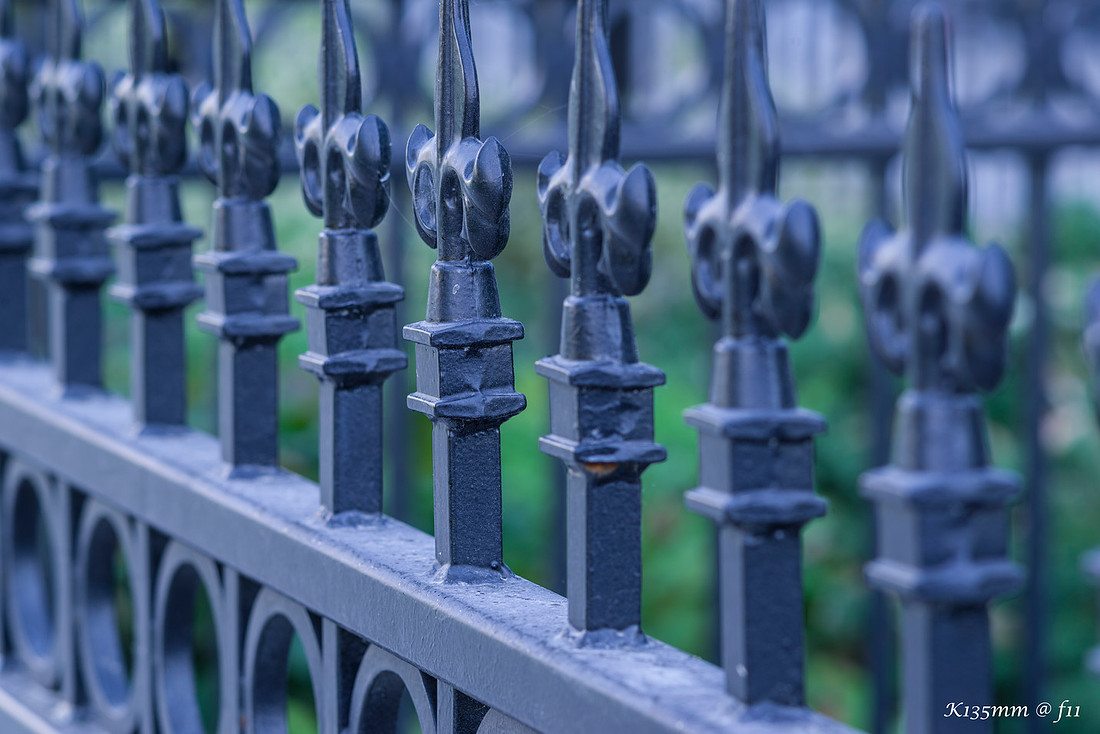
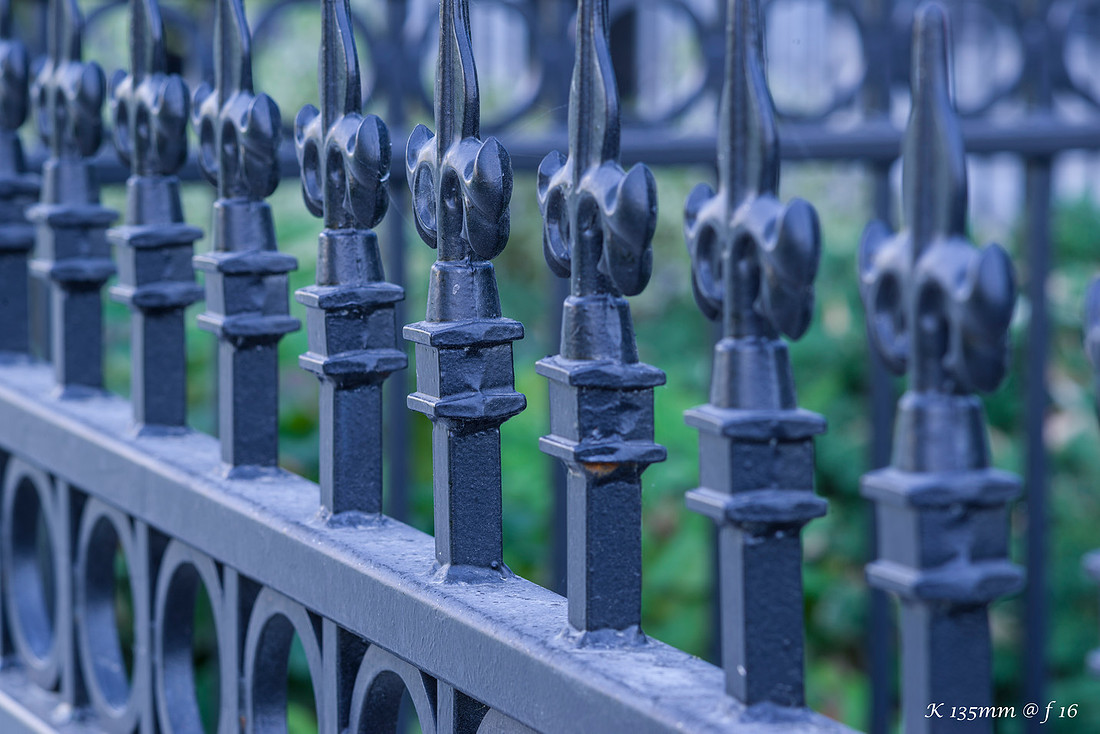
Technical Geekiness: The big thing to remember with aperture is it controls HOW MUCH light enters the camera through the lens, the less light you allow through the longer the shutter needs to be open to get a proper exposure, the opposite is also true that the more light you allow through the less time the shutter needs to be open. Balancing the shutter speed and aperture to achieve enough depth of focus to capture your subject without too slow of a shutter speed introducing motion blur is one of the primary calculations that a photographer makes. With modern lenses and cameras, you can let the camera balance it all for you, including the ISO or sensitivity of the sensor and you just point and shoot. Or you can control things partly yourself or manually set all parameters. With my modern lenses I typically use "Aperture Priority" mode where I choose the aperture I want, and let the camera meter the scene and choose the shutter speed for a proper exposure. I monitor what that is and if I feel it is too slow to hold the camera steady then I will manually turn up the ISO until I feel it is right. This type of lens, where the aperture is set manually on the lens and the camera does not know what it is, makes things more complicated. My camera has the Pentax "Green Button" function which will stop the lens down and meter how much light is coming in, to set a shutter speed, which you can then adjust up or down as you see fit. This all happens in "Manual Mode" or the M on the mode dial on a DSLR. Many are not comfortable doing things this way, which is fine, but I have been using these old lenses from the start and since I am old I am used to the days of less automation and doing these things. I remember the days of riding my triceratops to school with my film camera in my mammoth skin bag.
Anyhoo, for me, the photo making starts with choosing where to stand, then selecting an appropriate aperture for what I want to do. Do I want a narrow field of focus to isolate the subject, do I want to try to get more in focus like I would in a landscape setting. The hard part for me is that when I use a lens with a large aperture my lizard brain wants to shoot it with that wide open aperture because... well that is the selling point right? More light, faster shutter speed and subject isolation. Otherwise just get a zoom and stop it down, no need fussing with a single focal length lens. My lizard brain needs to shut up sometimes. You will see as we go through this set of photos I have taken over the last month or so that wide open can be fun, but stopping down helps sometimes.
Gallery time with notes about most photos. I walk past this every morning walking from the train to the bus stop. Wide open I was able to get reasonable parts in focus and blur the background. The oval highlights is how a point source light is rendered through a lens. In the center they typically are circular and as you move to the edge they become more oval. Several lights close together blend into a bar as you see in the mid upper right areas.
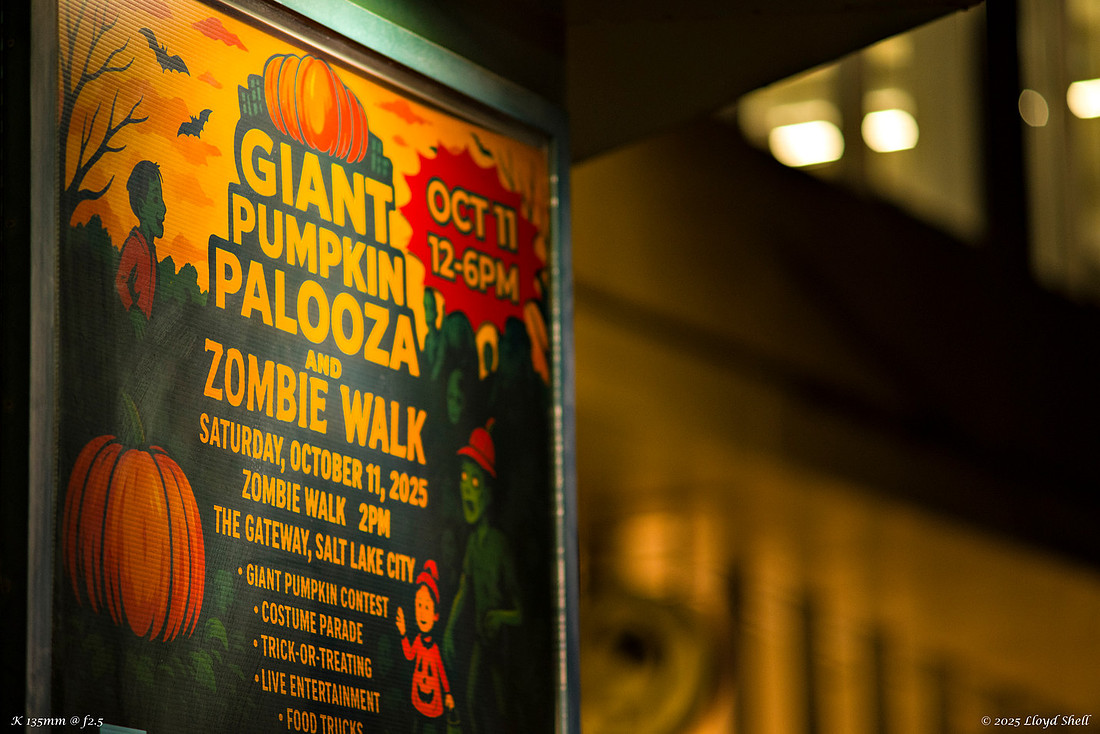
Just around the corner is this cool old bank with carved faces on the exterior, it is actually kind of hard to photograph and I continue to take photos hoping to find my favorite way to look at it. The point of focus was further from the camera than the previous photo which allows for increased depth of field. Yeah I forgot to mention that so far, the closer you get to something the thinner the depth of field or focus gets.
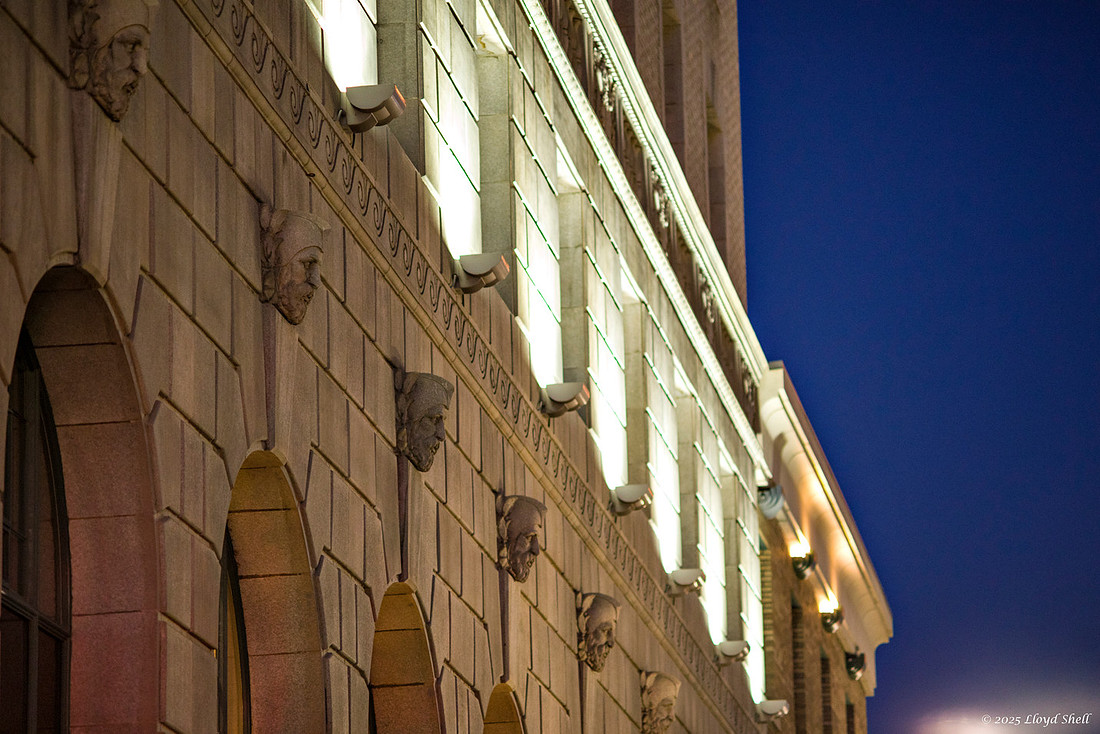
One thing that you have to watch out for on older lenses and faster lenses that are modern is Chromatic Abberation, it is quite apparent here, with purple fringing closer to the lens and more green in the area behind the field of focus. All lenses have a little some have more, it depends a lot the lighting and aperture, stopping down tends to eliminate these, software on your computer can also remove these problems. It is just something to be aware of. This can really rear its ugly head in high contrast situations, with the lens @ f2.5
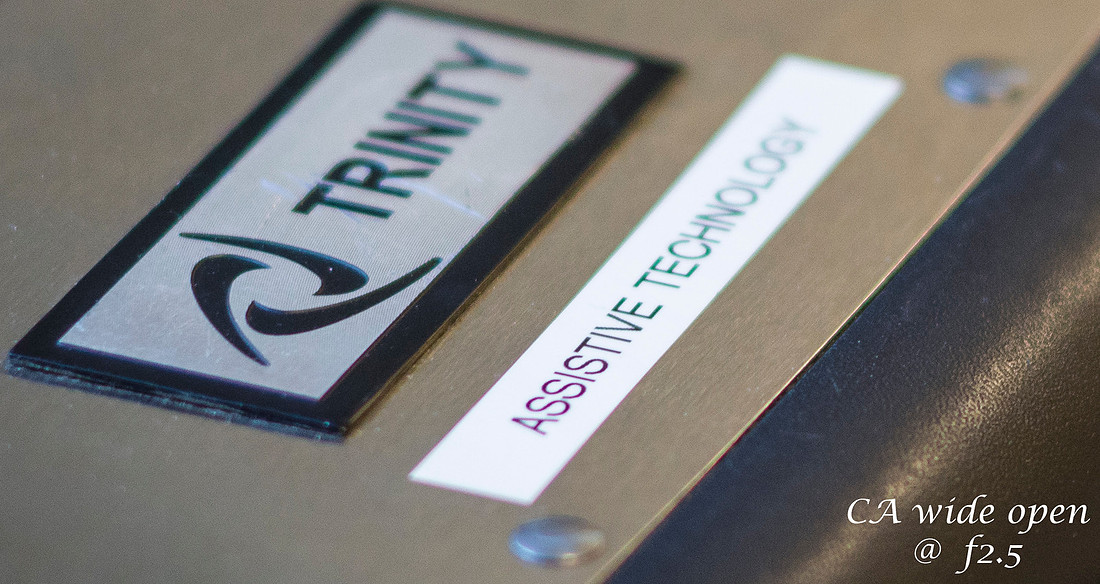
Stopped down to F4 or f5.6 the overall performance of the lens is really quite good and even pixel peeping (looking at the files at full resolution) they are quite good. I think this is where I may use it more with the focal length being a mid telephoto you can bring things farther away a little closer and frame a part of it to create interest. I see this every day as I walk out of the stairwell to go to the bus, but constricting the field of view changes how I see it compared to my eyes.
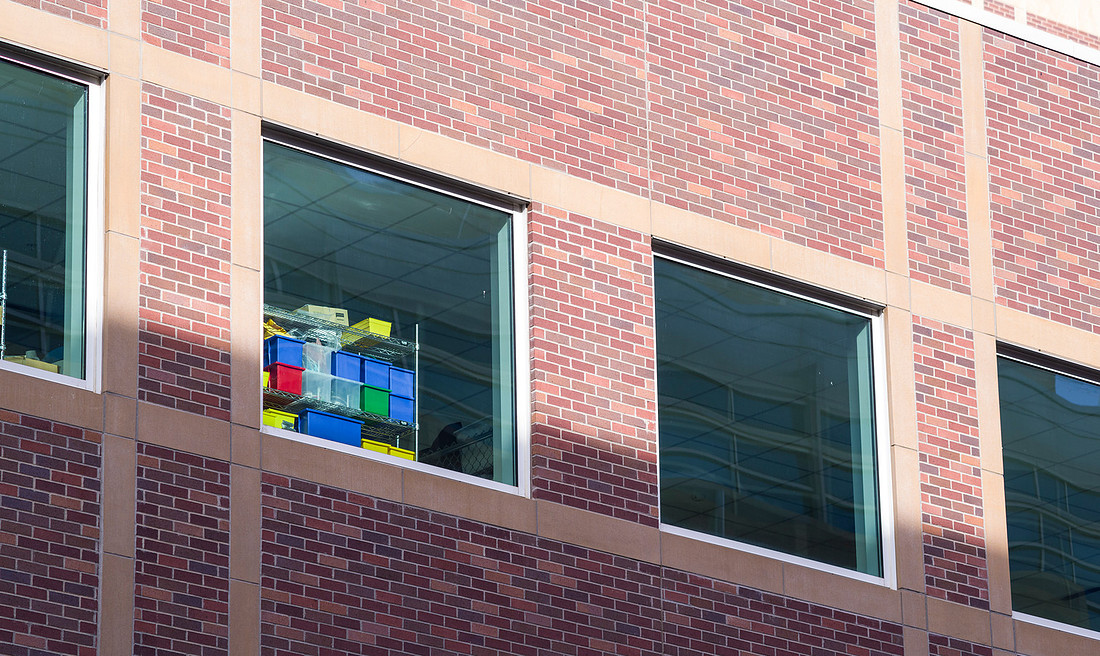
I see this everyday as I'm waiting on the bus to come, the photo is nothing special, but it demonstrates the capability of the lens at subject isolation at medium distances.
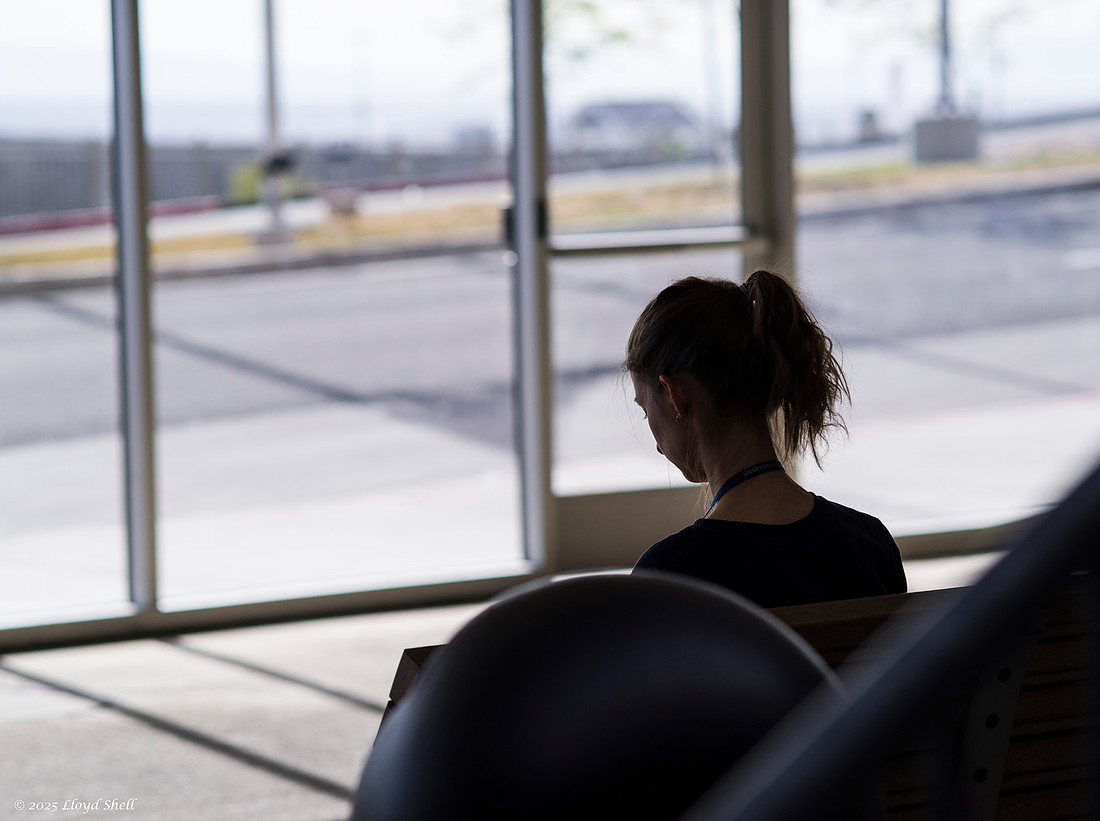
Just turn to my left and this is my view. Focus point was on the O on the one way.
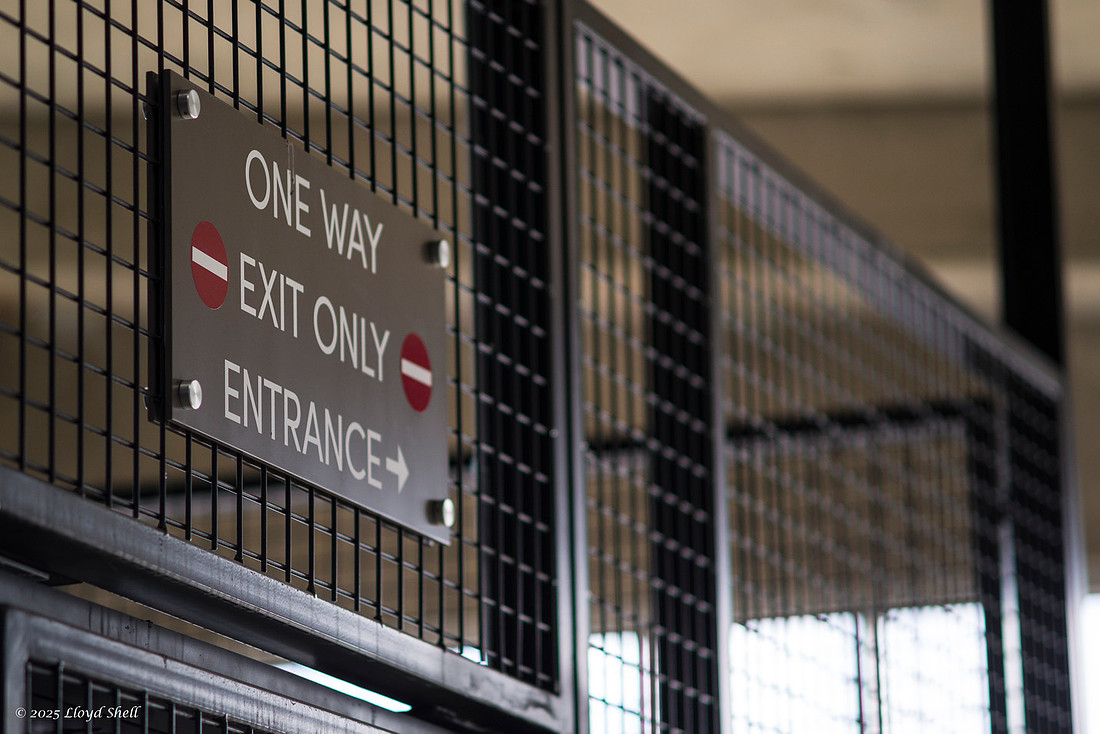
I do love some back alleyway Graffiti, I was worried about the focal length being too long, though it was constraining I was able to find some good compositions.
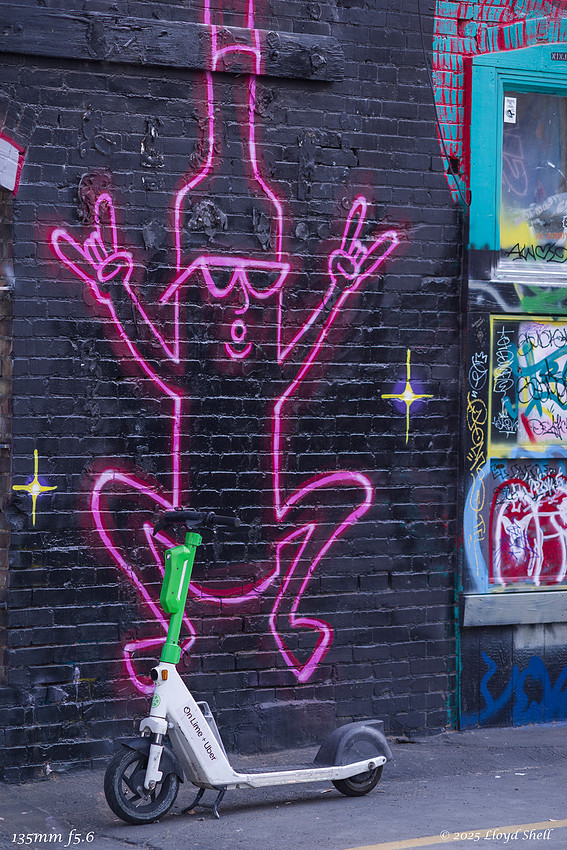
The color rendering of this lens is, like pretty much ALL Pentax lenses, exceptional, contrast and everything is awesome and this was wide open @ f2.5!

Stepping closer to the subject and staying @ f2.5 in this photo there was negligible chromatic aberration despite being in broad daylight when I expected it to be there. I was quite happy.
I had to stop down to f4 for this shot, just for a little more depth of field. Shoes thrown over power lines confuse me. Not sure why they don't caouse more problems than they do... or do they?
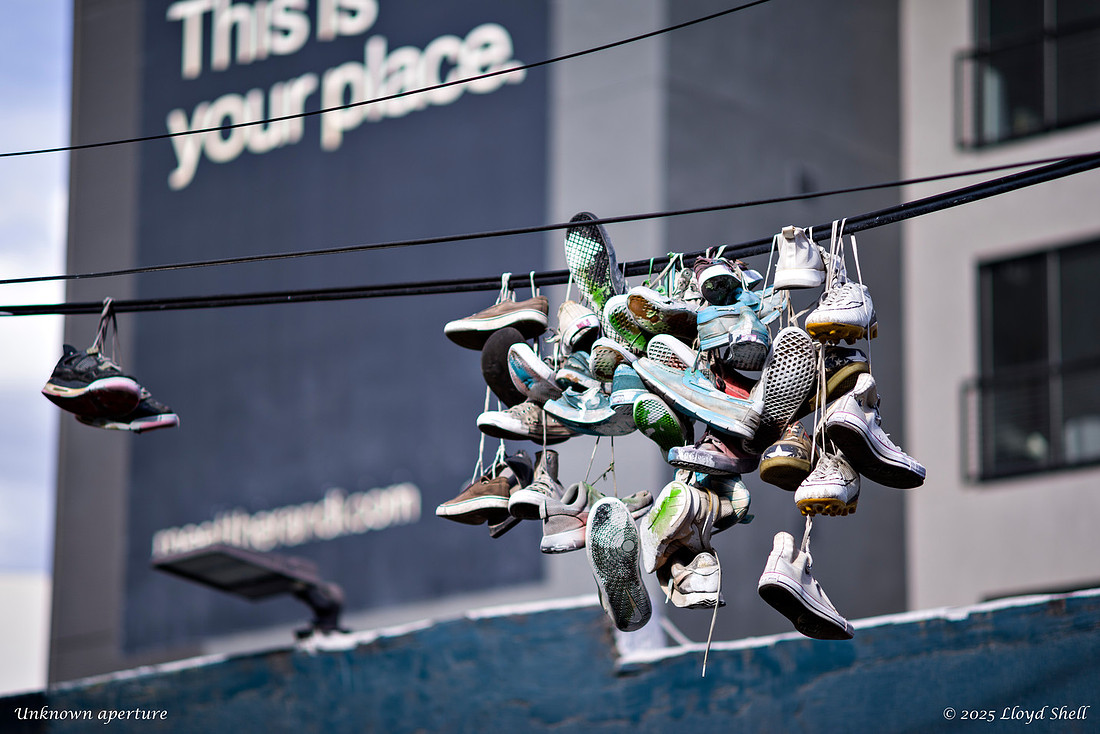
When you look at the full resolution file, the part of the shoes that are in focus are perfectly sharp, really a testament to the lens and Pentax's engineering abilities.
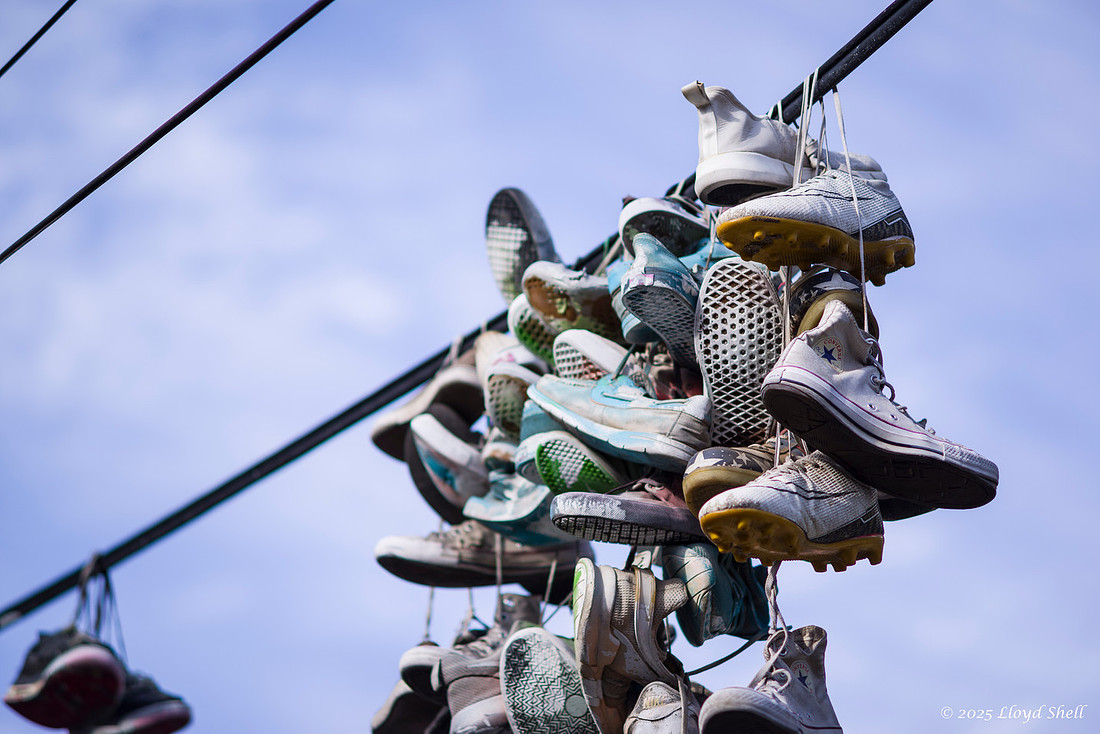
One of my many favorite things are reflections that distort and change the original subject, you would think that glass panels are perfectly flat, but they seldom are and even the slightest bend or misalignment when mounting can cause distortion. Which, honestly I prefer. I see this building a lot as I am transferring from bus to train or train to bus. The longer focal length works well for this, at some point I will see what my 200mm lens can do.
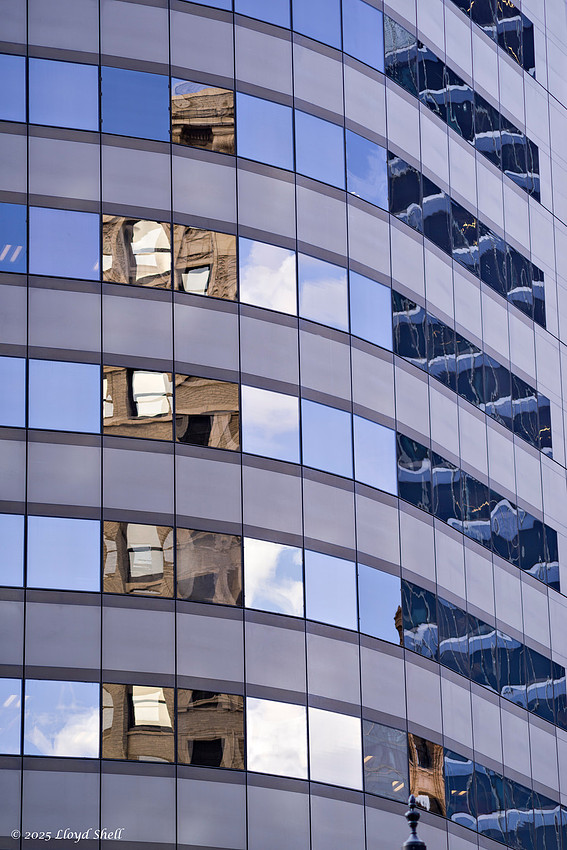
Back to my old bank building, but in better light. At this point in my journey I am realizing, again, the difficulty of nailing focus with a longer relatively fast lens. My camera with give me indicators in the viewfinder of when something is in acceptable focus, but only in the center of the frame, and with faster lenses it is not uncommon for that to confirm in front of or behind what you are thinking you are focusing on. Couple that with 50+ year old eyes and you can miss. Lesson to learn? Unless it is critical to the shot, stop down the aperture for increased depth of field and make your life easier. This was wide open at f2.5 and I did have to fix some green CA in the background areas in post and the subject is not crispy clear, but it is good enough for this size of posting.
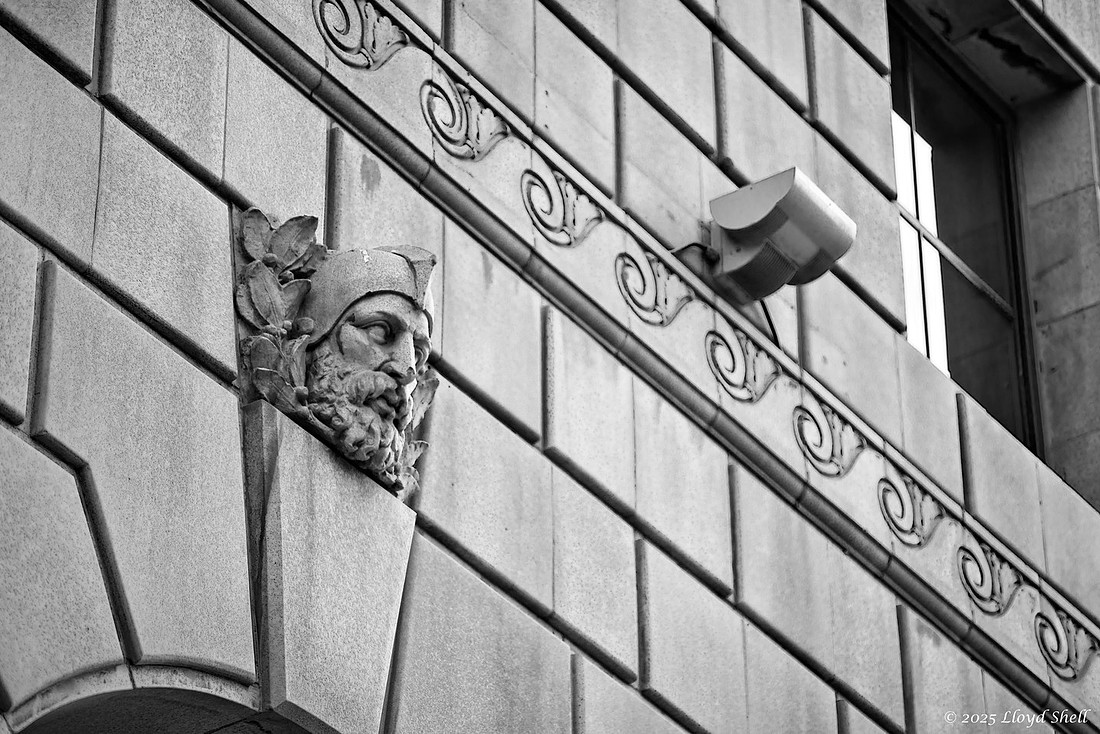
I believe that I like this photo more, as I look at it more. Pretty sure I stopped this down a bit, which really helps especially when the subject is further away.
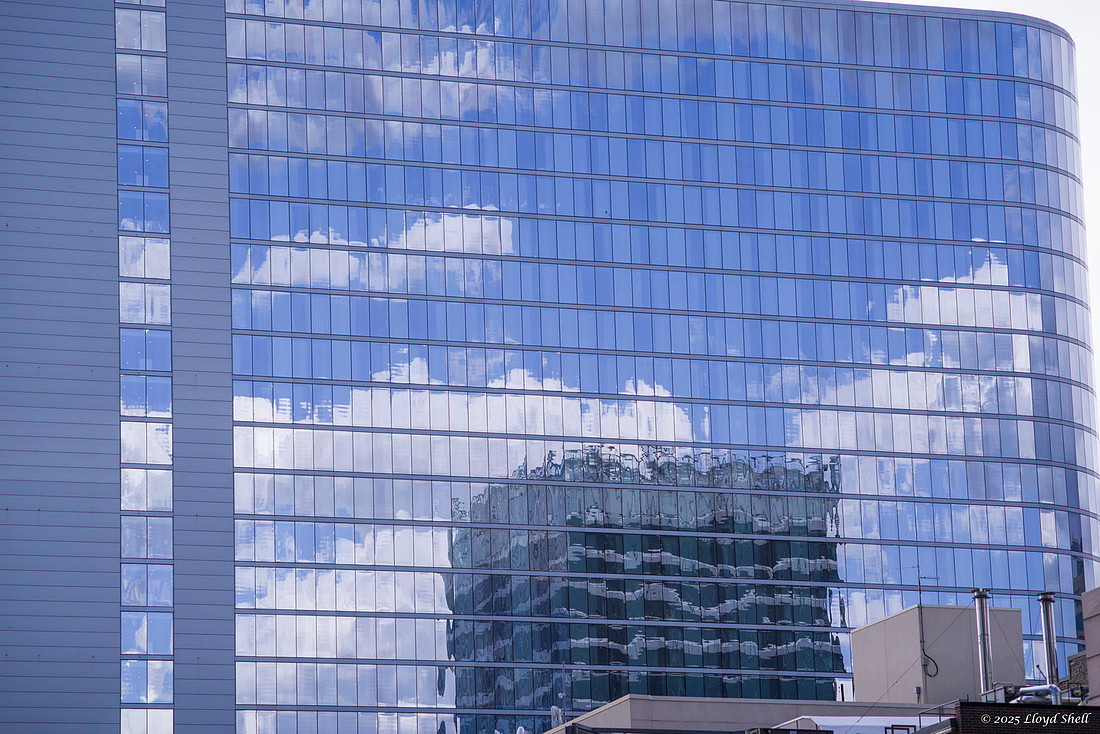
Him again, ever noticed that changing where you stand makes things look different? I think that is about 90% of photography once you get the technical knowledge of HOW to take a photo, it then becomes a factor or where to stand, sit, crouch or lie when taking the photo. Another plus for this lens from the technical side is the lack of distortion.
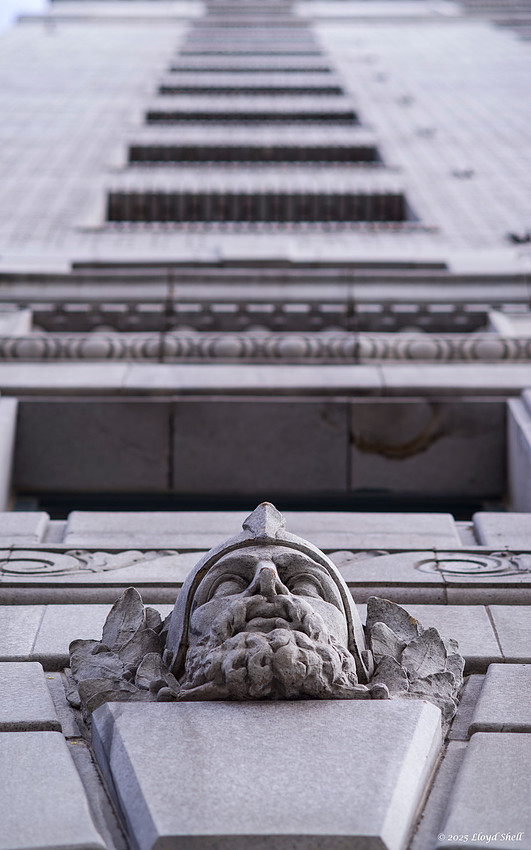
I found for this type of shot f4 seems to reduce the CA sufficiently and yet give reasonable depth of field.
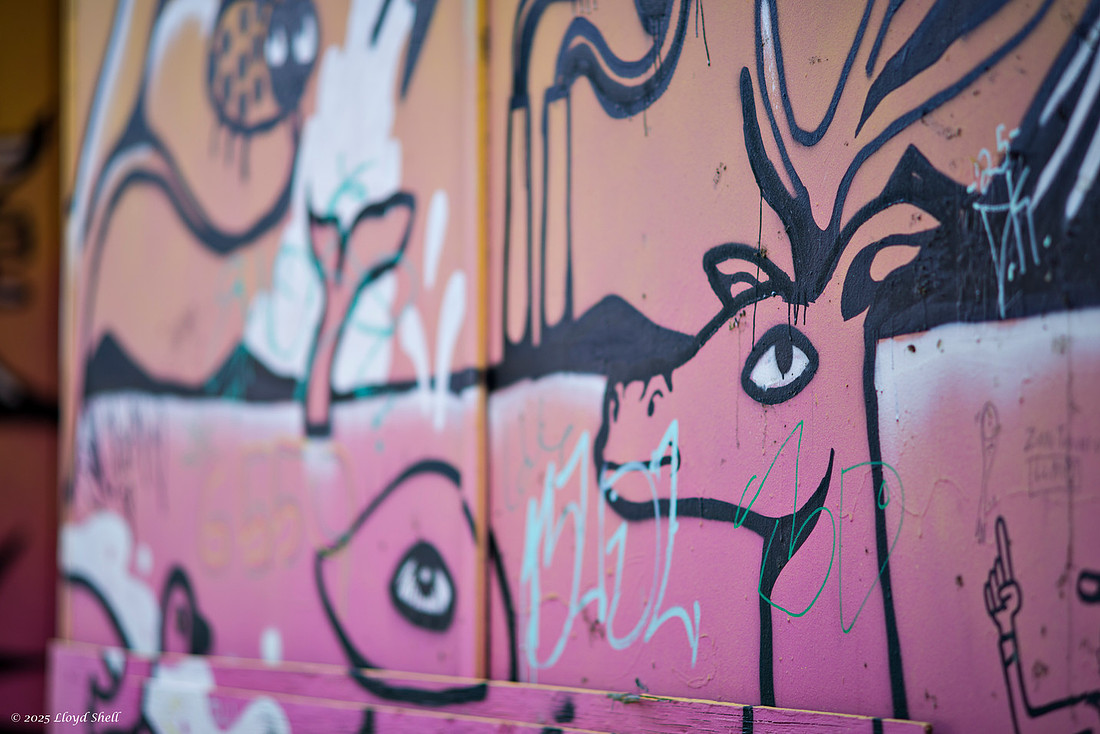
This fire hydrant is right across from the light rail stop and the sticker has been in other shots, It is interesting to revisit the same thing with different lenses and see how different they can appear.
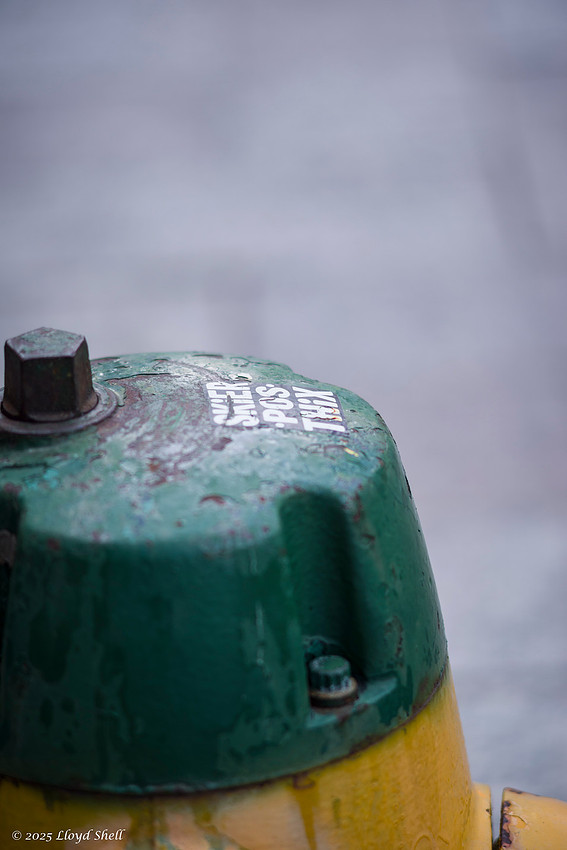
Landscape photos with medium telephoto lenses can be tougher than with a more wide angle lens, and yet more interesting in some ways. Telephoto lenses tend to draw distant things together allowing you to put subjects in context. These rail bridges are in use but are older with some cool patina. I don't like to trespass too much as it isn't safe, but using telephoto focal lengths helps to bring things together.
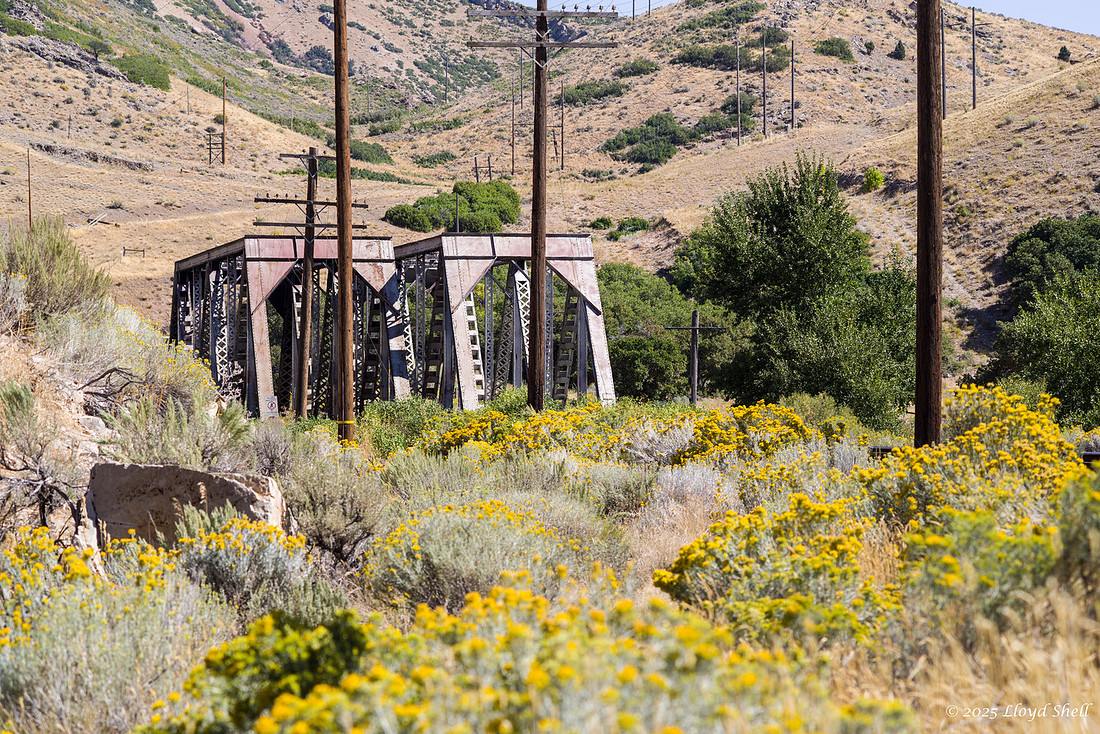
Stopping down to f11 for increased depth of field and crossing over allows me to bring the tracks into the frame leading the eye to the bridges. That pleases me.
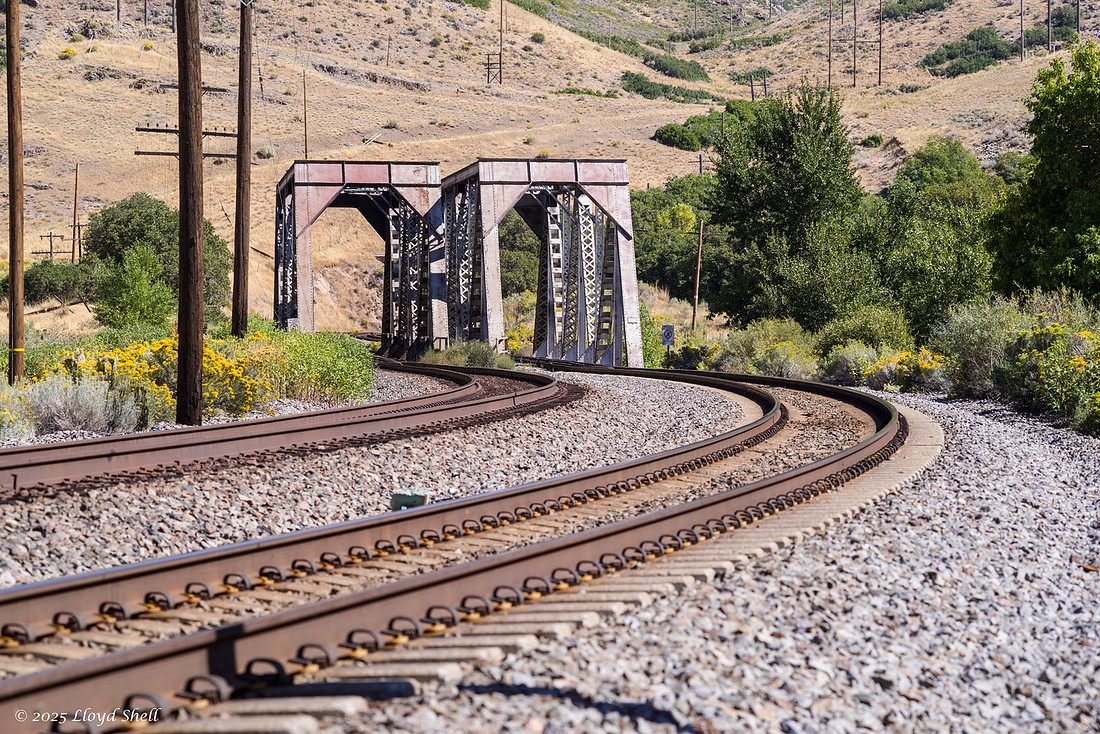
Back the other direction, with a closer focus point allows me to bring in the detail on the ties and attachment of the rails to them, blurring the background a little. Again the performance of the lens was superb and I could not ask for more.
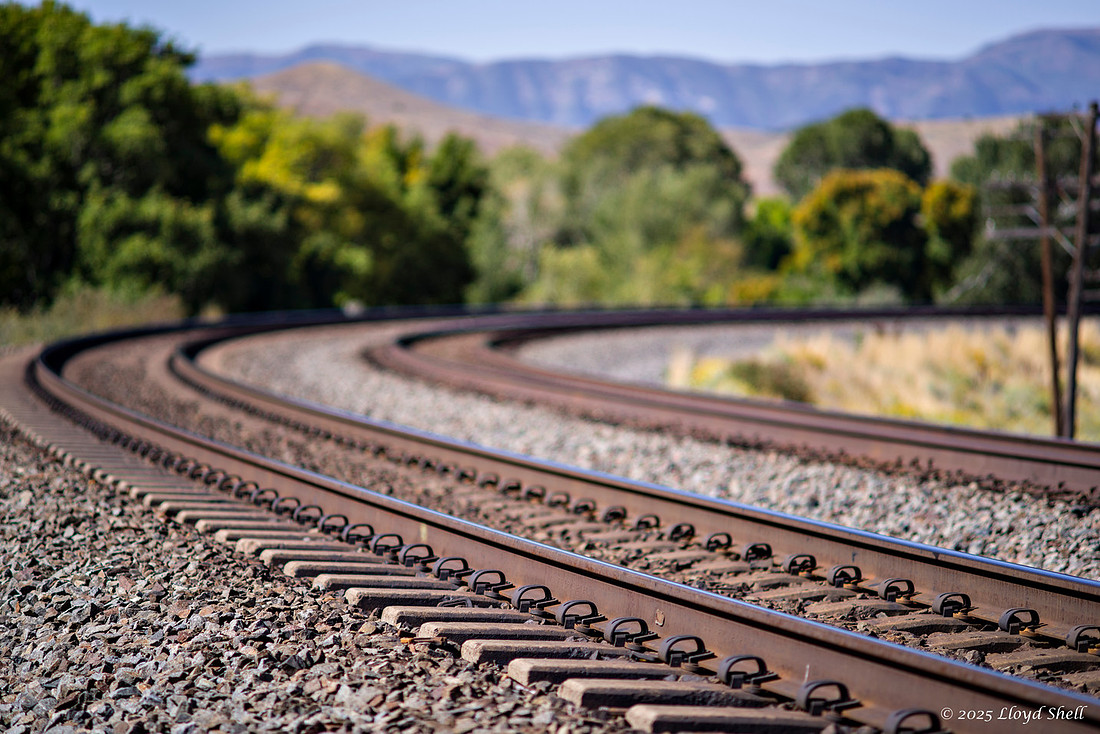
Back to Bokeh, wide open turning the lights into bubbles.
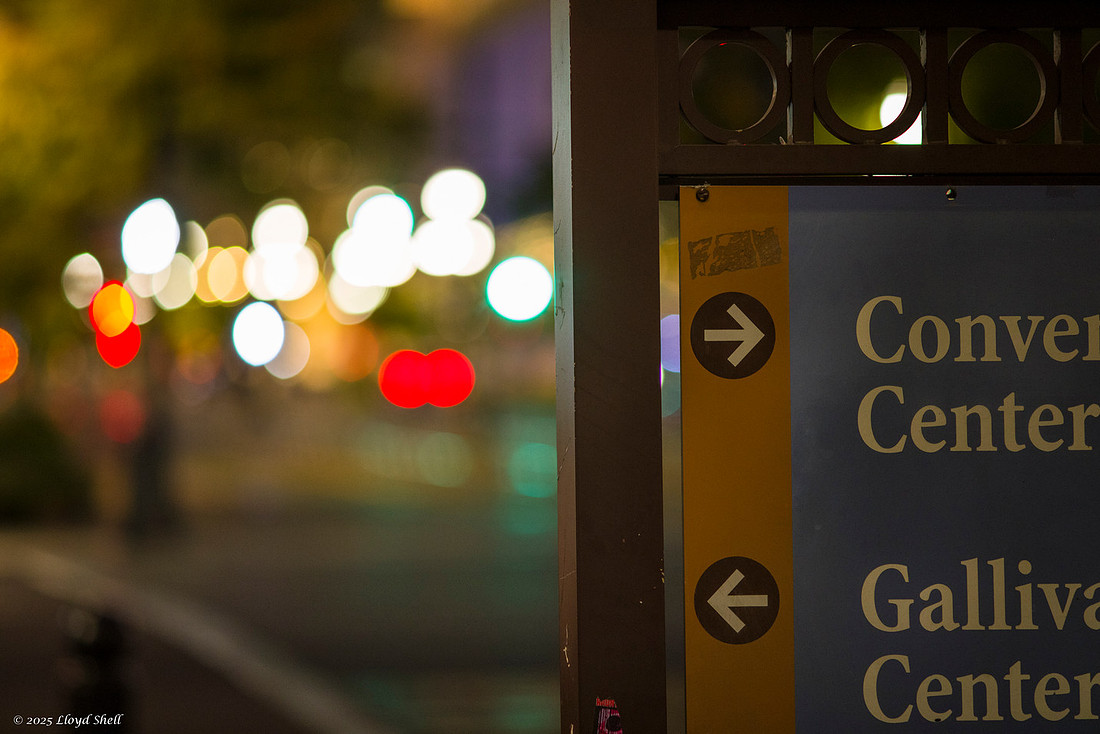
Moving from just playing with aperture, I wanted to see if I could "See" in this focal length, meaning could I walk around and look at a scene and know in my head approximately what it would look like through the viewfinder when I put the camera up to my face. This was close.
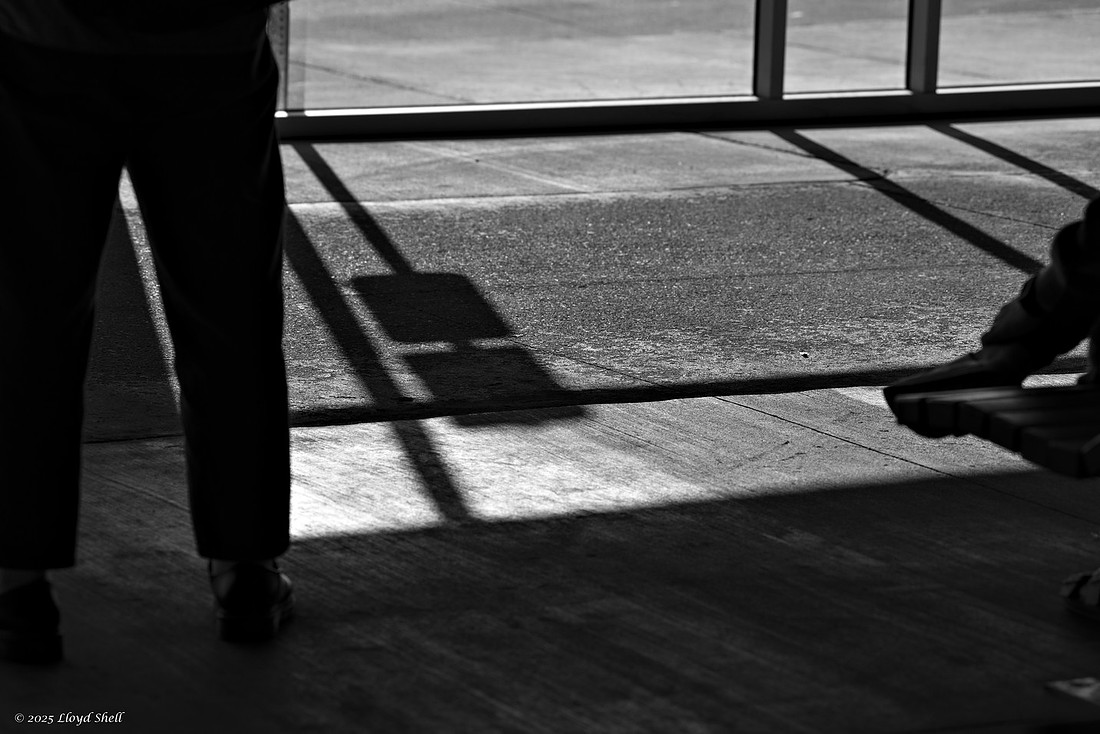
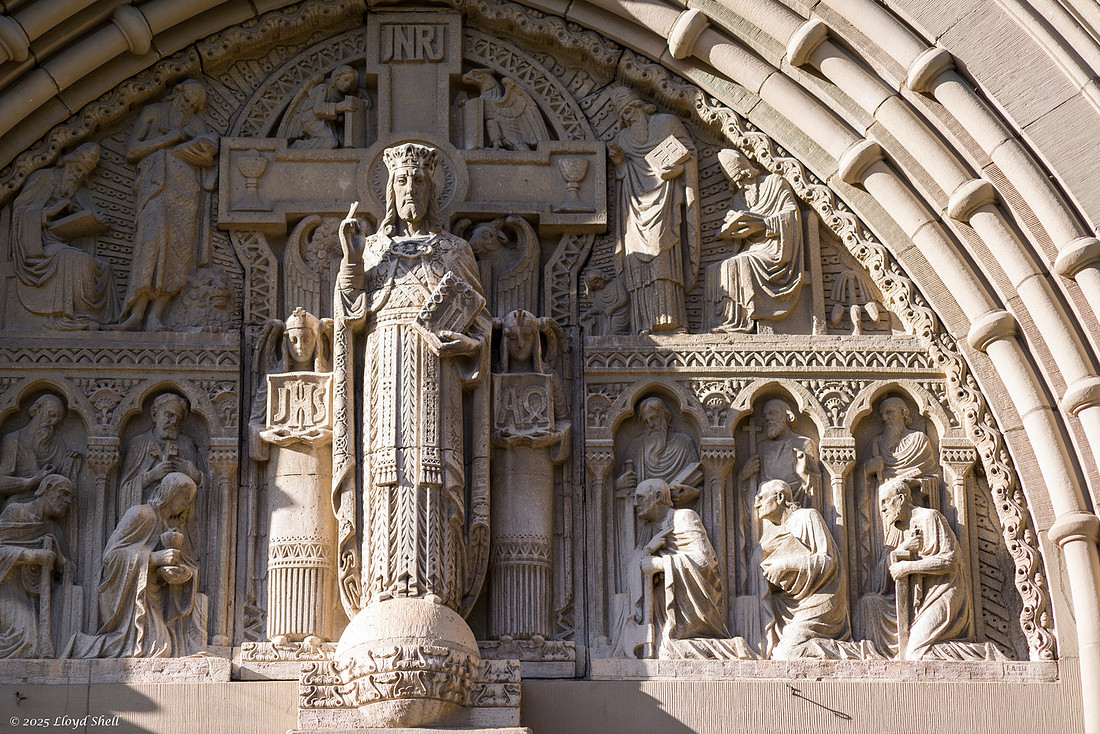
I included this shot purely to help illustrate how always shooting wide open can mess you up. I took multiple shots and none of them really were demonstrative of the sharpness I was looking for. I need to remember to stop it down a little.
Tough conditions, backlit in strong sunlight, I had to do some correcting of CA, but with that effort a reasonable outcome.
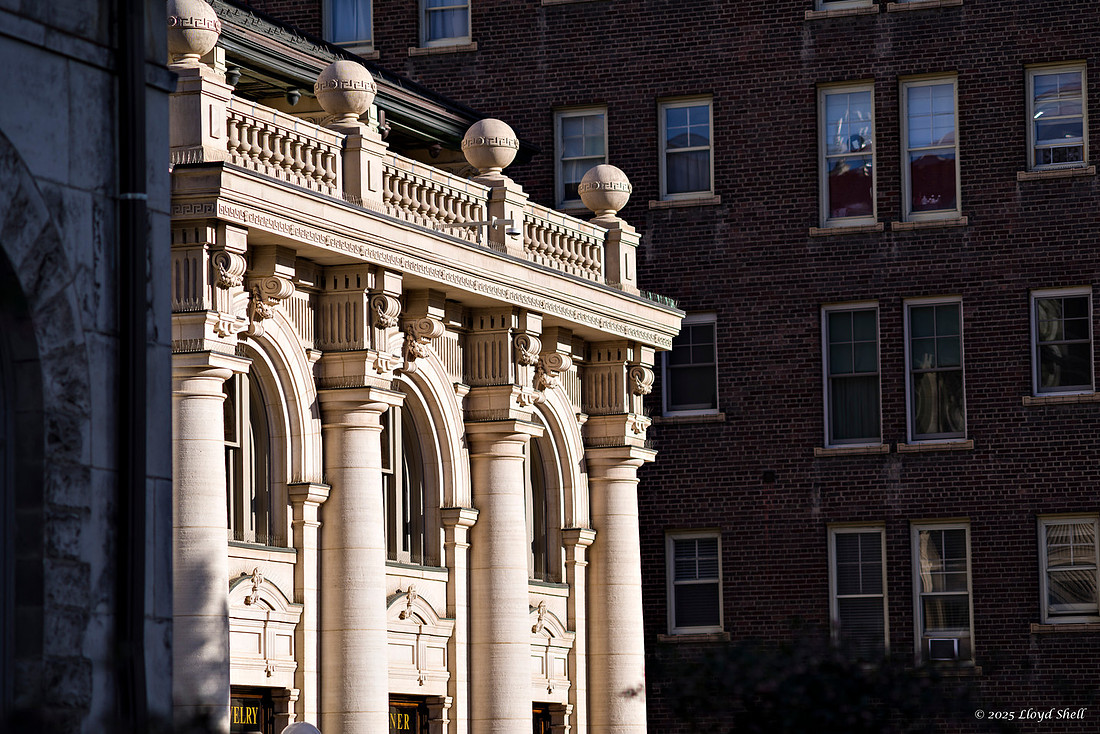
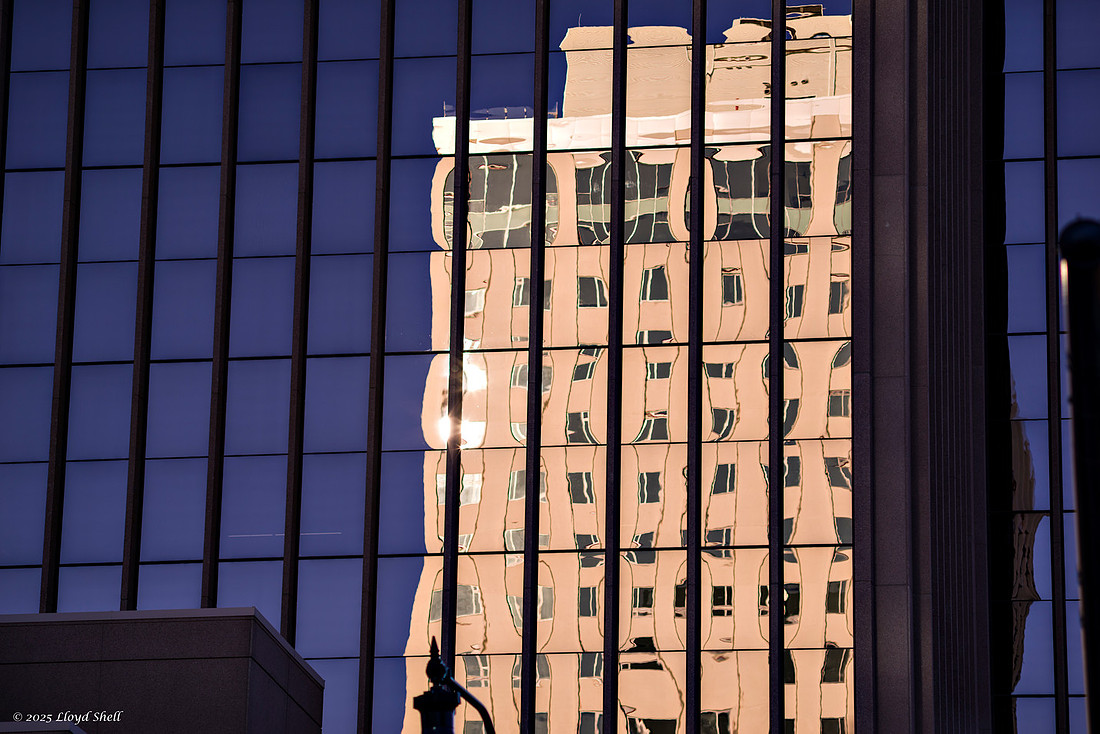
I don't normally use a tripod during the daylight when shooting on the street, I may want to repeat this shot using a tripod just to keep the framing the same. The first one was @ f4, you can see the shape of the aperture in the shape of the octagons in the background. The second wide open. The difference in detail and sharpness on the tree trunk is notable.
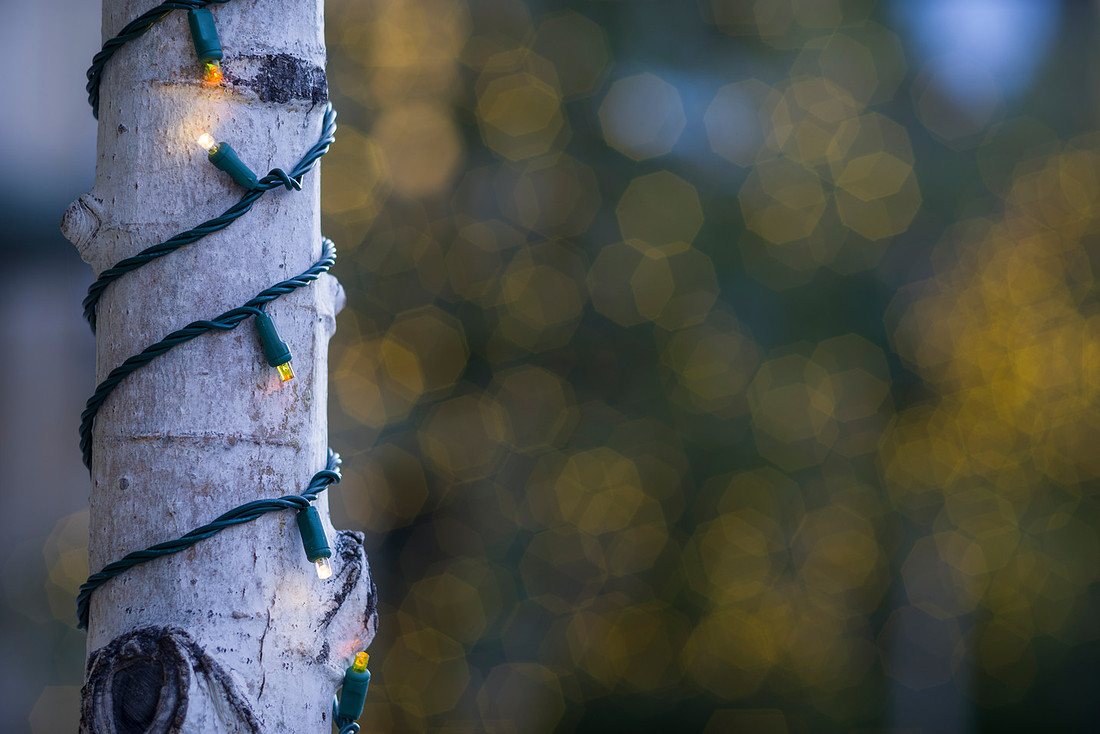
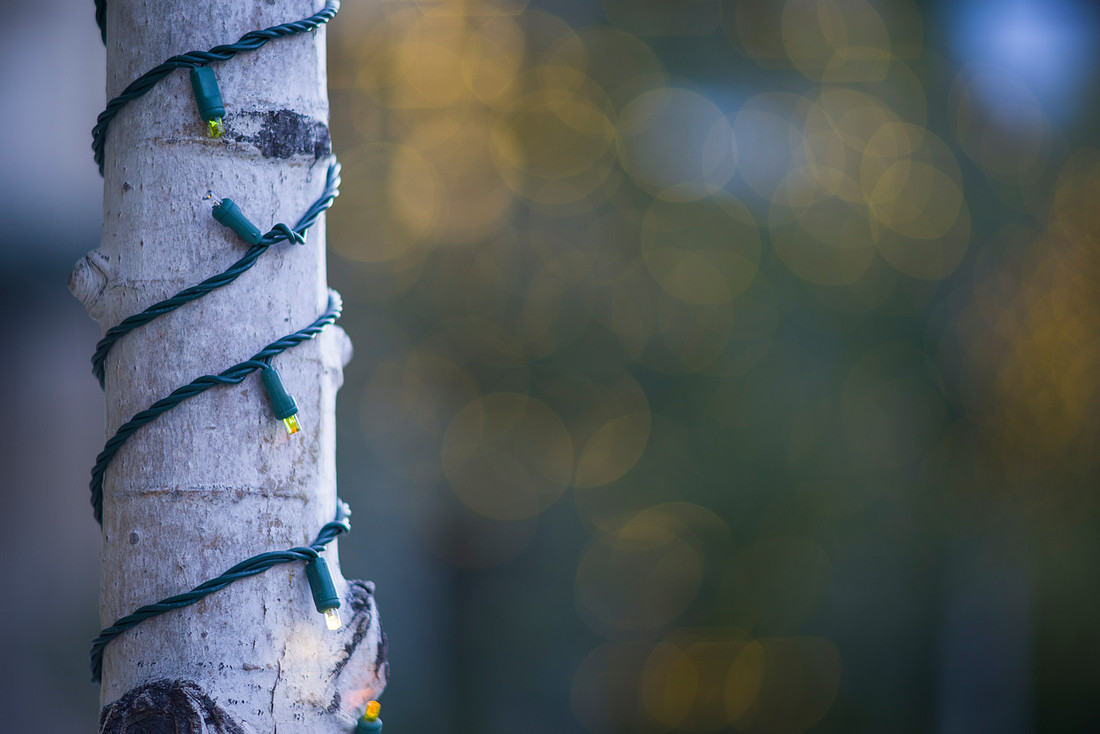
I have a soft spot for architectural details on ornate buildings, the old ZCMI building downtown has some cool stuff on it. This really is where this 135 can shine, a little bit of reach and good color.
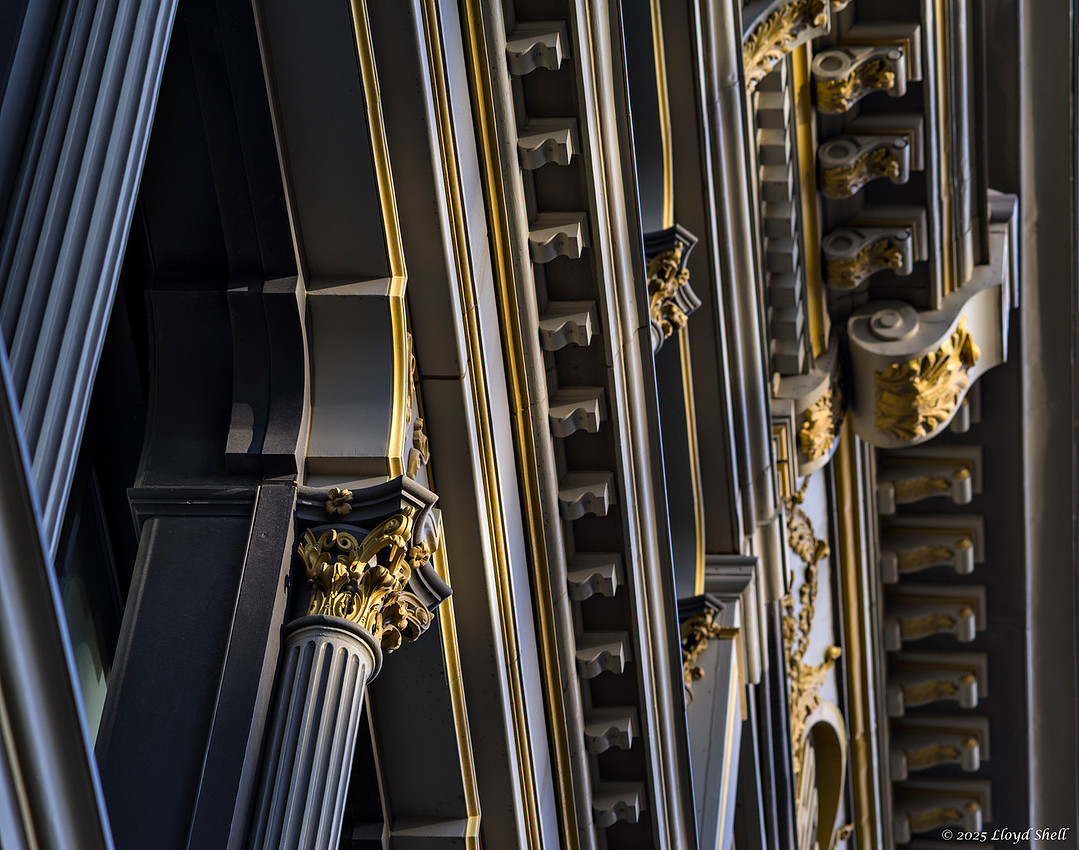
This little brass bee is on the railing of a platform at the light rail station, I keep forgetting about it, then rediscovering it. There is another platform with crickets on the canopy. Details like that make me smile.
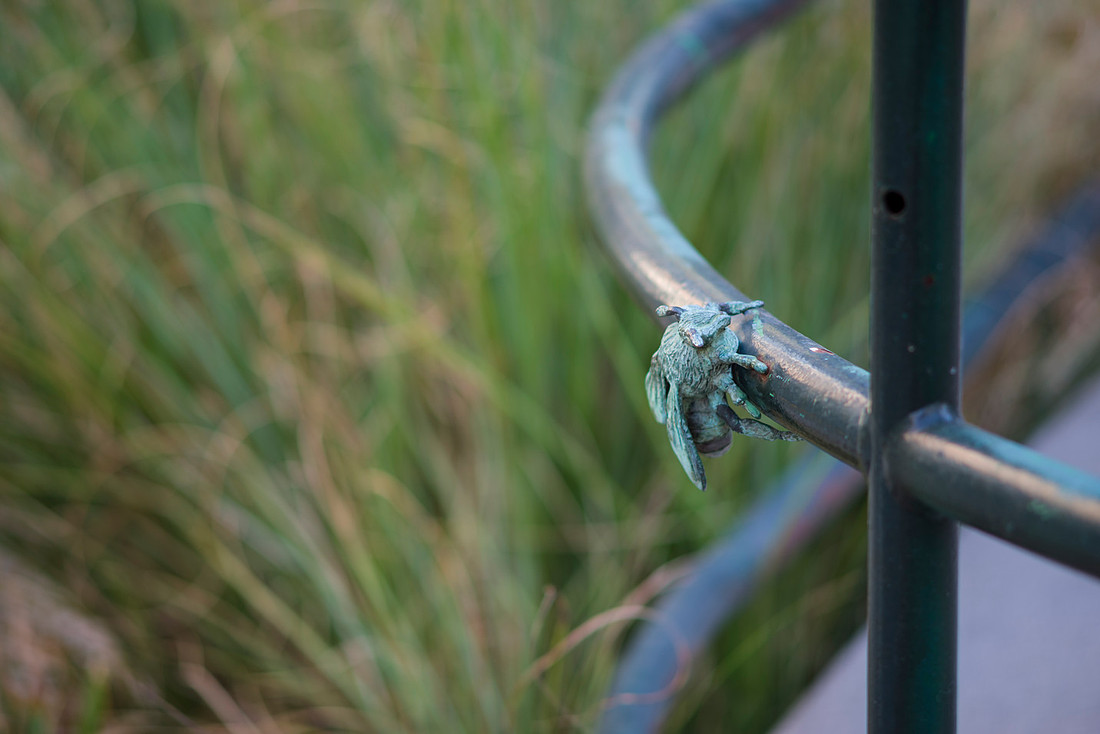
The compression of moderately distant things to make them look closer together is a function of telephoto lenses, here looking south on Main Street, we have our familiar friend the Walker Center with its neighbors sandwiched together. I love how you can take the familiar and make it look new by changing your lens.
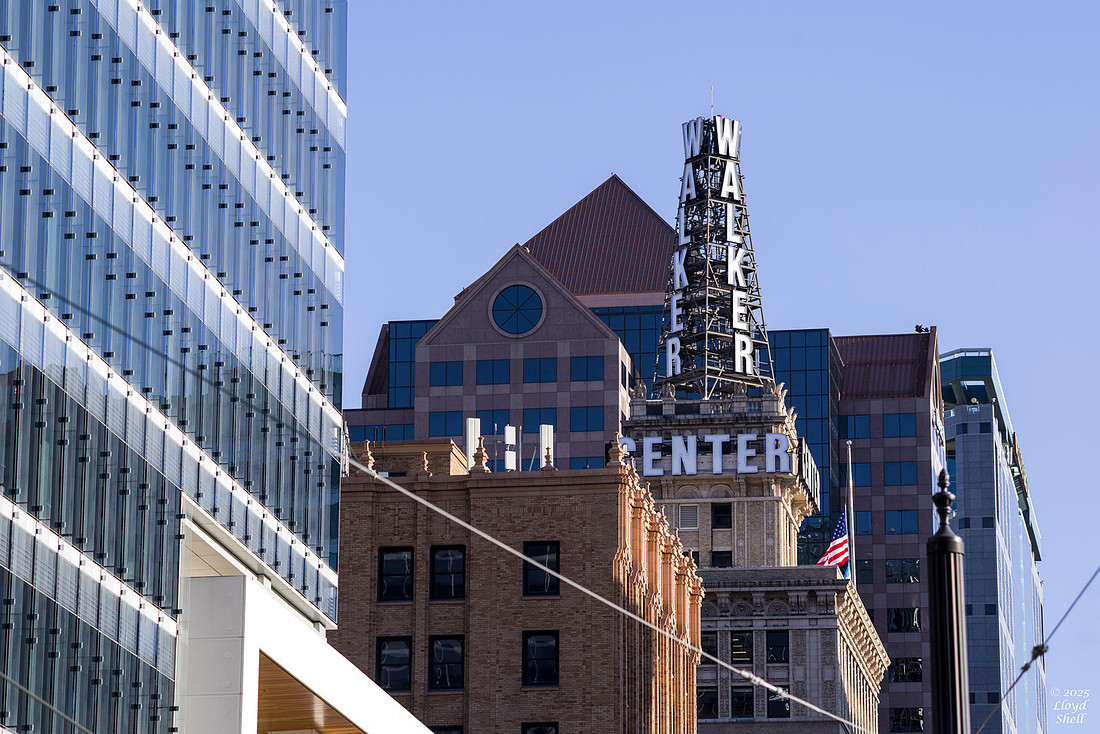
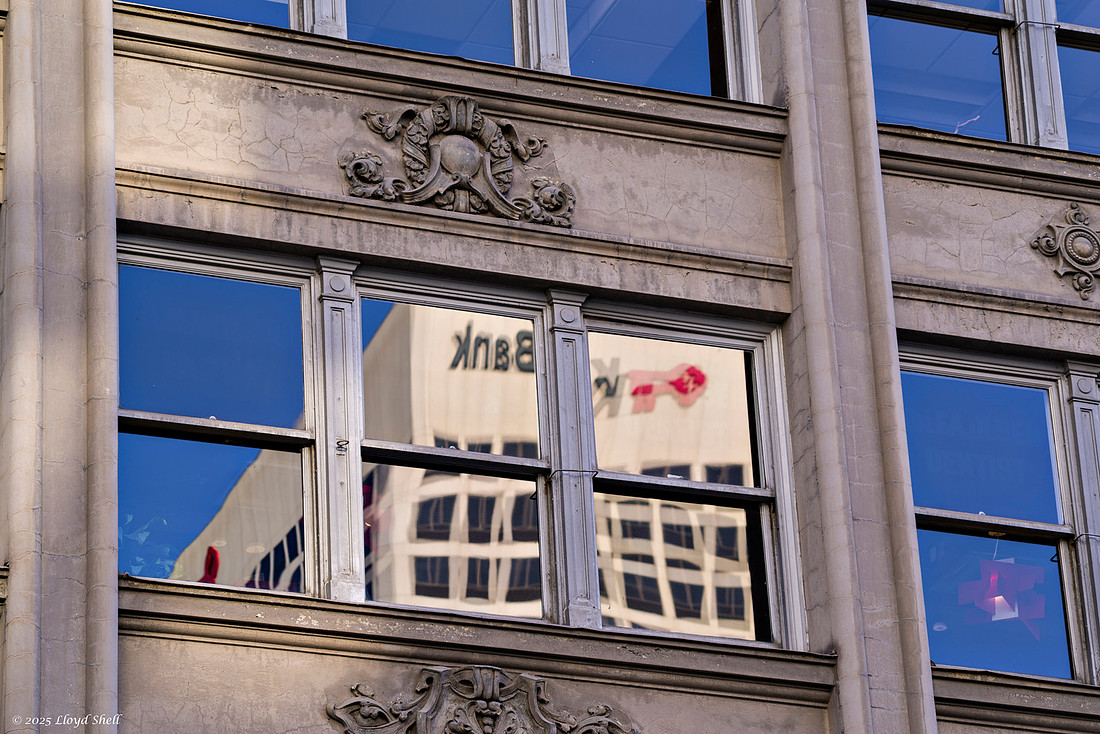
I expected more CA with this shot, we were in shadows but I felt the darker foreground would induce some, but it really didn't cause me any problems. This is an appropriate use of f2.5 and worked well.
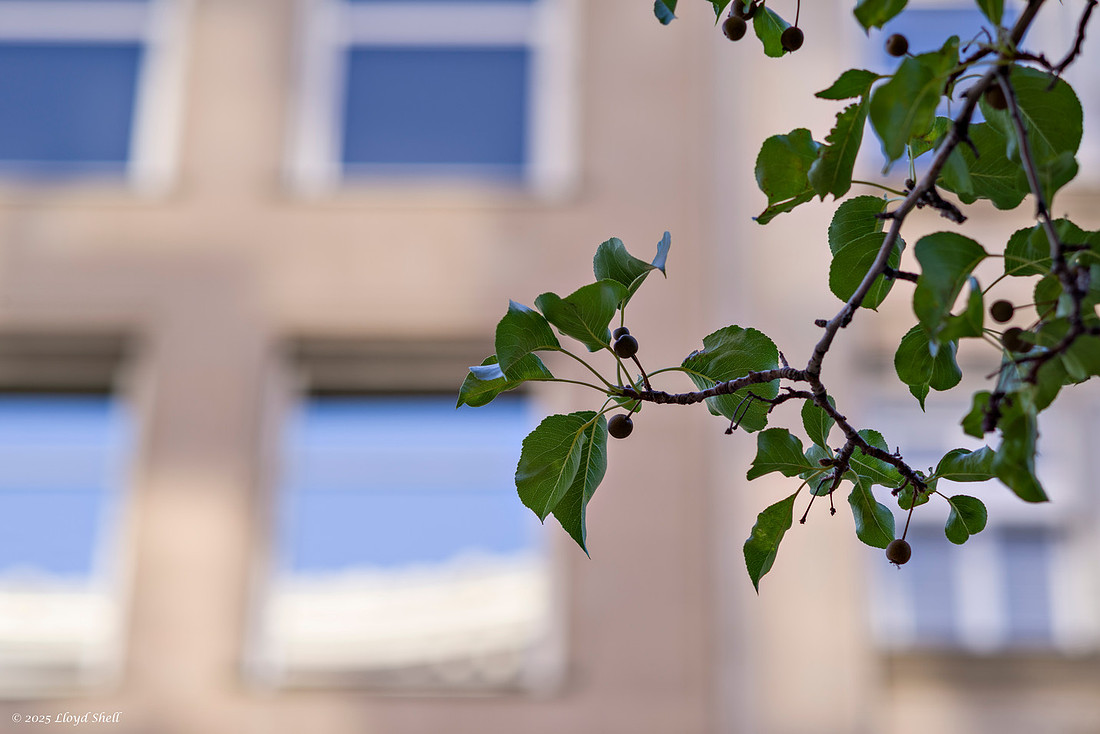
So, summary time.
Good things: Handling and tactility, build quality, sharpness especially stopped down a little, color rendering/contrast, unique compositions due to focal length, Bokeh (out of focus blur) is pleasing.
Bad things: Chromatic Aberrations in certain situations, can be tough to get focus correct and you can miss shots, at f2.5 depth of field can be shallow and sharpness limited. You will miss shots, especially if you are trying to focus in a hurry.
Overall I still love the lens, but it seems to handle full frame sensor better than APS-c, though that could be the sensor as well, I am beginning to think that each lens AND camera sensor combo is a low unto itself. There are a few youtube videos of people adapting this lens to a mirrorless camera and they don't mention the CA as much, but they seem to be smarter and stop it down a little too. My take away as a street lens, stop it down a little and play to its strengths.
Thanks for reading, assuming you got this far, and have a great photographic day!
Lloyd
Going to the Mountains for R&R
I have an aversion to being in nature with lots of people, to me it is a sanctuary to decompress and a break from that which keeps me from hearing myself. I will occasionally invite one other person on a limited basis, but I prefer to be alone. The problem anymore is finding a place where you can be alone. There are simply too many people around, especially in the summer. I have recently decided that after the Labor Day holiday is a good time to go to the Uinta Mountains. I went back in 2020 on Labor Day monday and stayed overnight, having a blast lying in my truck and listening to thunder echo back and forth and the sound of the rain. It was amazingly soothing. I ran away this last Labor Day too, but didn't get any rain. I took my motorcycle for a little dirt road riding and I also took my camera to try for a few astrophotography shots and general mischef.
I had partial clouds and some pretty skies. The waxing moon was a bit bright and I had more light pollution than I wanted which kind of annoyed me. But I did come back with some fun photos I wanted to share. Walking around the lake the afternoon I arrived was a blast, we used to camp there every summer as a kid and fish till I was sick of it. I was too pensive to take photos sitting at our fishing hole, but a little ways further around the lake I found a sky reflection I liked. The abstract distortion of clouds and sky make for more interest than the sky alone.
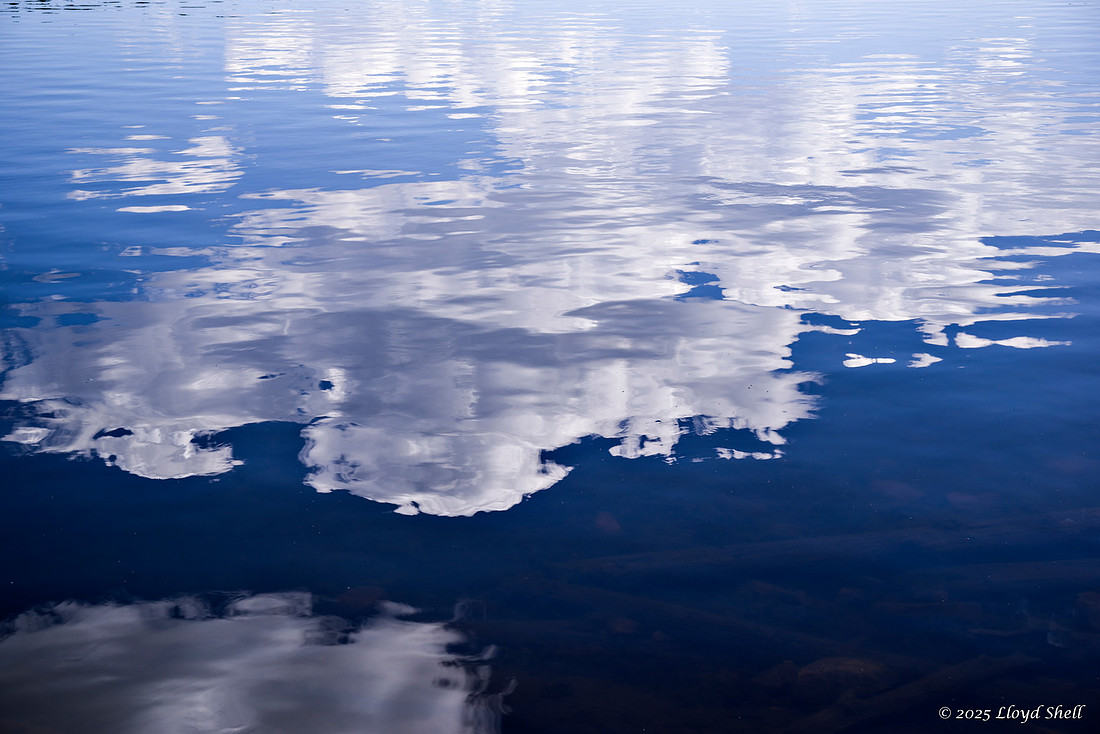
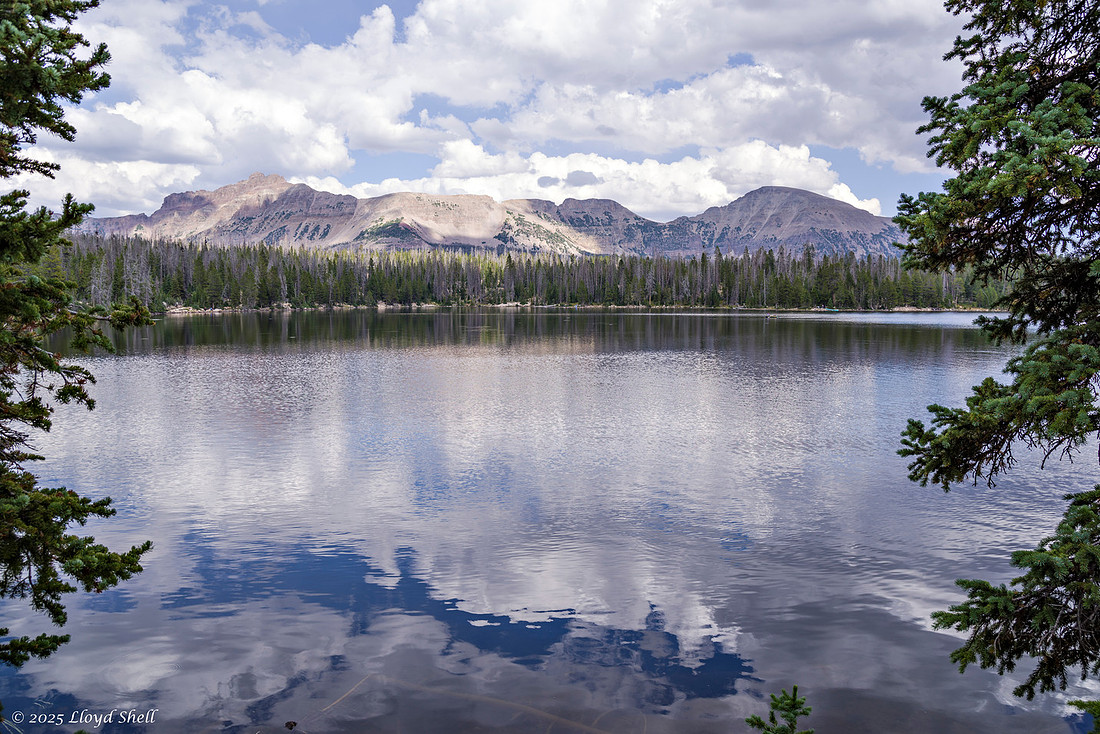
Sunset the first night was subtly beautiful, the wind calming especially in the little lagoon by my campsite that is more protected than the main part of the lake. Guess this is why the call it Mirror Lake.
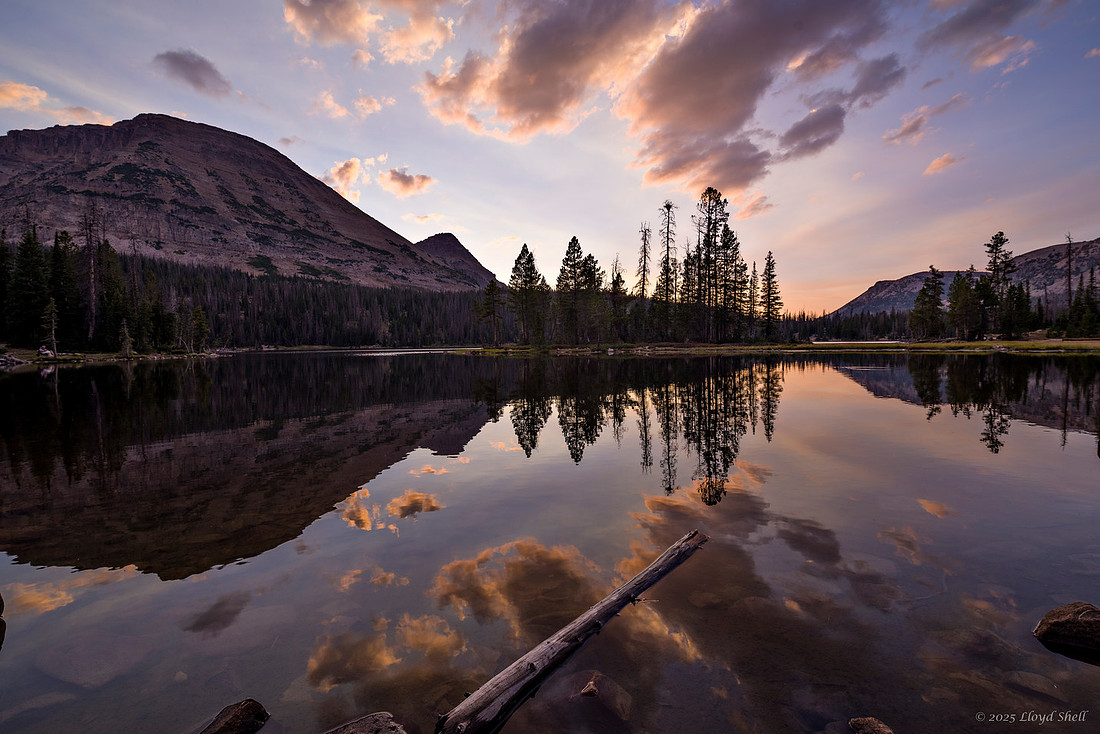
Repeating the theme of just the sky reflected in the lake worked here, surprisingly I did little post processing to this photo.
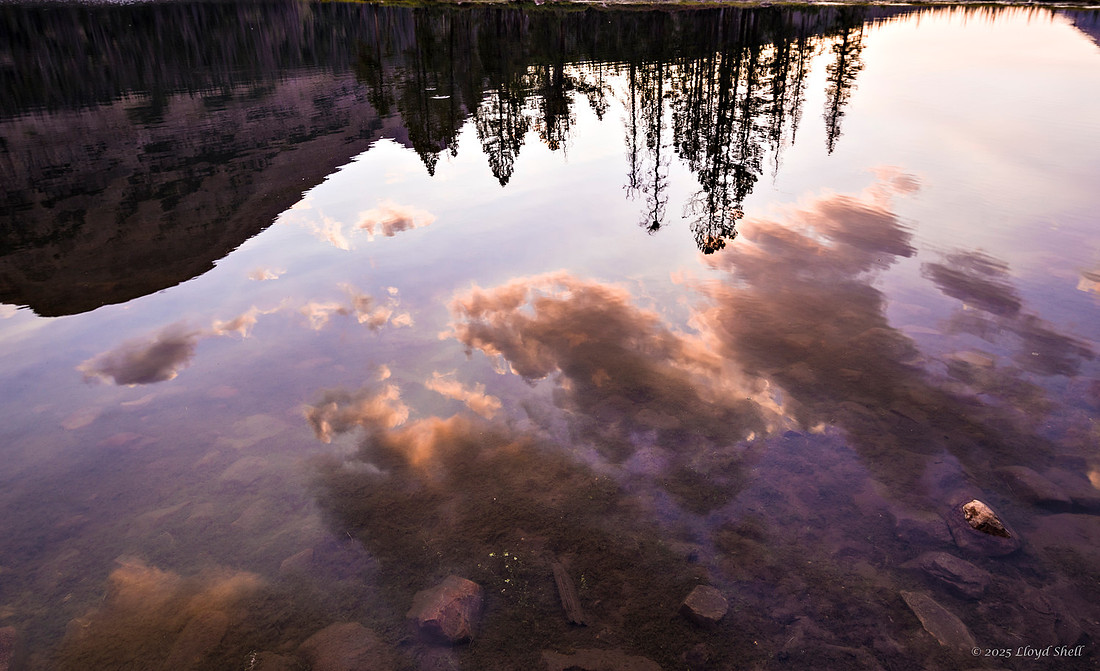
I do not remember these trees, partially as this is a part of the lake we seldom walked to, we had our fishing hole and went back and forth from the campsite but never seemed to find the time to hike around the lake. I found them photogenic and a nice accent. I do believe that the picture would be less without them.
Bald Mountain is the dominating feature to the west.
Waiting for the moon to set required getting out of a warm sleeping bag, which was not what I was hoping for to be honest. I like being comfy, It works for me, quite well thank you very much. One of the many hard parts of astrophotography and milky way photos in particular is the perspective and scale of the sky. Even with very wide angle lenses it is extremely difficult to place a foreground and still get adequate sky as well. This photos is actually a panorama take with an already ultra wide Pentax 15-30 lens at 15mm. The stitching software introduced a little distortion but I think it is a good start. I will likely extend further to the right the next time I try and get more of the eastern portion of the Milky Way included. I think it would improve the shape somewhat.
As a technical aside, there are several things you need for this type of photography I am about to show: A really solid tripod, some type of remote release to keep vibrations from affecting sharpness. You need a fast lens with aperture of f2.8 or wider and typically a wide to ultrawide lens. My Pentax K1mii and Pentax 15-30 f2.8 qualify, as well as my Rokinon 12mm f2.8 fisheye lens which I also used. There is a lot more than that, but honestly I am not qualified to really teach about it. I need to take some classes and play with it more. My settings are 1600ISO f2.8 and usually 30 seconds exposure. I probably should use 3200 ISO and let the camera do some noise reduction as it likely does it better than I can in post processing. I like what I got but there is a fair amount of noise from the sensor if you look too closely. Anywhoo, here are some of the photos I captured.
I love this perspective. Looking up through the trees and seeing that sky really makes me happy.
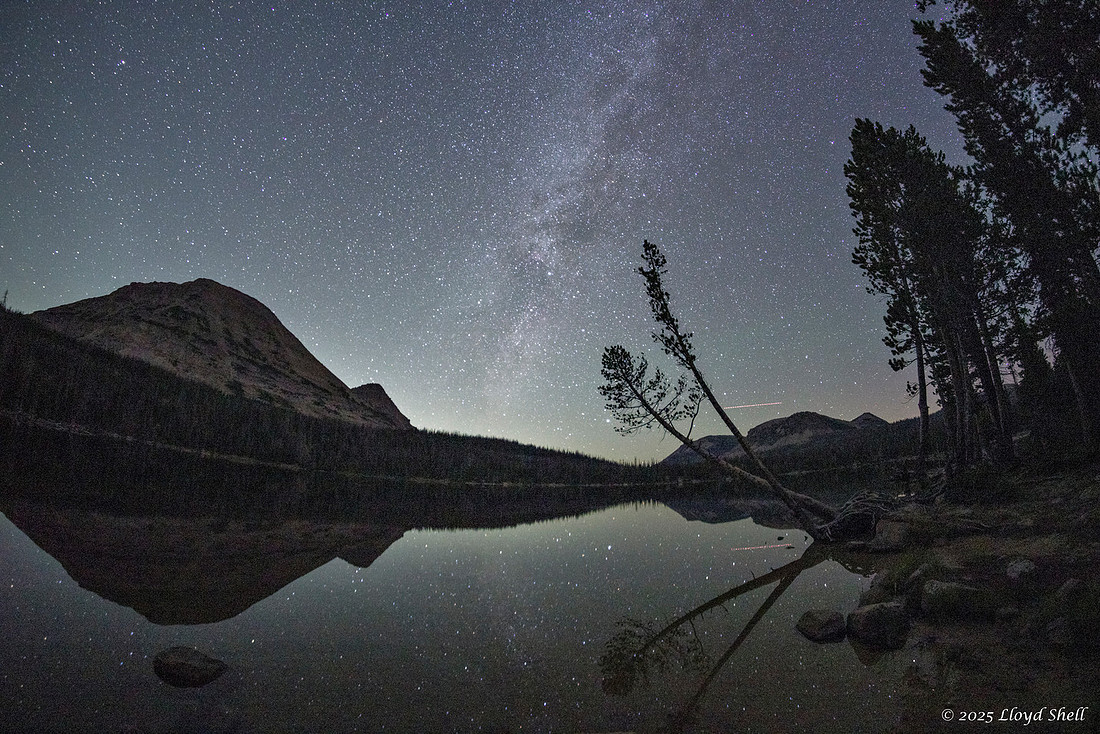
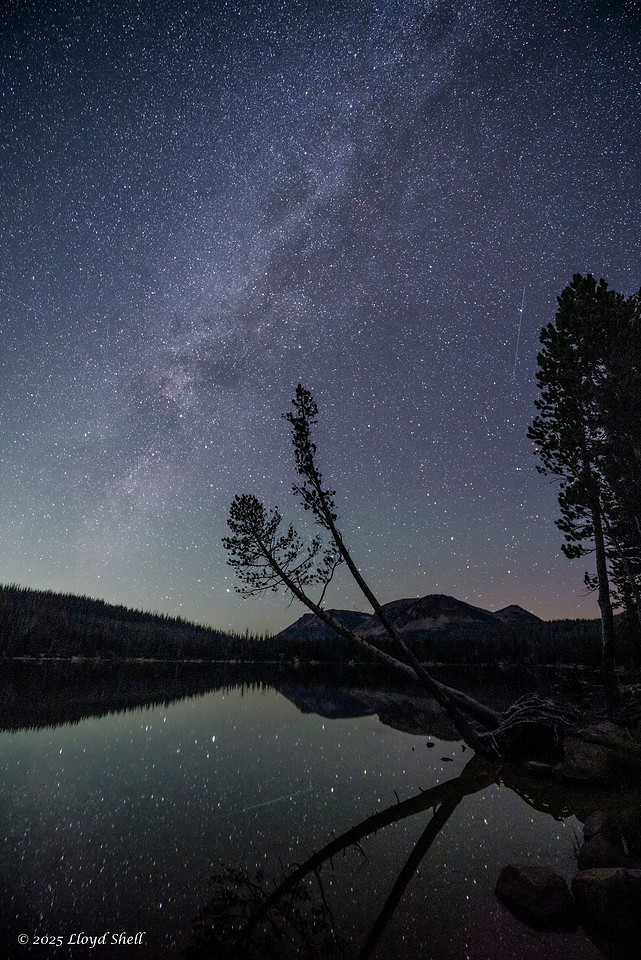
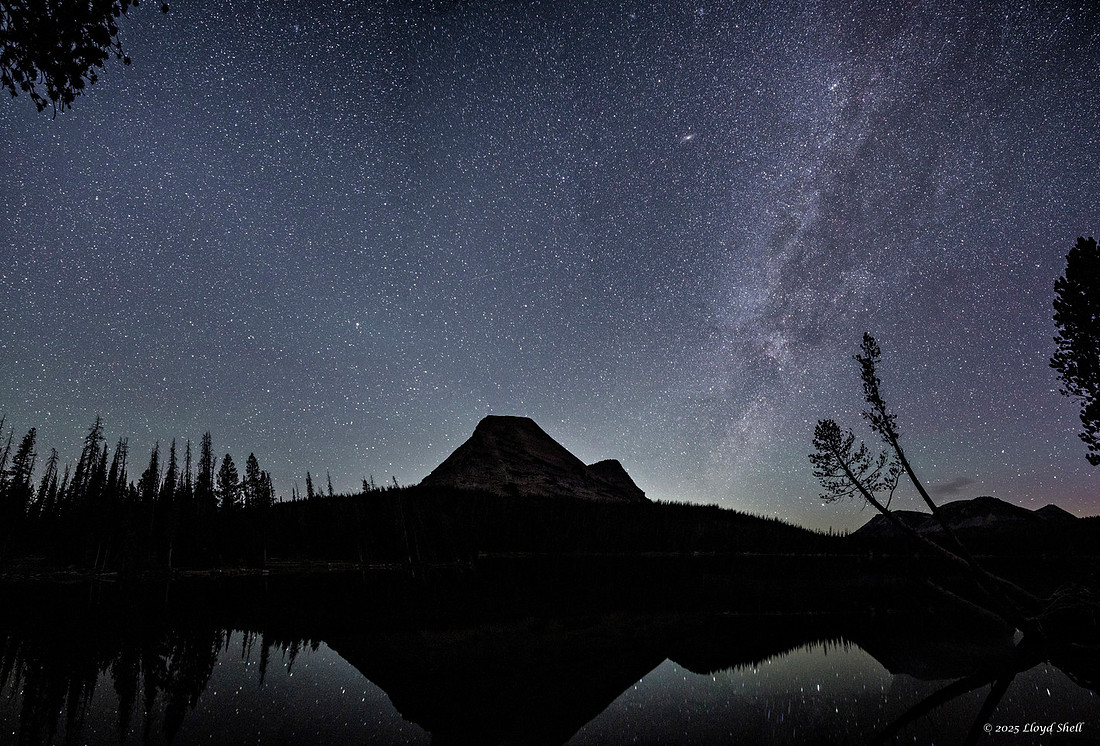
This photo was quite a long exposure, I almost let it go too long and as dawn was approaching I lost a few of the fainter stars. I also had an early morning hiker who didn't know he was being captured.
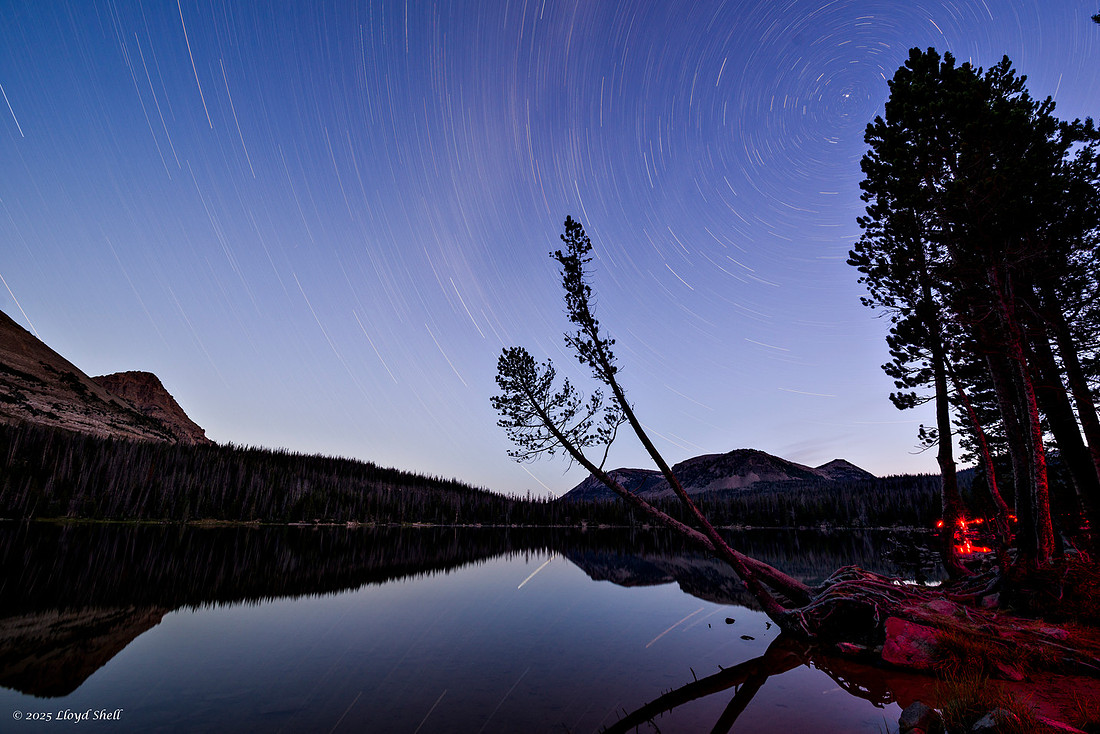
Thats it for this post. Hope you enjoyed it!
Addendum to my Last Post and What Is The Actual Focal Length of a Lens?
When I was testing my Rokinon 85mm for my last post I wanted to do a comparison of bokeh or how the lens blurs the background with other lenses I have. I decided to use some flowers in a flower bed, but they moved a little too much. I then decided to use a wrought iron fence, with my camera on a tripod to keep things the same. Using Live View I focused on a specific finial then proceeded to take pictures with the only change being closing the aperture in full stops from f1.4 to f11 and lengthening the exposure time to keep the exposure even. Then not moving the camera I switched to my DFA 28-105 and zoomed to frame the scene as closely as possible to the framing of the 85mm. The exif notes the focal length at 95mm, which I found curious, you can see the photo below and compare it. I then put the DFA 70-210 on the camera, again being careful to not move the camera. To match the framing with that lens it was at 70mm. You can see that photo below as well.
At similar apertures the lenses are very similar, the 28-105 is wide open at f5.6 at the focal length, the 70-210 is a constant f4 throughout it's zoom range, but is nearly identical to the others at f5.6. I am postulating that the physical length of the lenses and having the front element be closer to the subject is the reason for the focal lengths reading as so significantly different.
What do you think?
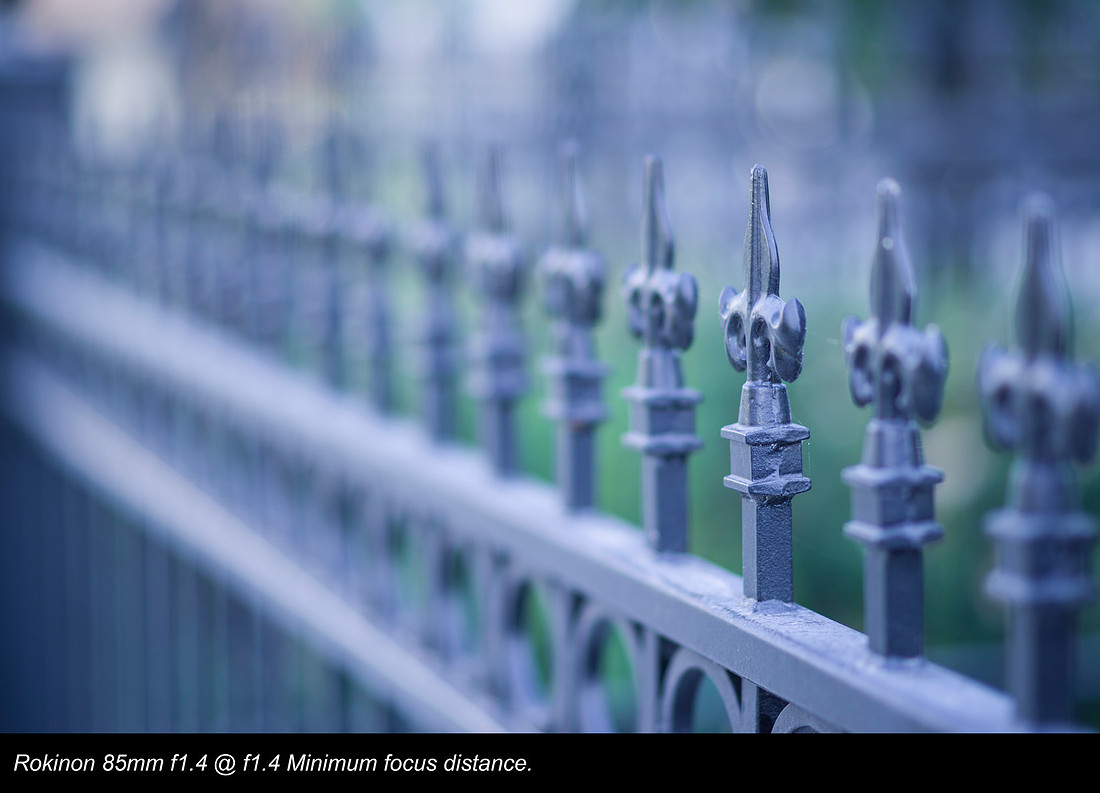
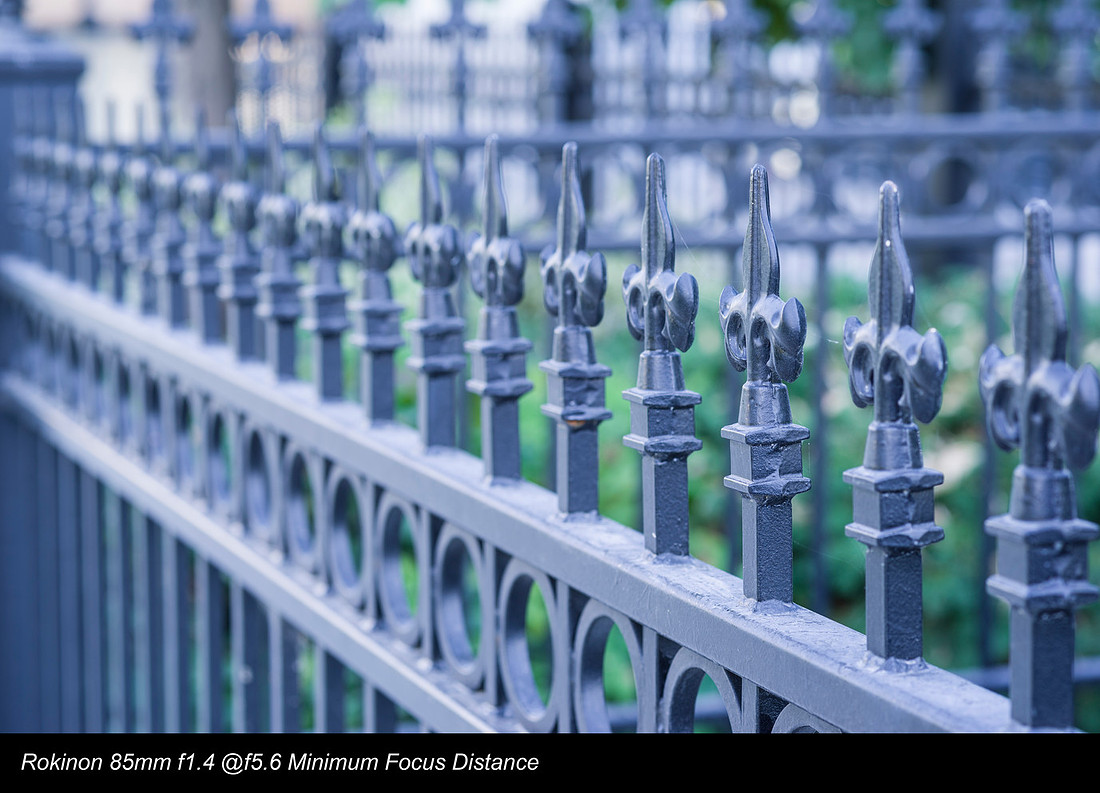
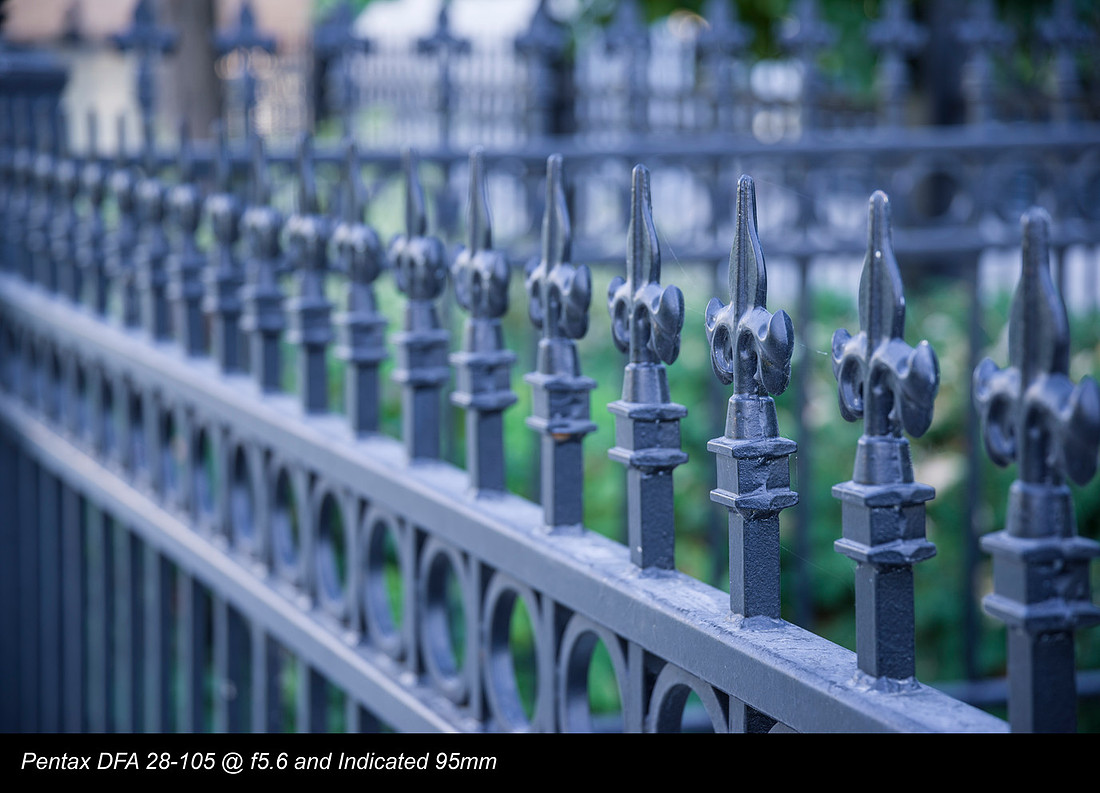
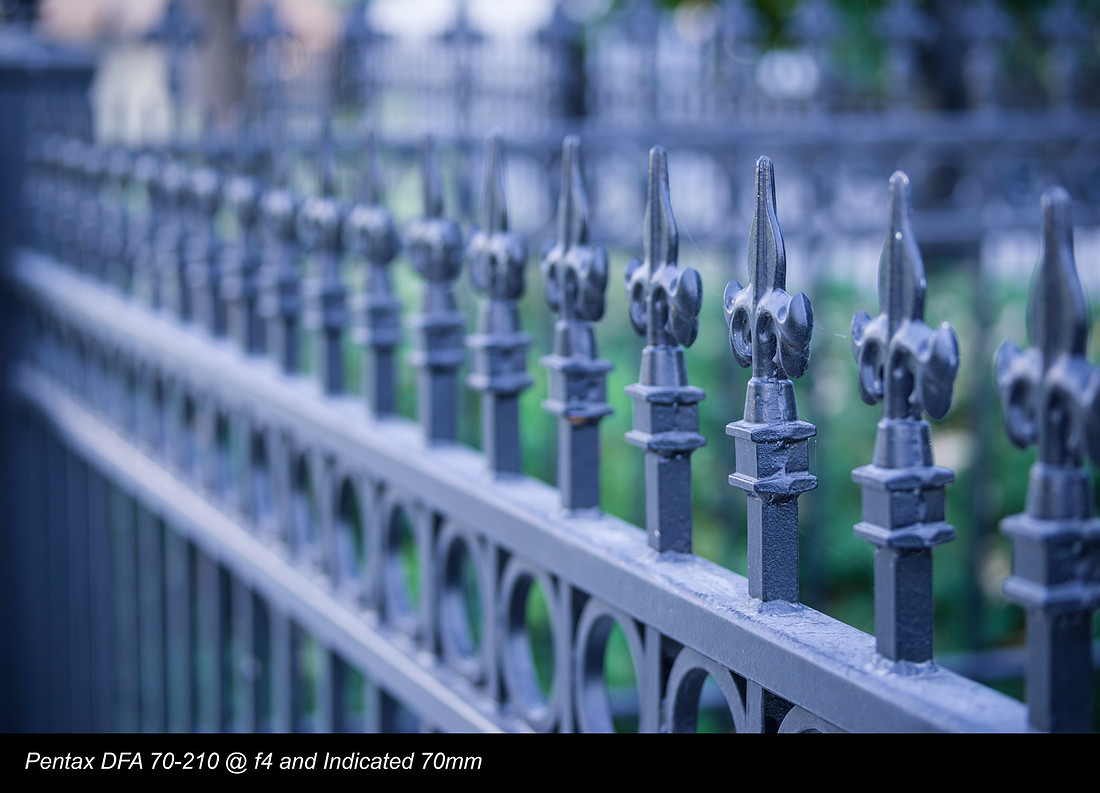
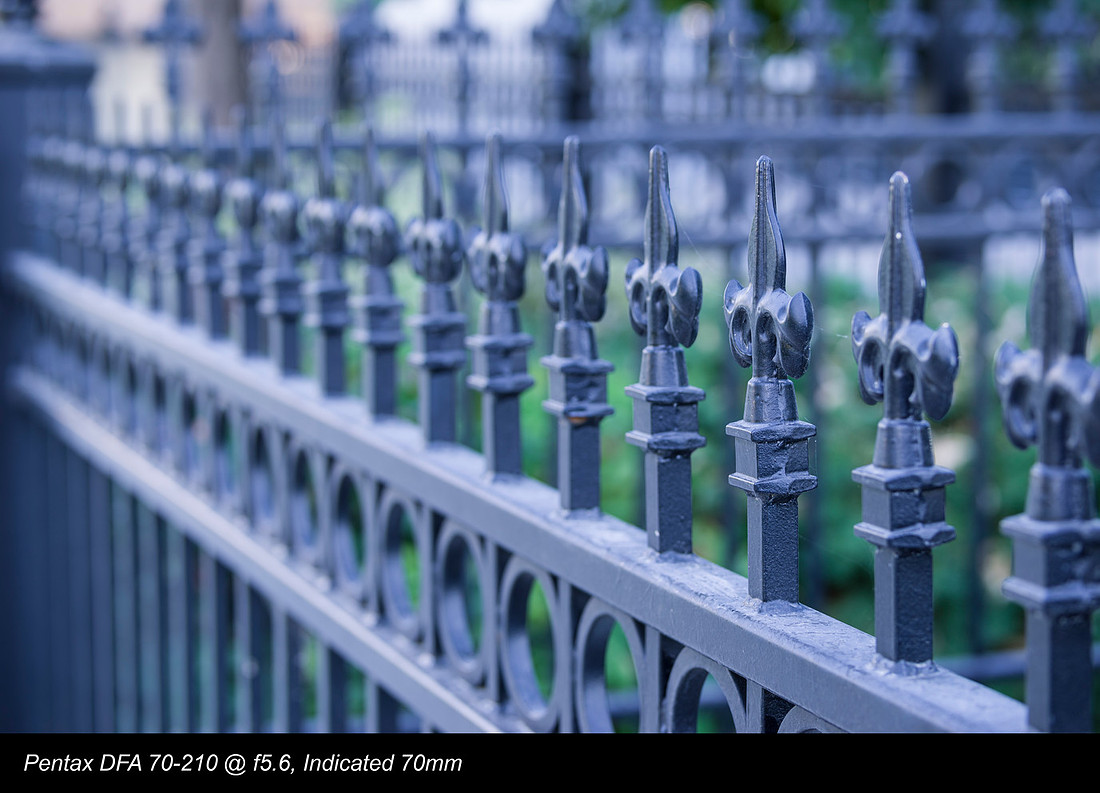
Rokinon 85mm f1.4 AS IF UMC in Pentax K Mount
I sometimes find myself believing that the purest form of photography involves identifying a scene you want to capture, planning the day/time/light/equipment etc... and going out and doing just that. But, MOST of the time I believe that is pretentious rubbish that makes me disgusted with myself. Maybe, because I have more success typically with just going out and immersing myself in the place with no agenda beyond looking for an image to make that pleases me and will capture that moment for me. It can be on the street, in the desert, the mountains anywhere really.
I frequently find myself wanting to take a single lens that is not too big and just go see the world around me. The question I am exploring in my head and in my recent post on my Vivitar 20mm, and future ones too, is this: Which lens to take? I am now shooting full frame, so all my legacy manual focus lenses work quite differently than on APS-c. If you care this will explain crop factor better than I possibly could: https://photographylife.com/what-is-crop-factor and I am having to re-calibrate my brain.
So... which lens should I take? I don't know, I loved my 24mm f2.8 on my APS-c Pentax K5, but it is much wider now and I haven't really played with it much on the K1 but I plan to. The focal length I tend to "see" is around 35mm which correlates to a 24mm on APS-c, and I have a lovely 35mm lens I will be posting on in the future the Pentax K35mm f3.5 However, I believe that I would find just one focal length to get limiting after awhile and my somewhat nebulous goal is to identify a group of lenses that I can grab for just walking around and being creative. Further I think I want to keep it "Pocketable" meaning I can put a lens in each jacket pocket and one on the camera switching as needed. I imagine having a wide angle in the range of 20-28mm, a medium wide to normal in 35-50mm and something longer... 85-135mm ish. I have several contenders to look at in this category. K135mm f2.5, likely my next victim for review, the DFA 100mm f2.8 macro which I ADORE, and something like this lens we are going to talk about in this post. The Rokinon (Samyang) 85mm f1.4. there are many 85mm lenses in the Pentax line up, but I don't own them. I had a chance to buy an 85mm f1.8 several years ago in the K series that matches my other vintage K glass, but I just didn't have the cash, I did play with it a little and it was a fun lens. https://www.lloydshell.com/p884566878 Should anyone wish to donate one I would not turn you down... just saying.
This Rokinon lens was given to me in a box of lenses from a friend, I have looked at it when lens browsing in the past, it is pretty inexpensive which makes it tempting and has a decent reputation for sharpness. There is a good review here where you can find a LOT of good lens information on lenses that fit Pentax cameras: https://www.pentaxforums.com/userreviews/samyang-85mm-f1-4-aspherical-if.html
My experience has been a little up/down with this lens. Like I said, I seem to see more in wide angle terms and find this an awkward focal length, especially in light of its closest focusing distance. The lens barrel does not move in and out like many lenses as it is internal focusing, but the closest closest focus is far enough away to annoy me as I like to get close to things, not straight up macro distances but, closer than this lens can get. So, gripe #1 doesn't focus very close, I did not try extension tubes, though I may at some point. Gripe #2 it is tough to nail focus, wide open the depth of field is quite thin and it tends to spoof my focus confirmation and I got a LOT of pictures where the focus point was in front of where I wanted it. This is a part of using an f1.4 lens with manual focus. That can be fixed using live view with focus confirmation but that is awkward in the extreme when just walking around and just didn't work well for me. Gripe #3 chromatic aberration, lots of it. It is an older design and not corrected as well as newer lenses. Pentax has a brand new 85mm f1.4 that is autofocus and is supposed to be excellent but is... unsmall.
Now the good: when you nail focus to get your subject right the bokeh, or blurred background quality, can be quite good. At least to my eye. There is not a way I am aware of to measure this as it is subjective, and blood feuds seem to have been started in discussing it in online forums, but I like what this lens can achieve. The build quality and feel of using the lens is quite good. The focus ring is nicely damped, it balances VERY well on my camera and it is a pleasure to handle. The colors are nice and it meters as good as any other lens on my camera. Last, it is quite sharp, but needs to be stopped down a little to really get as sharp as I want, so maybe a mixed good. Overall it is useful and may be included at times in my kit, but I have more lenses to test before this becomes a contender. I have included a bunch of photos below all taken with this lens, usually during my daily commute and within a fairly localized area of downtown Salt Lake City. I simply lack the time to devote a whole day right now to just playing with this lens, and honestly, it just didn't excite me enough to make the effort. That may be the concluding point really, it didn't excite me as much as I wanted, I missed focus too much with this, the other quirks are forgivable but that one was hard to get past.
You will have seen the Walker Building in my photos before, it looks imposingly down on my transfer point from train to bus in the morning. The longer reach allows me to capture this detail of its reflection in a window, but I found myself wanting something a little longer.
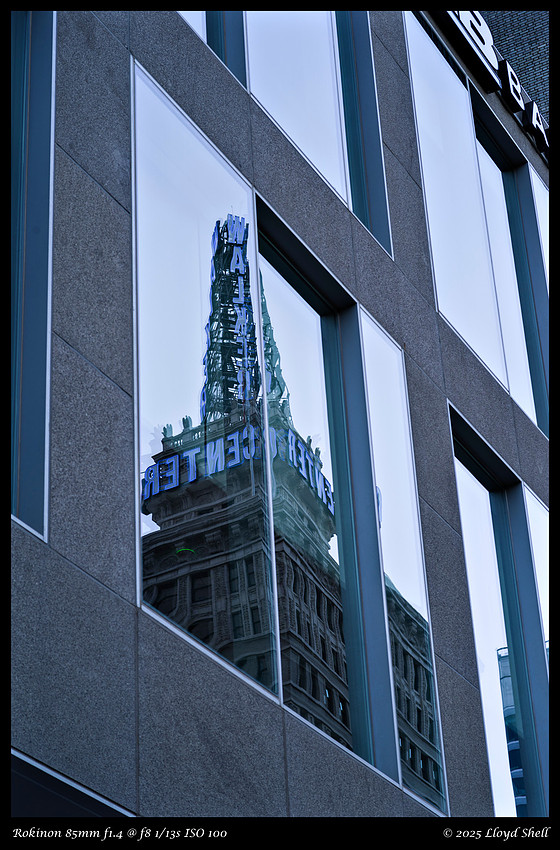
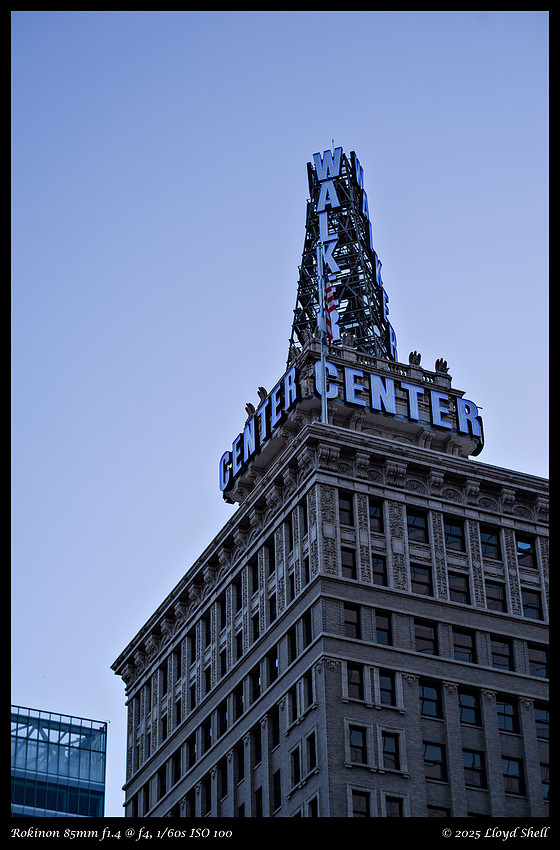
This is where the chromatic aberration reared it's ugly head, it is mostly corrected in the first photo. Not corrected in the second one.
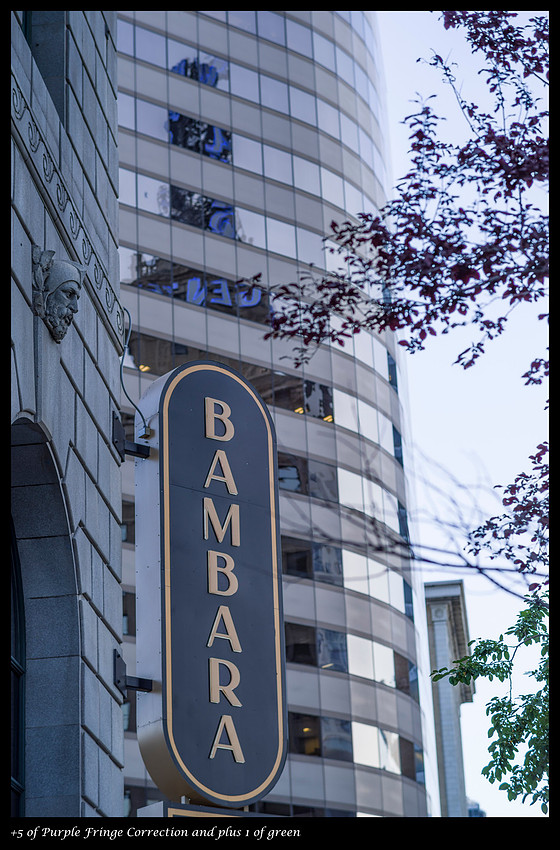
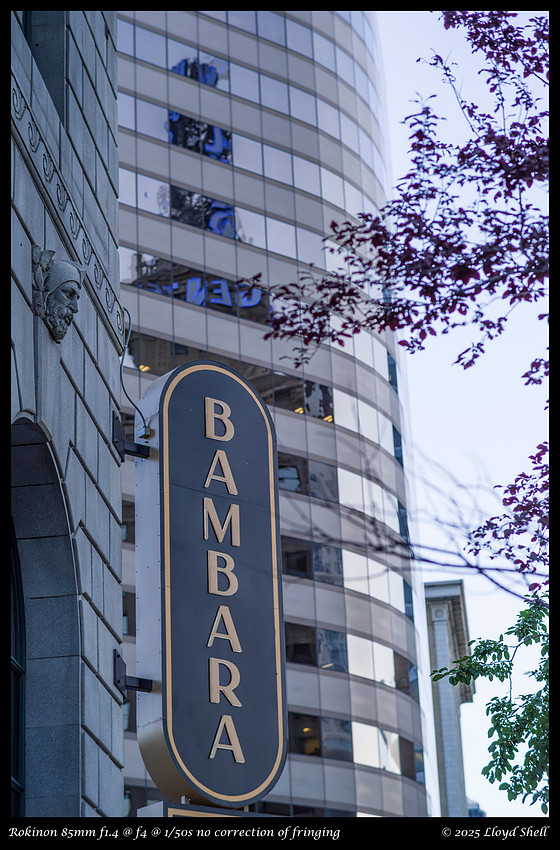
I hoped that the wider f1.4 aperture would help with taking pictures in the morning gloom, where light is limited, I took several photos before I got one with acceptable sharpness to view at this size, it would not hold up if you could see it fully zoomed in. The front focusing made this hard, you sway more when looking up and the camera moves with you changing which part of your subject is in focus.
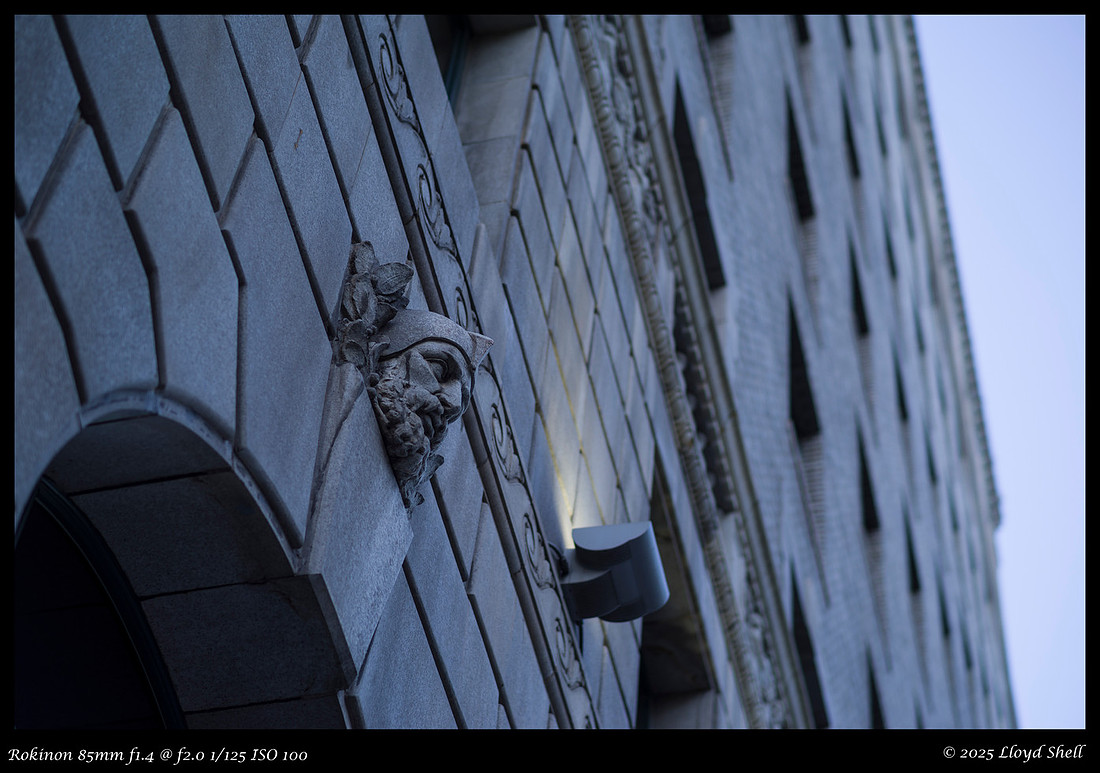
I typically don't photograph the place I work at but I made an exception here, this was taken at f4 with the focus point somewhere in the middle of the M

I have not visited the backboards outside of the ER for awhile, they have been a fun place to play in the past.
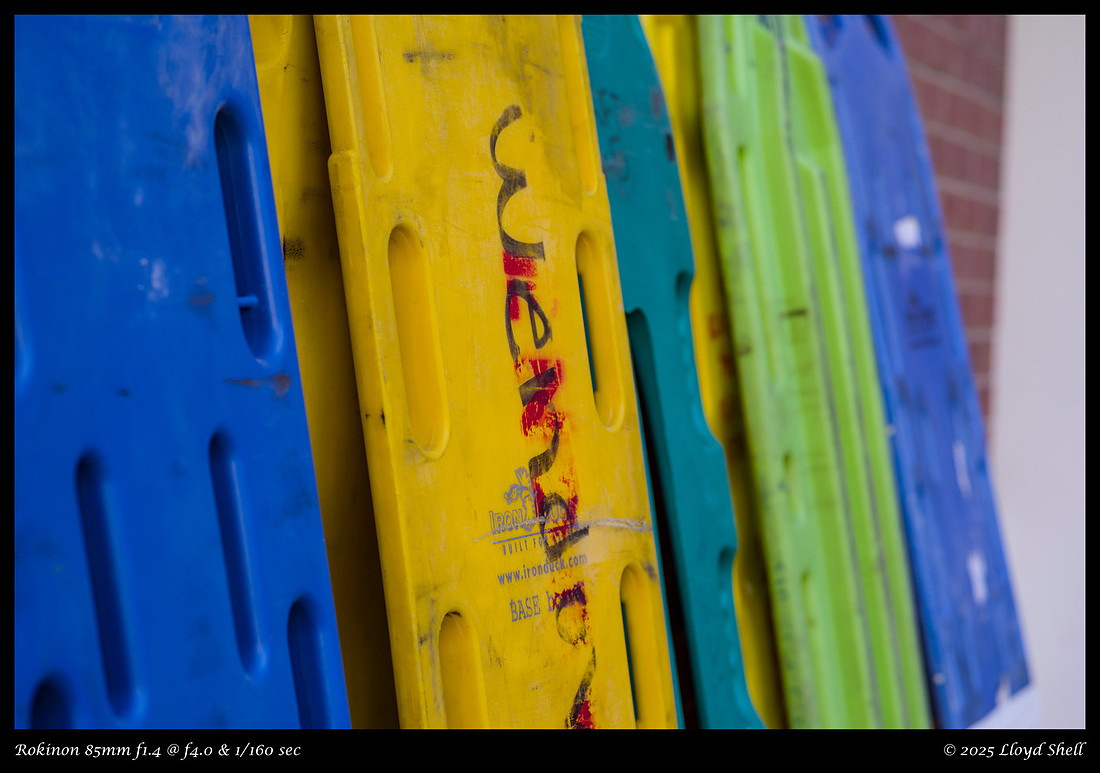
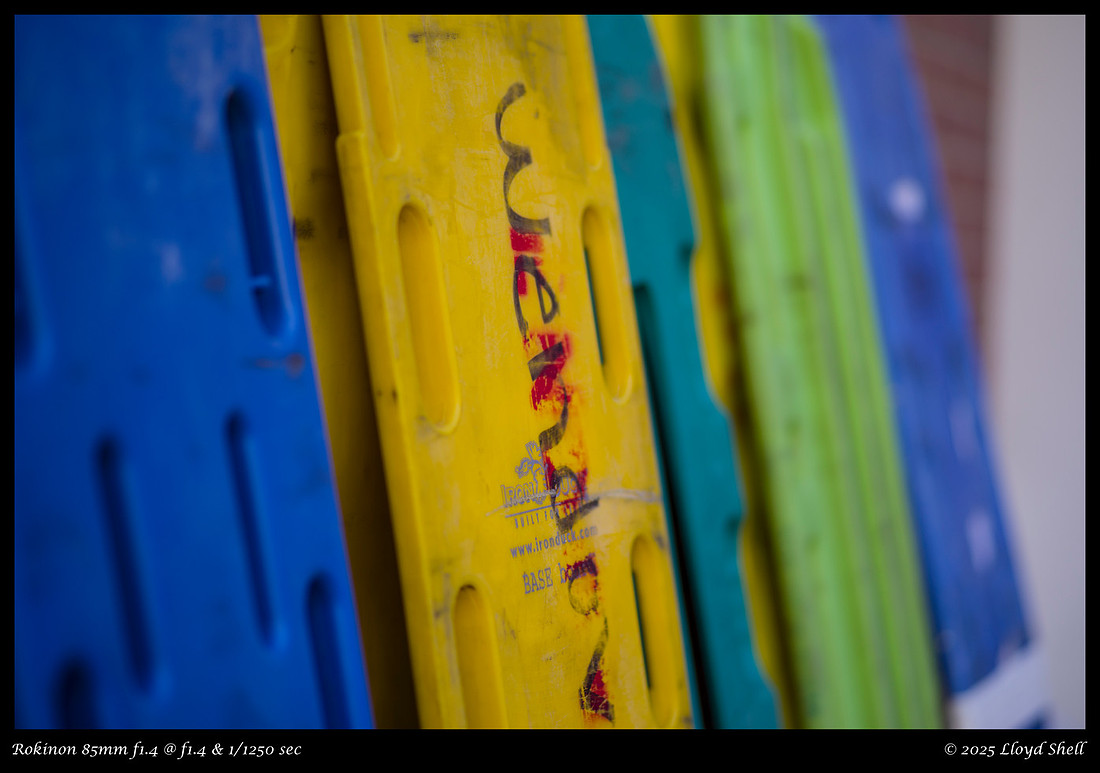
At closest focusing distance and f1.4 the depth of field is quite thin, but he subject isolation can be quite good. That is the trade off with this type of lens.
This is my favorite picture taken with this lens, I sit in this spot every day waiting for the bus when I leave work. I just like it, don't know why.
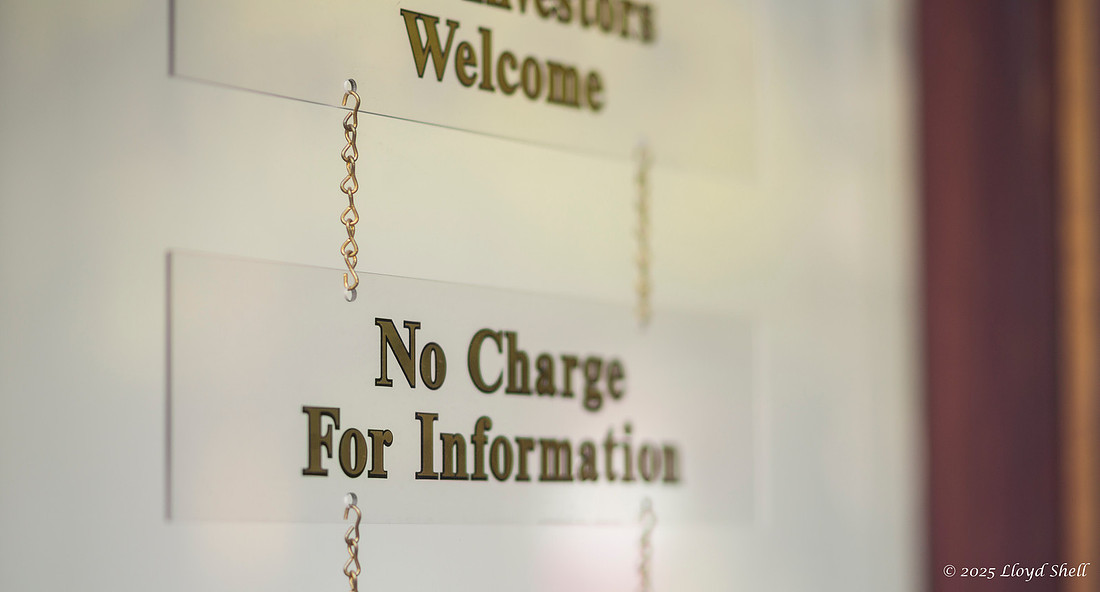
Stopping down gives excellent image quality and less subject isolation.
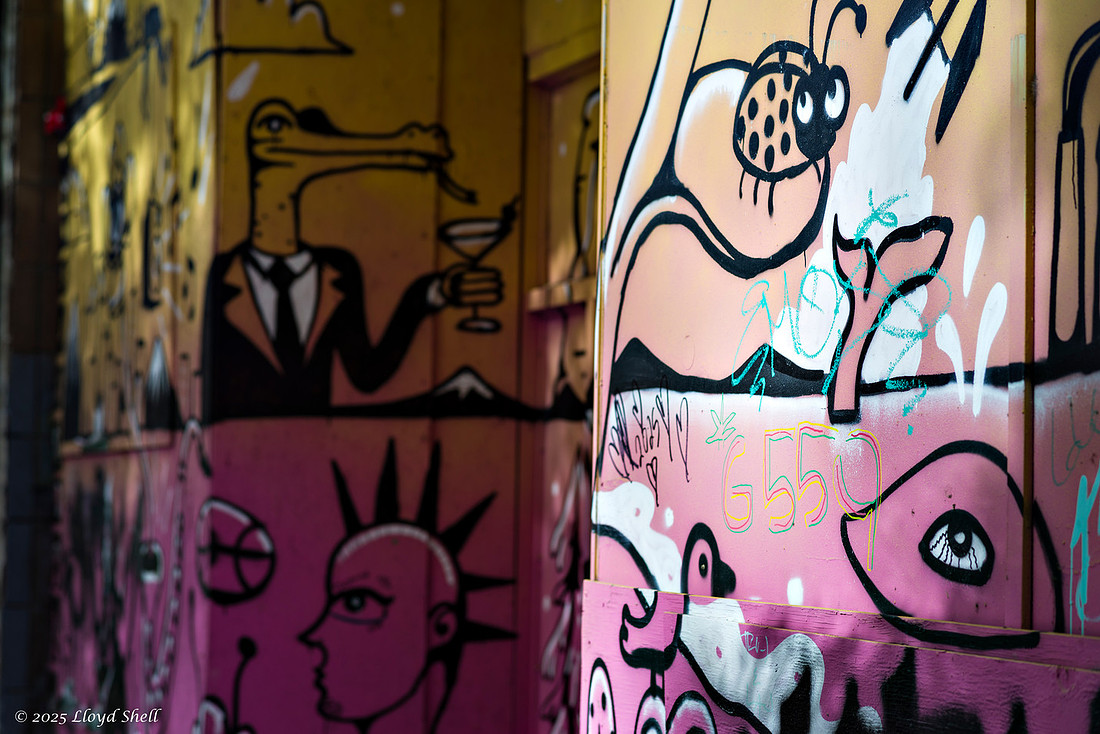
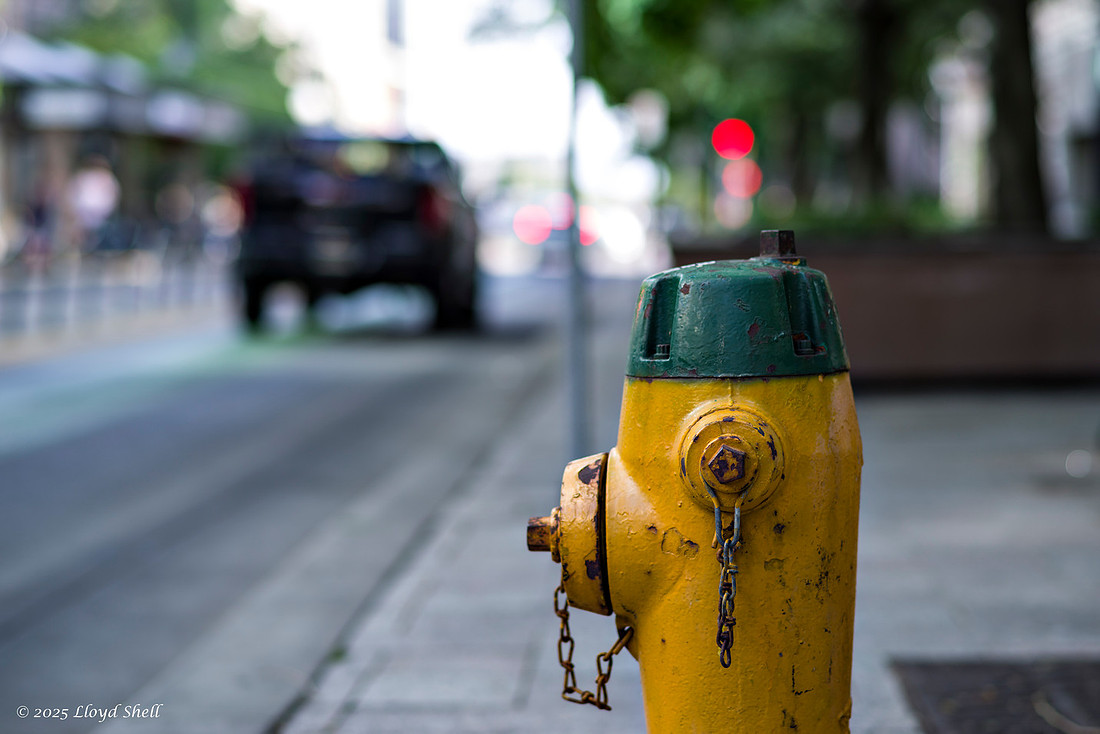
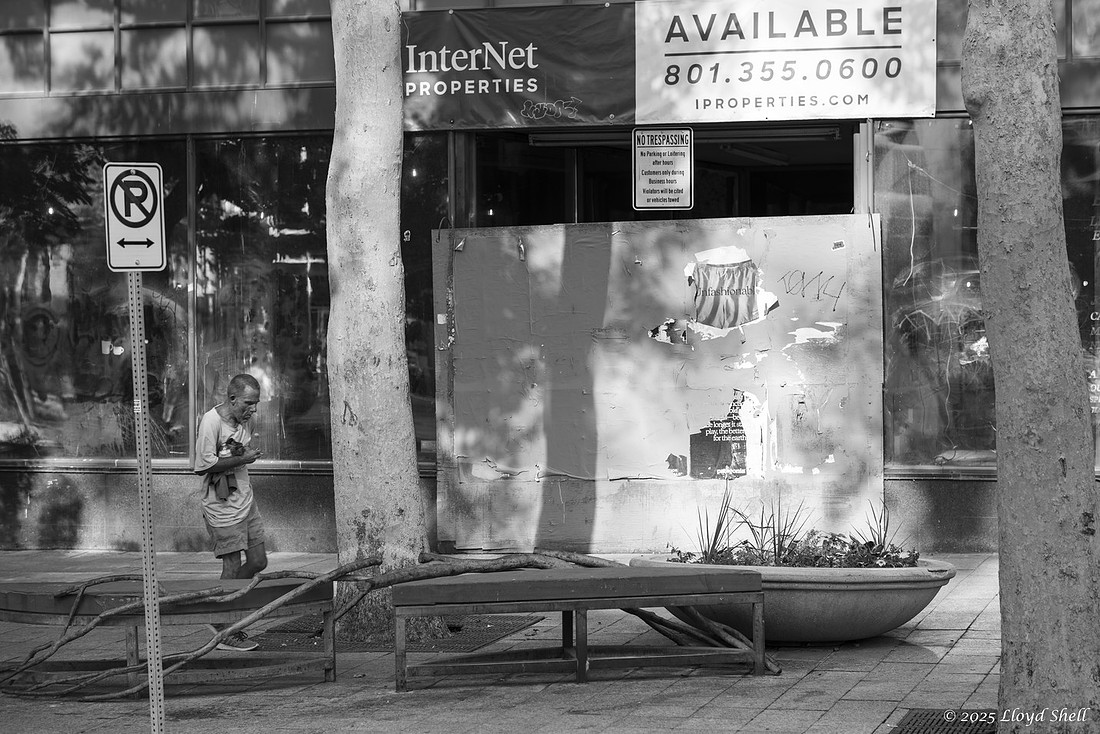
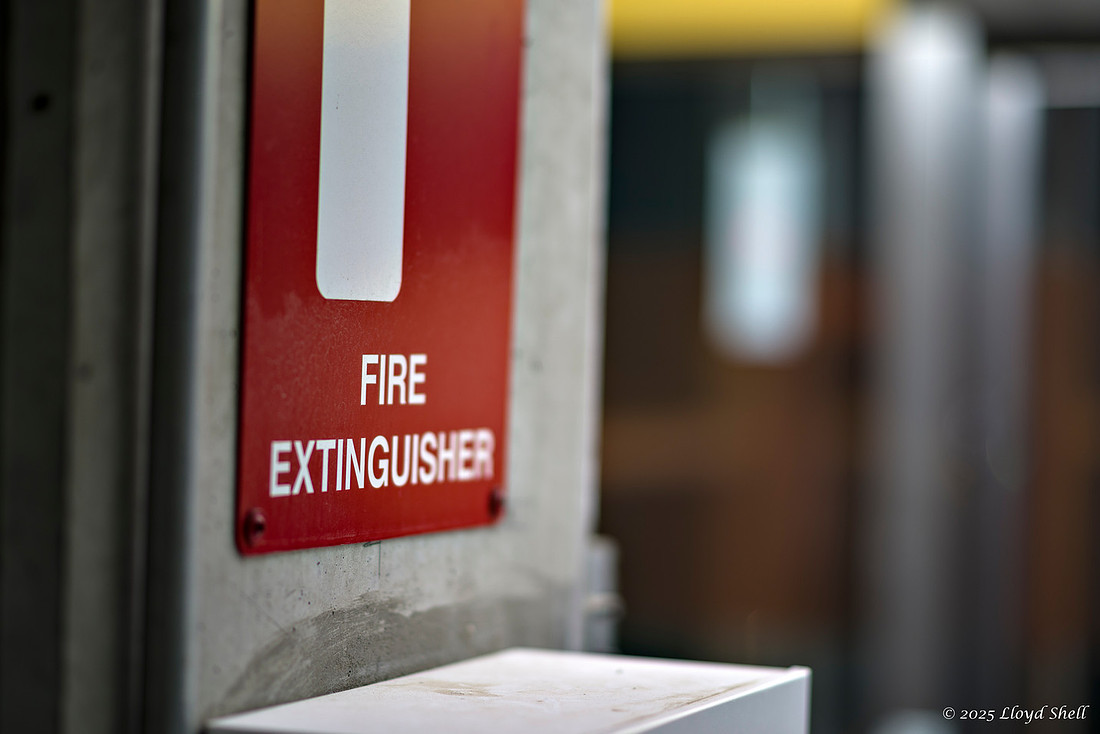
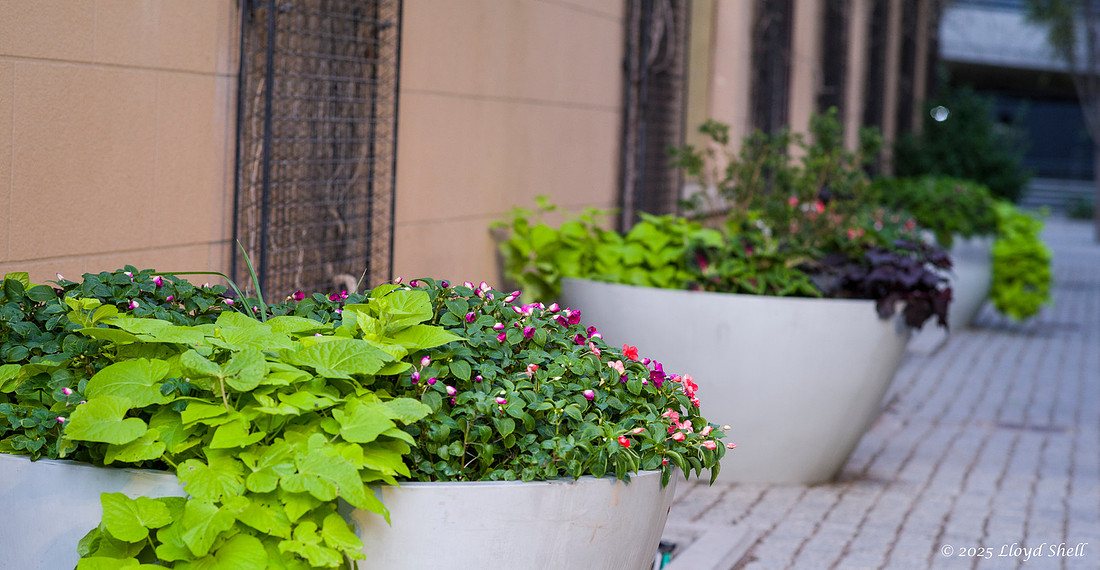
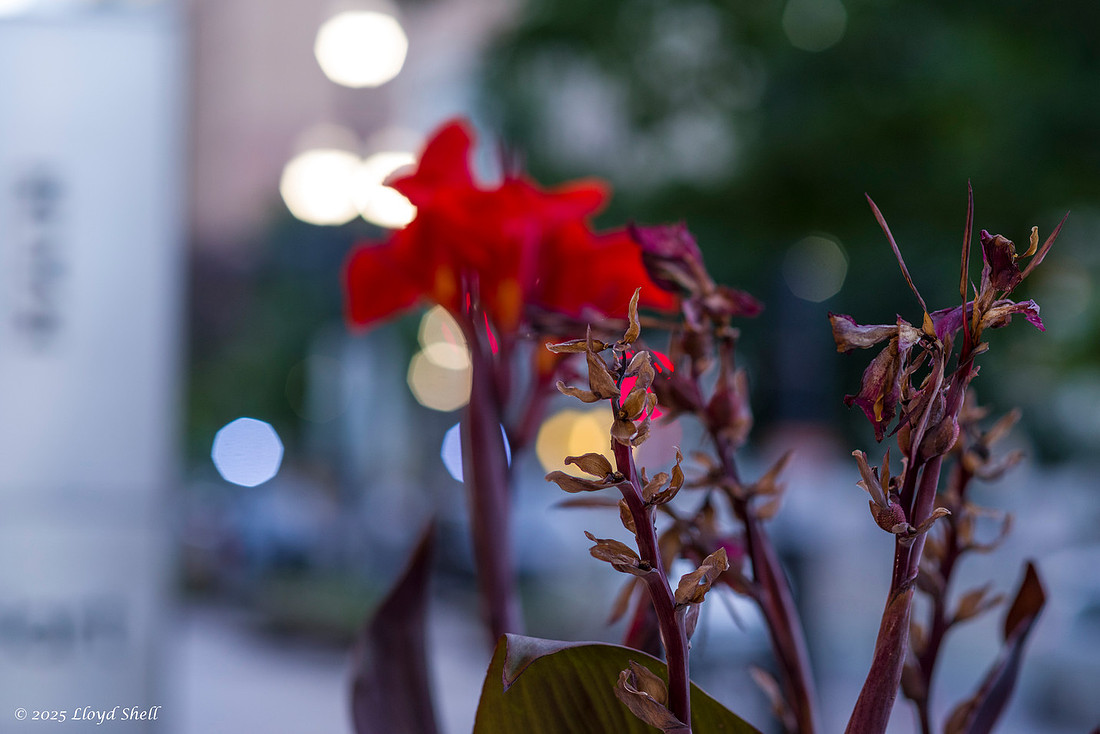
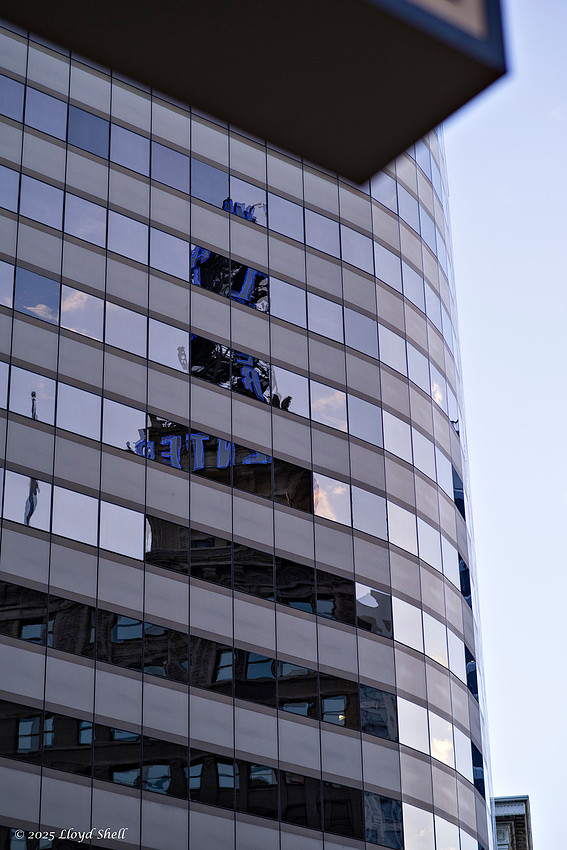
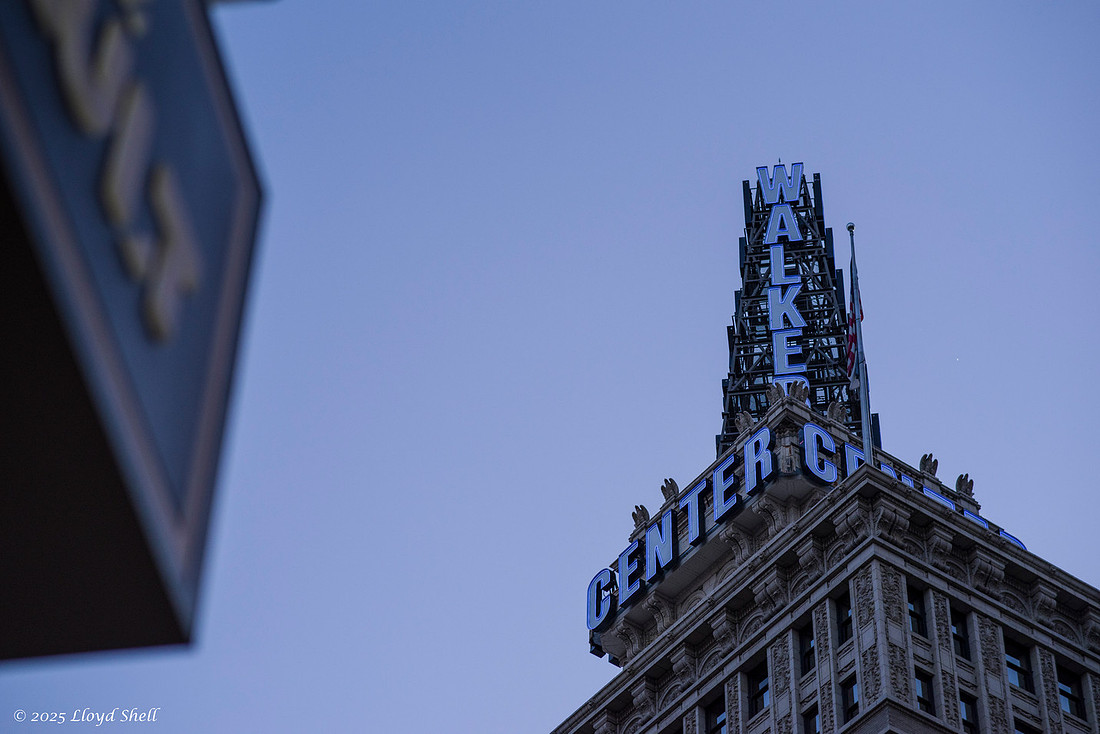
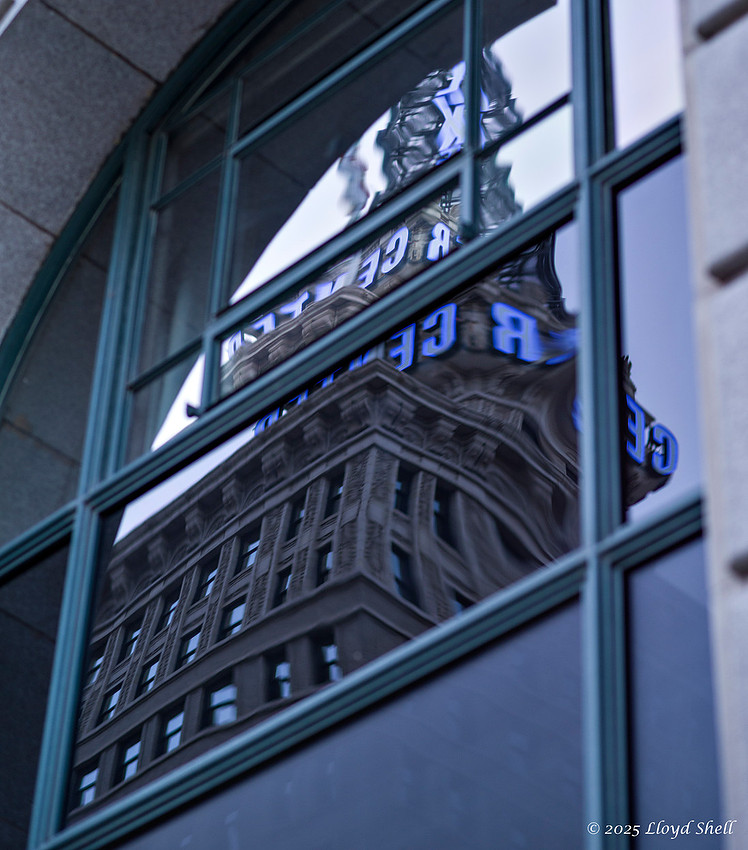



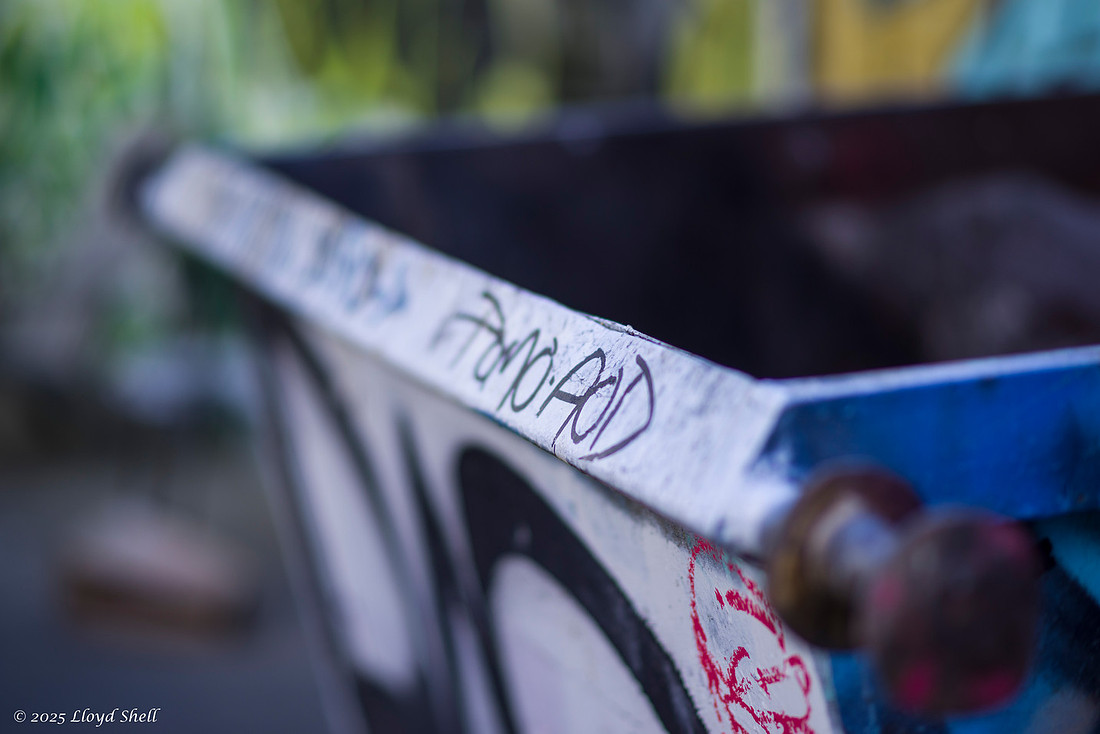
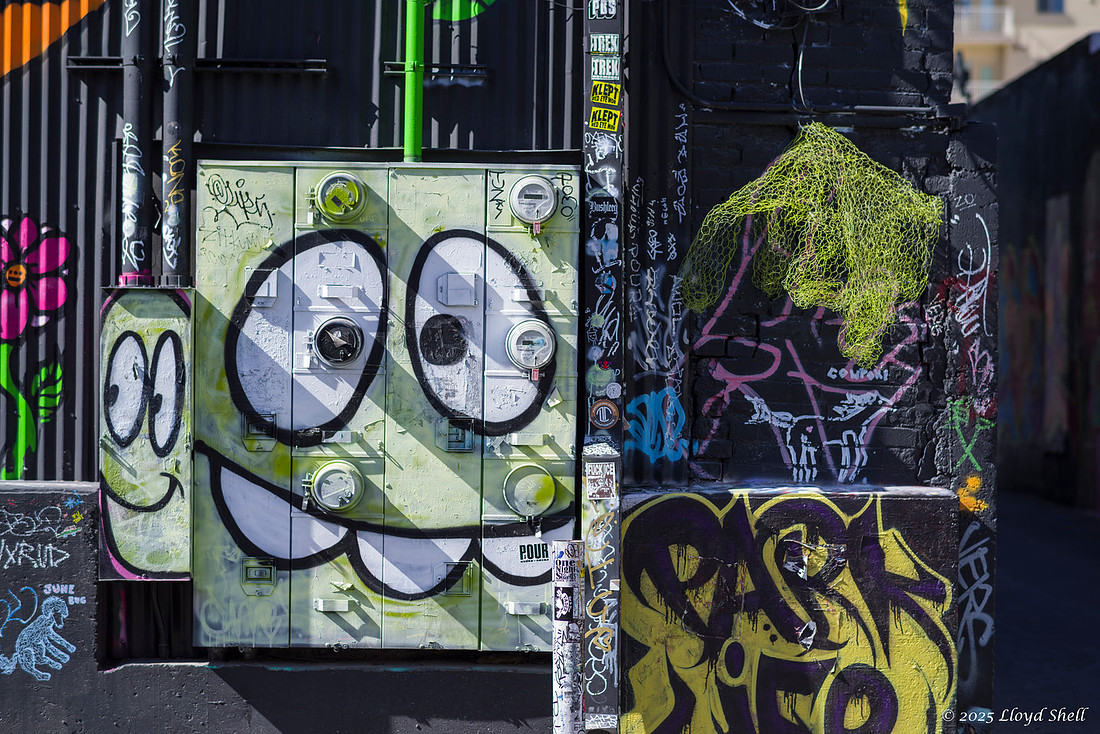
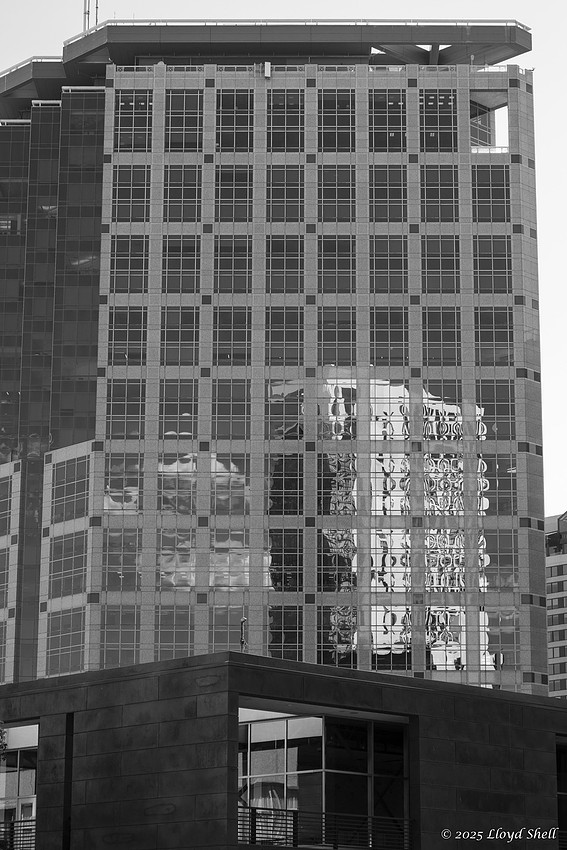

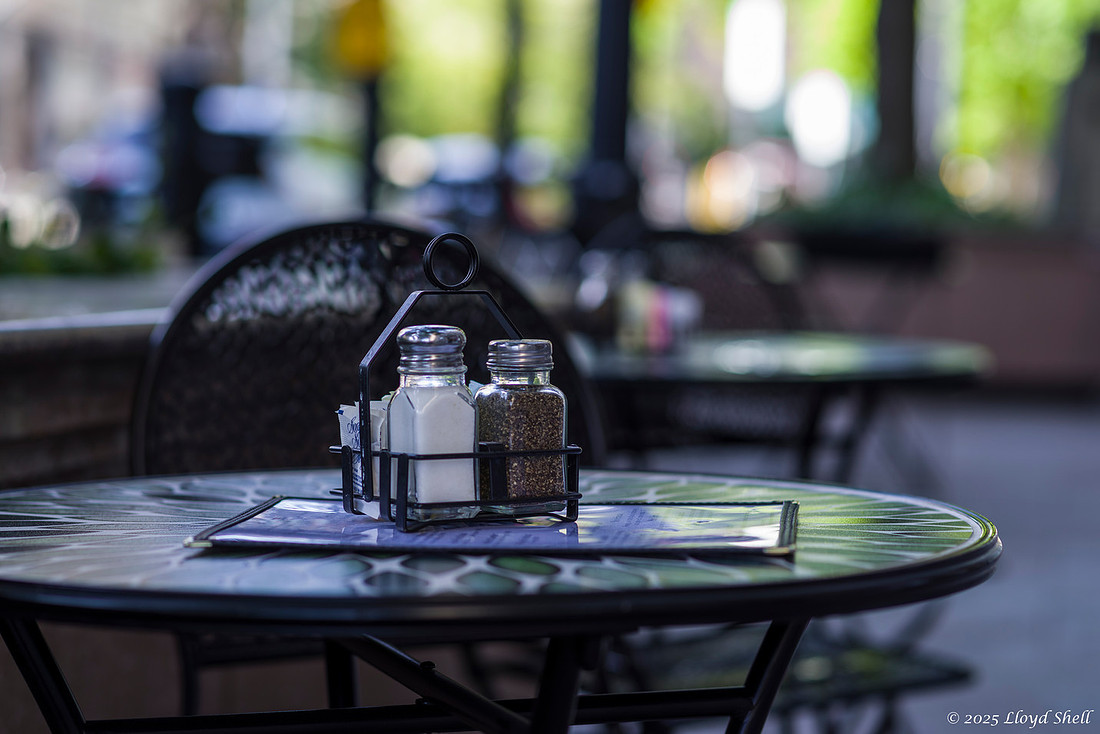
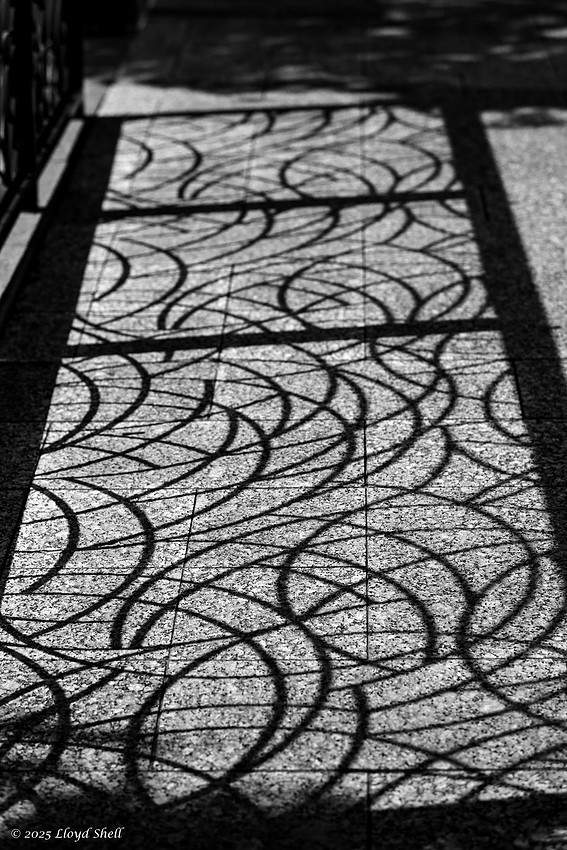
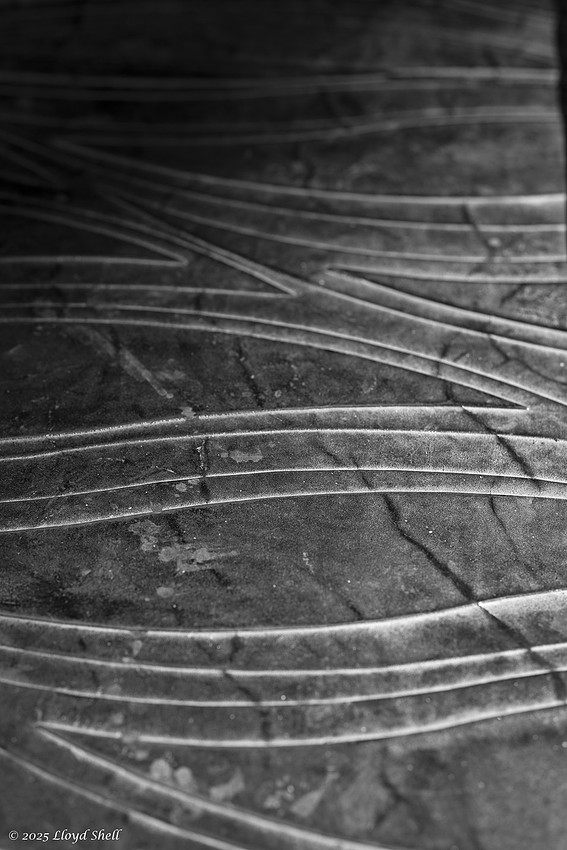
This was more of a test for my focusing skills than anything else I did, these folks were moving around a lot and it took a lot of effort to nail the focus, and I lot of lost shots due to focusing error. I tried to stay out of their way and hopefully out of their shots. They had a Canon with a standard kit zoom, and it looked like they were shooting pretty wide shots. But, again I stayed out of their way as best I could. They are in a public space and it is entirely OK for me to take their picture, but it is part of me to be unobtrusive when I can.
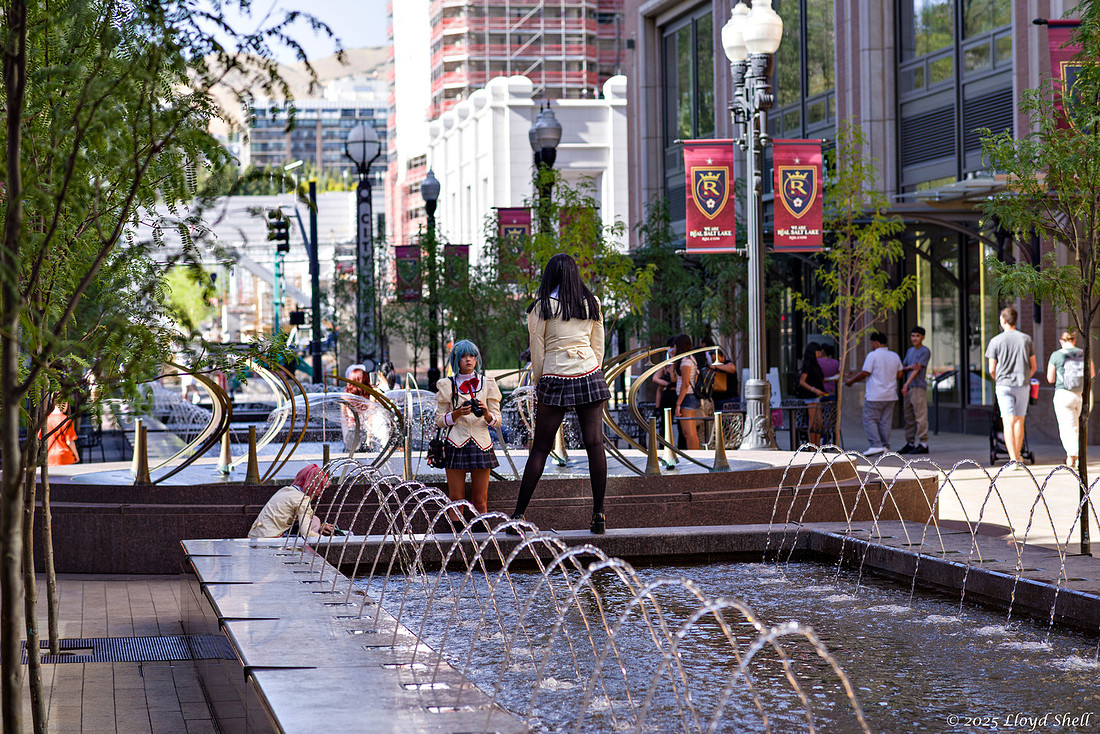
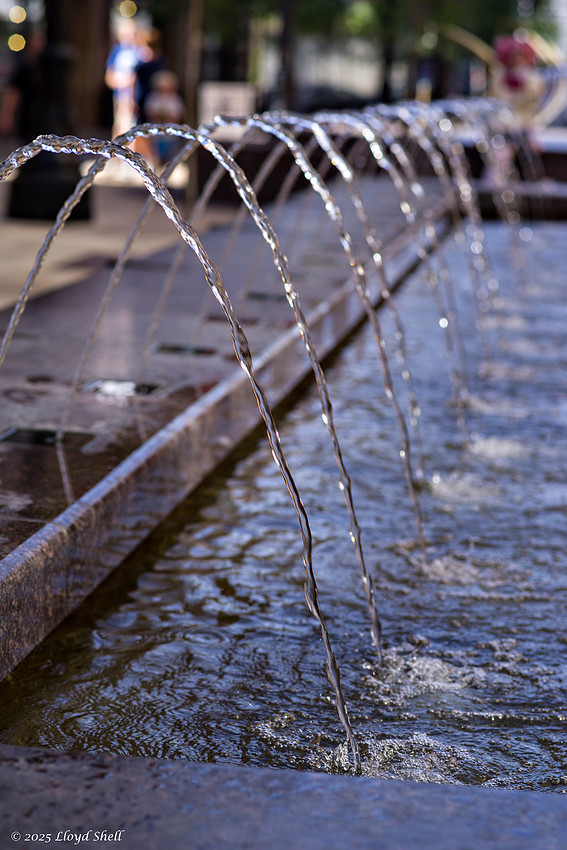
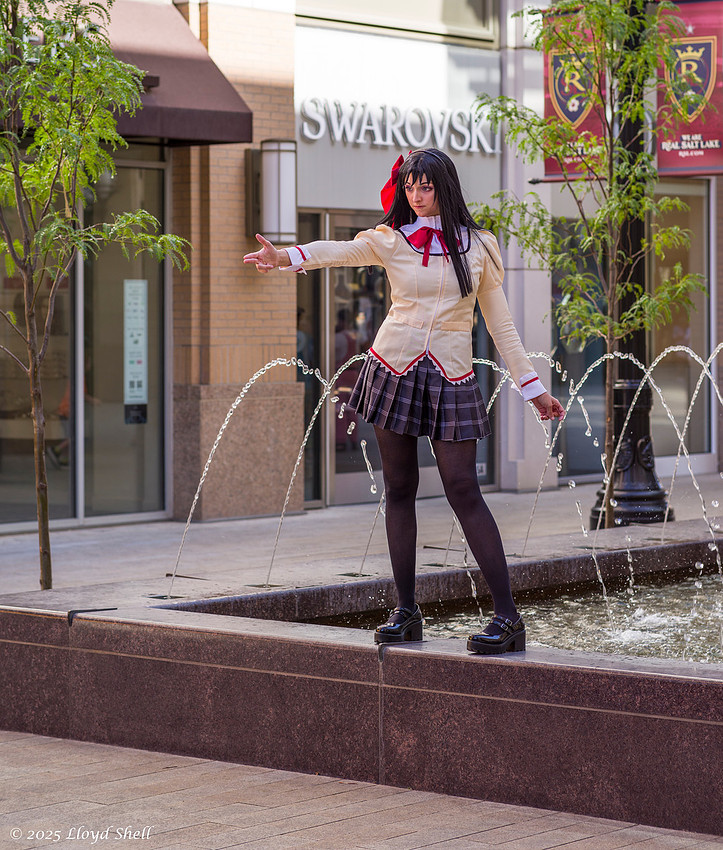
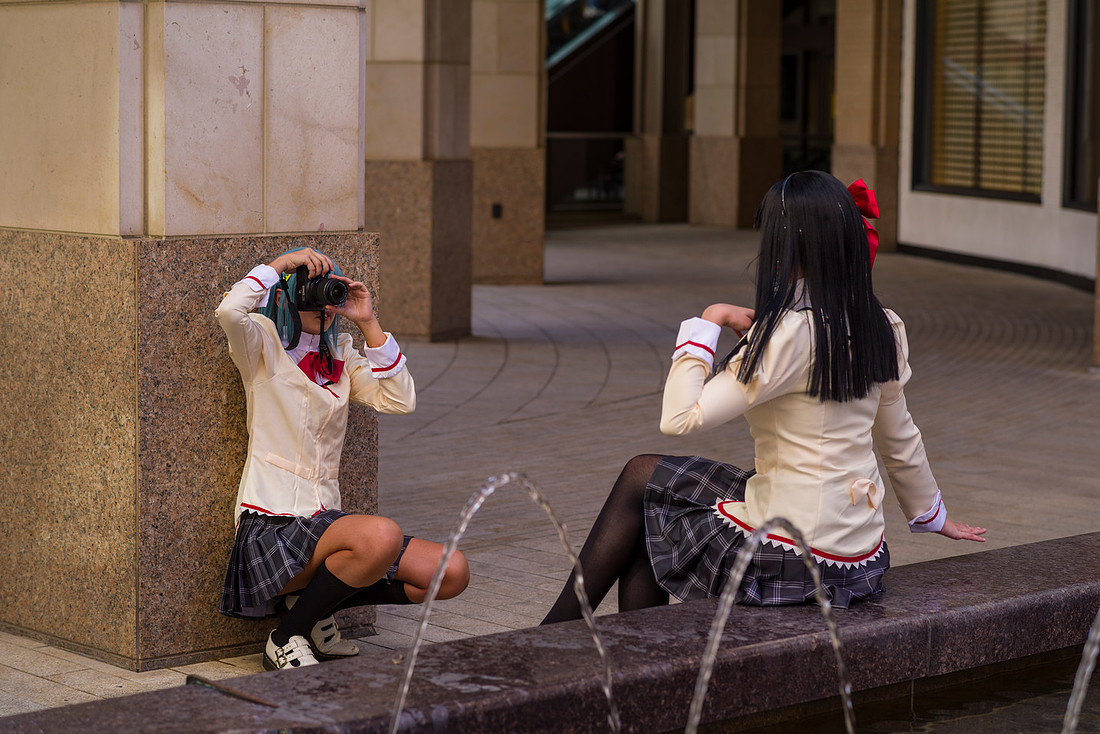
Middle distance shots trying to get really good isolation are hard, I was less pleased than I wanted to be with this, I had hoped for more blurring of the guy in the background.
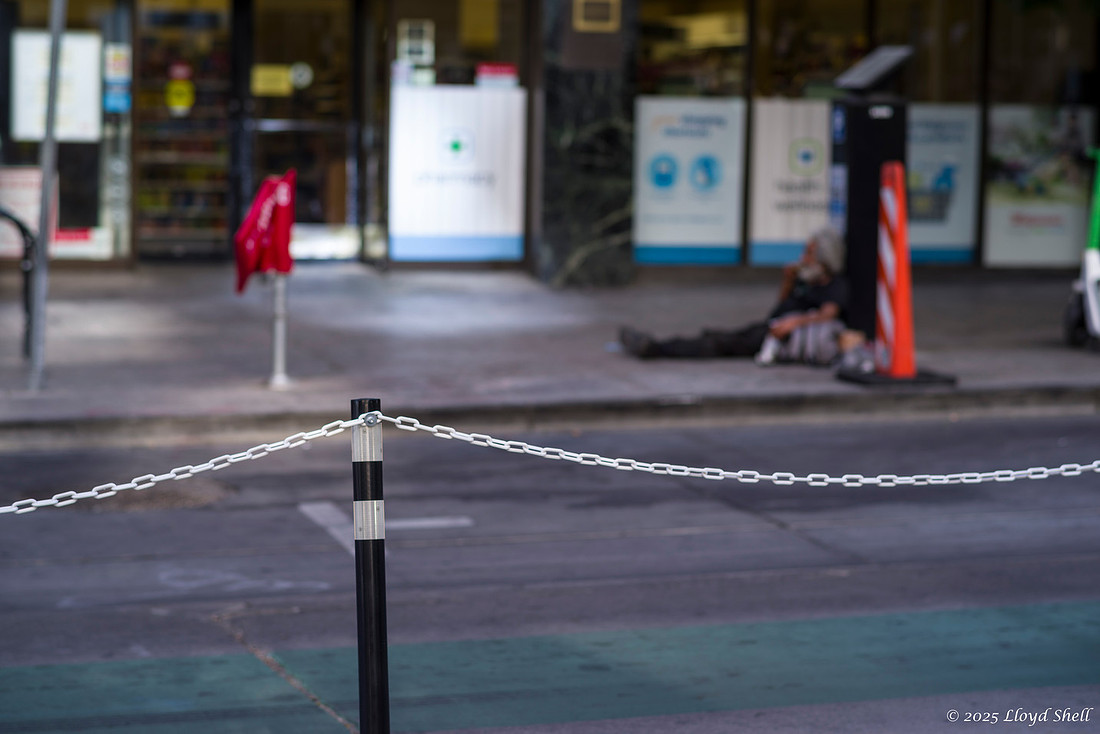
This was a f2.8 and I missed the focus ever so much to the front, but I included it as an example of background bokeh which I felt was entirely acceptable.
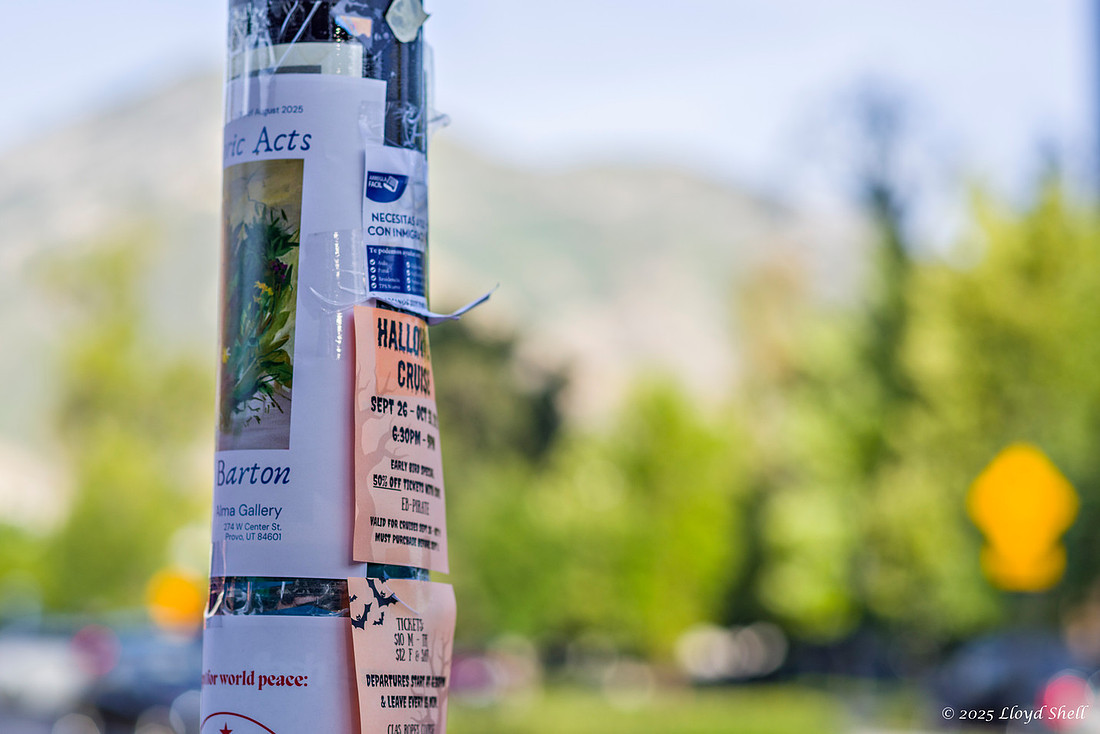
Good, you stuck around! Thanks for reading and have a great day! As always feel free to leave a comment.
When Plans Actually Work!!!
I had never been to Washington D.C. I HAD wanted to visit for years. So when an opportunity to go was presented I was more than happy to go. The original and main destination was Baltimore, Maryland for a Intensive Care Symposium at Johns Hopkins, but I quickly decided that D.C. was close and I could easily squeeze in some days there before and after the course at minimal cost to me as work was paying for the main part of the trip. Now, as a photographer I keenly wanted to get some photos that were memorable, but I also wanted to just see some things as well. I wanted to get there and decide, but I knew all along that I would settle on the Lincoln Memorial as a focus. I have a minor fascination with the man and what he accomplished and the monument itself I found very cool indeed.
Longtime readers, those select few of you, know that I like to take photos at night, on a tripod, with long exposures, that just have that... "look" that appeals to me. I don't often get to plan my nighttime photo sessions, and I simply explore and go with the flow which has it's pluses, "the flow" or "the zone" is a rush. You are so connected to the place and what you are photographing it is exhilarating and immersive and NOT conscious and just an amazing place to be. In this instance, not being able to re-visit the spot if I messed up I wanted to do a little recon before the night I planned to visit, hopefully without messing with my process on the night I was there.
I found the daytime to be interesting and worthy of a few photos. The building was larger inside than I had imagined and I was truly grateful to have ultrawide focal lengths available.
This photo @ 15mm, which is a really wide focal length gives you an inkling of the size. I realized the perspective this wide and this close was interesting but induced a LOT of perspective distortion.
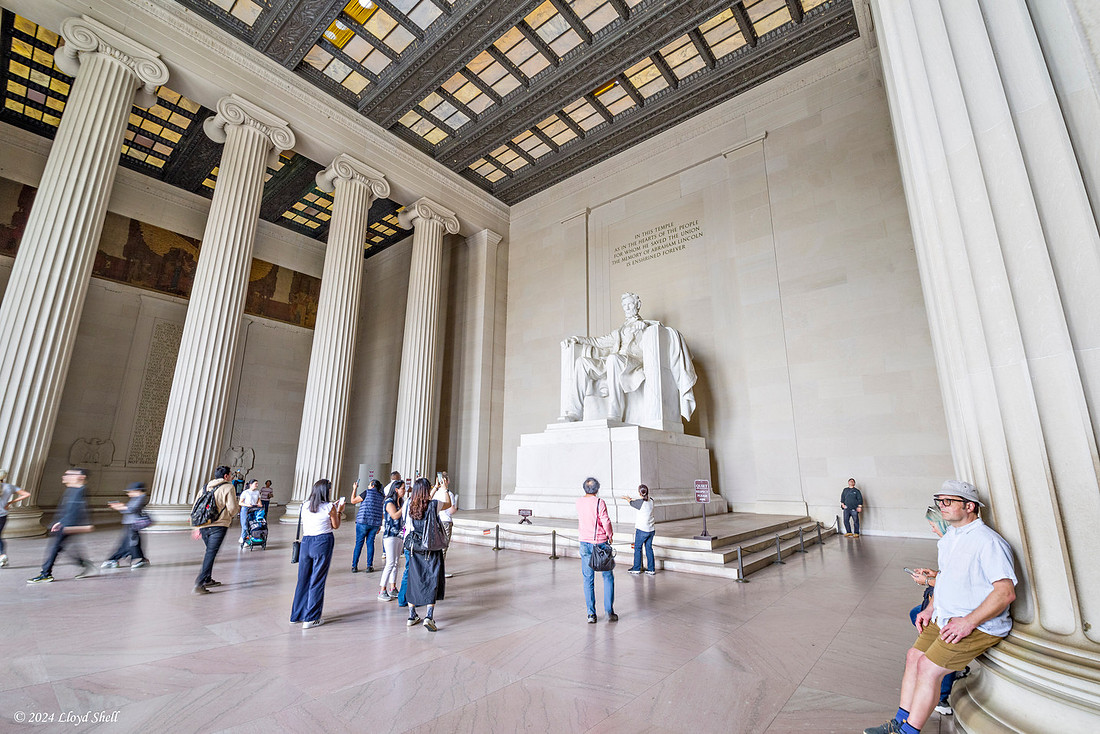
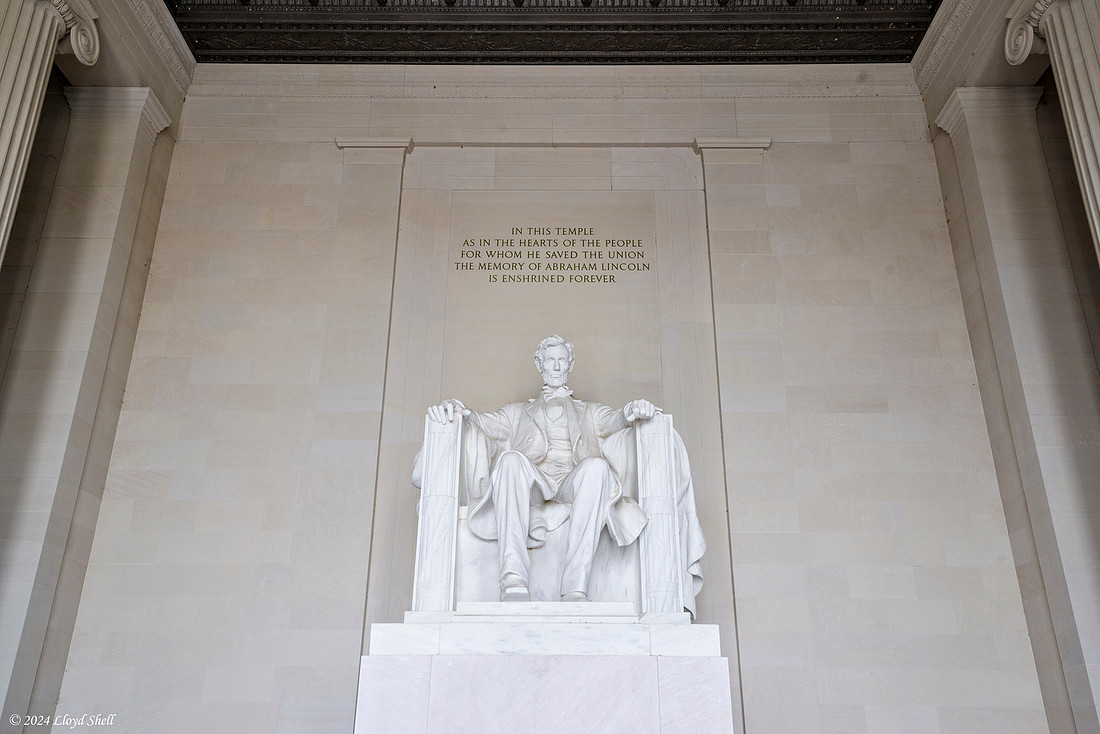
Moving off to the side I could get a little further away with less distortion and frame Lincoln as I wanted. Zooming to 30mm gave me more what I was looking for. I still had to do some work in post processing to fix the perspective, but I really did find this a pleasing perspective.
Switching to an even longer focal length and stepping back a little more gives me a tighter frame, but maybe losing the broader context of the environment. I think it is important to explore the whole environment, looking at multiple angles even the ones that I don't initially appeal. As I am often limited by time constraints it was nice to be limited only by my own endurance and not much else.
During the day I don't typically carry a tripod with me even one as light as my Three Legged Thing. For several reasons, one, that many indoor locations don't allow them and second that I'm in my 50's and the accumulated dings, dents and wear as a legacy of my well spent youth and middle age mean that things get achy faster the more I carry. I could have used a slightly longer shutter speed to blur the guard a little more, but, I shoot with what I got and a slower shutter speed would have been hard to keep this sharp.
Though, admittedly, 1/13 of a second isn't that long I guess, I have hand held longer exposures in the past. Maybe, I'm just bloviating, but I remember in the moment, thinking the guard was going to come back out in just a second or two and I needed to get to the spot I wanted quickly. And just making the decision. There is an element to shooting unplanned opportunistic photos that is both appealing and frustratingly chaotic. I tend to look back and be overly critical of the shot. That is OK though I think, as it gives me impetus to try harder and keep improving. It is also OK to accept and like what I got as well.
I had missed somehow that this is the view that Lincoln sees. I definitely decided that I needed to include this. Including people was my choice, I usually tend to not include people, I am not sure why but I tend to not want to do that. I think it added a little context to the shot.
4 days later on a rainy Sunday night I was back for my last night in D.C. I had NOT planned on rain. It ended up being very atmospheric and though a little miserable, it added to the photos. As a side note, I walked past the Vietnam Memorial during the heaviest part of the rain, it is a dark area and I had not scouted it, and was getting cold. It was a special moment I will long remember, those soldiers were often stuck in the rain, cold, wet and miserable. I sensed almost an echo of that in my mind, I thought of my Biological Father who was serving there at the time I was born and given up for adoption. Must have been more than a bit miserable.
Contrary to my usual MO that I mentioned, I planned to include people in my photos, but to blur them with my long exposures. The movement being part of the... story I guess. I stopped my 28-105mm lens down to f11 at 28mm giving me a 10 second shutter speed. Now I mentioned needing a tripod, besides the camera itself, having a reasonably stable tripod is your most important piece of equipment. My travel tripod from Three Legged Thing can be very steady but it will still have some vibrations that a much heavier non travel tripod won't. Limiting these vibrations is key to a sharp photograph. Where do the vibrations originate? Many places, the mechanical movement of the shutter/mirror combination in a digital SLR is a big one, a mirrorless camera has fewer issues with this certainly. However, touching the camera to trigger the taking of the image can also cause as much or more of an issue and you still have to do that unless you have your second most important item a remote trigger. This can have a wire that connects to the camera or be wireless, either works well. Another option on many cameras is to have a timer which allows vibrations to stop before triggering the exposure. It works better in a DSLR if the timer involves what is called "Mirror Lock-UP" or MLU, as the mirror has to flip out of the way so the sensor can be exposed when the shutter is triggered. Flipping the mirror up and allowing for the vibrations to stop before exposure helps sharpness significantly. I will grant that mirrorless makes this easier as they have no mirror and no actual shutter mechanism to move, but at the cost of using a screen in the viewfinder to look make your composition, versus an actual optical viewfinder. You have probably already guessed I prefer the optical route, I like seeing in realtime, it is just me being a gen x old school curmudgeon or something. But it works for me, and I am NOT bagging on mirrorless, it is just not for me.
Moving on.
The only real differences here between these two photos is the 30 second exposure time on the second and slightly different level of perspective correction if you look closely. There were a few people who moved through the frame but the longer exposure blurred them out. You may be wondering why this one is not a lot brighter than the first one with more than double the exposure time = twice as much light entering the sensor during the exposure. Well, this is where the magic of digital camera sensors and the digital darkroom in the computer comes into play. I can adjust almost any part of the exposure I want to, though overexposure or "Blown out highlights" cannot be recovered. But as long as you have not lost those areas, shadows can be brought up easily and with the sensor in my Pentax K1mii there is a LOT of flexibility. The top photo looked a LOT darker in the RAW file when brought into Photoshop but cleaned up nicely. The bottom photo had the highlight or lightest areas close to blown out if not a little bit so. Making the lightening of the shadows easier with less noise. Noise being the tradeoff for lightening the shadows.
Quick technical blather: the sensors in digital cameras can be likened to a bunch of barrels collecting rainwater, the more rain that gets in, the more full it is. Once it is full, adding water only results in water overflowing the sides and being lost. Each pixel on the sensor has 4 barrels with one being red, one blue and two green. Each barrel has a filter that lets only that color in, the longer that light hits the sensor the brighter the value of that color. After the exposure the circuitry calculates a RGB value combined of how much light of each color entered and assigns a value to the pixel representing brightness and color for that pixel. All the pixels combined (36 million of them on my sensor, 36 megapixels) combine to form an image. With the right software you can magnify any image and see the individual pixels that make up the image. Now, to my point, blown highlights means that so much light entered that the value assigned to that pixel is pure white. Other pixels have something less than that, and can be manipulated to have the same color but brighter, which is what you do when you lighten darker areas. Areas that received minimal to no light are called: blocked up. Like there was a tiny roof over the barrel and it got no rain water at all. Noise comes from raising the brightness number which just like in your stereo can cause distortion if you turn it up too loud. Hope that makes sense.
Here I used a 25 second shutter speed meaning that the shutter was open and allowing light on the sensor for 25 seconds. You can see the movement and of the people, and also the fact that some of them stood quite still. I quite like the ghostly feel to the image, capturing a moment in time, freezing movement in stillness, yet still showing the movement. This is what I LOVE about doing long exposure photos and what keeps me coming back.
Another of my preplanned spots, this is at 30mm f11 and 30 seconds. As I have discussed before very wide angle lenses distort vertical lines when looking up, there was a lot of correction used the get this where the verticals were nearly parallel. I tend to get them perfect as I can then back off a little as it looks weird if you completely correct them. Your brain both knows that they are straight AND also knows that it automatically corrects perspective when you are looking at it in person, or at least ignores it. It is complicated, you can look at all kinds of stuff talking about it if you want, it just makes my head hurt, I just know that not correcting it makes things look weird. Have fun in that rabbit hole.
The rain had stopped by this point, the wind had died down and the reflecting pool was... reflecting as it should.
IF you look closely between the photo above and the photo below, you can see the change in the reflection of the Washington Monument, this was from just a little wind ruffling the surface of the water. Wind is spotty and leads to differing levels of water movement based on how it blows. Water movement is another cool thing that you get from longer exposures, you know, waterfalls that look like mist, things like that. I LOVE this stuff, it fascinates me, no photo is exactly the same. If you look closely at the Monument you will notice there are areas that look a little white, those areas ended up blown out, I was trying to get as much light as I could on the other parts of the photo and deliberately allowed for that as a compromise. IF you are still reading, and I thank you for sticking with my ramblings, I appreciate your visiting and would love to know what you thought of the photos and my explanations.
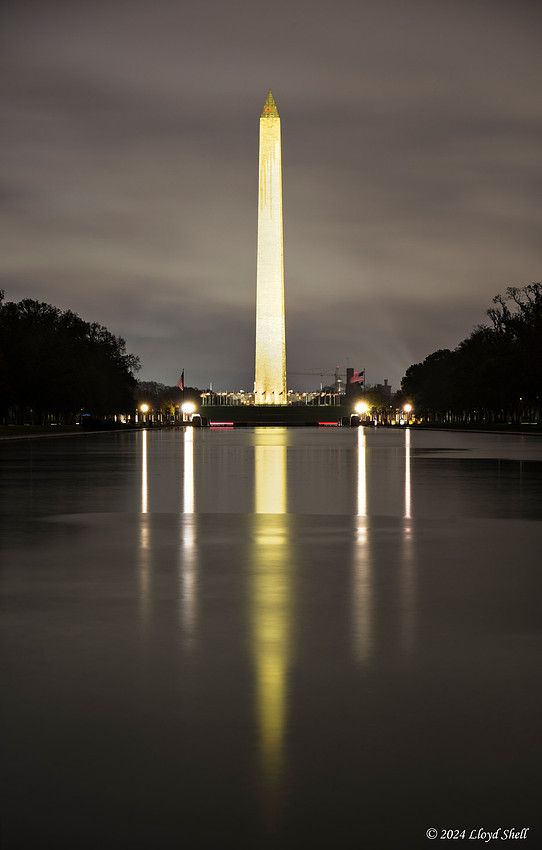
Playing with old lenses is FUN!!!!!!
Every now and then something fun happens. You run into an old friend on the street when you were just thinking about them. You remember how long it has been since you saw a good rainbow and the next day it rains and gives you a good one. That happened to me recently, an old photography friend who used Pentax gear for years contacted me about rehoming some lenses he was not using, at the time I was literally on ebay just browsing old wide angle lenses for fun. In my film days I used Canon cameras, with my trusty AE-1 Program I took a lot of fun photos and learned a LOT. When I was in Scotland in school I ran across and bought an inexpensive Vivitar 19mm lens, this one here: https://www.pentaxforums.com/userreviews/vivitar-19mm-f-3-8.html It was my first ultrawide lens and introduced me to a whole new way of seeing the world.
When his message came up I told him I was up for a re-homing and gladly accepted the gift. Not knowing WHAT lenses he had for me, beyond a few m42 screwmount's and some other K-mount lenses. FYI K-Mount is the mount for most Pentax Cameras made after the mid 70's.
A few weeks later I met him for breakfast we had a great chat and he handed me two BOXES of lenses. I was VERY excited to see a lens I had been looking at in one of the boxes when I opened them up. The Auto Vivitar Wide-Angle 20mm f3.8 manufactured by Kiron/Kino in Japan. This lens listed here: https://www.pentaxforums.com/userreviews/vivitar-20mm-f38-auto-wide-angle.html
I had never dreamed that I would just have one just drop into my lap! I have the Pentax 15-30 f2.8 that I have talked about previouslym but I had been toying with the idea of a Pentax branded lens of the same era/series of my other old manual focus lenses as a smaller walk-around for street shooting. This one actually https://www.pentaxforums.com/lensreviews/SMC-Pentax-K-20mm-F4-Lens.html the problem being price... and finding one in good repair. So to say I was excited would be quite the understatement, as soon as I got home I immediately put my m42 to Pentax adapter on my K1 and mounted the Vivitar up.
First Impressions:
The front element is really quite large, especially for the modest aperture.
The lens is all metal and quite well made, it handles nicely and is not too big nor too small.
It can focus REALLY close, like REALLY REALLY close (More about this later)
It is not super sharp at closest focus distance and wide open (i.e. aperture not closed at all)
It gets sharper stopped down and if you back off a few inches.
I have since had it on my camera a fair amount, and I am ready to post some photos and talk about how it performs.
My first desire when I put on a lens for streetwork is that it gives me a different way to look what I see everyday. Often my only chance is transferring from the bus to the train downtown, and maybe deliberately skipping a train so I can deviate a block or two.
My second desire from a lens is reasonable sharpness in a decent sized package. I have big lenses that are very sharp, but cumbersome, and not what I want to carry on the train for the days commute. I will trade a little sharpness, and a smaller aperture wide open for size and portability. There are far more qualified folks to talk about that than me, but those are my priorities.
This Vivitar seems to meet these criteria fairly well, I don't think it is the sharpest ever, especially at infinity focus, but it does seem to do reasonably well at medium to close distances, and the wideness helps to change HOW you see through the viewfinder.
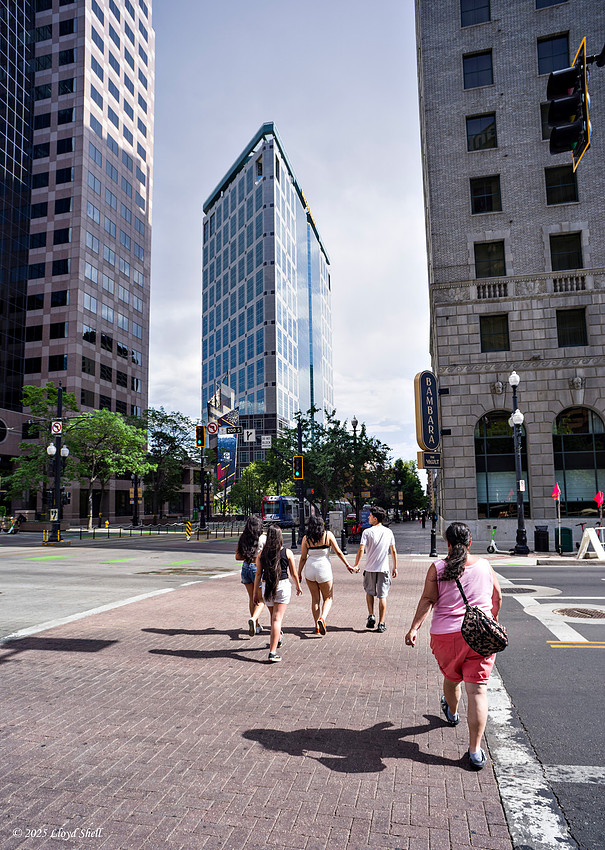
This is at or near closest focus and wide open (f3.8) it is a little soft, however, and this is a big however. It can isolate subjects reasonably well due to the close focus, the background blur (Bokeh it is called) is not terrible and I think this lens will be quite useful up close.
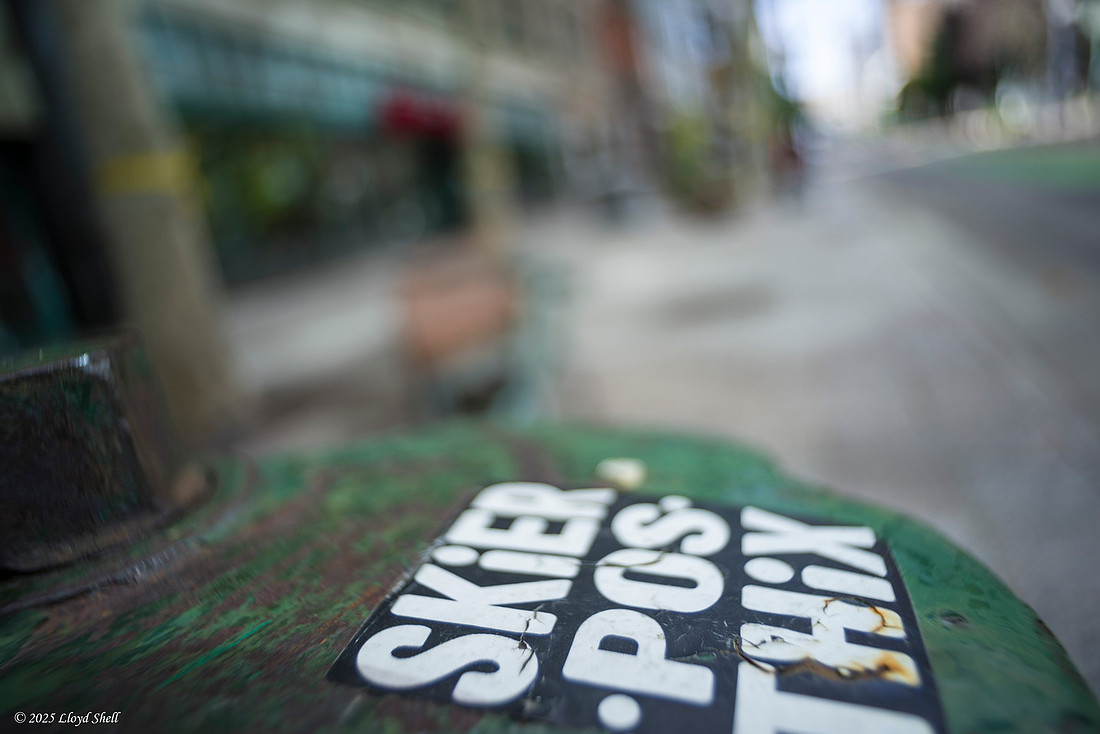
Being able to place a subject inside of it's environment is a benefit to ultra wide angle lenses, often the juxtaposition of the subject to the surrounds creates the flow and charm of the image. At medium distance and medium f number this lens is quite acceptably sharp. (IIRC this was f8 but the lens does not communicate with the camera so I do not know.)
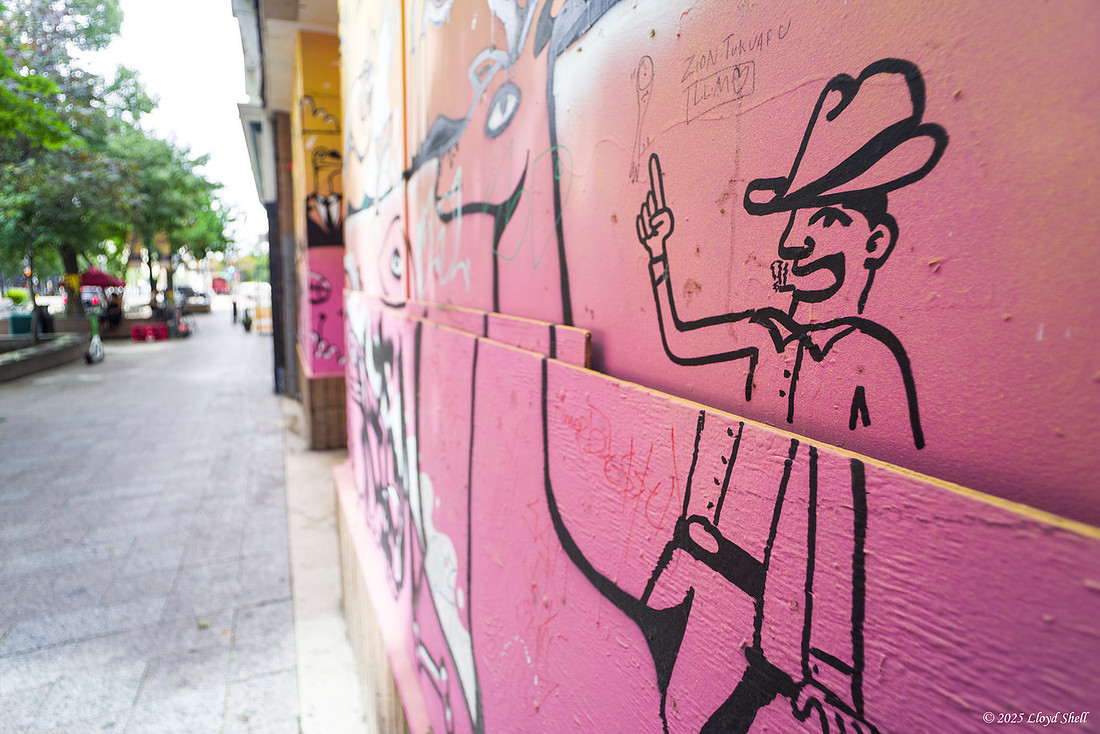
I photographed this sculpture many years ago, it is in an old neighborhood that I like to go back to occasionally. I played with different apertures varying the background blur, again I find the rendering acceptable, there is some light drop off in the corners but nothing too drastic.
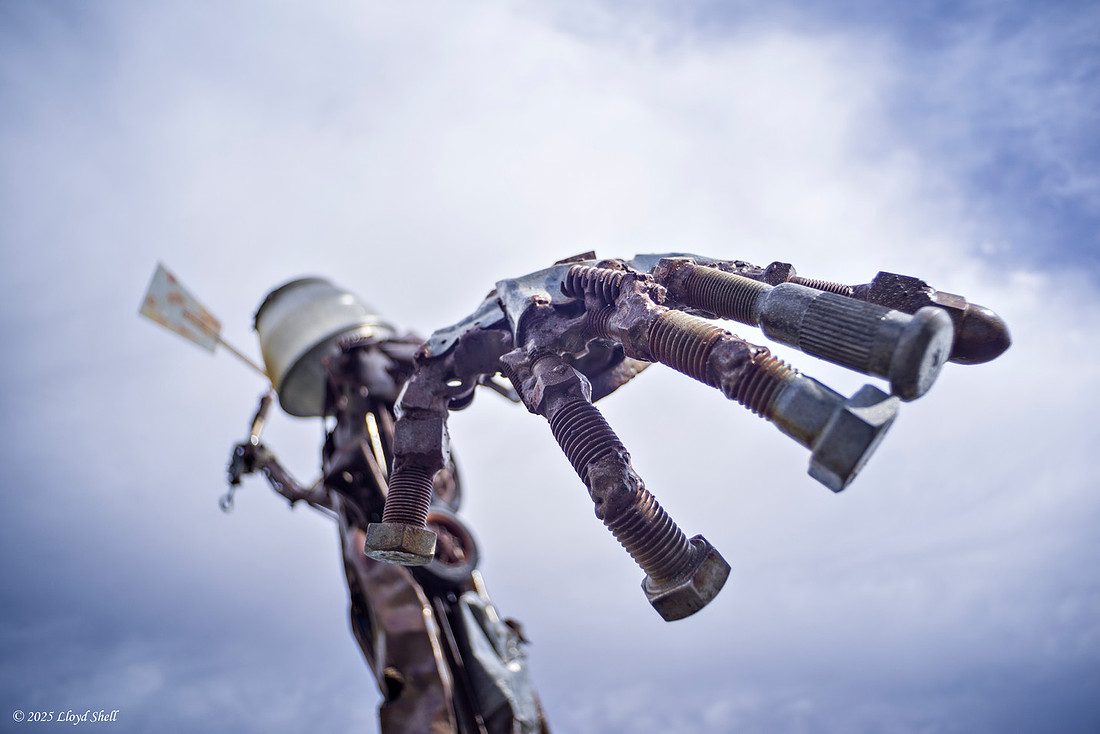
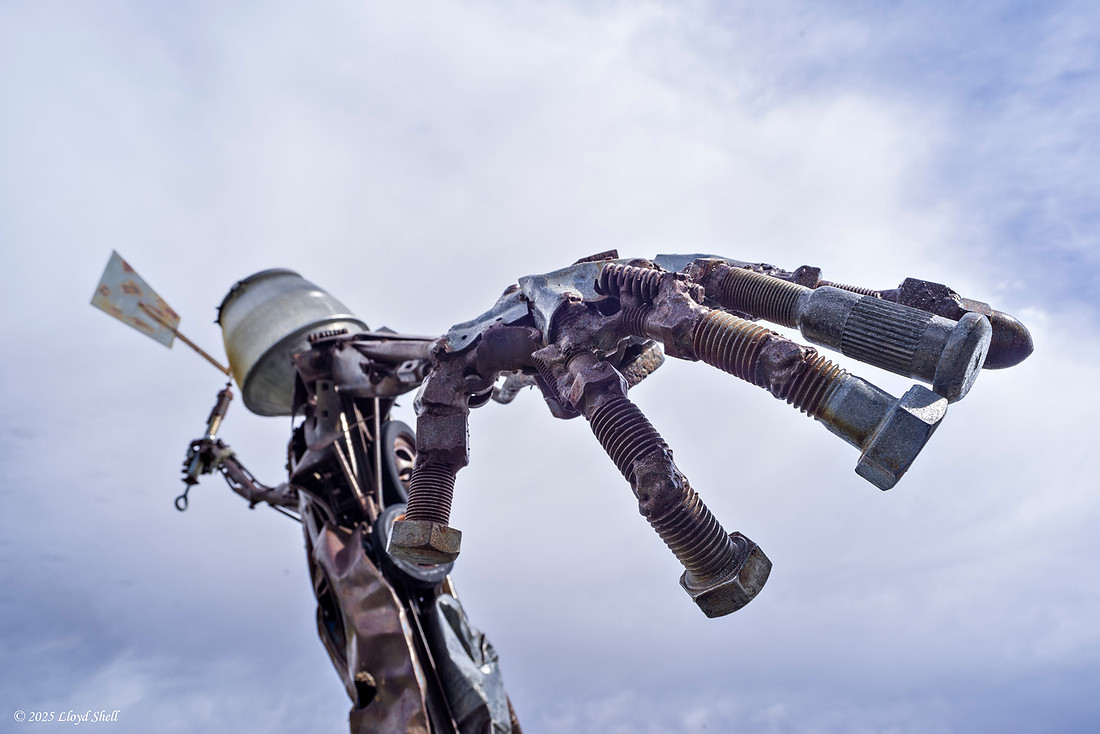
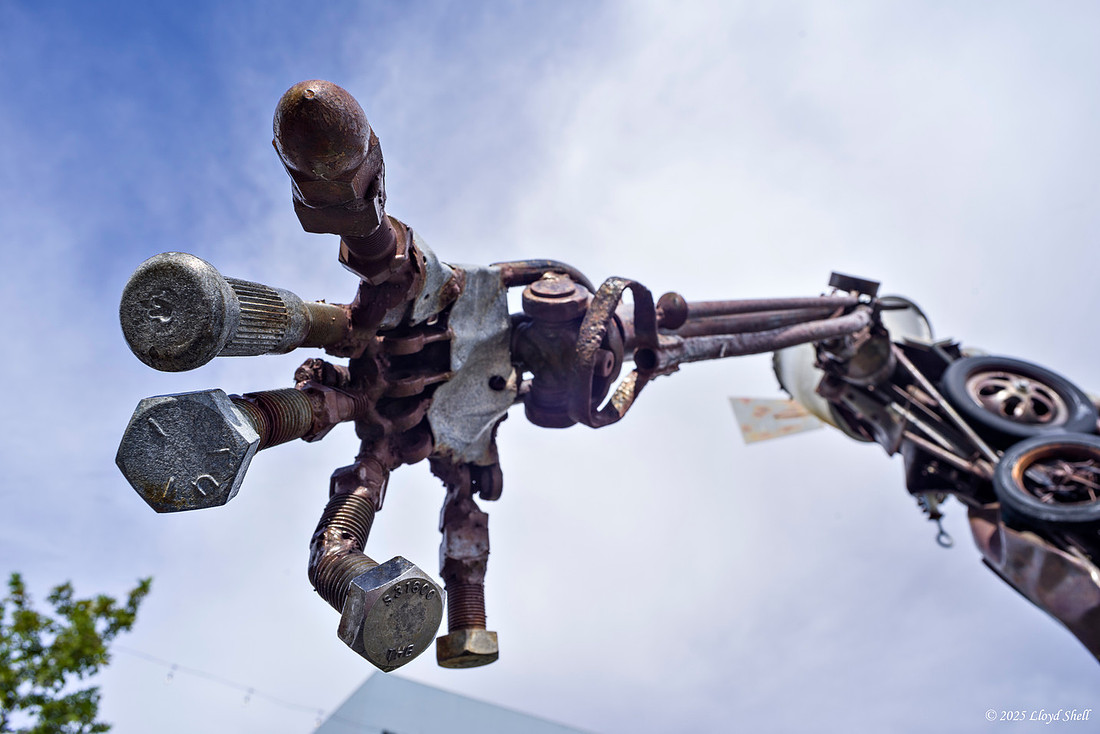
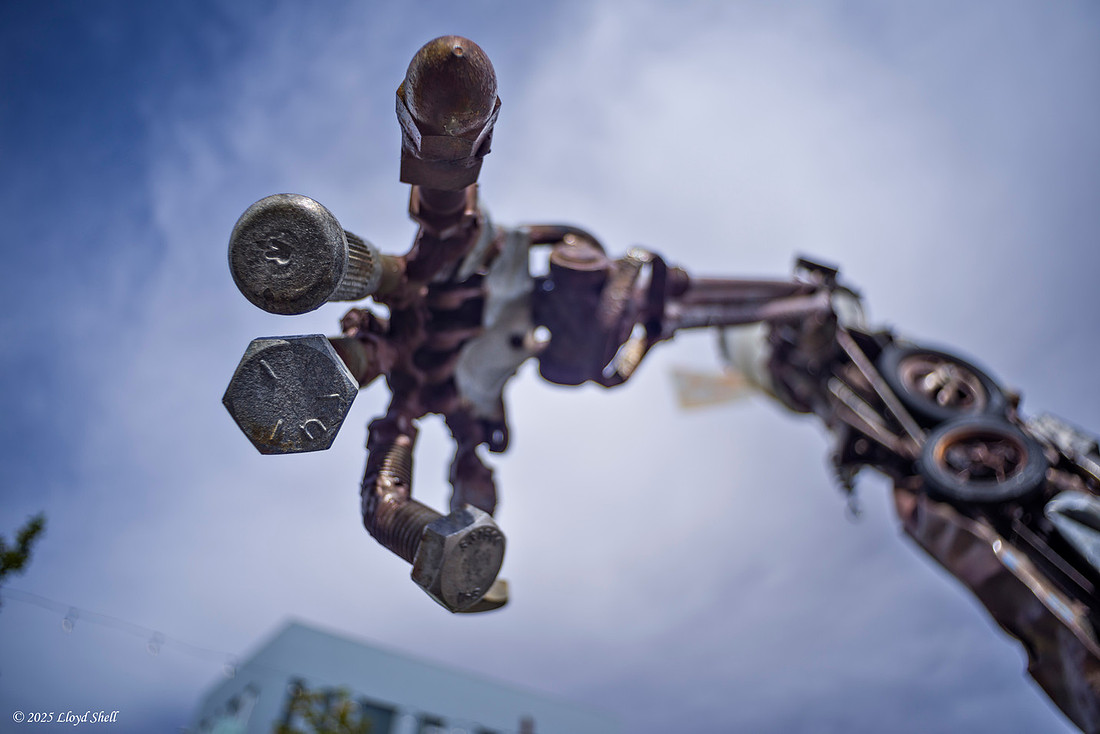
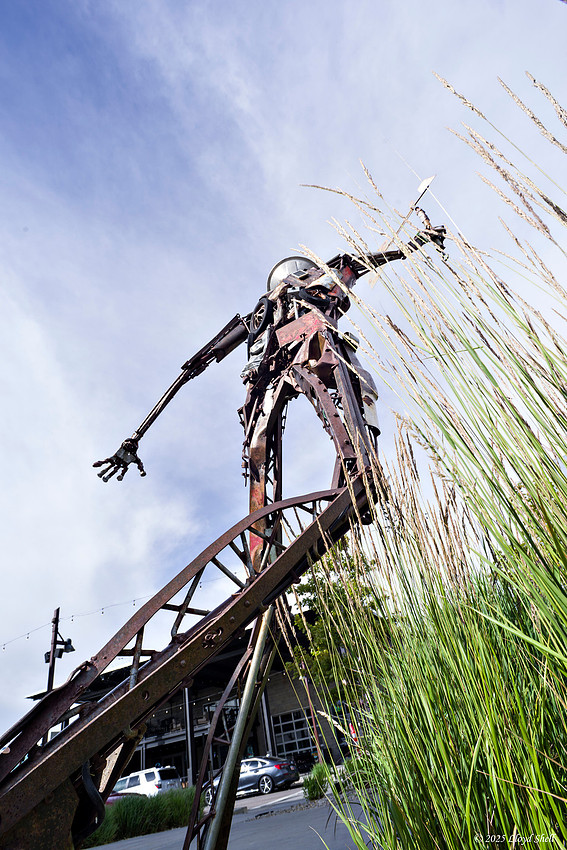
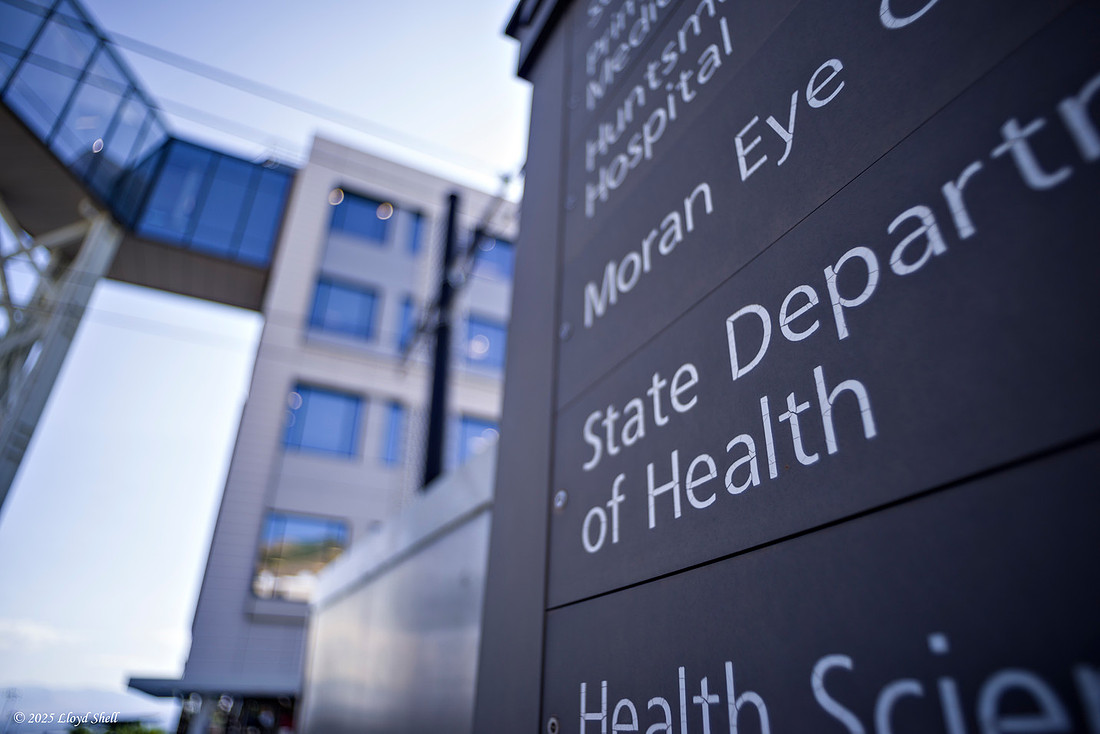 The drama that the lens can produce and the overall rendering work well, I do think it will become a part of my street kit.
Now, I wanted to do a little comparison to my other ultrawide lens my Pentax DFA 15-30 f2.8, so I set up a quick and dirty scene in my kitchen this morning to compare the two lenses relative to how they render wide open and stopped down and see how the closest focus compares. I found out a few things. First the relative position of the front of the lens to the subject is VERY different between the two lenses.
This is as close as the 15-30 can get.
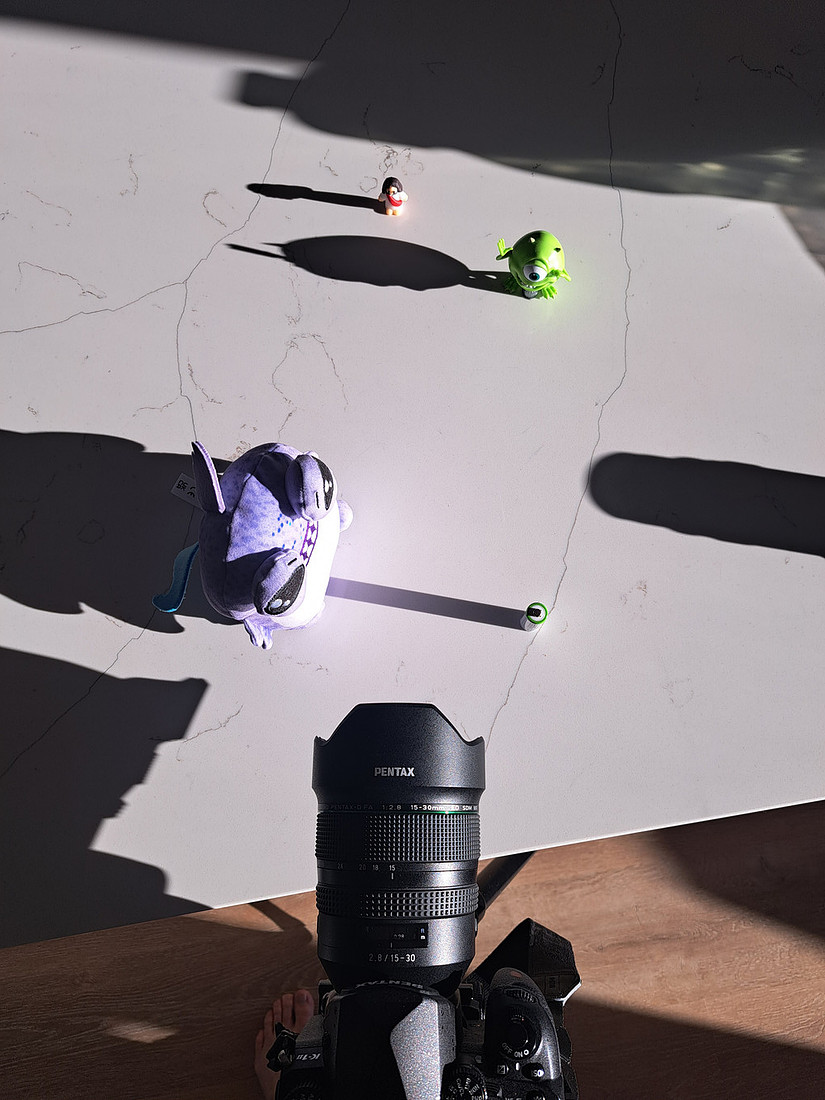
Without moving anything but the stuffie this is as close as the Vivitar can get.
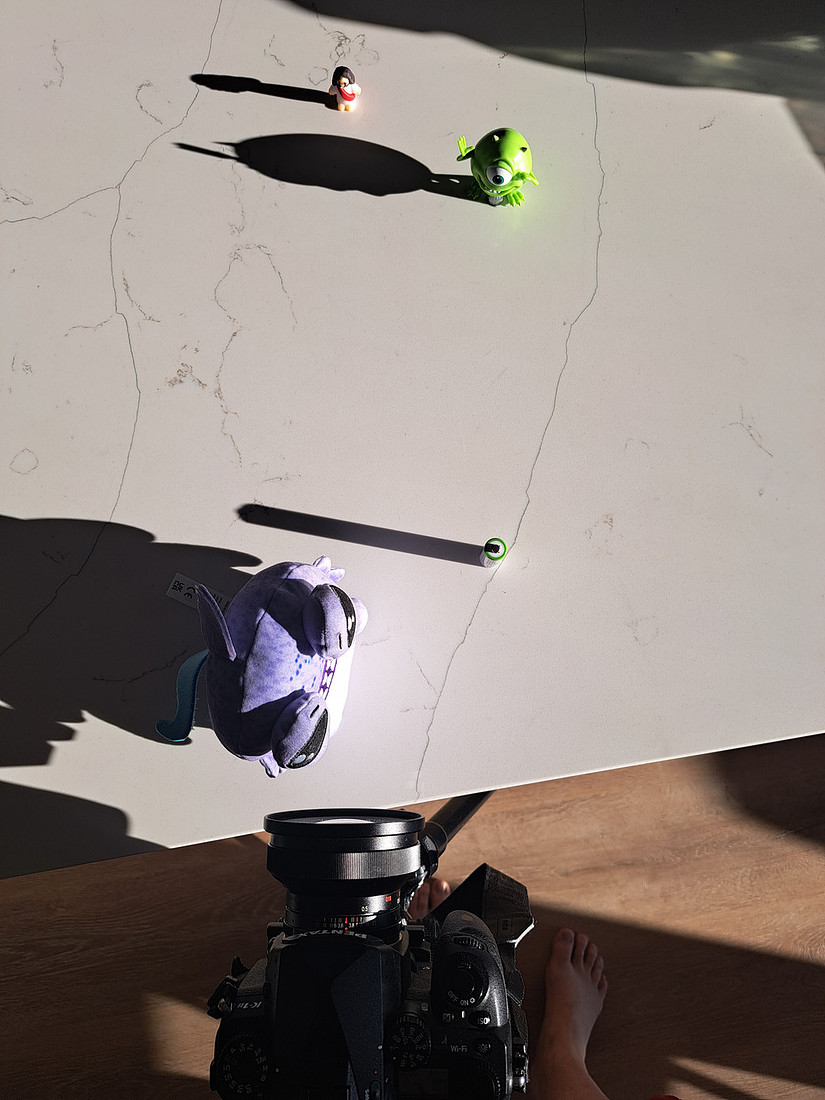
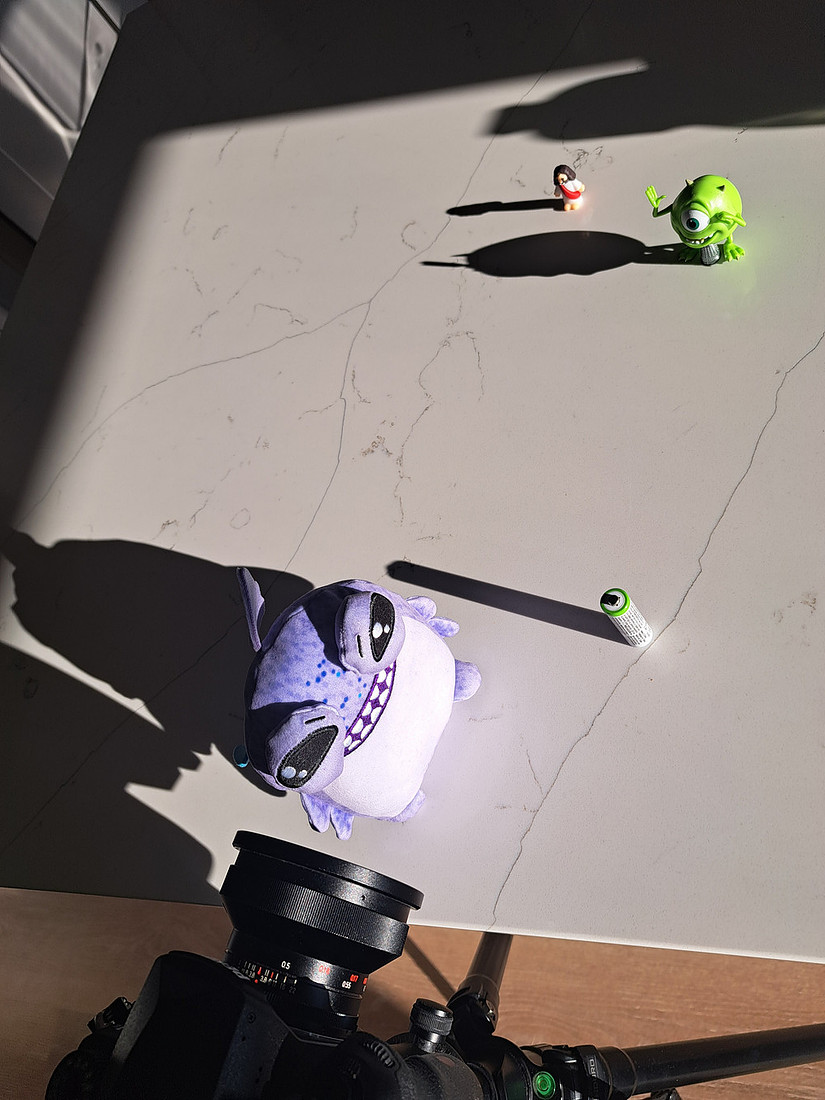
That introduced a little chaos into my test shots, but I think is illustrative of how these lenses differ in use. So I tried but ended up having the 15-30 set at 19mm instead of 20mm, but you will notice that the field of view varies between the two with the camera position untouched and just switching lenses. This first set of photos is the 15-30 @ 19mm per the lens starting at f2.8 and going smaller in 1 stop increments to f22. Notice the change in depth of field and rendering of the background. I put the focus on the first and second teeth on the stuffies smile. The only processing was to increase the exposure by one stop, reduce highlights by 50% and increase shadows by 100%, using the same preset for ALL photos.
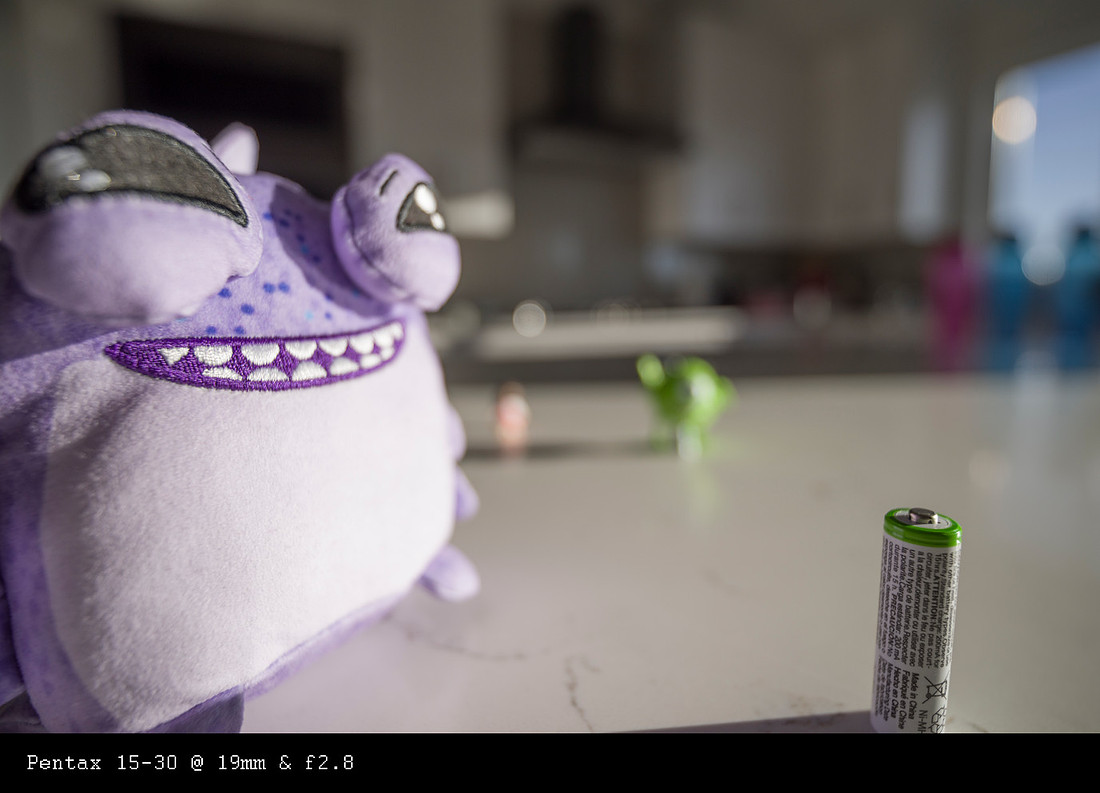
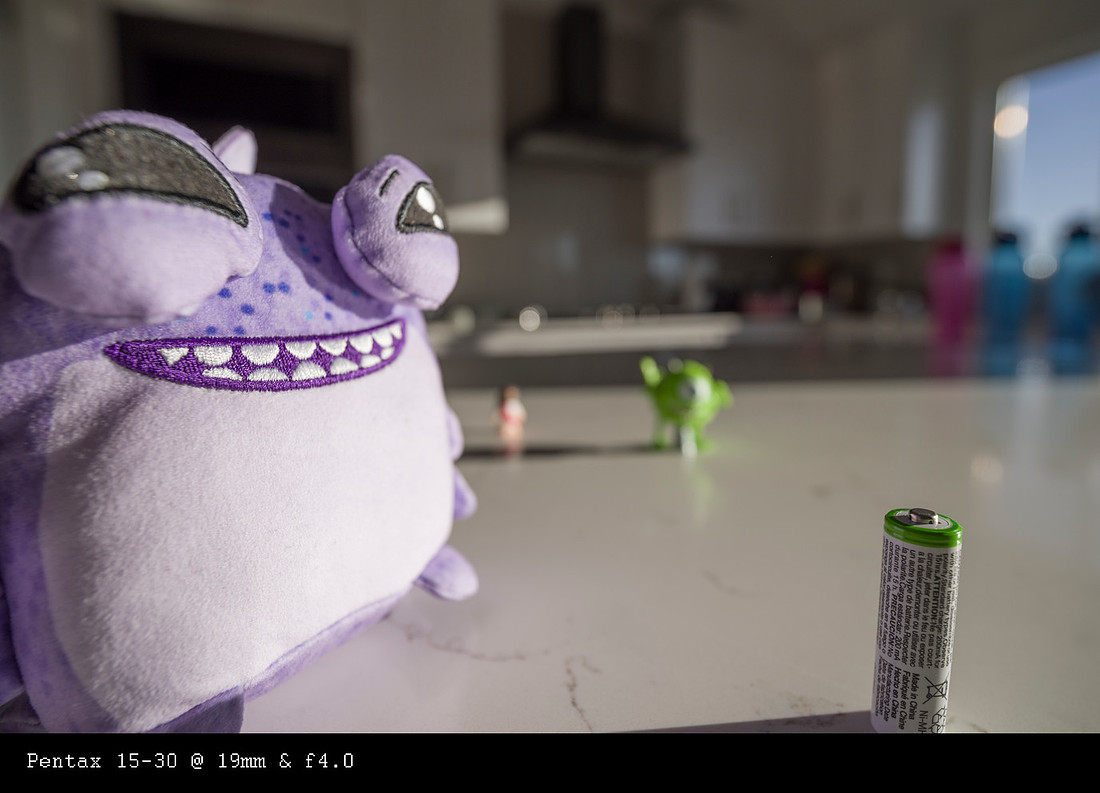
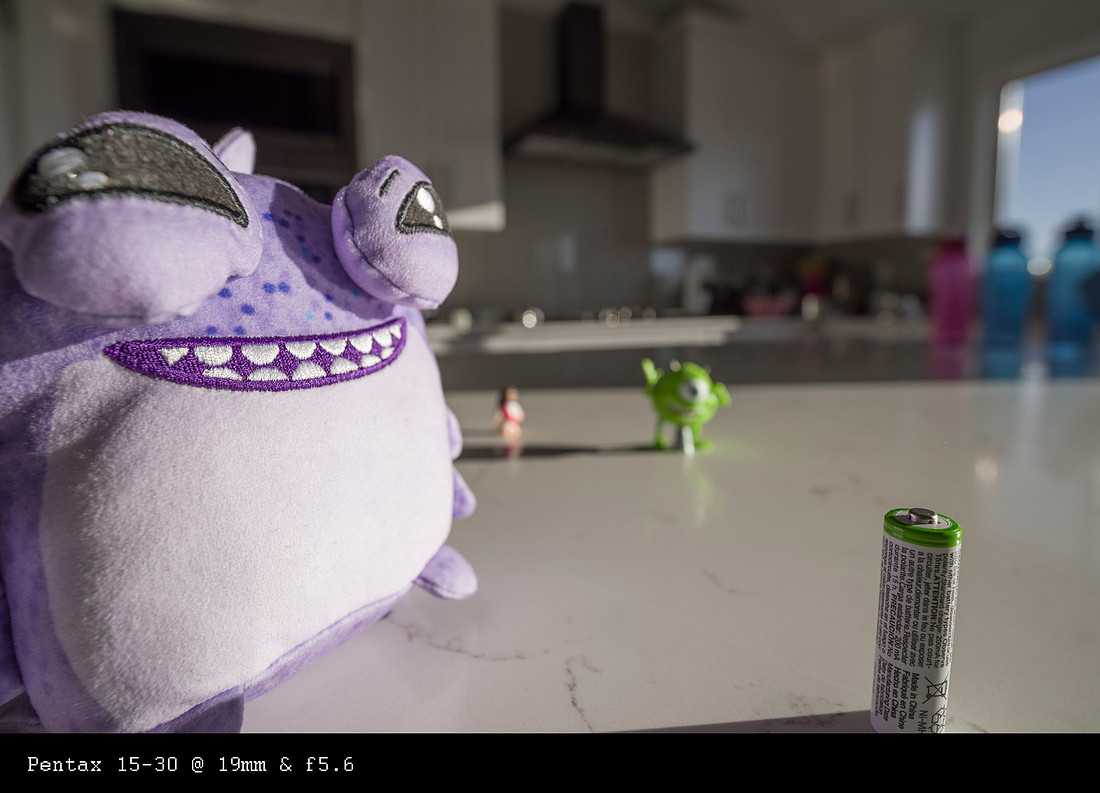
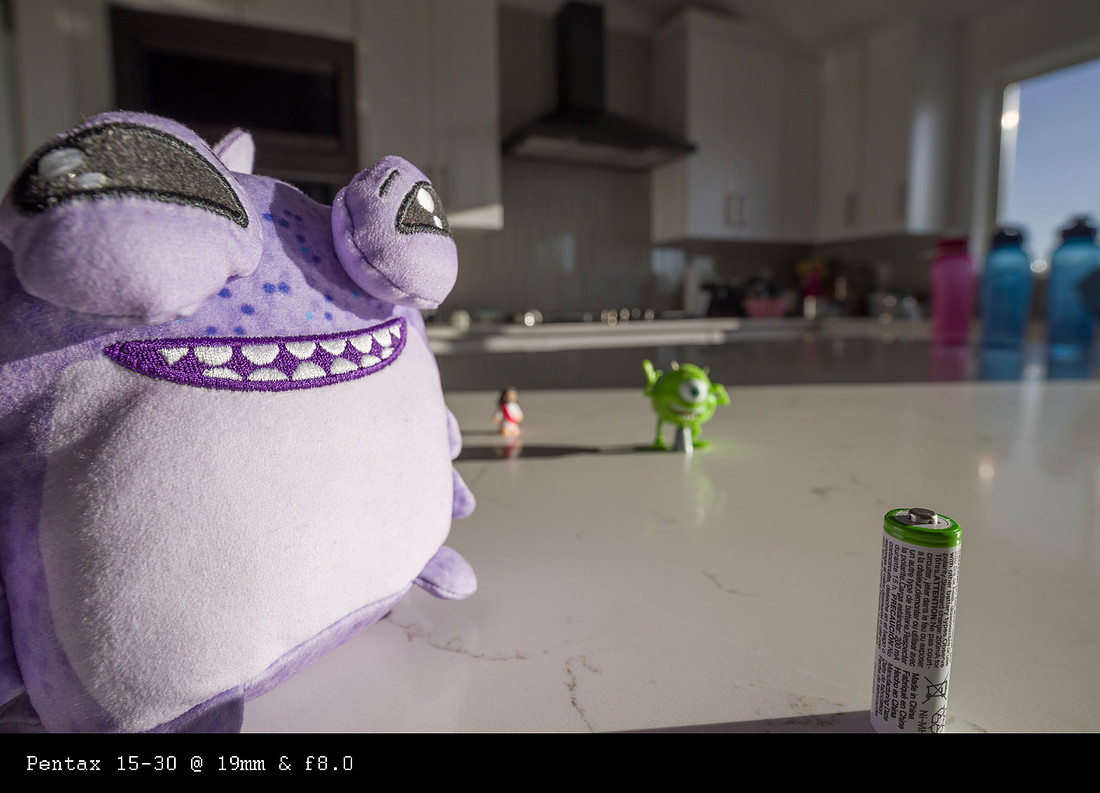
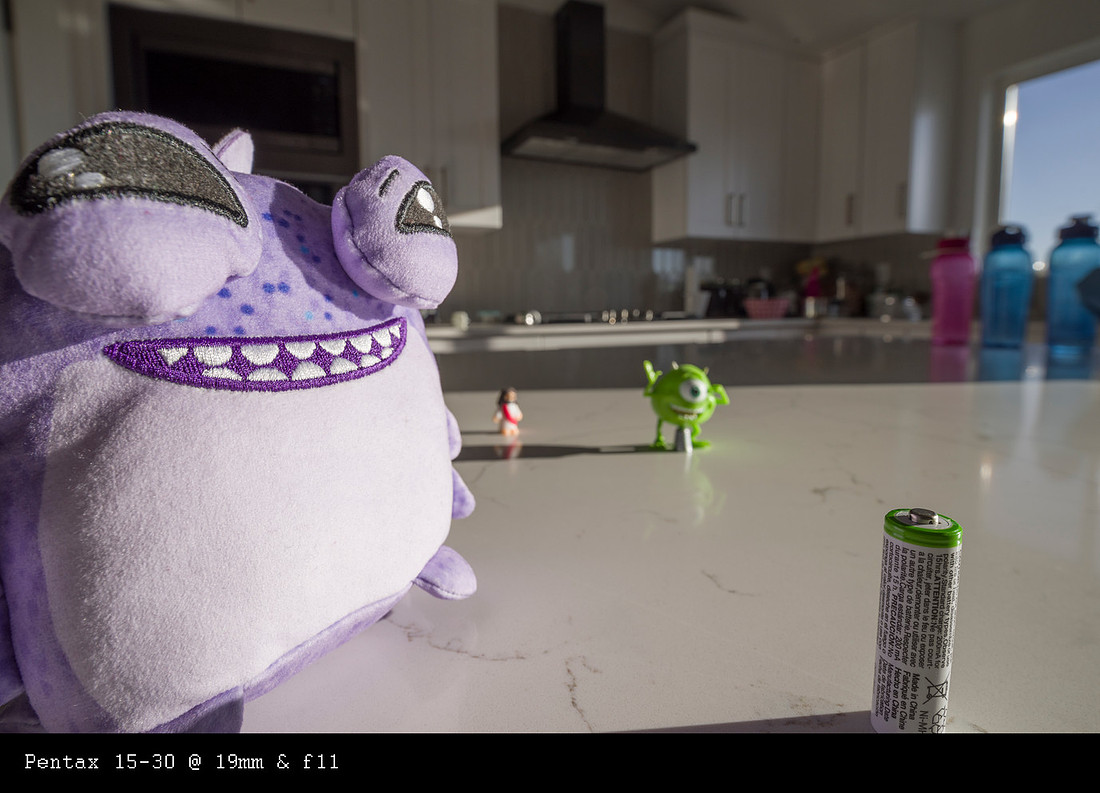
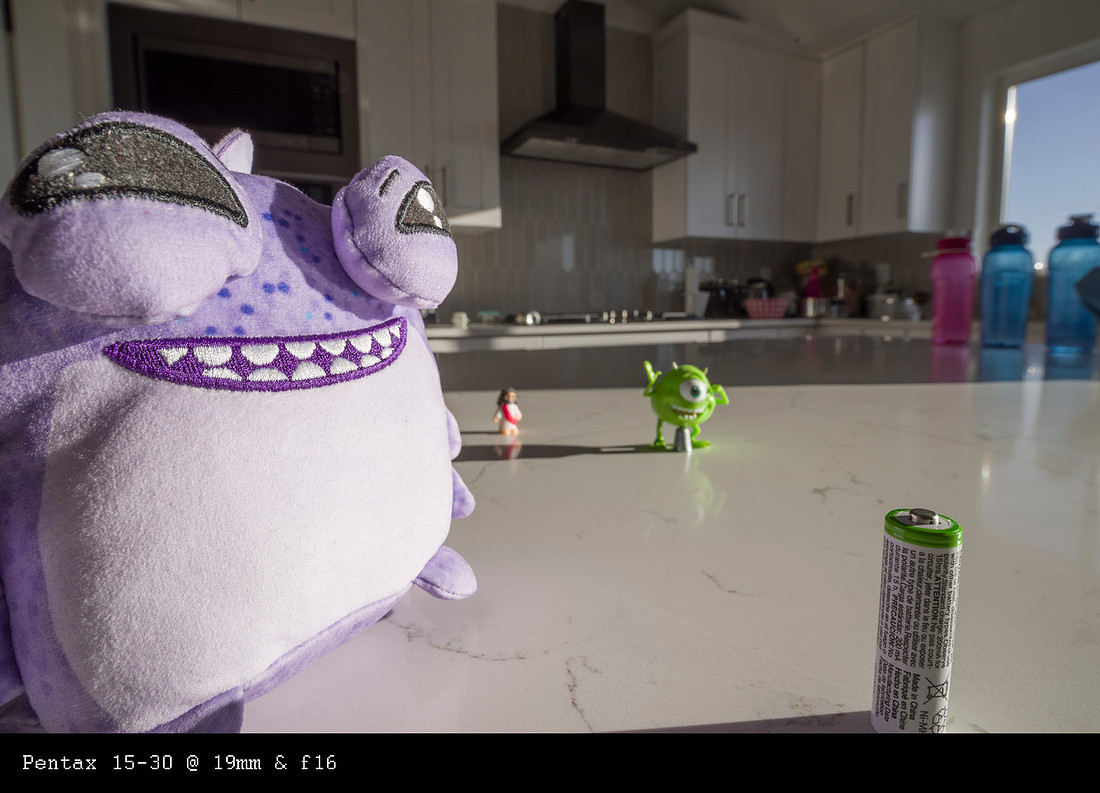
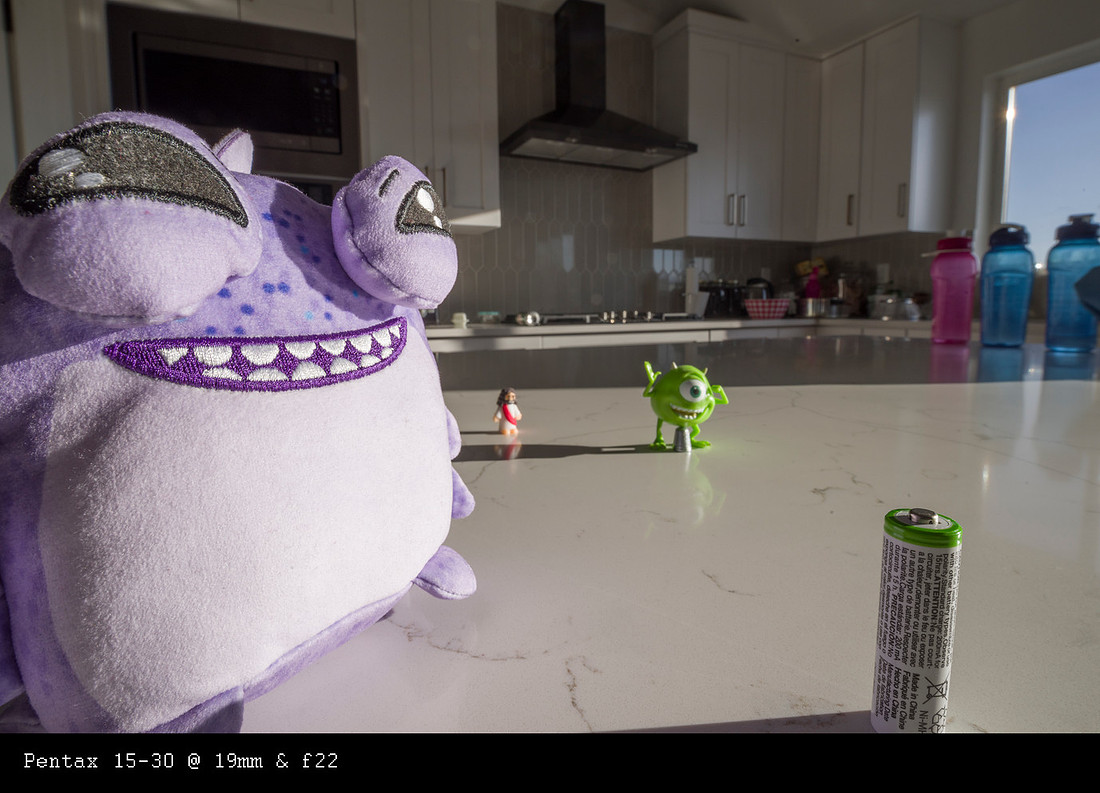
Now all I did for this set is switch to the Vivitar, not moving anything and trying to focus in the same spot, I used the same aperture and shutter speed as the first series, though there is no f2.8 as the Vivitar starts at f3.8 (which is effectively f4) First thing I noticed was the lens APPEARS wider than the 15-30 @ 19mm. I think in part to how much bigger then 15-30 is and how close the front of the lens is to the subject.
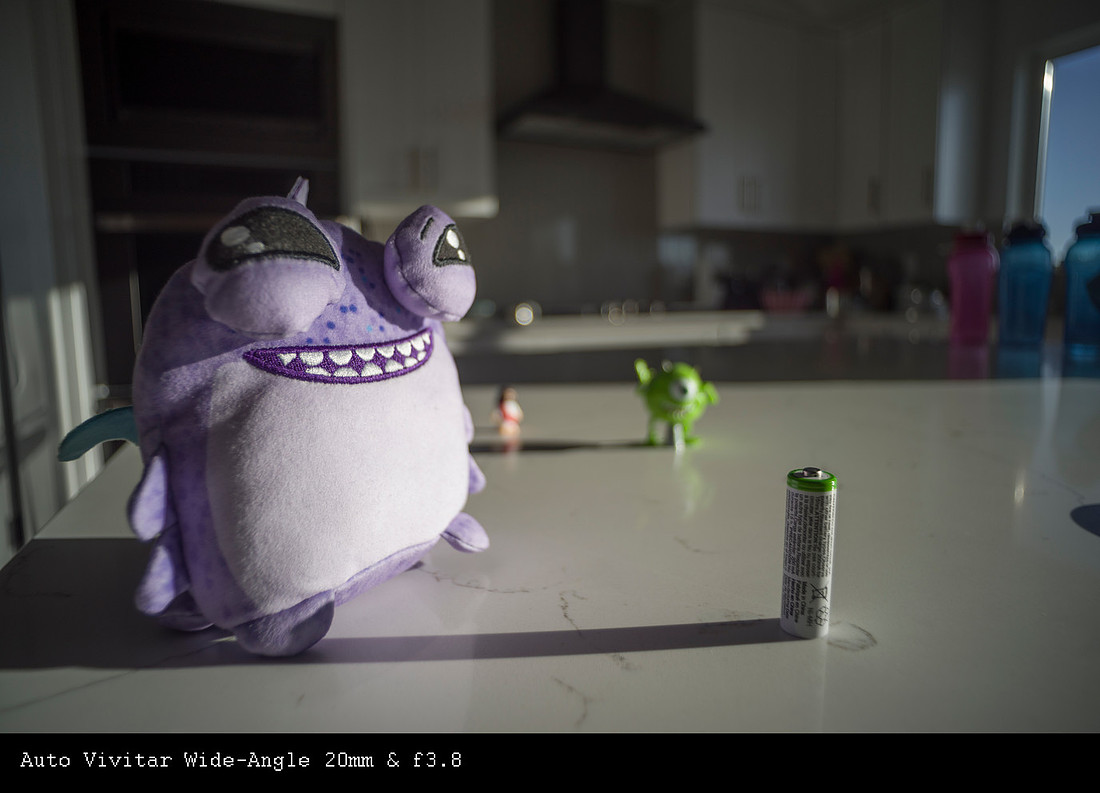
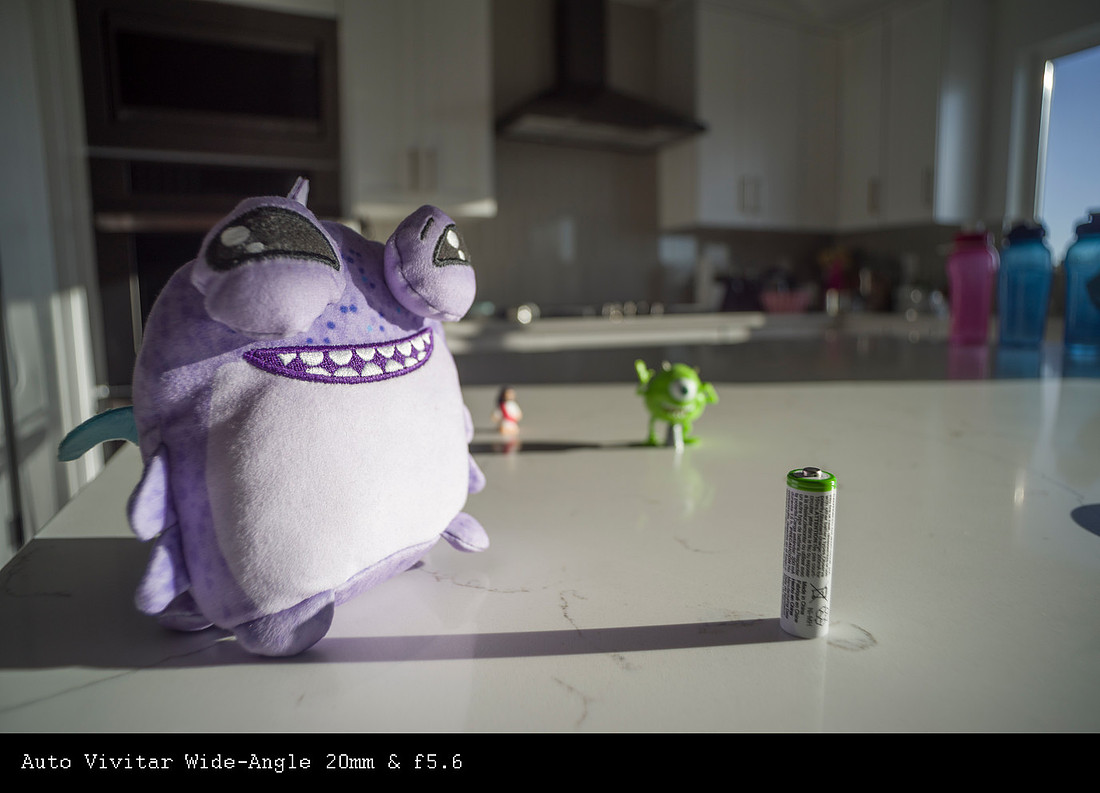
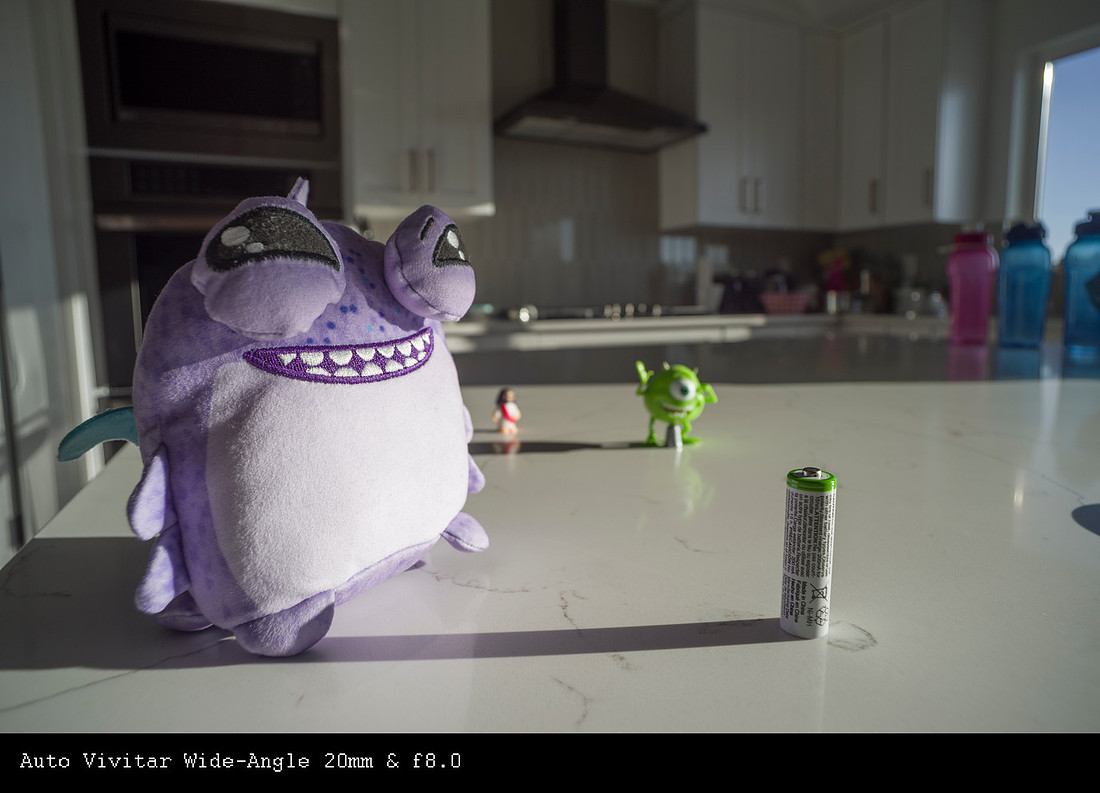
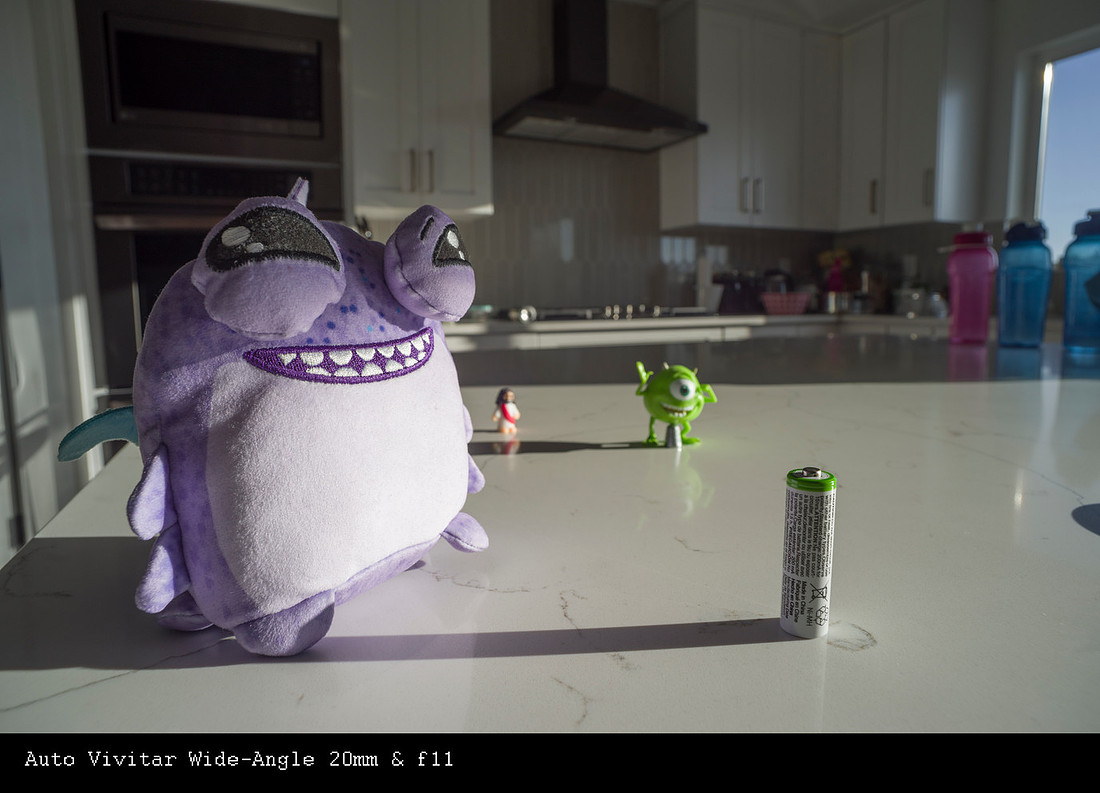
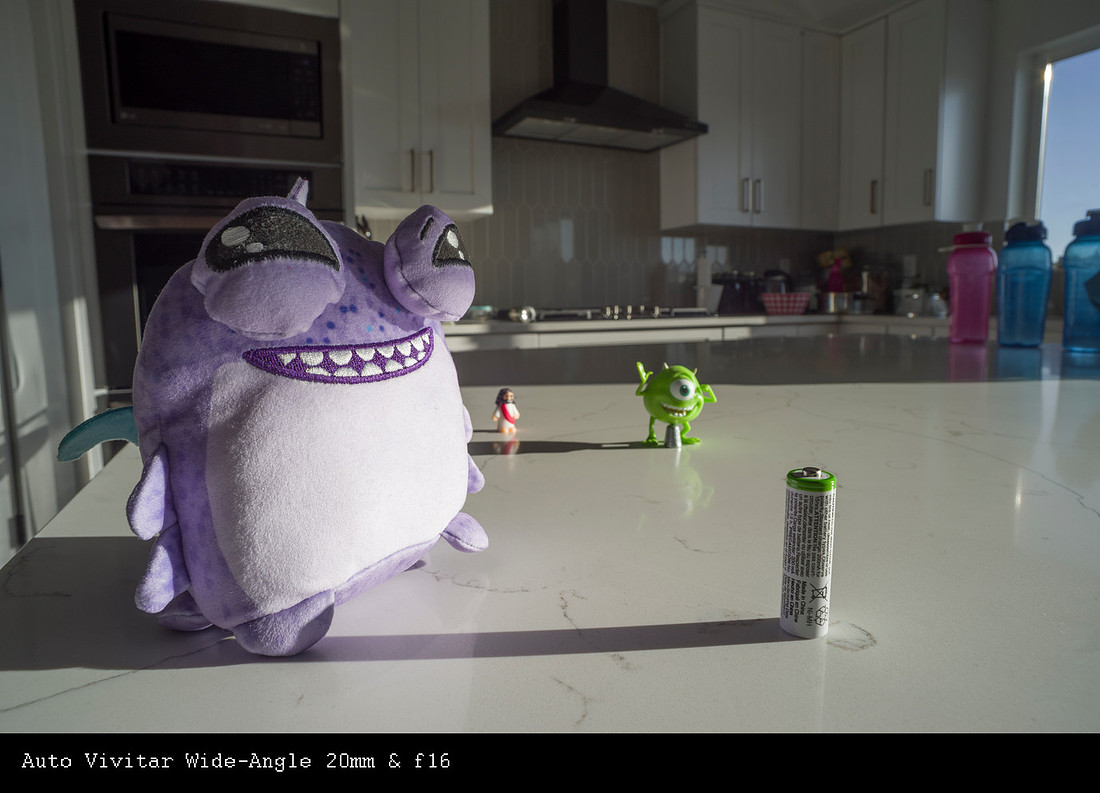
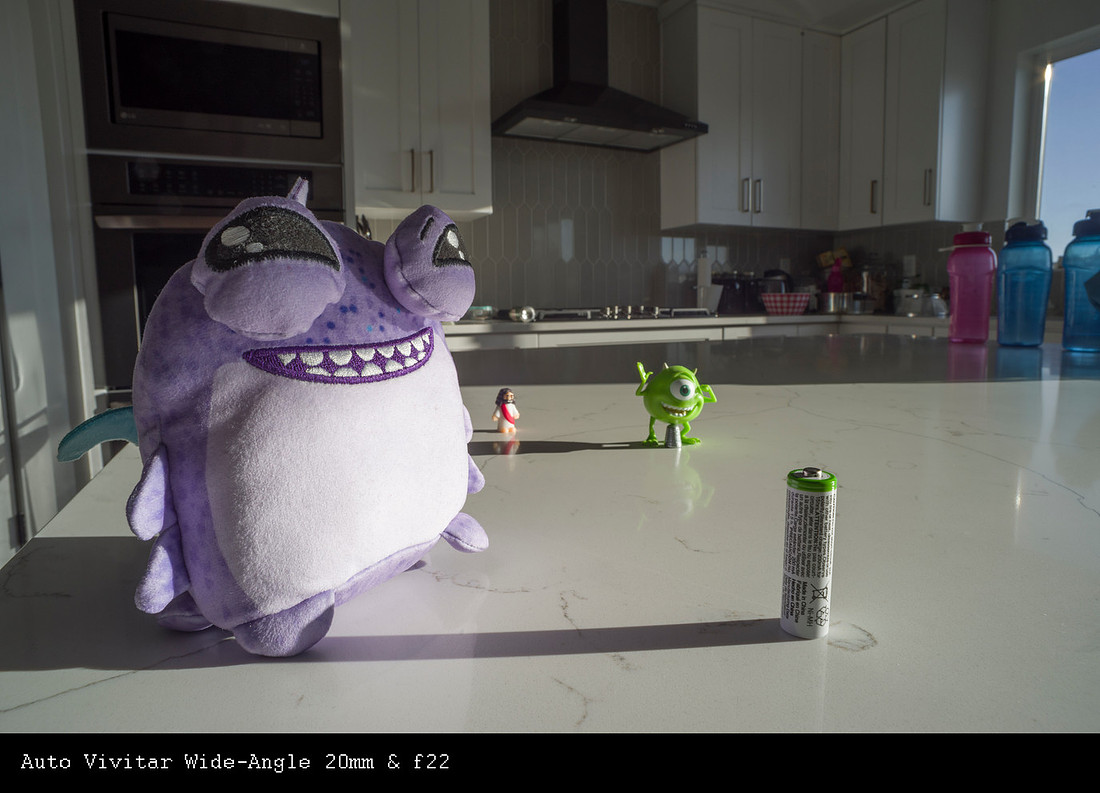
So I put the 15-30 back on and zoomed out to 15mm, it changes the perspective a little but it is not the same, maybe a little more dramatic.
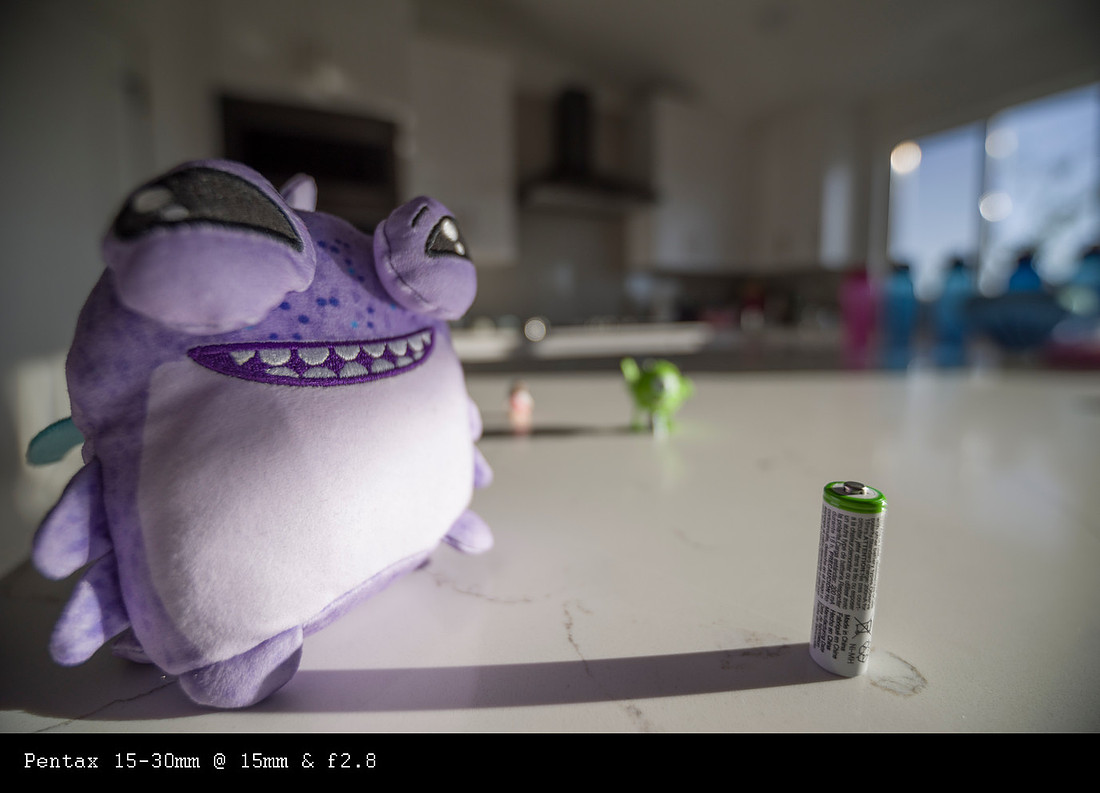
I was rapidly losing light on the stuffies head so I re-arranged a little for one more shot at 15mm
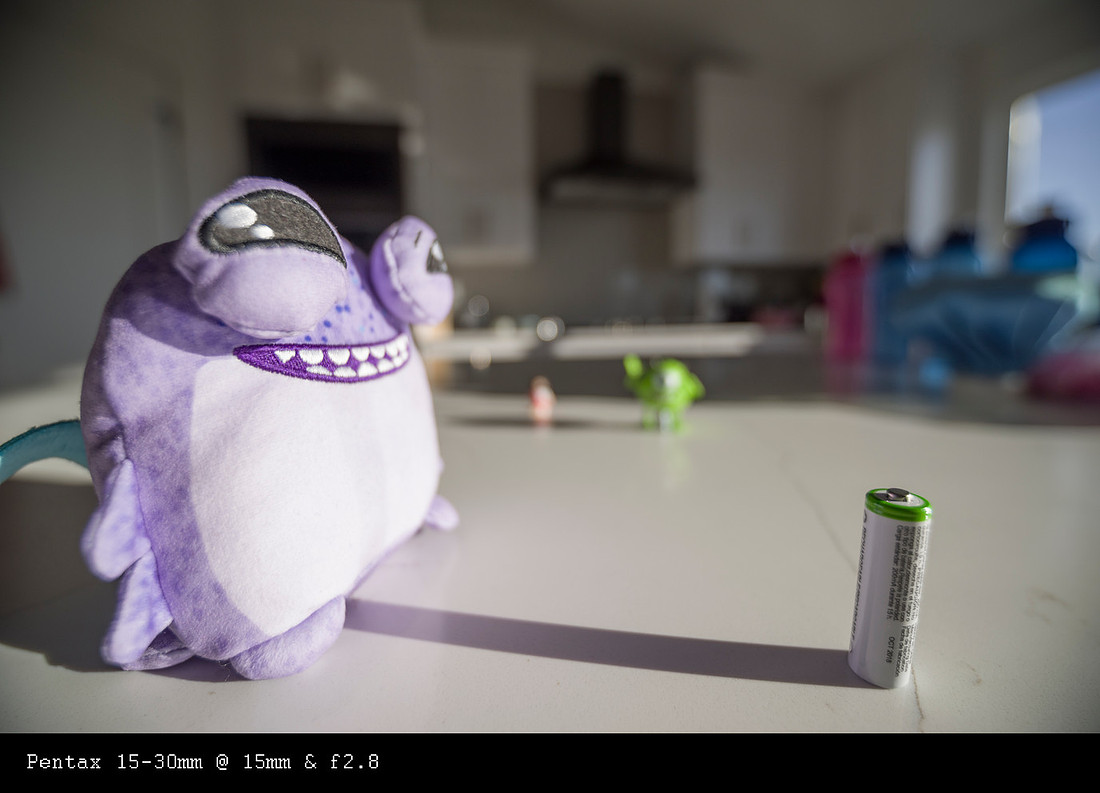
I then put the 20mm back on with the camera in the same position. The appearance is just that bit different isn't it.
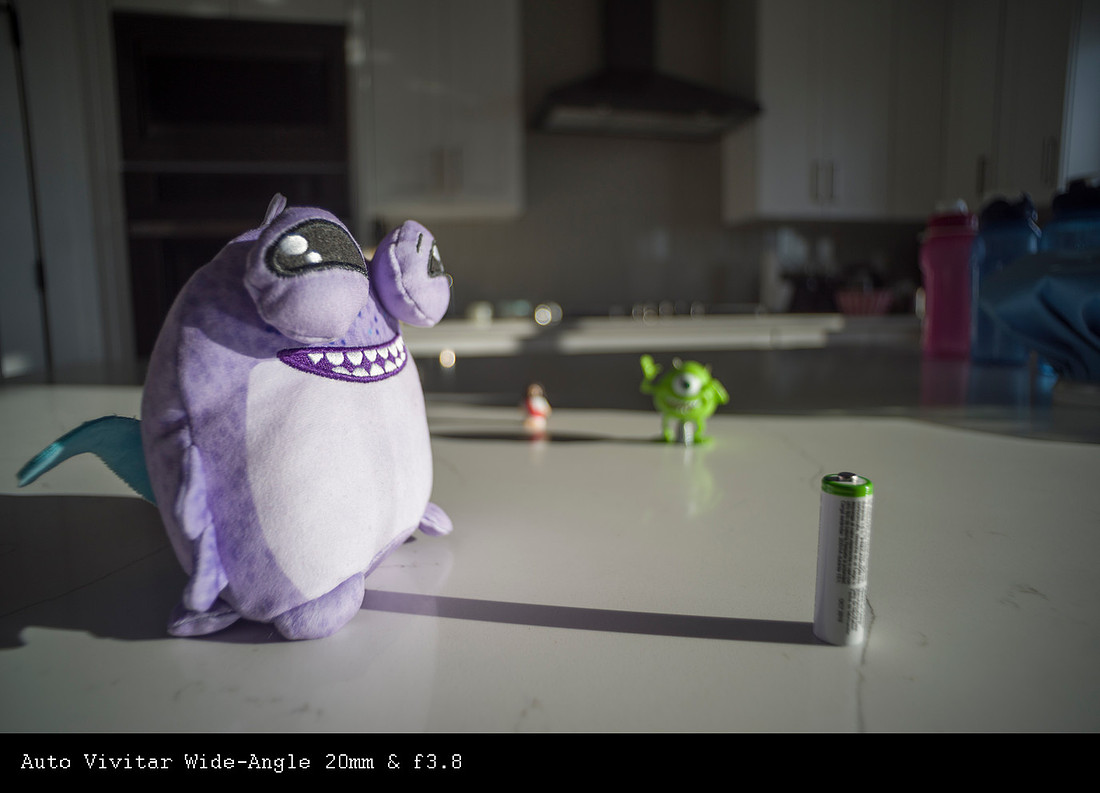
Now to illustrate HOW different the close focus ability makes things. All I did was turn the Vivitar to the closest distance it will focus then move the stuffy to place the in focus point in close to (but not quite) the same place as before without moving anything else. That changes the appearance significantly. I do not know the magnification ratio of this lens, but getting much closer will require some interesting lighting adaptations. If you scroll back up to the overhead shots taken with my cell phone you will see just how close this is to the front element. There is quite a bit of separation of the subject from the background and this can be quite the dramatic effect.
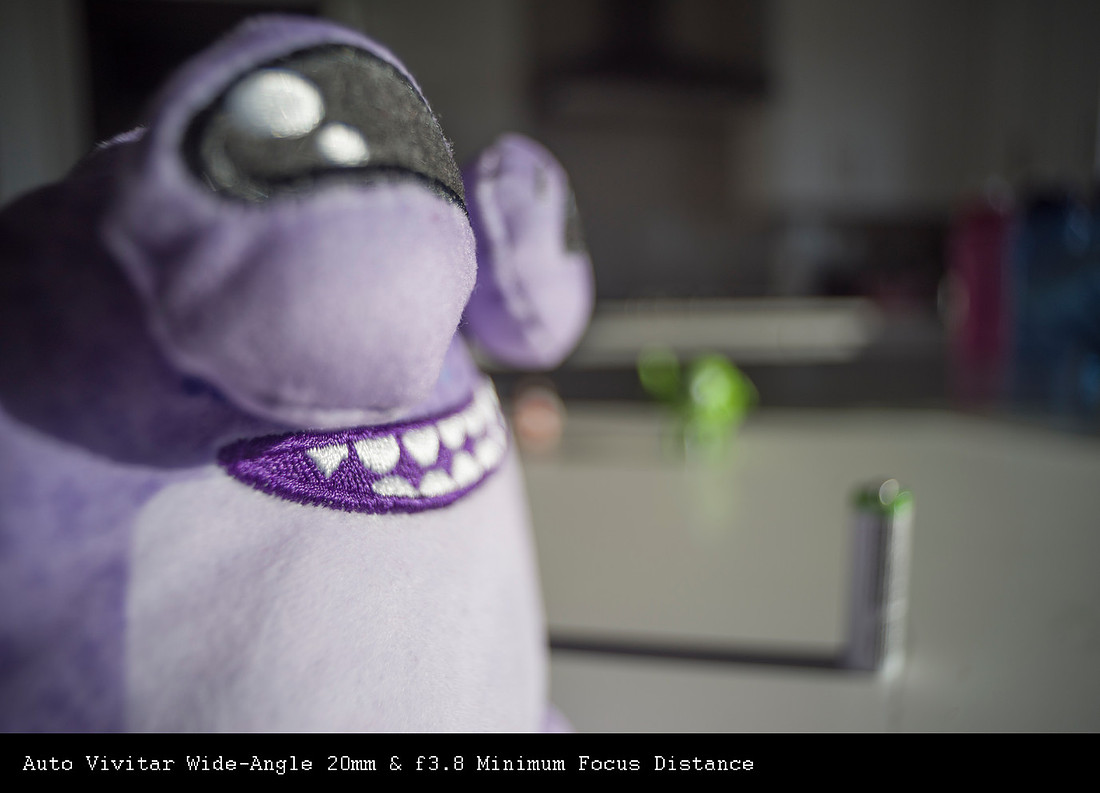
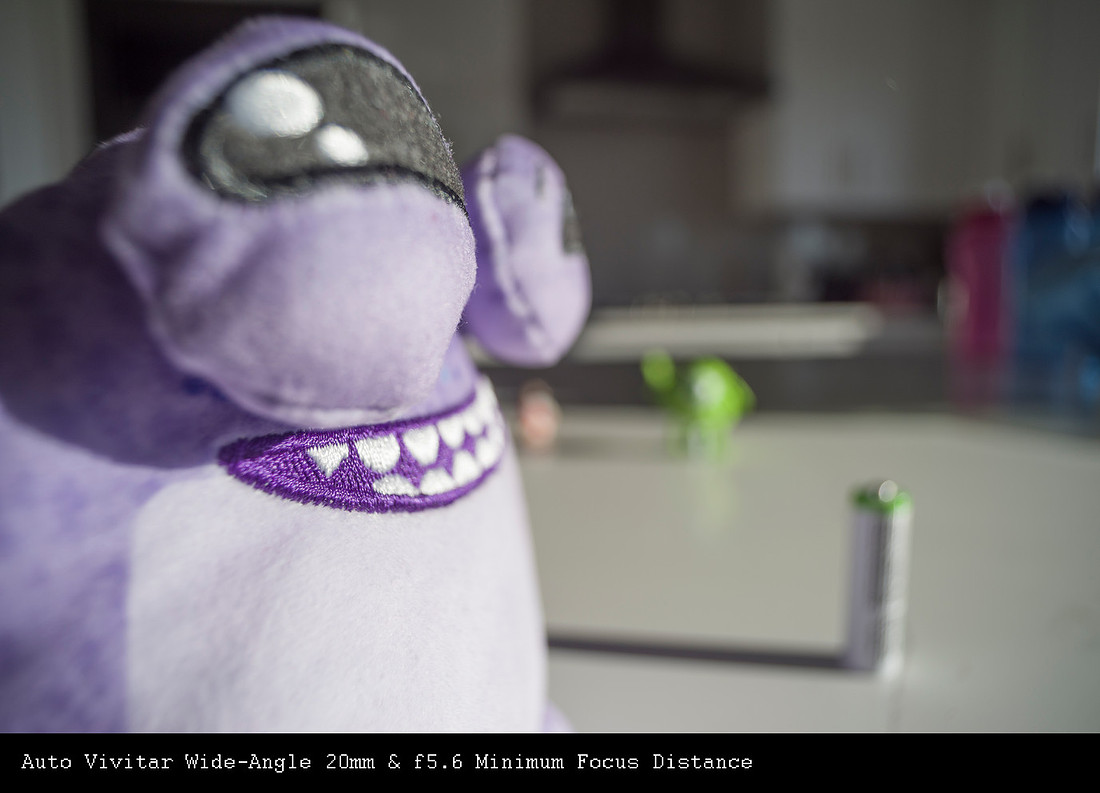
I would be quite comfortable at f5.6-f8 with the balance of sharpness to bokeh at closest focus. That will likely entail higher ISO when in the shadow of buildings to keep shutter speed up to avoid motion blur, but for street stuff that is not a problem.
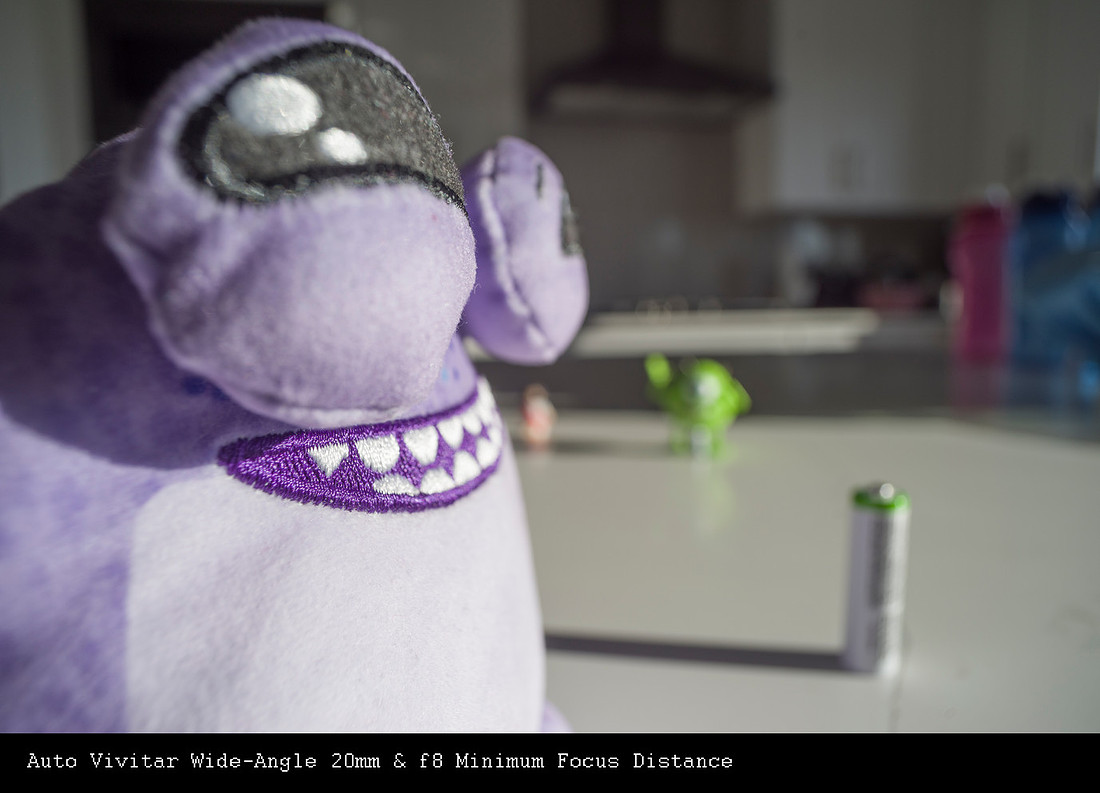
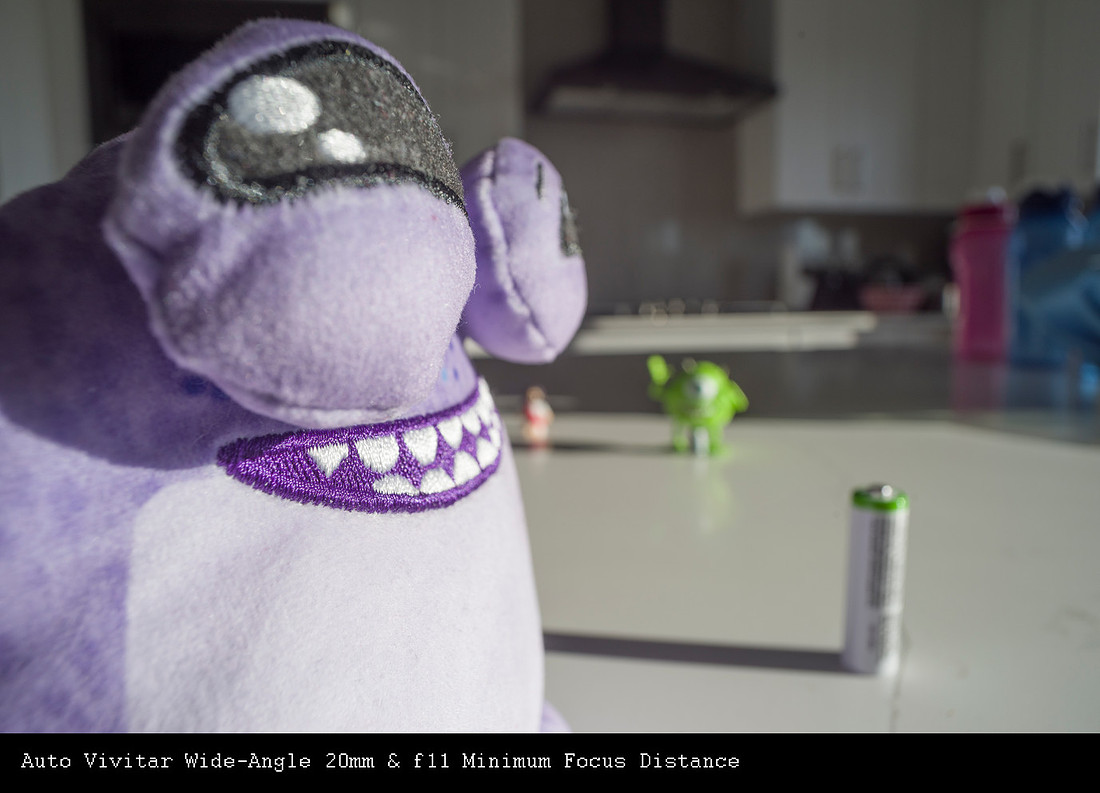
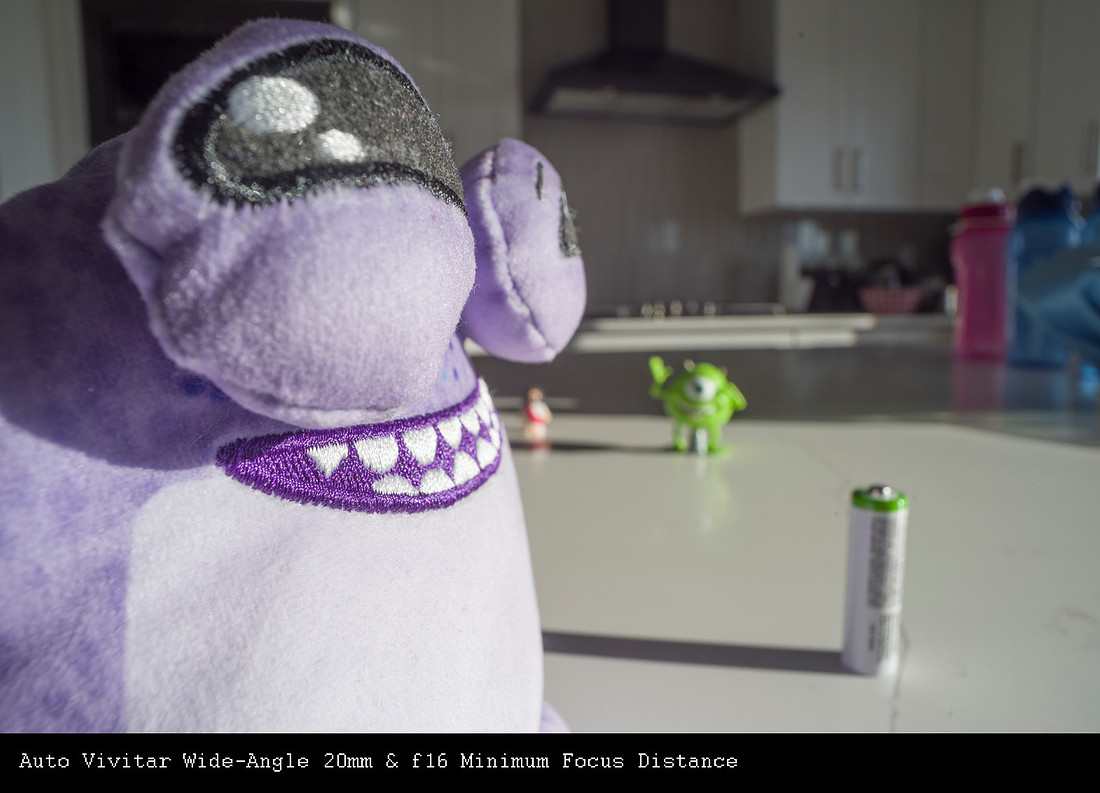
f22 still isn't bad at all in regards to sharpness, but there is some due to diffraction from the small aperture.
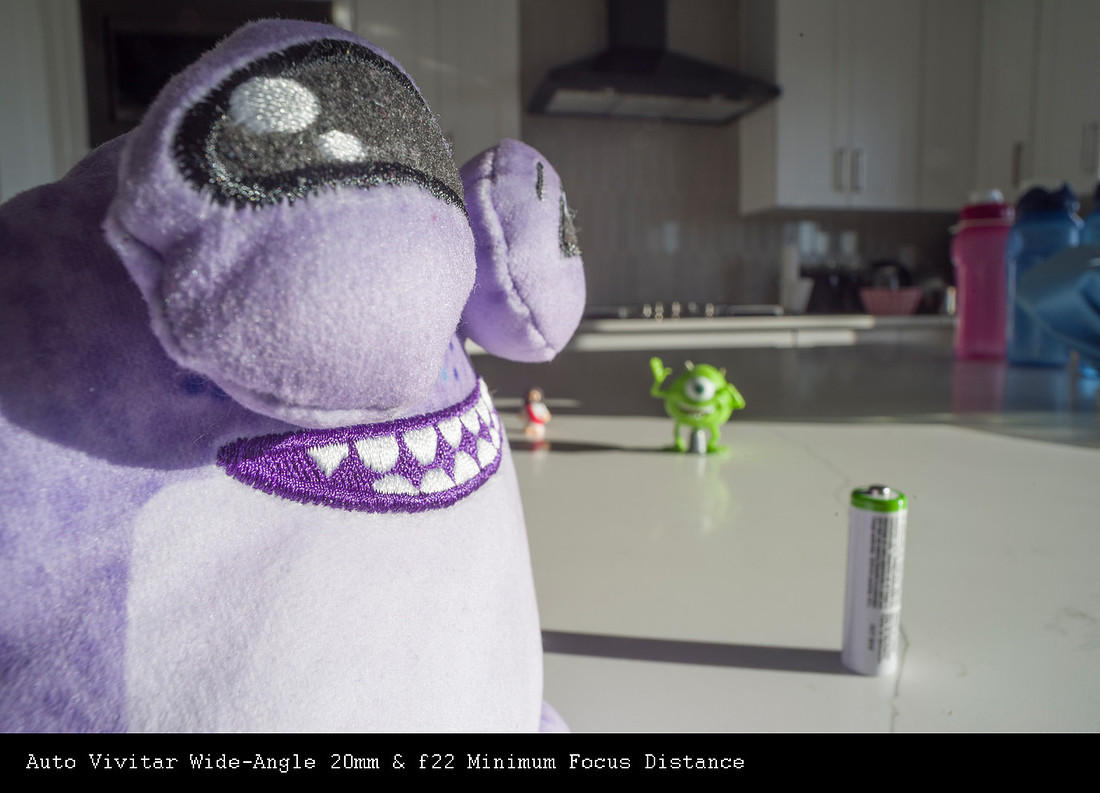
Overall conclusion: I like this lens, I will be adding it to my street shooting arsenal and it is a keeper. The close focusing ability combined with the wide angle of view will allow for some unique perspectives and and a different way to see the world compared to more conventional focal lengths for street shooting. From me two thumbs up!
Thanks for making it to the end, if you have questions or concerns feel free to email me: [email protected]
Part 17: Durham Cathedral & Last Stop: Chatsworth House
You will have to forgive me a but of meandering here. I am both happy to be nearing the end of this project, I am realizing how much ground we really covered and how many amazing things we saw. It truly was the trip of a lifetime for us, and I am kind of longing for the time to come again. So, if anybody has a spare 20-30 grand they want to throw at me I wouldn't turn you down. I have tried to not post TOO many photos, but it is hard as I loved so many of them, and it is hard to not show them all to you. I will do a follow up post discussing how my equipment choices panned out and talking about transportation choices etc... tying things up. But this IS the last photo filled extravaganza.
Taking leave of Scotland by way of Edinburgh Waverly Station, we drove there from our Hotel in Irvine and I dropped off lovely wife with our stuff and
drove to the car drop off about a mile away. (This brings me to a moment where I have to admit one of my many mistakes, where I believed the website where Budget said their car drop off is convenient and close to the station. Two lies for the price of one.) I dropped off the car and walked back, arriving with plenty of time to collect my bride and find the platform for the train to Durham. The ride was lovely with great views, our first daylight train trip beyond the short steam train ride we took. Now, we could have gotten a hotel or B&B close to our last great house we planned to visit, which could have made some things easier, I was fulfilling another of my promises to myself. When I took a train down to London for a placement during my physiotherapy training, it ran through Durham and I saw the Cathedral perched on a hill and found myself really wishing I could have stopped to see it. That desire stuck with me, and though I did try to take a trip down I was never able to arrange it, and I was determined to stop there on our way back. It is a grand building, and I enjoyed it, but planned poorly as it was a Sunday, and tours were not on offer, and there was a service starting that curtailed my photographic endeavors. I had given consideration to trying to photograph the exterior in the evening, but we had been traveling for nearly a month now and after the travel of the day, we were happy to rest. I did go out in the early evening in search of some snacks and really did enjoy walking around the town, Durham, at least the older part we were in, is a pleasant place to wander.
You can see how the cathedral dominates the skyline.

The pedestrian bridge over the river Wear was a favorite


The entrance is oddly through the side of the nave rather than at the end of the narthex to enter into the nave walking straight up the aisle.

Now THAT is a door knocker. Though, it may be used to pull the door closed as well.


The crossing or central part of the cross shape in this cathedral has thousands of origami "Peace" doves as part of an art installation, unfortunately due to services that were starting soon, we were not allowed closer to see them.


IF you look closely in the first two Harry Potter movies you will see parts of the cathedral, including this walkway around the cloister.


Such a lovely pedestrian area, though there are some steep hills to climb getting around, it is quite enjoyable.


Looking up the road towards our Hotel (The green dome is on the top, it is the former offices of the Shire, or county government built in the late 1800's a lovely baroque revival style with extremely dark red brick.)


There is a story behind the next days events. Shortly before leaving, the plan was to have a leisurely morning, take the train down to London, and spend a relaxing afternoon and evening in our Hotel close to St. Pauls before flying home the next morning. Then, we were watching the 2005 Pride and Prejudice moving starring Keira Knightley one night and as nosy people like me are wont to do, I looked up the filming location of Pemberly the house of Mr. Darcy. Called Chatsworth House, one of the largest and most ornate homes in England. As I looked at the map, I realized that it was located roughly midway between Durham and London and just a few miles from Chesterfield which is a stop on the route our train to London would take. I remember asking lovely wife if she would be interested in adding a stop here on our last day and being met with a significantly positive response. Now, to do this, required hiring a cab that not only could transport us there and back, but also store our larger bags while we were in the home and get us back to the station in time for the next leg of our journey. Honestly, I stressed about the cab arrangement more than anything else on the trip. The online booking website for the company was widgy and Expedia was not helpful for this kind of thing. It was eventually sorted and we were delivered precisely on time and safely to the entrance.
To put it delicately Chatsworth House was STUNNING! It is amazing what hundreds of years worth of effort and large amounts of money can produce. Your first staff member you meet after gaining entrance is a little surly but doesn't bother you.

The one on the other side of the street has a slightly less threatening look on their face, but remains quite quiet.

Imagine rolling up to this entrance in your carriage.


The interior is as much art as it is residence, at times it was overwhelming, they did keep it dark in many places, I would guess to protect the frescoes painted on the walls and the wood.

My face mirrored that of Elizabeth Bennett in Pride and Prejudice walking through this hall. Every inch is designed to overawe and impress.


Decorating a wall in just another hallway, I would think this could be the centerpiece of many smaller homes.


It is just... beyond words. Lovely bride and I exchanged many wide eyed looks.

Yes, upon closer examination, the statue is devoid of skin, which has been thrown over its upheld arm. I find it both exquisite and frankly disturbing. Having performed anatomic dissection in school and worked with cadavers, I am not bothered by that. But having one, in gold (Maybe polished brass, can you imagine the cost?) standing AND holding it's own skin. If a cadaver did that I would be quite astonished really.

The most glaring incongruity I find in the art in these homes, is the prevalence of many partially clothed and even completely nude women and men yet the people commissioning these artworks were quite prudish about uncovered skin in real life. It does make me shake my head at times.


It is a stairwell, just a stairwell. Decorated within an inch of it's life. In case you are wondering, it is extremely difficult to hold your camera so that it points perfectly straight up and keep yourself in the geometrical center of the thing. I think I got this pretty straight though.


I am not sure I can say how much I LOVE this photo, B&W is a delicate art, everything becomes about the light and shadow, the shape and how the light touches it. It is just a vase (Ornate vase) in a backlit window, but it captures the mood of the moment so well for me.


I can feel right now, what I felt there. The overwhelming level of decoration, It is extravagant and ornate, but not a usable space to me.


A dome at the top of a stairwell.

When I read Victorian or Regency Romance novels, yes I do, I never imagined the "Library" being... this...Heavens!


This statue being at least moderately well known I found it odd that it was available to view from that close of a view point, It was close enough to touch. The lighting made this quite a challenging photo to take, and I had little choice but to make it Black & White.


Not quite sure that dining at this table would make for a relaxing meal. I'm actually sure they were not particularly comfortable.


I think they put the soup in that?


It is fair to say that Lovely Bride was zeroed in on maximizing her time in the sculpture gallery, it plays a big part in the film and it was definitely a significant part of what I was looking forward to. But, for her it was a particularly important stop. Did you know they have busts of Mr. Darcy you can buy that look just like the one in the movie?


From a photographers perspective, it is easy to take a picture of a beautiful object, but in this setting it will look like everyone else's. I had sufficient time to play a little and try to make an image that is different than what Aunt Martha will get with her cell phone and a steady hand. My 15-30mm with the aperture wide open at f2.8 was where I started, this was at 21mm. The wide open aperture gives me some background blur.

15mm and stopping back down for greater depth of field (Area in focus) as well as a nice starburst from the light helped me out here as well as getting up close and personal.

Do you like the color of monochrome picture better?


It was time to see the grounds. Lovely lively bride was happy to sit and not be on her feet knowing that I would be moving quickly to get to the end of the lake and back.


An iconic shot for me in the movie was stopping the carriage to see the reaction of Elizabeth and her Aunt/Uncle to this view. You have to admit it IS impressive.

The urn is a monument to a lost loved one, just kind of stuck in the middle of the road at the end of the trees. Melancholy and striking.

Conversion to monochrome (Black and White) allowed me to turn the trunks of the trees more spectral and just visible in the darkness. What is difficult when you are taking a file from the RAW format straight out of the camera and "Developing" it in the digital darkroom (i.e photoshop or whatever software you use.) is that the device you view the picture on will change what it looks like. Looking at it on my calibrated monitor compared to my tablet the shadow detail is very different? I have no control over how bright your screen is set and I don't know if the photo you see looks like what I chose to make it look like. That is the more beautiful part of printing a photo, it is static and I control the brightness. That is part of why it is important to have a tool to calibrate your monitor as a photographer if you are printing. What you see on your monitor should very closely match what you see on your print.

It wasn't raining, yet, but the fountain was providing some atmosphere, really loved the interaction of the ducks with the couple eating their lunch.


The snake in the infinity symbol is the sigil of the building, echoed in many places.


At last we have ended the journey, we did have a night in London where I took many photos of St. Pauls and Tower Bridge reflected in the Thames, but they were included earlier in the posts about London.
A full month traveling, seeing both familiar and new things for me, with ALL OF IT being novel to my patient lovely bride. I sincerely hope that those of you viewing this blog have enjoyed in some way coming on this trip, maybe helping you see places you will someday visit. It has been my pleasure to share these photos with you. As ever, if you have questions or comments, feel free to contact me or leave a comment on the post or main page.
See you soon, go take some photos for yourself!